
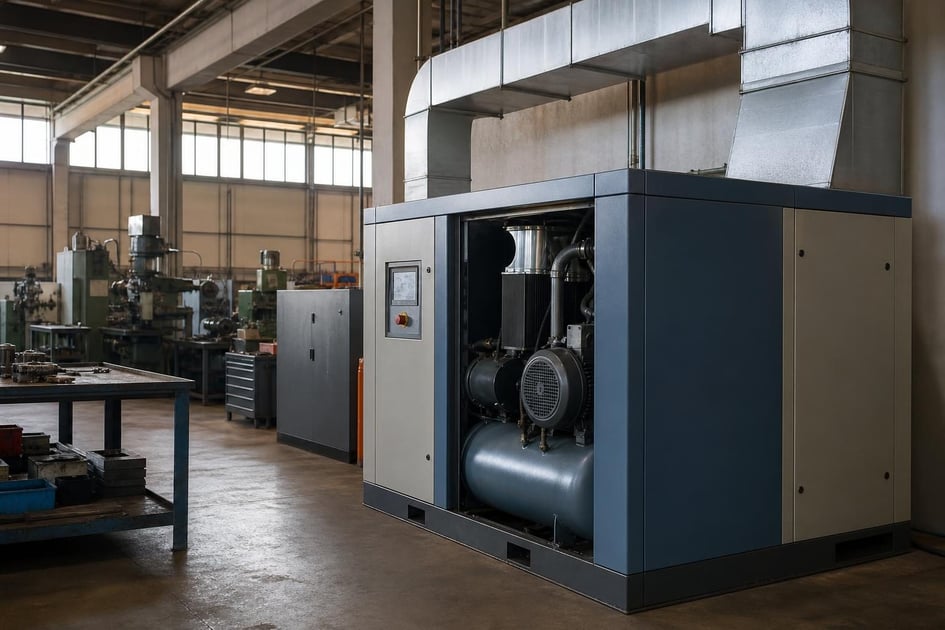
What an Air Compressor Financing Calculator Actually Tells You
An air compressor financing calculator gives you a payment estimate based on a few variables. It is not a credit decision. Most calculators ask for the equipment cost, your estimated credit tier, how long you want to finance, and whether you plan to put money down. The output is a projected monthly payment. The actual offer you receive can differ because the calculator does not underwrite your business bank statements, verify your time in business, or appraise the specific compressor model.
The calculators are useful for two things: budgeting before you shop, and comparing the cost of different term lengths. If you are looking at a $35,000 rotary screw compressor for your shop, a calculator tells you whether the payment fits your monthly cash flow before you spend time on an application.
Provide Capital finances new and used business equipment from $5,000 to $5 million, using the equipment itself as collateral, which keeps rates competitive. That range covers everything from a shop compressor to a full plant air system.
If you want to see real numbers for equipment you are already quoting, start an application in a few minutes to get a decision based on your actual profile rather than a generic estimate.
Get a fast decision on your equipment
Applying takes just a few minutes, and decisions can come as soon as the same day.
Start Your ApplicationWhat Drives the Monthly Payment on Compressor Financing
Three factors move the number more than anything else: the equipment, the borrower, and the term.
Equipment Cost and Collateral Value
Air compressors range from portable 20-gallon units to 200-horsepower stationary systems. Lenders base the advance amount on the cost or wholesale value of the specific unit. A new Ingersoll Rand or Atlas Copco rotary screw machine holds value well, which reduces the lender's collateral risk. A 15-year-old piston compressor with high hours may still finance, but it can shorten the available term or require a larger down payment because the resale market is thinner. Rates vary by credit profile, equipment age and term.
Credit Profile and Business History
Most equipment lenders want to see at least two years in business. That said, some programs accept younger companies with strong personal credit or a larger down payment. Your business credit score, personal credit score, and any recent liens or defaults all feed into the risk rating. Stronger credit means access to longer terms and lower monthly payments relative to the amount financed.
Term Length and Down Payment
Terms for air compressor financing usually run 24 to 60 months, with some industrial equipment stretching to 72. A longer term lowers the monthly payment but increases the total dollars you pay over the life of the contract. A down payment of 10 to 20 percent lowers the financed amount and can improve the rate tier you land in.
By the Numbers: A $25,000 compressor financed over 36 months typically carries a lower all-in cost than the same unit at 60 months, even though the monthly payment is roughly 40 percent higher. Run both scenarios through a calculator before deciding.
New vs. Used Air Compressors: Financing Differences
The age of the compressor matters to lenders because it is the collateral.
New equipment usually qualifies for the longest terms and the most competitive rates. The manufacturer warranty also protects cash flow in the first year or two. For a new rotary screw system in the $40,000 to $80,000 range, lenders often advance 100 percent of the invoice, including soft costs like delivery and installation, because the resale value is predictable.
Used equipment can make strong financial sense if the unit has low hours and a documented maintenance history. A five-year-old compressor may sell for 40 to 60 percent less than new, and if it still has productive life left, the monthly savings on the financing can outweigh the shorter warranty. The trade-off is that lenders may cap the term at 36 or 48 months and require a larger down payment to cover the steeper depreciation curve.
For Air Compressor financing, used units from reputable brands with national parts availability generally clear underwriting more easily than obscure makes with limited service networks.
Lease or Loan? A Side-by-Side Look
You can acquire an air compressor through an equipment loan or a finance lease. The monthly payments can look similar on a calculator, but the structure and long-term implications differ.
| Feature | Equipment Loan | Finance Lease |
|---|---|---|
| Ownership | You own it from day one; lender holds a lien | You own it after final payment or $1 buyout |
| Down Payment | Often 0–20% required | Often minimal or none |
| Term | 24–72 months | 24–60 months typical |
| Collateral | The compressor secures the loan | The compressor secures the lease |
| Monthly Payment | Fixed, based on rate and term | Fixed, sometimes slightly lower than loan |
| End of Term | You hold clear title | Title transfers after buyout |
| Upgrade Path | Sell or trade when you own it | Easier to upgrade mid-term on some programs |
A loan makes sense if you plan to keep the compressor for ten years and want the depreciation and Section 179 benefits on your 2026 tax return. A lease can make sense if you expect technology to change or if you need to preserve bank lines for inventory and payroll.
Key Insight: Some leases written as true leases (operating leases) do not transfer ownership automatically. At the end of the term you may need to return the equipment, renew the lease, or pay fair market value to buy it. Read the end-of-term clause carefully before signing.
Who Qualifies for Air Compressor Financing
Lenders look at four things: time in business, revenue stability, credit history, and the equipment itself. The Small Business Administration notes that equipment financing is one of the most common uses of small-business capital, especially among firms that need to preserve cash for operations.
Time in Business
Two years is the standard threshold. Businesses with less than two years can still qualify, but they usually need a stronger personal credit profile or a larger down payment. Startups are not a focus for most equipment finance programs.
Revenue and Bank Deposits
Lenders want to see that your cash flow can cover the new payment. They typically review three to six months of business bank statements. If your average monthly deposits are at least five to ten times the projected equipment payment, you are generally in the comfort zone.
Credit Requirements
There is no universal minimum score. A 650 personal credit score opens many doors, but some programs accept lower with compensating factors. Recent bankruptcies, open tax liens, or accounts in default make approval harder regardless of score.
The Equipment
The lender underwrites the collateral as well as the borrower. A name-brand rotary screw compressor from an authorized dealer is easier to finance than a private-sale piston unit with no serial number verification. For Industrial Air Compressor financing, having a detailed invoice that breaks out the compressor, dryer, tank, and installation helps the underwriter value the collateral accurately.
If you are unsure where your profile lands, get a decision on your equipment, possibly the same day, without committing to a specific unit first.
Find the right financing structure
Tell us about the equipment you need and we will show you the options that fit your business.
See Your OptionsThe Tax Picture for 2026
How you finance affects how you deduct.
If you take an equipment loan and place the compressor in service in 2026, you may be able to deduct the full purchase price under Section 179, subject to the 2026 annual limits and phase-out thresholds. The exact dollar limits for tax year 2026 are set by the IRS; talk to your CPA about whether your total equipment purchases for the year fall within the current cap. If you do not elect Section 179, you can still take bonus depreciation on qualifying new and used equipment, though the percentage available for 2026 may differ from prior years.
With a true lease, you typically deduct the monthly lease payment as an operating expense rather than depreciating the asset. That can simplify bookkeeping, but the total deduction over time is spread across the lease term rather than front-loaded.
New and Used Equipment Both Qualify
Both new and used compressors can qualify for Section 179 and bonus depreciation in 2026, as long as they are new to your business and used more than 50 percent for business purposes.
Pro Tip: If you are comparing a December 2026 purchase against a January 2027 purchase, remember that Section 179 is claimed in the tax year the equipment is placed in service, not the year you sign the finance agreement. A machine that arrives in January counts for 2027, which could change your deduction strategy.
Documentation You'll Need Ready
Before you apply, gather:
- A quote or invoice for the specific compressor, including make, model, year, and serial number
- Three to six months of business bank statements
- Your most recent business tax return (usually one or two years)
- A voided business check for automated payment setup
- Proof of business entity (articles of incorporation or LLC operating agreement)
Having these ready prevents delays. If you are buying from a private seller rather than a dealer, you may also need a third-party equipment inspection to verify condition and value.
Cost Examples: From Shop Compressor to Industrial System
Below are three realistic scenarios. The monthly payments are illustrative; rates vary by credit profile, equipment age and term.
Scenario A: Shop Compressor
- Equipment: New 30-gallon rotary screw, $12,000
- Term: 48 months
- Estimated monthly: low-to-mid $300s
- Total cost: roughly $15,000 to $16,500 over the term
Scenario B: Mid-Size Manufacturing System
- Equipment: New 50 HP compressor with dryer, $55,000
- Term: 60 months
- Estimated monthly: mid-to-high $1,100s
- Total cost: roughly $68,000 to $72,000 over the term
Scenario C: Industrial Plant Setup
- Equipment: New 200 HP variable speed drive system, $180,000
- Term: 60 months
- Estimated monthly: high $3,000s to low $4,000s
- Total cost: roughly $220,000 to $240,000 over the term
These examples show why a calculator is only a starting point. The difference between a 36-month and a 60-month term on the $55,000 unit can swing the monthly payment by hundreds of dollars while changing the total cost by thousands. U.S. Census Bureau data on manufacturing and construction firms confirms that equipment acquisition is typically the second-largest capital outlay for small employers after real estate, which makes choosing the right term especially important.
Common Mistakes When Using Financing Calculators
Only Looking at the Monthly Payment
A $299 monthly payment looks better than $449, but if the $299 option stretches over 72 months on a used unit with no warranty, you may pay more in maintenance than you save in financing. As Forbes has noted in coverage of small-business capital trends, the total cost of an equipment finance agreement often surprises owners who focus only on the monthly payment.
Ignoring Total Cost of Ownership
Compressors consume electricity. A variable speed drive machine may cost 20 to 35 percent more upfront than a fixed-speed unit, but the energy savings over five years can exceed the price difference. A calculator does not show your electric bill.
Not Locking in the Equipment Quote
Calculator outputs are only as good as the equipment cost you enter. If the dealer changes the price or the used unit sells before you are approved, your estimate is worthless. Get a written quote with an expiration date.
Forgetting Soft Costs
Delivery, rigging, electrical work, and air-line installation can add 10 to 25 percent to the project cost. Some lenders allow these to be included in the financing; others do not. Ask before you calculate.
What Happens After You Apply
Once you submit an application, the lender reviews your credit, business bank statements, and equipment details. For applications under $150,000, this can take a few hours to one business day. Larger requests or complex collateral may take two to three days. Same-day approvals are possible when the file is complete and the equipment is standard.
After approval, you receive a term sheet or finance agreement. Review the payment amount, term, buyout structure, and any prepayment penalties. Once signed, the lender pays the vendor or private seller. A UCC-1 financing statement is filed against the equipment to perfect the lender's lien. You take delivery and start making payments.
For Manufacturing equipment financing, the process is straightforward when you buy from a dealer with a standard invoice. Custom-built compressor skids or auctions require extra documentation but are still financeable.
Key Insight: Most equipment finance agreements do not have prepayment penalties, but they are not simple-interest loans either. Paying off early usually saves only the remaining interest that has not yet accrued, not the full scheduled interest. Ask your lender to explain the payoff structure before you sign.
Put the right equipment to work
From $5,000 to $5 million, new or used, Provide Capital helps businesses nationwide finance the equipment they need.
Apply TodayFAQ
How accurate are air compressor financing calculators?
They are accurate for estimating purposes if the inputs are honest. The actual offer depends on your verified credit, business financials, and the specific equipment. Treat the output as a budget planning tool, not a guarantee.
Can I finance a used air compressor?
Yes. Many lenders finance used compressors up to ten or fifteen years old, depending on hours, brand, and condition. Older units may require shorter terms or larger down payments.
What credit score do I need?
There is no fixed minimum. A personal credit score in the mid-600s or higher generally qualifies for standard programs. Lower scores may still work with compensating factors or a larger down payment.
How fast can I get approved?
Same-day approvals are possible for well-qualified applicants with complete files. Most decisions arrive within one to two business days.
Can I include installation and delivery in the financing?
Often yes. Many lenders allow soft costs to be bundled up to a certain percentage of the equipment cost. Ask your lender what counts as an eligible cost.
Is it better to lease or buy an air compressor?
It depends on your tax strategy, how long you plan to keep the unit, and whether you want to preserve cash. A loan builds equity; a true lease may offer lower monthly payments and simpler write-offs. Compare the total cost and the tax treatment with your CPA.
What happens if I pay off the financing early?
Most equipment finance companies allow early payoff, but the savings may be less than you expect because the interest is often baked into the payment stream. Request an amortization schedule and early payoff quote before deciding.
Can I finance a private-party purchase?
Yes, though the lender may require an independent inspection and a bill of sale that meets their legal requirements. The process adds a day or two to funding.
Ready to Finance Your Air Compressor?
An air compressor financing calculator is a smart first step, but the real number comes from an underwriter who knows your business and the equipment. Whether you are adding capacity to a Construction equipment financing fleet or upgrading the shop in a manufacturing plant, the right financing structure keeps your cash flow intact and gets the machine working for you quickly.
If you have a quote in hand and want to move forward, see what financing you qualify for on that compressor and get a decision, possibly the same day.
Disclaimer: The information provided in this article is for general educational purposes only and is not financial, legal, or tax advice. Funding terms, qualifications, and product availability may vary and are subject to change without notice. Provide Capital does not guarantee approval, rates, or specific outcomes. For personalized information about your business funding options, contact our team directly.
