
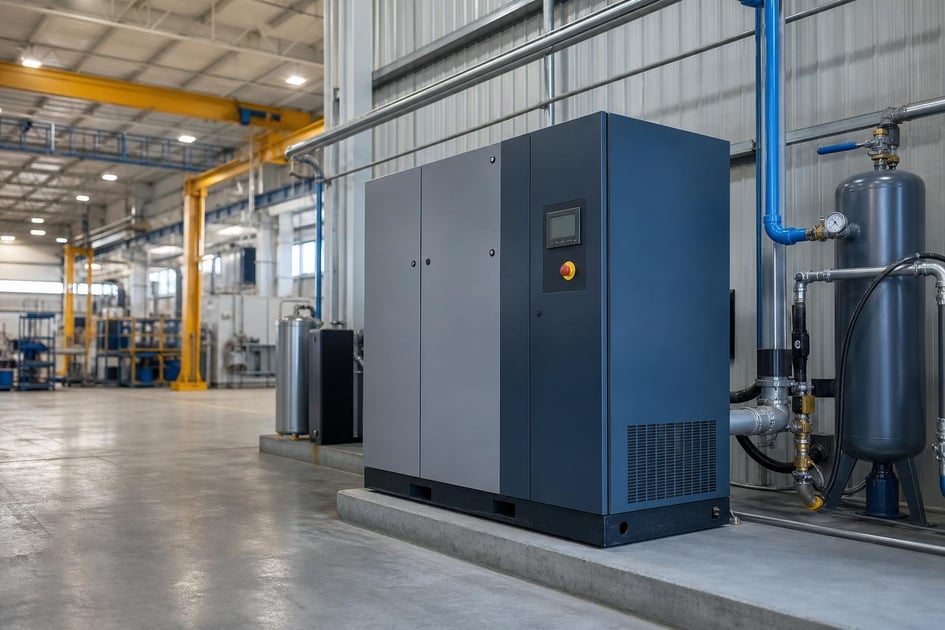
How Air Compressor Financing Works
Air compressor financing lets you buy or lease a compressor without paying the full cost upfront. The equipment itself secures the loan, which means rates stay competitive and approval decisions can come back the same day for well-qualified buyers. Most lenders finance both new and used units from $5,000 up to $5 million, with terms usually tied to the expected useful life of the machine.
If you are weighing a purchase for your shop or fleet, start an application to see what you qualify for on that compressor and get a decision in as little as a few hours.
By the Numbers: A 30-horsepower rotary screw compressor retails between $8,000 and $15,000. A 100-horsepower industrial unit can run $25,000 to $50,000 or more. Financing spreads that cost across 24 to 72 months, preserving working capital for payroll, materials and fuel.
Already have a machine in mind?
Provide Capital finances new and used equipment from $5,000 to $5 million, with same-day decisions possible.
Apply NowWhat Lenders Look For
Equipment lenders underwrite the business and the asset together. They want to see that the compressor will generate enough revenue to cover its payment, and that the borrower has a track record of managing debt. Here is what matters most.
Time in Business
Most equipment finance companies prefer at least two years of operating history. That said, some programs accept applicants with as little as six months if the credit profile and cash flow are strong. Startups with no revenue history are generally outside the scope of standard equipment financing and may need to explore vendor programs or SBA-backed loan options instead.
Credit Profile
Personal and business credit both factor into the decision. A score in the mid-600s or higher opens access to better terms, though some lenders work with lower scores by requiring a larger down payment or a shorter term. Recent bankruptcies, open tax liens or judgments will usually stall an application until they are resolved.
Revenue and Bank Statements
Lenders typically review the last three to six months of business bank statements. They are looking for consistent deposits, positive ending balances and no frequent overdrafts. Annual revenue of $100,000 or more is a common threshold, though some programs go lower for smaller-ticket items.
Equipment Details
The age, make, model and condition of the compressor affect both approval odds and pricing. New equipment with a manufacturer warranty is the easiest to finance. Used equipment is also financeable, but lenders may cap the term on a unit older than ten years or require a larger down payment to offset depreciation risk.
Pro Tip: If you are buying used, ask the seller for maintenance records and hour-meter readings. A compressor with 5,000 hours and proof of regular oil changes is a safer collateral bet than a low-hour unit with no service history, and that difference can show up in your rate.
New vs. Used Air Compressors
The choice between new and used is not just about sticker price. It affects your financing terms, tax treatment and total cost of ownership.
| Factor | New Compressor | Used Compressor |
|---|---|---|
| Purchase price | Higher upfront cost, full manufacturer warranty | 30% to 60% below new retail depending on age and hours |
| Financing term | Up to 60 to 72 months | Often capped at 36 to 48 months for units over 7 years old |
| Down payment | As low as 0% to 10% for strong credit | 10% to 20% is common to offset depreciation risk |
| Tax treatment | Full Section 179 or bonus depreciation in year one for tax year 2026 | Same first-year write-off if purchased, but verify remaining useful life with your CPA |
| Maintenance risk | Low; covered by warranty | Higher; budget 5% to 10% of purchase price annually for service |
Used compressors make sense when you need capacity fast and the unit has verifiable service history. New compressors are the better bet when uptime is critical and you want the longest possible term to keep payments low. Either way, the equipment serves as collateral, which keeps the rate competitive compared to an unsecured loan.
Equipment Loan vs. Lease: What to Choose
Most buyers default to a loan because they want to own the compressor outright. But leases have a place, especially for short-term projects or when you expect technology to change.
An equipment finance agreement, or EFA, is essentially a loan secured by the compressor. You make monthly payments, own the asset from day one and can claim depreciation and Section 179 deductions on your 2026 tax return. At the end of the term, there is no balloon payment; the lien simply releases.
A true lease, or operating lease, works like rent. The lender owns the compressor, you pay a monthly fee, and at the end you can return it, buy it out at fair market value or extend the lease. Monthly payments are often lower than an EFA, but you do not build equity and the tax treatment differs. For tax year 2026, lease payments are generally deductible as a business expense, while an EFA lets you depreciate the asset. A CPA can tell you which structure saves more based on your bracket and other deductions.
One-dollar buyout leases blur the line. They look like a lease on paper but transfer ownership at the end for a nominal fee. The IRS usually treats these as loans for tax purposes, so do not assume you are getting lease treatment just because the contract says "lease." Ask your accountant to review the paperwork before you sign.
Key Insight: If you are financing through a manufacturer captive lender, read the fine print on service requirements. Some contracts void the warranty or impose penalties if you use third-party maintenance shops. That clause can add thousands to your total cost over five years.
What Air Compressor Financing Costs
Rates vary by credit profile, equipment age and term length. A well-qualified borrower buying a new compressor might see lower rates than a borrower with challenged credit financing a 12-year-old unit. Down payment size also moves the number; zero-down deals exist for strong applicants, but putting 10% or 20% down usually improves the rate and reduces the total interest paid.
Here is a realistic look at how financing changes the monthly obligation for a mid-size rotary screw compressor.
| Equipment cost | Term | Estimated monthly range | Total out-of-pocket at closing |
|---|---|---|---|
| $10,000 | 36 months | $310 – $360 | $0 – $1,000 |
| $10,000 | 60 months | $200 – $250 | $0 – $1,000 |
| $25,000 | 48 months | $600 – $720 | $0 – $2,500 |
| $25,000 | 72 months | $420 – $520 | $0 – $2,500 |
| $50,000 | 60 months | $1,050 – $1,250 | $0 – $5,000 |
These ranges are illustrative. Your actual payment depends on credit score, time in business, the specific compressor and the lender's current pricing. There are no guaranteed rates, and every application is evaluated individually. Get a decision on your equipment, possibly the same day, by submitting a short application with your equipment quote and last three bank statements.
Industry-Specific Use Cases
Air compressors are not one-size-fits-all. The right unit and the right financing structure depend on what you do with it.
Construction and Contracting
Portable diesel compressors power jackhammers, shotcrete rigs and abrasive blasting equipment on job sites with no electrical hookup. A 185-CFM towable unit costs roughly $15,000 to $30,000 new. Because construction revenue fluctuates seasonally, many contractors choose a 60-month term to keep payments manageable during slower winter months. Construction equipment financing from Provide Capital covers these units nationwide, with approvals possible in a single business day.
Manufacturing and Fabrication
Factories run stationary rotary screw or centrifugal compressors around the clock. A 200-horsepower unit feeding an automated paint line or pneumatic conveyor can cost $40,000 to $80,000. Manufacturers often pair the compressor with a maintenance agreement rolled into the financing, so the payment covers both the asset and the service contract. Manufacturing equipment financing can bundle the machine and its installation into one loan. Census Bureau manufacturing data shows that capital spending in this sector runs into the hundreds of billions annually, much of it on productive equipment like compressors and conveyors.
Automotive and Fleet Service
Body shops and fleet garages need reliable compressed air for painting, tire mounting and general service. A 60-gallon vertical tank with a 5-horsepower pump might run $2,000 to $4,000, which is below many lenders' minimums. If you are also buying a lift, a frame machine or a tire changer, bundle the compressor into the same financing package to meet the $5,000 threshold and simplify your bookkeeping with one payment.
Agriculture and Food Processing
Dairy operations and food packers use oil-free compressors to meet sanitary standards. These units command a premium, often 20% to 40% more than standard lubricated models. Because the equipment is specialized, lenders may require a vendor invoice or appraisal before funding. Plan for an extra 24 to 48 hours in the approval timeline if you are buying a niche unit.
Dental and Healthcare
Dental practices run small, quiet oil-free compressors to power handpieces and suction. A three-chair practice might spend $3,000 to $6,000 per compressor. Practices often finance these alongside other office equipment, bundling multiple assets into a single schedule.
See what you qualify for
The equipment itself secures the financing, which keeps rates competitive. Checking your options takes minutes.
Check Your OptionsTax Treatment for Tax Year 2026
The tax code rewards equipment investment, but the exact numbers shift from year to year. For tax year 2026, Section 179 allows businesses to deduct the full purchase price of qualifying equipment in the year it is placed in service, subject to an annual limit and a phase-out threshold. Bonus depreciation may also apply, though the percentage has been stepping down in recent years. Because these limits change annually and interact with other deductions, speak with a CPA before you structure a purchase around a specific tax outcome. Never assume a deduction amount without confirming the current-year rules.
If you choose a true lease instead of a loan, you generally deduct the lease payments as a business expense rather than depreciating the asset. Which approach saves more depends on your tax bracket, profit level and whether you have other capital expenditures in 2026. A tax professional can model both scenarios in minutes.
Pro Tip: Place the compressor in service before December 31, 2026, if you want the deduction on this year's return. Delivery, installation and commissioning all take time. Order in November, not the week before Christmas, or you risk missing the cutoff.
Documentation You Will Need
Having paperwork ready speeds up the process. Most lenders ask for:
- Last three to six months of business bank statements
- A vendor quote or invoice for the specific compressor
- One or two years of business tax returns for requests over $50,000
- A brief equipment description, including year, make, model and serial number if used
- Proof of business entity status, such as articles of incorporation or an LLC operating agreement
For requests under $25,000, some lenders can approve with just bank statements and an equipment quote. Larger requests, especially for used industrial units, may trigger a soft credit pull and a review of your debt-service coverage ratio. The entire process can still wrap up in one business day if the file is complete. Forbes Advisor outlines similar documentation standards for most small-business lending, and equipment finance is no exception.
Common Mistakes Buyers Make
Avoiding these errors saves time and money.
Buying the wrong size. An undersized compressor runs constantly and burns out prematurely. An oversized unit wastes energy and money. Size the system for your peak CFM and PSI requirements, not your average load. A reputable dealer will perform a compressed-air audit before quoting.
Ignoring installation costs. Electrical runs, air piping, ventilation and concrete pads can add $1,000 to $10,000 to the project. If you need these extras, tell your lender upfront so they can be included in the financing. Otherwise, you will pay cash for infrastructure and finance only the machine.
Financing through the dealer without shopping. Dealer rates are not always competitive. Get a quote from an independent equipment finance company to compare. Even a half-percent difference over 60 months adds up on a $30,000 purchase.
Skipping the maintenance budget. Rotary screw compressors need oil, filters, separators and annual inspections. Budget roughly $500 to $2,000 per year depending on size and duty cycle. A financed compressor with no service fund is a compressor headed for an early failure.
Overlooking the UCC filing. The lender will file a Uniform Commercial Code lien on the equipment. That is normal and releases when you pay off the loan. But if you plan to sell the business or refinance other assets, know that the lien must be satisfied first.
What Happens After Approval
Once the lender issues an approval, you will receive a term sheet or finance agreement spelling out the payment, term, buyout structure and any collateral requirements. Review it carefully. Look for prepayment penalties, late fees and automatic renewal clauses. If everything looks right, sign and return it with any required down payment.
The lender then pays the vendor directly, usually by wire or ACH. You take delivery, inspect the compressor and confirm it matches the invoice. Some lenders require a delivery receipt and photos of the installed unit before they fund. From application to funding, the entire cycle often completes in 24 to 48 hours for straightforward deals.
After funding, your first payment is typically due 30 to 45 days later. Set up automatic ACH withdrawals if the lender offers a discount, and keep the compressor insured. The lender is listed as a loss payee on the policy until the loan matures.
Key Insight: Some lenders charge a documentation fee or filing fee at closing, usually between $100 and $500. Ask for an itemized list of all upfront costs before you sign. A rate that looks low can become expensive if it is padded with origination fees.
Ready to move forward?
More than 10,000 businesses have financed equipment with Provide Capital. See what you qualify for today.
Get StartedFAQ
Can I finance a used air compressor?
Yes. Used compressors are financeable, though terms may be shorter and down payments larger than for new units. Most lenders want to see maintenance records and will cap the term based on the equipment's age and remaining useful life.
What credit score do I need for air compressor financing?
Mid-600s and up will qualify for the broadest range of programs. Scores below that are not automatically disqualified, but you may need a larger down payment, a shorter term or additional collateral. Lenders look at the full picture, not just the score.
How fast can I get approved?
Same-day approvals are possible when the application is complete and the equipment is standard. Complex deals, used units without clear title or requests over $250,000 may take 24 to 48 hours. Submitting clean bank statements and a detailed vendor quote speeds things up.
Is there a minimum or maximum amount I can finance?
Provide Capital finances equipment from $5,000 to $5 million. Smaller compressors can be bundled with other equipment to meet the minimum. There is no maximum above $5 million.
Can I include installation and shipping in the loan?
Often yes. Tell the lender upfront if you need soft costs covered. Some programs allow up to 20% of the total to cover delivery, installation and training. Others finance only the hard asset. It varies by program and lender policy.
Will the lender file a lien on my other assets?
In most equipment finance agreements, the compressor itself is the only collateral. The lender files a UCC-1 lien specifically on that serial number. They do not usually take a blanket lien on your business unless the deal is exceptionally high-risk or you are borrowing close to the $5 million cap.
Can I pay off the loan early?
Most equipment finance agreements allow early payoff, but some include a prepayment penalty or a minimum interest clause. Read the term sheet carefully. If prepayment flexibility matters to you, negotiate it before signing or choose a lender whose standard contract does not penalize early payoff.
Do I need to put money down?
Not always. Zero-down programs exist for strong credit and established businesses. However, a down payment of 10% to 20% improves your rate, reduces the total interest cost and shows the lender you have skin in the game. On used equipment, down payments are more commonly required.
Your Next Step
Air compressor financing is straightforward when you know what to expect. Gather your bank statements, get a firm quote on the unit you want and decide whether new or used makes more sense for your cash flow. Then choose a lender that understands equipment, not just general business loans. See what financing you qualify for on that compressor and move from quote to funded in as little as one business day. Whether you need a portable diesel unit for the jobsite or a fixed rotary screw system for the plant, Air Compressor financing through Provide Capital keeps the process simple and the rates competitive.
Disclaimer: The information provided in this article is for general educational purposes only and is not financial, legal, or tax advice. Funding terms, qualifications, and product availability may vary and are subject to change without notice. Provide Capital does not guarantee approval, rates, or specific outcomes. For personalized information about your business funding options, contact our team directly.
