
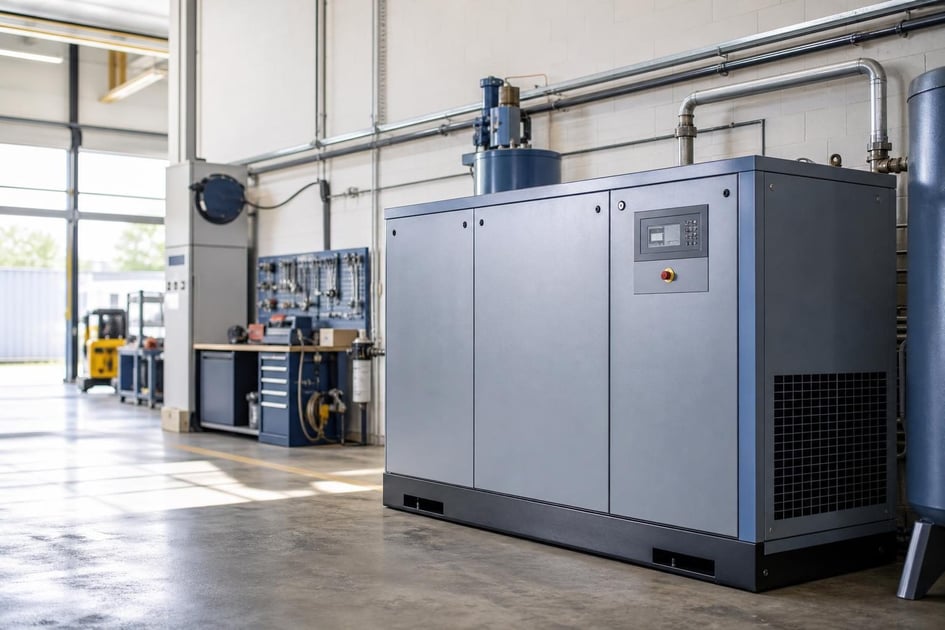
Most lenders want to see a profitable business with two or more years of operation, a credit profile that shows you pay your obligations on time, and an equipment quote from a verified seller. The compressor itself secures the loan, which means the machine's value and condition matter as much as your balance sheet. If you have a quote in hand and your business bank statements show consistent revenue, you can start an application in a few minutes and get a decision on your equipment, possibly the same day.
Credit Profile and Time in Business
Lenders evaluate air compressor financing applications on three axes: credit, cash flow, and collateral. Your personal and business credit histories tell the underwriter whether you have managed debt responsibly. Most equipment finance companies do not publish hard minimums, but borrowers with credit scores in the upper-600s and above typically receive the most competitive structures. That does not mean a lower score disqualifies you. Because the compressor serves as collateral, lenders can approve files that banks might decline, though the structure may include a larger down payment or a shorter term.
Time in business matters because it demonstrates staying power. A shop that has operated for three years and shows stable deposits has a lower perceived risk than a startup with no revenue history. Most equipment lenders prefer at least two years in operation. If you have been in business for less than two years, expect to provide a larger down payment, personal guarantee, or additional documentation such as a business plan and customer contracts.
Cash flow verification usually comes from the last three to six months of business bank statements. Underwriters look for average daily balances, recurring deposits, and whether negative days cluster at month-end. They also compare your existing debt service to your revenue. If your current obligations already consume a large share of your income, adding a compressor payment may require a larger down payment to bring the monthly obligation into line.
Key Insight: Lenders often calculate "payment coverage" by dividing your average monthly revenue by the proposed equipment payment. A ratio below 1.2 is usually a red flag, while ratios above 1.5 move quickly through underwriting. If your deposits are seasonal, submit statements from your busiest quarter to show peak capacity.
Already have a machine in mind?
Provide Capital finances new and used equipment from $5,000 to $5 million, with same-day decisions possible.
Apply NowEquipment-Specific Requirements
The machine you are buying shapes the approval as much as your financials do. Lenders want to know the manufacturer, model year, serial number, horsepower, and whether the unit is new or used. For Air Compressor financing, the collateral value must cover the loan amount, which means the underwriter will verify the resale market for that brand and size.
New compressors from major brands such as Atlas Copco, Ingersoll Rand, Sullair, and Kaeser are the easiest to finance. They carry manufacturer warranties, have established resale values, and parts are widely available. Lenders typically advance 100 percent of the invoice, including freight and installation, for qualified buyers purchasing new equipment.
Used compressors require more scrutiny. Underwriters want photos, hour-meter readings, maintenance logs, and confirmation that the unit is free of existing liens. Most lenders set an age limit of 10 to 15 years at the end of the term. That means if you want a five-year loan, the compressor should be no older than 10 years at closing. Very large rotary screw or centrifugal units may be exceptions if they have documented rebuilds or remanufacturing.
| Factor | New Air Compressor | Used Air Compressor |
|---|---|---|
| Typical financing advance | 100% of invoice | 85–95% of appraised value |
| Underwriting speed | 24–48 hours | 48–72 hours (may need appraisal) |
| Warranty status | 3–5 years standard | Limited or expired |
| Best fit | Permanent installs, high duty cycles | Backup units, seasonal work, tight budgets |
| Hour-meter limit | None | Varies by lender; often under 15,000 hours |
Documentation You Will Need
Having paperwork ready before you apply eliminates the back-and-forth that slows funding. At minimum, gather the last three months of business bank statements, a current equipment quote or invoice, and your business tax returns from the prior two years. If your business is a corporation or LLC, the lender may also request your articles of incorporation, operating agreement, and a copy of your driver's license.
The equipment quote must come from a verifiable seller. That can be an authorized dealer, a recognized distributor, or a private party. For private-party sales, the lender will run a UCC lien search to confirm no existing lender has a security interest in the compressor. You may also need a bill of sale that transfers title cleanly. If the seller cannot produce a clear title, the deal will stall until the lien is satisfied.
For larger industrial systems, some lenders require a site survey or installation plan. This is especially true for permanently mounted rotary screw compressors that need concrete pads, electrical drops, or refrigerated air dryers. The lender wants assurance that the total project cost, including installation, matches the quote and that the equipment will be operational shortly after funding.
For very large capital projects, some businesses also explore the SBA 504 loan program, though most shop owners find direct equipment financing faster for individual compressor purchases.
How Collateral Works with Air Compressor Financing
Equipment financing is a collateralized transaction. The lender secures its interest by taking a security interest in the compressor itself, not in your real estate or other assets. That structure is what makes Industrial Air Compressor financing accessible to shops that do not want to pledge their building or personal property.
Because the equipment backs the loan, the lender's risk is tied to the machine's resale value. That is why brand, age, and condition matter so much. A well-maintained 50-horsepower rotary screw compressor from a Tier-1 manufacturer retains value better than an obscure brand with no dealer network. If you default, the lender repossesses and resells the unit. The stronger the secondary market, the more comfortable the underwriter.
After you pay off the loan, the lender releases its UCC filing, and you own the compressor free and clear. Until then, you cannot sell the unit without the lender's permission, and you must maintain insurance that names the lender as loss payee. Standard commercial equipment insurance satisfies this requirement.
Pro Tip: If you are buying from an auction or liquidation site, confirm the lender will finance auction purchases before you bid. Some lenders exclude auction sales because title transfer can be delayed or disputed. Get a conditional approval letter that specifies "auction purchase approved" in writing.
New vs Used Air Compressor Financing Trade-Offs
The decision between new and used often comes down to duty cycle and capital reserves. A new compressor gives you the latest efficiency standards, a full warranty, and predictable maintenance costs for the first several years. If you run three shifts and cannot afford unplanned downtime, new equipment is usually the better risk-adjusted choice.
Used compressors make sense for backup systems, seasonal operations, or shops that only run pneumatic tools intermittently. A used 80-gallon two-stage piston compressor for a small auto body shop might cost $3,000 to $6,000, while a new rotary screw system for a manufacturing line can run $30,000 to $80,000 or more. Because Provide Capital finances equipment from $5,000 to $5 million, both ends of that spectrum fit within a single approval.
The financing structure differs, too. New equipment often qualifies for 100 percent financing, meaning no down payment. Used equipment may require 5 to 15 percent down to cover the gap between the loan amount and the lender's appraised value. The term length also shifts. New compressors can be financed for 60 to 84 months, while used units usually top out at 36 to 60 months, depending on age.
Tax Treatment for 2026
How you structure the purchase affects your tax position for the 2026 tax year. If you take out an equipment loan and own the compressor, you may be able to deduct the full purchase price in the first year under Section 179 or bonus depreciation, subject to the limits Congress set for 2026. Alternatively, you can spread the deduction across the asset's useful life through standard MACRS depreciation. The exact 2026 Section 179 limit and phase-out threshold are set by the IRS for the current tax year. Because these figures change annually and your eligibility depends on your total equipment purchases and taxable income, review the specific 2026 limits with a CPA before you file.
If you lease the compressor, you generally deduct each lease payment as a business expense. That simplifies bookkeeping but may yield a smaller total deduction over the life of the agreement compared with accelerated first-year depreciation. Again, a CPA can model the after-tax cost of a loan versus a lease based on your 2026 tax bracket and projected income.
One detail many buyers miss: if you finance a used compressor, the depreciable basis is what you actually paid, not the original sticker price. That means a $20,000 used unit gives you a $20,000 deduction base, even if it cost $45,000 new. Your CPA can confirm how that basis interacts with the 2026 Section 179 cap.
See what you qualify for
The equipment itself secures the financing, which keeps rates competitive. Checking your options takes minutes.
Check Your OptionsLease vs Loan: Which Structure Fits Your Shop
Equipment loans and leases both let you use the compressor while you pay for it, but the legal and financial differences are significant. With a loan, you own the asset from day one, build equity, and can claim depreciation. At the end of the term, you hold title free and clear. With a true lease, the lessor owns the compressor, and you return it or purchase it at fair market value when the lease ends.
| Feature | Equipment Loan | True Lease |
|---|---|---|
| Ownership | You own the compressor; lender holds lien | Lessor owns the compressor |
| Tax deduction | Depreciation or Section 179 (2026 tax year) | Lease payments as operating expense |
| Down payment | Often $0 for qualified buyers on new units | First and last payment, sometimes 10% |
| End-of-term | $1 buyout or title release | Return, renew, or buy at FMV |
| Best for | Long-term use, high duty cycles | Short-term needs, technology turnover |
Many shop owners choose a loan because they plan to keep the compressor for 10 to 15 years. Loans also pair well with Manufacturing equipment financing when you are buying multiple machines under one approval. Leases work better when you expect to upgrade every three to five years or when you need the lowest possible monthly outlay and are comfortable not owning the asset. As Forbes Finance Council guidance on equipment financing notes, preserving cash flow while acquiring productive assets is a primary reason owners choose financing over outright purchase.
By the Numbers: A $50,000 rotary screw compressor financed over 60 months might carry a monthly payment in the low-to-mid-$1,000 range, while a 36-month true lease on the same unit could run in the high-$900 range. The loan builds equity; the lease does not. Rates vary by credit profile, equipment age and term.
Industry-Specific Use Cases
According to Reuters reporting on business equipment spending, capital investment in industrial machinery has remained a priority for manufacturers even as overall economic conditions fluctuate. Air compressor requirements vary sharply by industry, and lenders know it. A Construction equipment financing underwriter expects portable diesel compressors that move between job sites, while a manufacturing lender looks at permanently installed rotary screw systems tied to a production line.
In construction, contractors finance towable diesel compressors in the 185 to 375 CFM range for running jackhammers, impact wrenches, and shotcrete rigs. These units take abuse, so lenders want to see that the borrower has insurance that covers job-site theft and damage. Seasonal cash flow is common in construction, so some lenders offer skip-payment structures during winter months.
Manufacturing plants use stationary electric compressors from 50 to 200 horsepower to power CNC machines, pneumatic conveyors, and robotic assembly lines. Downtime is expensive, so many manufacturers finance redundant compressor pairs: one primary, one backup. Lenders treat these as a single collateral package if they are on one invoice.
Automotive and collision repair shops need smaller reciprocating or rotary screw units, typically 5 to 30 horsepower, for paint booths, tire changers, and air tools. Because these shops are often owner-operated with thin margins, lenders pay close attention to debt-service coverage. A shop with steady insurance-company work and recurring revenue will find faster approval than one relying entirely on walk-in retail.
Agricultural operations use compressors for grain handling, livestock ventilation controls, and equipment maintenance in remote shop buildings. Lenders may request photos of the building where the compressor will live to confirm it is secured and weather-protected. Farm revenue is seasonal, so underwriters often look at annual cash flow rather than monthly averages.
Common Mistakes Buyers Make
Even qualified buyers slow down their own approvals by making predictable errors. The first is under-sizing the compressor. A shop that buys a 10-horsepower unit to save money, then adds a second blast cabinet six months later, ends up running the compressor at 100 percent duty cycle and burning it out. Buy for your projected CFM and pressure needs three years out, not just today.
The second mistake is ignoring installation and electrical costs. A large rotary screw compressor may need a 230-volt three-phase drop, a concrete pad, and a refrigerated air dryer. If your quote only covers the machine, you may face an additional $5,000 to $15,000 in site work that strains your cash flow. Some lenders will finance soft costs like installation if they are itemized on the seller's invoice; others will not.
The third mistake is applying with the wrong lender profile. A bank that specializes in medical equipment may have no appetite for a used piston compressor in a welding shop. An equipment finance company that writes Commercial Air Compressor financing daily understands the collateral, the resale market, and the documentation needed. Matching the lender to the asset class saves time.
Pro Tip: Always get the seller to itemize freight, rigging, and installation on the same invoice as the compressor. Lenders can often advance 100 percent of a single invoice that includes all costs, but they may refuse to fund a second invoice for installation that arrives two weeks later.
What Happens After Approval
Once the lender issues an approval, you will receive a term sheet or commitment letter that spells out the advance amount, term length, payment schedule, and any conditions. Read it carefully. Conditions might include proof of insurance, a final invoice, or a site verification photo. Satisfying those conditions quickly keeps funding on schedule.
Same-day approvals are possible when the file is clean, the equipment is new, and the seller is a known dealer. In those cases, the lender wires funds directly to the seller within 24 to 48 hours of receiving signed documents. Used equipment, private-party sales, or applications with weaker credit may take three to five business days while the lender verifies collateral and title.
After funding, the lender files a UCC-1 financing statement in your state to perfect its security interest in the compressor. This is a standard public notice that the asset is encumbered. It does not appear on your personal credit report as a judgment; it simply protects the lender's collateral rights. When you make the final payment, the lender files a UCC-3 termination statement, and the public record is cleared.
Ready to move forward?
More than 10,000 businesses have financed equipment with Provide Capital. See what you qualify for today.
Get StartedFrequently Asked Questions
Can I finance an air compressor with bad credit?
Yes, though the structure changes. Because the equipment itself is collateral, lenders can approve lower credit profiles than unsecured lenders would. Expect a larger down payment, a shorter term, or a personal guarantee. Improving your credit score by even 20 to 30 points before applying can shift you into a better tier.
How long does approval take?
For straightforward applications with complete documentation, decisions often come within one business day. Complex files, used equipment from private sellers, or applications requiring additional collateral verification may take two to four business days. Submitting clean bank statements and a detailed equipment quote upfront is the best way to speed the process.
Do I need a down payment?
Not always. Established businesses with strong credit can often finance 100 percent of a new compressor, including freight and installation. Used equipment and riskier credit profiles may require 5 to 15 percent down. The exact amount depends on your credit history, time in business, and the equipment's age and condition.
Can I finance a used air compressor from a private seller?
Yes, but the lender will verify title and run a lien search. You will need the serial number, photos, hour-meter reading, and maintenance records. The seller must provide a clear bill of sale. If the unit has an outstanding lien, the seller must pay it off before or at closing.
What size air compressor can I finance?
Provide Capital finances business equipment from $5,000 to $5 million. That covers everything from a small shop reciprocating compressor to a multi-compressor plant air system. The key is matching the equipment cost to your demonstrated ability to service the monthly payment.
Is the interest tax-deductible?
If you structure the purchase as a loan and own the compressor, you can generally deduct the interest portion of your payments as a business expense. You may also be able to take accelerated depreciation under Section 179 or bonus depreciation for the 2026 tax year, subject to IRS limits. Consult a CPA to determine the optimal strategy for your situation.
Can I pay off the loan early?
Most equipment loans allow early payoff, but some include a prepayment penalty or a minimum interest clause. Read your loan agreement before signing. If early payoff is important to you, ask the lender to confirm the prepayment policy in writing before you accept the terms.
What happens if the compressor needs repairs?
You are responsible for maintenance and repairs, just as if you had paid cash. If you financed the unit, you must keep it in working order because it is collateral. Some lenders require proof of a service contract for large industrial systems. A new compressor under manufacturer warranty reduces this risk for the first three to five years.
Next Steps
Start by defining exactly what your shop needs: CFM, pressure, power source, and whether the unit will be stationary or portable. Then get a detailed quote from a reputable dealer or seller that breaks out the compressor, freight, and installation. With that quote and your last three months of bank statements, see what financing you qualify for on that compressor and get a decision, possibly the same day. The sooner you submit a complete file, the sooner you can put the machine to work generating revenue.
Disclaimer: The information provided in this article is for general educational purposes only and is not financial, legal, or tax advice. Funding terms, qualifications, and product availability may vary and are subject to change without notice. Provide Capital does not guarantee approval, rates, or specific outcomes. For personalized information about your business funding options, contact our team directly.
