
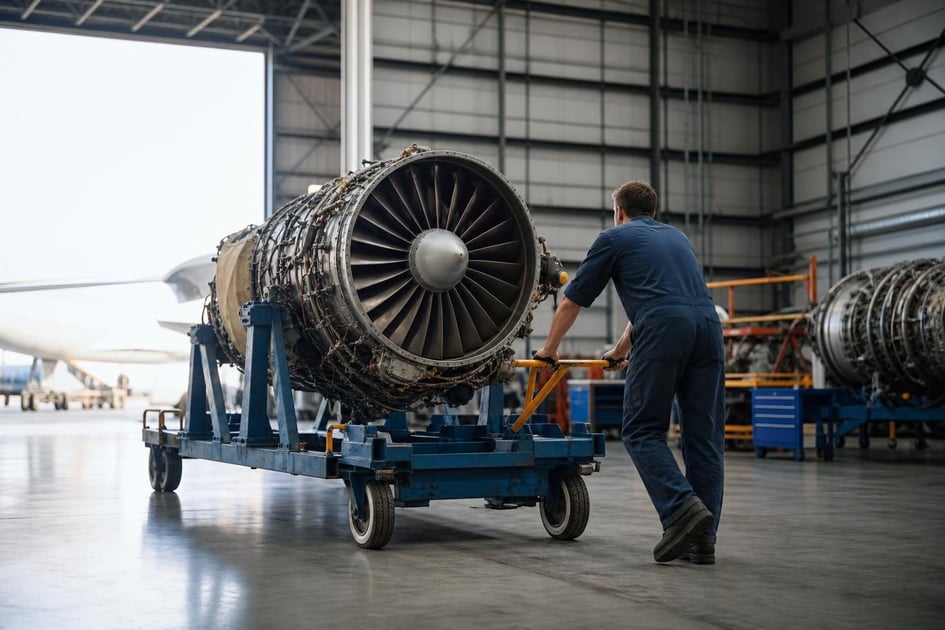
Yes, You Can Finance an Aircraft Engine Stand With No Money Down
If you are looking at a $15,000 engine stand for a regional jet overhaul or a $180,000 heavy-duty stand for wide-body engines, tying up cash in a single piece of ground support equipment is rarely the best use of capital. No-money-down equipment financing lets you secure the stand, keep your cash in operations, and pay for the asset over its useful life. Start an application in a few minutes to see what structure fits your shop.
At Provide Capital, we finance new and used business equipment from $5,000 to $5 million. The equipment itself serves as collateral, which helps keep rates competitive and reduces the need for a large upfront payment. Same-day approvals are possible once we have a complete file. This applies to Aircraft Engine Stand financing as well as related ground support equipment like Aircraft Tug financing.
Key Insight: Because the engine stand is the collateral, lenders underwrite the asset as carefully as the borrower. A stand from a recognized manufacturer with traceable maintenance records and current certification can qualify for better terms than an uncertified unit, even if the borrower's credit is identical.
Get a fast decision on your equipment
Applying takes just a few minutes, and decisions can come as soon as the same day.
Start Your ApplicationWhat an Aircraft Engine Stand Actually Costs
Prices vary widely by capacity, condition, and certification. A used stand for a narrow-body engine might run $8,000 to $25,000. A new, heavy-duty stand rated for the largest turbofans can exceed $120,000. Transport stands, storage stands, and maintenance fixture stands each occupy different price tiers. If you are buying multiple units for a growing MRO operation, the total can reach six figures quickly.
That capital intensity is why no-money-down financing matters. Rather than drawing down a line of credit or writing a check that empties your maintenance reserve, you spread the cost over 24 to 60 months. The monthly payment becomes a predictable operating expense, and the stand generates revenue immediately by keeping engines moving through your shop.
How No-Money-Down Equipment Financing Works
"No money down" in equipment financing usually means the lender covers 100 percent of the equipment cost, including soft costs such as freight and installation if they are bundled in the invoice. You sign, the vendor gets paid, and your first payment is due 30 to 45 days later. There is no equipment lease-style residual buyout at the end unless you choose a lease structure.
The lender secures its position by filing a UCC-1 lien on the engine stand. Because the stand is the collateral, the transaction does not typically require additional real estate or unrelated asset pledges. Rates vary by credit profile, equipment age and term. A 24-month term on a new stand for a borrower with strong credit will carry a lower rate than a 60-month term on a 10-year-old stand for a borrower with challenged credit.
We see the strongest approval odds when the stand is less than 15 years old, has a clear title, and is being purchased from a vendor or dealer rather than a private party. Private-party sales are financeable, but they require extra documentation to verify ownership and condition. The Small Business Administration notes that equipment loans backed by the asset itself are a standard way for repair shops to preserve cash flow.
By the Numbers: A $45,000 engine stand financed over 48 months at a competitive equipment rate might carry a monthly payment in the low four figures. Over the same term, a $12,000 used stand for a regional jet engine could run under $300 per month. Rates vary by credit profile, equipment age and term, so the only way to know your exact payment is to run the credit and review the asset.
Qualification Criteria in Detail
Equipment lenders look at four pillars: credit, cash flow, collateral, and character of the transaction. For aircraft engine stands, the collateral piece is straightforward because the asset is specialized, trackable, and essential to aviation maintenance operations. The other three pillars deserve a closer look.
Credit Profile
Most equipment finance companies want to see a personal credit score above 600 for transactions under $150,000. For larger requests, business credit and trade references enter the picture. A bankruptcy within the last two years or current tax liens can complicate approval, but they do not always disqualify you. If your credit is bruised, expect a shorter term or a slightly higher rate, but the deal can still happen because the stand backs the loan.
Time in Business
Two years in operation is the standard threshold for the best terms. Startups and new businesses are outside our scope, but an established MRO shop, FBO, or airline maintenance department with two-plus years of filed tax returns will find the process straightforward. If you have been operating less than two years but have strong contracted revenue, some lenders will consider the file with additional documentation.
Revenue and Bank Statements
For requests under $250,000, three months of business bank statements are usually enough. For larger transactions, expect to provide two years of business tax returns and year-to-date financials. The underwriter is looking for consistent revenue that can absorb the new payment. A common rule of thumb is that the new equipment payment should not push your total debt service above roughly 50 percent of monthly revenue, though this varies by lender and industry.
The Equipment Itself
The stand must have a verifiable serial number, a current inspection or certification where applicable, and a purchase invoice or bill of sale. If it is used, photos and maintenance logs help. Lenders avoid stands with cloudy title history or those that have been modified outside manufacturer specifications.
Get a decision on your equipment, possibly the same day, once you have an invoice and basic financials ready.
New vs. Used Aircraft Engine Stands
New stands come with manufacturer warranties, the latest compliance certifications, and longer useful lives. They also command higher prices and may have lead times of 8 to 16 weeks depending on the manufacturer and configuration. Financing terms on new equipment usually stretch to 60 months because the residual value is stronger.
Used stands offer immediate availability and lower entry prices. A five-year-old stand from a major OEM can perform identically to a new unit at 40 to 60 percent of the cost. The trade-off is shorter available financing terms, often 36 to 48 months, and a closer inspection requirement. You should verify load-testing certification and check for corrosion or structural repairs, especially if the stand spent time in coastal or humid environments.
Pro Tip: If you are buying used, ask the seller for the stand's last load-test certificate and any repair history. A stand that has been re-certified within the last 12 months is viewed more favorably by lenders than one with a five-year-old sticker and no paperwork. That single document can be the difference between a 48-month term and a 24-month term.
Lease vs. Loan: Choosing the Right Structure
Both structures let you acquire the stand without a down payment, but they treat ownership, tax deductions, and end-of-term options differently. A loan is usually the better fit if you want to own the asset and claim depreciation. A lease can make sense if you expect to upgrade stands frequently or want a lower monthly payment with a stated buyout.
| Feature | Equipment Loan | Equipment Lease |
|---|---|---|
| Ownership | You own the stand from day one; lender holds a lien | Lessor owns the stand; you are the lessee |
| Monthly Payment | Higher than a lease because you are building equity | Often lower because you are paying for use, not full cost |
| Tax Treatment | Interest deduction plus depreciation (Section 179 or MACRS for 2026) | Lease payments typically fully deductible as operating expense |
| End of Term | No balloon; lien releases after final payment | $1 buyout, 10% buyout, or return/renew depending on structure |
| Credit Impact | Appears as debt on balance sheet | May appear as operating lease liability; consult your CPA |
| Best For | Shops that plan to keep the stand 7+ years | Shops that rotate equipment or want lower short-term payments |
Most MRO shops choose the loan route for engine stands because the asset does not become obsolete quickly. A well-maintained stand lasts 20 years or more, so owning it outright makes financial sense. If you are unsure which structure fits your tax situation, consult a CPA before signing.
Find the right financing structure
Tell us about the equipment you need and we will show you the options that fit your business.
See Your OptionsTax Treatment for Tax Year 2026
For tax year 2026, businesses can deduct qualifying equipment purchases through Section 179 expensing and bonus depreciation, subject to annual limits that adjust yearly. Because these limits change with inflation and legislative updates, you should confirm the 2026 cap with your CPA before relying on a specific deduction amount.
With a loan, you generally deduct the interest portion of each payment and take depreciation on the stand itself. Section 179 may allow you to expense the full cost in the first year up to the annual limit, while bonus depreciation can cover any remaining basis depending on the current phase-down schedule. A lease, by contrast, typically lets you deduct the entire lease payment as an operating expense. Neither structure automatically guarantees the best outcome; your existing tax liability, profit level, and future equipment plans all play a role. Forbes reporting on capital expenditure strategy emphasizes that the financing structure you choose affects your tax outcome as much as the deduction rules themselves.
We do not give tax advice. Speak with a CPA who understands aviation maintenance businesses before you choose a structure.
Industry-Specific Use Cases
Aircraft engine stands are not one-size-fits-all, and neither are the shops that finance them. An MRO specializing in narrow-body overhauls might need a fleet of storage stands to queue engines during high-season turnaround surges. A corporate flight department might need one transport stand to move an engine between its hangar and an overhaul vendor. A parts reclamation shop might finance a fixture stand that holds an engine steady while components are harvested.
Regional airlines often face seasonal cash-flow patterns tied to route schedules. No-money-down financing lets them acquire stands before the busy spring and summer maintenance windows without draining the cash reserves needed for operational expenses. Similarly, Forestry Logging equipment financing follows a similar seasonal logic, though the assets are obviously different. U.S. Census Bureau employment data shows aviation maintenance and repair remains a steady segment of the transportation sector. The principle is the same: match the equipment payment to the revenue cycle.
We serve the aviation sector alongside construction, healthcare, dental, restaurant and food service, manufacturing, transportation, agriculture, HVAC and forestry nationwide. If your business maintains, transports, or stores aircraft engines, the stand is likely financeable.
What Documentation You Need
Having your paperwork ready before you apply can turn a two-day process into a same-day approval. Here is what underwriters typically request for an aircraft engine stand finance transaction:
- Business tax returns for the last two years
- Three to six months of recent business bank statements
- A copy of the equipment invoice or purchase agreement
- Proof of insurance naming the lender as loss payee
- Serial number and photos of the stand if it is used
- Current load-test or certification documents where applicable
- A brief business overview explaining how the stand will be used
For transactions over $250,000, expect to provide year-to-date financials and possibly an interim balance sheet. If you are buying from a private seller, a bill of sale and a clear title search are essential. The lender will also verify that the seller has the legal right to transfer ownership.
Common Mistakes to Avoid
First, do not assume that a low credit score blocks you entirely. Because the stand is the collateral, equipment financing is more flexible than unsecured credit. The mistake is applying with a major bank that does not specialize in equipment and getting turned down for a reason that would not matter to a dedicated lender.
Second, do not ignore the soft costs. Freight for a heavy engine stand can run $1,500 to $4,000 depending on distance and whether a flatbed is required. If your financing only covers the stand and not the delivery, your "no money down" deal suddenly requires cash at closing. Ask your financing source whether freight and installation can be included in the lease or loan amount.
Third, do not skip the insurance requirement. Lenders require proof of equipment insurance before funding. If you wait until after approval to shop for a policy, you delay funding by days or weeks. Call your insurance broker early and ask for a quote naming the lender as loss payee.
Fourth, avoid buying a stand with incomplete certification. Even if the price is attractive, a stand without current load-test documentation may fail the lender's collateral review or require a shorter term. The savings on the purchase price can be erased by a higher monthly payment.
Pro Tip: Before you commit to a vendor, ask if they have financed customers through Provide Capital before. Vendor familiarity with our documentation requirements can cut days off the funding timeline, especially if the vendor is used to providing photos, serial numbers, and certificates of inspection on request.
What Happens After Approval
Once approved, you receive a term sheet detailing the monthly payment, term length, and any documentation still required. Review it carefully. If the terms match your expectations, sign and return the documents. The lender then verifies insurance, confirms the equipment details, and issues payment to the vendor or seller.
Funding usually occurs within 24 to 48 hours of signed documents and verified insurance. The vendor ships or releases the stand, and your first payment is due according to the schedule. If same-day approval was granted, funding can still take a day or two because of the insurance and verification steps, but the heavy lifting is done.
After funding, the lender files a UCC-1 lien on the stand. You own the asset and use it freely; the lien simply secures the lender's interest. Once the final payment clears, the lender releases the lien and sends you a paid-in-full letter. The stand is then free and clear.
Put the right equipment to work
From $5,000 to $5 million, new or used, Provide Capital helps businesses nationwide finance the equipment they need.
Apply TodayFrequently Asked Questions
Can I really get aircraft engine stand financing with no money down?
Yes. Equipment financing is designed to cover 100 percent of the asset cost for qualified borrowers. The stand itself acts as collateral, which reduces the need for a large upfront payment. Rates vary by credit profile, equipment age and term.
What credit score do I need to finance an engine stand?
Most lenders look for a personal credit score above 600 for transactions under $150,000. Stronger credit unlocks longer terms and better rates, but lower scores do not automatically disqualify you because the equipment secures the deal.
Can I include freight and installation in the financing?
Often yes, if the costs appear on the vendor invoice or can be documented alongside the purchase. Including soft costs preserves your cash reserves and keeps the transaction truly no-money-down.
Is it better to finance a new stand or a used one?
New stands carry longer terms and manufacturer warranties but cost more. Used stands cost less and are available immediately, though financing terms may be shorter and documentation requirements stricter. The right choice depends on your budget and how long you plan to keep the asset.
How long does approval take?
With complete documentation, same-day approvals are possible. Funding typically follows within 24 to 48 hours after signed documents and verified insurance. Delays usually come from missing paperwork, not the underwriting decision itself.
Can I pay off the loan early?
Most equipment loans allow early payoff, but some include a prepayment penalty or a minimum interest charge. Read the term sheet carefully and ask your financing source about prepayment terms before you sign.
Do I own the stand during the loan term?
Yes. In a loan structure, you own the stand from day one. The lender holds a lien until the balance is paid. In a lease, the lessor owns the stand and you have use rights according to the lease agreement.
What tax benefits apply to aircraft engine stands in 2026?
For tax year 2026, you may be able to deduct the cost through Section 179 expensing, bonus depreciation, or regular MACRS depreciation depending on your structure and the current limits. Because tax rules change annually, consult a CPA to confirm the 2026 limits and the best strategy for your business.
Closing: Get the Stand Without Draining the Account
An aircraft engine stand is a necessity, not a luxury, for any shop that handles engine removals, overhauls, or transport. Financing it with no money down lets you preserve working capital for payroll, parts, and the inevitable surprises that come with aviation maintenance. You get the stand now, generate revenue from it immediately, and pay for it over time with predictable monthly payments.
If you have a quote or invoice in hand, see what financing you qualify for on that engine stand. The application takes only a few minutes, and same-day approval is possible with complete documentation. We finance new and used business equipment from $5,000 to $5 million nationwide, and we are ready to fund your next stand.
Disclaimer: The information provided in this article is for general educational purposes only and is not financial, legal, or tax advice. Funding terms, qualifications, and product availability may vary and are subject to change without notice. Provide Capital does not guarantee approval, rates, or specific outcomes. For personalized information about your business funding options, contact our team directly.
