
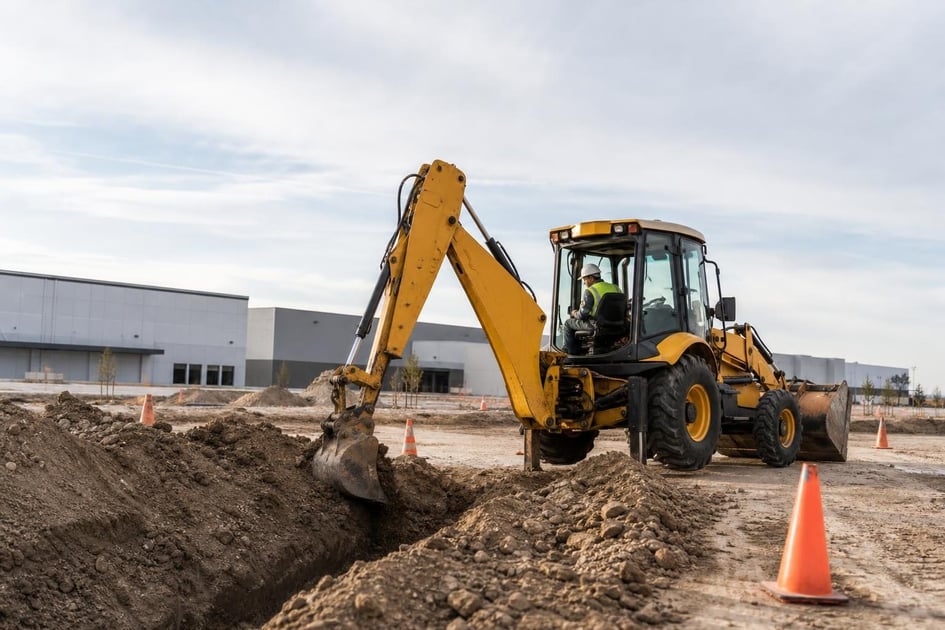
If you need a backhoe for your business, equipment financing is generally available to established companies with the machine itself serving as collateral. Rates vary by credit profile, equipment age and term. Same-day approvals are possible, and loan amounts range from $5,000 up to $5 million depending on the unit and your qualifications. The key is understanding what lenders look for before you shop, so you do not waste time on machines that will not clear underwriting.
You can see what financing you qualify for on that backhoe by starting a short application that takes only a few minutes. Most borrowers receive a response within hours, which lets you negotiate with a seller knowing exactly what you can spend.
What Backhoe Financing Covers and Who Qualifies
Backhoes financing covers new and used machines from major manufacturers as well as attachments, warranties, and soft costs such as delivery and installation. Lenders treat the backhoe as the primary collateral, which keeps rates competitive compared with unsecured borrowing. Because the equipment secures the deal, even borrowers with less-than-perfect credit can often qualify, though the rate and down payment requirement will adjust to reflect the risk.
The typical applicant is a construction contractor, excavation company, landscaper, utility contractor, or agricultural operator with at least six months to two years in business. Lenders prefer to see a track record of revenue because the monthly payment must fit comfortably within cash flow. Established companies with documented revenue history are the best fit for standard equipment finance programs.
Loan terms usually run from 24 to 72 months, with longer terms reserved for newer, more expensive units. A $35,000 used backhoe might be financed over 36 months, while a $120,000 new loader-backhoe with extendahoe and hydraulic thumb could stretch to 60 or 72 months. The exact structure depends on the age and hours of the machine, your credit profile, and the overall term.
Key Insight: Lenders often require the financed backhoe to be no older than 10 to 15 model years at origination, and many cap hours at 8,000 to 10,000 on the meter. Exceeding those limits does not always kill the deal, but it usually shortens the available term or raises the required down payment.
Already have a machine in mind?
Provide Capital finances new and used equipment from $5,000 to $5 million, with same-day decisions possible.
Apply NowHow Lenders Evaluate a Backhoe as Collateral
Underwriters look at four main factors when valuing a backhoe: manufacturer, model year, operating hours, and recent comparable sales. Brand-name machines from Caterpillar, John Deere, JCB, Case, and Komatsu hold value better and are easier to liquidate if the lender must repossess. That liquidity translates into better rates and lower down payments for the borrower.
Operating hours matter more than model year in many cases. A five-year-old backhoe with 3,000 hours is often viewed more favorably than a three-year-old machine with 7,000 hours. The reason is simple: the engine, transmission, and hydraulics have more remaining life, which protects the lender's collateral value over the term of the loan. Expect the lender to request a photo of the hour meter or an equipment inspection report.
Attachments such as hammers, augers, grapples, and thumbs can usually be financed along with the base machine if they are part of the same invoice. However, lenders typically want the attachment value to remain a minority of the total financed amount. If you are buying a $40,000 backhoe and $25,000 in attachments, the underwriter may ask you to pay for some of the attachments out of pocket to rebalance the collateral coverage.
New vs. Used Backhoes: What Changes in Financing
New backhoes come with manufacturer warranties, predictable maintenance schedules, and the lowest interest-rate tiers a lender offers. The downside is depreciation: a new machine can lose 20 to 30 percent of its value in the first year, which means you may owe more than the machine is worth for the first 18 to 24 months. That gap is manageable if you plan to keep the unit long term, but it matters if you expect to trade it in early.
Used backhoes offer a lower entry price and slower depreciation, but financing terms tighten. Lenders may shorten the maximum term by 12 to 24 months compared with a new unit, which raises the monthly payment. They may also require a larger down payment—sometimes 10 to 20 percent—to offset the collateral risk. Still, for most owner-operators, a late-model used machine with 2,000 to 4,000 hours represents the sweet spot between affordability and remaining useful life.
Construction equipment financing programs typically allow used equipment up to a certain age, but the cutoff varies by lender. It is worth confirming the age and hour limits before you fall in love with a 12-year-old unit with 9,000 hours, because the financing terms may make the monthly payment uncomfortably high.
Pro Tip: If you are buying used, request a complete maintenance log and a third-party inspection. Lenders increasingly require an inspection report for any used machine over five years old or 5,000 hours, and having one ready speeds approval by several days.
Lease or Loan? Choosing the Right Structure
Equipment finance agreements generally fall into two categories: loans (or capital leases) where you own the backhoe at the end, and operating leases where you return or purchase the machine for fair market value. The right choice depends on how long you plan to keep the unit, your tax strategy, and your balance-sheet preferences.
| Factor | Equipment Loan / Capital Lease | Operating Lease |
|---|---|---|
| Ownership | You own the backhoe after final payment | You return or buy at fair market value |
| Down payment | Often 0–10% | Usually one or two monthly payments upfront |
| Term | 24–72 months | 24–60 months |
| Monthly payment | Higher | Lower |
| Depreciation | You claim depreciation and Section 179 | Lessor claims depreciation; you deduct payments |
| Ideal if | You plan to keep the machine 7+ years | You upgrade equipment frequently |
| End-of-term | $1 or $101 buyout | Fair market value or defined residual |
For a backhoe that will see heavy daily use in excavation or utility work, a loan or capital lease is usually the better fit. You beat up the machine, you maintain it yourself, and you want the equity at the end. For seasonal landscapers who only need a backhoe six months a year and want a new model every three years, an operating lease can preserve cash flow and eliminate resale risk.
Be careful with operating leases that contain mileage or hour restrictions. A backhoe in commercial construction can easily accumulate 1,000 to 1,500 hours per year. Exceeding the lease allowance triggers per-hour surcharges that erase the monthly savings.
Tax Treatment and Section 179 for 2026
For the 2026 tax year, businesses may be able to deduct the full purchase price of qualifying equipment, including backhoes, in the year the machine is placed in service under Section 179 of the Internal Revenue Code. The exact deduction limit for 2026 is set by the IRS and adjusts annually for inflation. Because those figures are subject to final IRS announcements, you should consult a CPA to confirm the current-year limit before making a purchase decision.
If you finance the backhoe, you can still take Section 179 even though you have not paid the full cash price upfront. That creates a powerful cash-flow arbitrage: you deduct the equipment in year one while paying for it over three to five years. Bonus depreciation may also be available for 2026, though the percentage and eligibility rules phase down over time. Again, a CPA familiar with your business structure should model the exact benefit.
Interest paid on an equipment loan is generally deductible as a business expense. Lease payments are also deductible, but the mechanics differ depending on whether the lease is classified as a true lease or a capital lease for tax purposes. Do not assume your bookkeeper knows the difference; have your CPA review the lease structure before you sign.
By the Numbers: A $75,000 backhoe financed over 60 months might generate a first-year Section 179 deduction that exceeds the total cash outlay in year one, depending on the 2026 limit. Even if you put 10 percent down—$7,500—you could potentially deduct the full $75,000, producing a significant tax shield while preserving working capital. Confirm eligibility and limits with your CPA.
Qualification Criteria in Detail
Credit and Time-in-Business
Most equipment lenders want to see a personal credit score in the mid-600s or higher for the primary guarantor. Scores below that do not automatically disqualify you, but they push the deal into a higher-risk tier with larger down payments and shorter terms. If your score is under 600, expect to put down 15 to 20 percent and to show strong business revenue to compensate.
Time-in-business requirements vary. Some programs accept six months of operating history, while others want two years or more. The longer your track record, the less weight the lender places on personal credit. A construction company with three years of tax returns showing steady revenue can often qualify with a lower credit score than a business with only six months of activity.
Equipment Age and Hour Limits
As collateral, the backhoe itself must meet the lender's standards. Common thresholds include a maximum age of 10 to 15 years at the end of the loan term, not just at the beginning. If you are financing a 2016 backhoe over 60 months, the machine will be 15 years old at payoff. Some lenders will reject that deal outright; others will simply require a larger down payment or a shorter term.
Hour limits work the same way. A lender might cap the machine at 8,000 hours at origination for a 60-month term, or 10,000 hours for a 36-month term. The logic is that a machine with 12,000 hours has limited remaining life and resale value, so the collateral coverage weakens over time.
Down Payment and Collateral Requirements
Down payments on backhoe financing typically range from zero to 20 percent. Borrowers with strong credit and newer equipment can often secure 100 percent financing, meaning the lender covers the machine, delivery, and even the first-year warranty. Borrowers with challenged credit or older equipment should plan on 10 to 20 percent down.
The lender will file a UCC-1 lien on the backhoe, which appears on the equipment's title history. That lien must be satisfied before the title can transfer to a new buyer. If you plan to sell or trade the machine before the loan is paid off, you will need to coordinate with the lender to release the lien, usually by paying off the remaining balance with sale proceeds.
See what you qualify for
The equipment itself secures the financing, which keeps rates competitive. Checking your options takes minutes.
Check Your OptionsDocumentation You'll Need
Having your paperwork ready before you apply can cut the approval timeline from days to hours. Most lenders request the following:
- A completed application with business and personal details
- Last three months of business bank statements
- Current year financials or tax returns (sometimes one year, sometimes two)
- A copy of the equipment invoice or listing showing year, make, model, serial number, and price
- Photo of the hour meter for used machines
- Proof of insurance listing the lender as loss payee
For loans above $150,000, some lenders also request business tax returns and an interim profit-and-loss statement. If you are buying from a private party rather than a dealer, the lender may require an independent appraisal or inspection report to verify condition and value.
Dump Trucks financing follows a similar documentation path, so if you have financed equipment before, the process will feel familiar. The key difference with backhoes is the hour verification, which most truck lenders do not require.
Industry-Specific Use Cases
Construction and Excavation
General contractors and excavation crews use backhoes for trenching, foundation work, grading, and material handling. In this environment, the machine runs hard and depreciates quickly, so most buyers prefer a loan over a lease. A contractor who keeps a backhoe for eight to ten years builds equity and avoids perpetual payments. According to U.S. Census Bureau construction spending data, residential and non-residential construction activity influences equipment demand directly, and contractors who own their machines can take on jobs without worrying about rental availability during peak season.
Landscaping and Forestry
Landscape contractors use smaller loader-backhoes for grading, stump removal, and retaining-wall construction. Because the work is seasonal in many regions, these owners often prioritize lower monthly payments over long-term equity. A used machine with 2,500 hours financed over 48 months keeps the payment manageable during winter months when revenue drops. Adding a hydraulic thumb or grapple attachment turns the backhoe into a year-round tool for brush clearing and debris removal.
Agriculture and Utilities
Farmers and rural utility districts use backhoes for drainage ditches, fence-line maintenance, and culvert installation. The workload is lighter than construction, so a machine can last 15 years or more with proper care. Agricultural buyers often favor capital leases or loans with longer terms because the backhoe stays in the fleet indefinitely. SBA guidance on business planning emphasizes matching equipment life to financing term, and that principle is especially relevant for farmers who measure asset life in decades rather than years.
Key Insight: Utility contractors working on municipal contracts often face bonding requirements that restrict leased equipment. If your backlog includes public-works projects, verify that an operating lease will satisfy the bond underwriter before you sign. A loan or capital lease is usually the safer choice for bonded work.
Common Mistakes to Avoid
First, do not shop for equipment before you know your budget. Sellers will show you machines at the top of your range, and emotional attachment makes it hard to walk away. Get pre-qualified or at least know your maximum monthly payment before you browse.
Second, avoid backhoes with unclear hour histories. A machine that shows 4,000 hours but has a worn pedal pad, replaced seat, and fresh paint is a red flag. Lenders know these signs too, and they may reject the collateral or demand an inspection that delays your closing.
Third, do not forget to insure the machine before funding. The lender will not release funds until they see a certificate of insurance naming them as loss payee. Arrange coverage as soon as you have a serial number, because gaps in coverage expose both you and the lender to risk.
Fourth, match the term to the useful life. Financing a 10-year-old backhoe over 72 months means you will still be paying for a machine that is 18 years old and likely retired. That creates a negative equity trap if you need to sell or trade.
Fifth, review the payoff structure before you sign. Industry reporting from Reuters notes that some equipment finance agreements include prepayment penalties or require the full interest amount even if you pay off early, so ask your lender to explain the exact terms.
What Happens After You Apply
Once you submit an application, the lender reviews your credit, business bank statements, and equipment details. For deals under $100,000, this can take a few hours. For larger deals or more complex credit profiles, expect 24 to 48 hours. The lender may request additional documentation, such as a current profit-and-loss statement or an explanation for a prior credit issue.
After approval, you receive a term sheet showing the monthly payment, term, down payment, and any fees. Review it carefully. If you accept, the lender prepares the final documents, which you sign electronically. Funds are typically sent directly to the seller or dealer. For private-party sales, the lender may issue a check payable to both you and the seller, or they may wire funds upon receipt of the title.
The lender files a UCC lien on the backhoe, and you take possession. Your first payment is usually due 30 to 45 days after funding. If you get a decision on your equipment, possibly the same day, you can close quickly enough to beat another buyer to a hot listing.
Put the right equipment to work
From $5,000 to $5 million, new or used, Provide Capital helps businesses nationwide finance the equipment they need.
Apply TodayFrequently Asked Questions
Can I finance a backhoe with bad credit?
Yes, but expect a larger down payment and a shorter term. The equipment itself serves as collateral, which gives lenders more flexibility than unsecured lending. Most programs require a credit score in the mid-600s for standard terms, though exceptions exist with strong revenue or a qualified co-signer.
How old can a used backhoe be to qualify for financing?
Most lenders cap the age at 10 to 15 years at the time of financing, and they also consider how old the machine will be at the end of the term. A 12-year-old backhoe might qualify for a 24-month loan but not a 60-month loan. Hours on the meter matter just as much as model year.
What is the typical down payment for a backhoe loan?
Down payments range from zero to 20 percent. Strong credit and newer equipment often qualify for 100 percent financing. Older machines, challenged credit, or private-party sales usually require 10 to 20 percent down to protect the lender's collateral position.
Can I finance attachments along with the backhoe?
Yes, if they are on the same invoice and represent a reasonable share of the total cost. Lenders generally want the base machine to make up the majority of the financed amount. Extremely high attachment values may require a separate line item or additional down payment.
Is the interest on backhoe financing tax-deductible?
Interest paid on a business equipment loan is generally tax-deductible. Lease payments are also deductible, but the exact treatment depends on whether the lease is classified as a true lease or capital lease for tax purposes. Consult your CPA to determine the best structure for your 2026 tax situation.
How long does approval take?
Many applications receive a decision within hours, and same-day approvals are possible when the paperwork is complete. Larger deals or requests for used equipment inspections may take 24 to 48 hours. Having your bank statements, equipment invoice, and insurance quote ready speeds the process significantly.
Can I pay off the loan early?
Most equipment loans allow early payoff, but some include prepayment penalties or minimum interest charges. Read the term sheet carefully before accepting. If early payoff is important to you, ask the lender upfront about their policy.
Do I need a commercial driver's license to finance a backhoe?
No. A CDL is not required to operate or finance a standard backhoe. However, if the machine is mounted on a truck chassis and exceeds certain weight thresholds, your state may require specific licensing or permitting. Check local regulations.
Ready to Finance Your Backhoe?
Backhoe financing is straightforward when you understand the lender's perspective on collateral, age, hours, and credit. Shop for a machine that fits the program guidelines, gather your documentation, and know your target monthly payment before you negotiate. The right financing structure preserves your working capital, delivers potential tax benefits for the 2026 tax year, and puts you in control of a machine that will earn revenue for years to come.
Check your financing options in just a few minutes and move from shopping to working faster than you might expect. With loan amounts from $5,000 to $5 million and decisions often returned the same day, you can secure the backhoe your business needs without draining cash reserves.
Disclaimer: The information provided in this article is for general educational purposes only and is not financial, legal, or tax advice. Funding terms, qualifications, and product availability may vary and are subject to change without notice. Provide Capital does not guarantee approval, rates, or specific outcomes. For personalized information about your business funding options, contact our team directly.
