
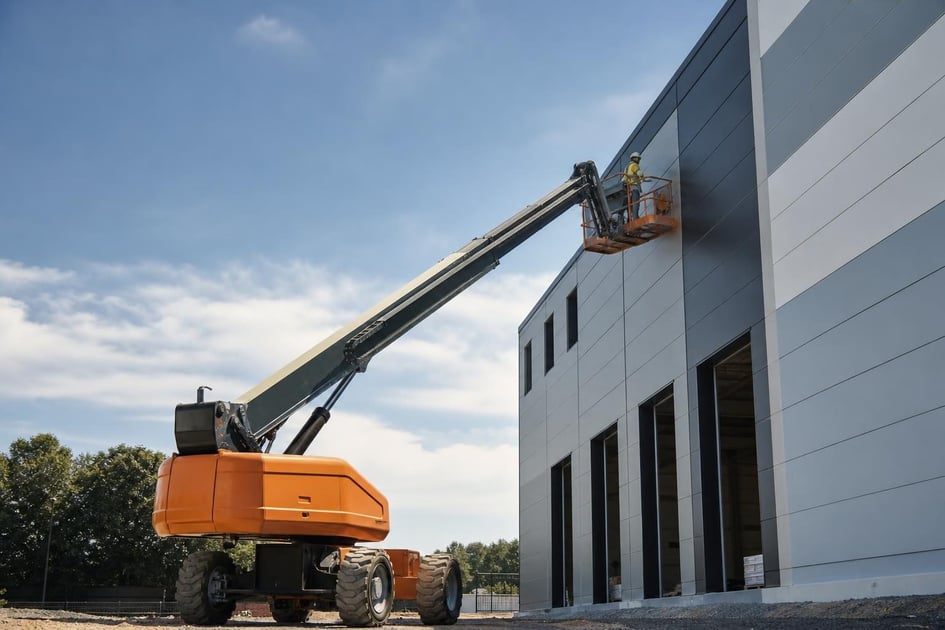
A boom lift financing calculator gives you a monthly payment range before you talk to a lender. Most calculators ask for the equipment price, your intended down payment, an estimated credit tier, and the term length you want. The output is a projected payment, not a binding offer. The actual approval depends on your full credit profile, time in business, and the specific unit's age and condition.
At Provide Capital, we finance boom lifts from $5,000 up to $5 million. The equipment itself serves as collateral, which helps keep rates competitive compared to unsecured borrowing. Rates vary by credit profile, equipment age and term. A 2019 45-foot articulating boom lift with 2,500 hours will price differently than a 2024 telescopic unit straight from the dealer. The collateral value gives the lender confidence, but your business history determines the exact structure.
When you use a calculator, you are seeing a scenario. If you enter a $75,000 machine, a 60-month term, and "good credit," the result might show a range that fits your cash flow. But if your actual credit profile is stronger—or if the equipment is newer than the scenario you entered—the real number can move. If you are curious about what you might qualify for on a specific unit, see what financing you qualify for on that boom lift in just a few minutes.
What the Calculator Estimates vs. What the Underwriter Sees
The calculator runs a formula based on the purchase price, down payment, estimated credit band, and desired term. It assumes the equipment is standard collateral with a recognized resale value. The underwriter runs a file. The underwriter looks at your business bank statements, tax returns, and debt obligations. They also verify the equipment's serial number, hours, and whether it is being purchased from a dealer or a private party. A private-party sale often requires more documentation and can affect the rate because the lender has less recourse if the title is cloudy or the seller misrepresented the machine's condition.
The calculator cannot see whether your business has two years of tax returns or six months. It cannot see if you have an existing equipment loan with six months left. Those details shift the final structure. Use the calculator as a planning tool, then let the underwriter match you to the actual program.
Get a fast decision on your equipment
Applying takes just a few minutes, and decisions can come as soon as the same day.
Start Your ApplicationWhy the Same Machine Can Quote Two Different Prices
Two buyers looking at the same $85,000 JLG 800S can receive different terms. One buyer has been in construction for eight years, owns three pieces of equipment already, and puts 15% down. The other is a two-year-old HVAC contractor buying his first lift. The first buyer likely sees a longer term and a lower monthly obligation. The second buyer might need a shorter term or a larger down payment to fit the lender's risk parameters.
This is why "rates vary by credit profile, equipment age and term" is not a disclaimer—it is the core mechanic of equipment finance. The collateral helps, but the borrower's demonstrated ability to generate revenue with that collateral matters just as much. Lenders want to know that the boom lift will generate enough contract revenue to cover its payment.
Key Insight: Lenders often reserve the best terms for equipment with verified maintenance records. A boom lift with dealer service history and under 3,000 hours typically qualifies for longer terms than a high-hour unit sold at auction without records.
New vs. Used Boom Lifts: How Age Affects the Numbers
New boom lifts come with manufacturer warranties, known service intervals, and no mystery hours. That predictability makes them easier to finance. Lenders like collateral they can value confidently. A 2025 or 2026 unit from an authorized dealer usually qualifies for the longest terms and the most competitive rates available within your credit tier.
Used boom lifts are where most owner-operators shop. A three-to-five-year-old unit has already taken its initial depreciation hit, so the purchase price is lower. But the lender will cap the term based on remaining useful life. You might want a 60-month term on a 2019 Genie S-65, but the lender may offer 48 months because the equipment is seven years old. The monthly payment ends up higher than on a new machine financed over 60 months, even though the total borrowed is less.
For construction contractors adding height access to their fleet, Construction equipment financing programs are built around these new-vs-used trade-offs. The key is matching the term to the equipment's expected revenue life. If you plan to run the lift for four years and then trade it in, a 48-month term on a used unit makes sense. If you want to keep it for eight years, buying newer and stretching to 60 months preserves cash flow.
| Factor | New Boom Lift | Used Boom Lift (3-7 Years) |
|---|---|---|
| Typical financing term | 48–60 months | 36–48 months |
| Down payment expectation | First payment or 5–10% | 10–15% |
| Rate influence | Stronger credit profiles see best terms | Rates vary by credit profile, equipment age and term |
| Collateral confidence | High; warranty and known history | Moderate; depends on hour count and service records |
| Best for | Long-term fleet additions, high utilization | Short-term projects, first lift purchase |
If you are also weighing other elevated work platforms, Scissor Lifts financing follows similar age-based logic, though scissor lifts often have lower entry prices and shorter typical terms.
How to Choose the Right Boom Lift Size for Your Work
Before you run a calculator, you need to know which boom lift class you are pricing. Articulating boom lifts bend in the middle, letting you maneuver up and over obstacles. They top out around 150 feet and excel in tight construction sites or maintenance yards where you need to reach over a roofline or into a courtyard. Telescopic boom lifts extend in a straight line and reach higher—some models hit 180 feet. They are favorites for bridge work, high-rise exterior maintenance, and large industrial installations where horizontal reach is less important than maximum height.
Trailer-mounted boom lifts tow behind a truck and set up quickly. They are popular with tree services and event installers but have lower weight capacities than self-propelled units. Spider lifts, with their narrow footprint and outriggers, fit through standard doorways and work on finished floors. If your work spans indoor and outdoor, a spider lift might replace both a boom lift and a scissor lift.
The size and type drive the price, which drives the financing. A 30-foot electric articulating lift might cost $35,000 used, while an 80-foot diesel telescopic unit can run $120,000 or more. Entering the wrong class into a calculator gives you a useless number. Match the machine to the job first, then model the payment.
Lease vs. Loan: A Side-by-Side Look for Boom Lifts
An equipment loan for a boom lift means you own the asset at the end. You make monthly payments, and once the final payment clears, the lender releases the lien. You can then run it without a payment, sell it, or trade it in. A loan preserves equity and, for tax year 2026, may allow you to deduct the full purchase price under Section 179 up to the statutory limit—though you should confirm your specific situation with a CPA because limits and eligibility change with tax law.
A lease, specifically a $1 buyout lease or a 10% PUT lease, acts like a loan in practice but has different accounting. In a true lease or operating lease, you do not own the asset unless you exercise a purchase option at the end. The monthly payment is often slightly lower than a loan payment because you are not amortizing the full purchase price unless you buy out. However, you must return the equipment in good condition or pay the residual.
Most construction and maintenance contractors choose a loan or $1 buyout lease for boom lifts because they intend to keep the equipment for its full working life. If you upgrade every three years, a fair-market-value lease might make sense, but fewer lenders offer true operating leases on used boom lifts. The secondary market for seven-year-old boom lifts is strong enough that lenders prefer to write loans.
The decision usually comes down to your tax strategy and how long you plan to run the machine. For tax year 2026, Section 179 deduction limits apply to purchased or financed equipment. Lease payments are generally deductible as operating expenses, but the rules differ. Always consult a CPA before structuring a transaction for tax purposes.
| Structure | Ownership | Typical Term | End of Term | Tax Treatment (2026) |
|---|---|---|---|---|
| Equipment Loan | You own it; lender holds lien | 36–60 months | Free and clear | Section 179 may apply; confirm with CPA |
| $1 Buyout Lease | You own it after final payment | 36–60 months | $1 purchase | Similar to loan; confirm with CPA |
| FMV Lease | Lender owns it | 24–48 months | Return or buy at fair market value | Payments often deductible; confirm with CPA |
Find the right financing structure
Tell us about the equipment you need and we will show you the options that fit your business.
See Your OptionsSection 179 and 2026 Tax Treatment
For tax year 2026, the Section 179 deduction allows businesses to deduct the full purchase price of qualifying equipment, subject to annual limits and phase-out thresholds. The exact dollar limits for 2026 are set by inflation-adjusted IRS guidance. Rather than cite a specific number that may not reflect the final published limit, the safe approach is to confirm the current-year ceiling with your CPA or tax preparer before you buy.
Bonus depreciation has been phasing down. For tax year 2026, bonus depreciation may be available at a reduced percentage depending on legislative status. Again, this is a moving target. What matters for financing is that you can still deduct equipment financed with a loan in 2026, provided you place it in service this year and meet IRS requirements. You do not have to pay cash to get the deduction.
The equipment must be used for business more than 50% of the time to qualify. If you buy a boom lift and use it for both personal and commercial work, track the hours carefully. The IRS can disallow part of the deduction if the business-use percentage drops below the threshold. Your CPA can help you set up the right log system.
Pro Tip: If you are buying in November or December, verify delivery and in-service dates before signing. Equipment must be placed in service during tax year 2026 to qualify for that year's Section 179 treatment. A delay in delivery that pushes the start date into January can shift your deduction by a full year.
What Documentation You'll Need
For Established Contractors
If your business has been operating for two or more years, expect to provide one to two years of business tax returns, three to six months of business bank statements, a quote or invoice for the specific boom lift, and proof of insurance naming the lender as loss payee. Some lenders also ask for a current year-to-date profit and loss statement. If you are buying from a dealer, they usually provide the invoice and help coordinate the title transfer. Private-party sales require a bill of sale and a title search to ensure no liens exist.
Insurance is non-negotiable. Physical damage coverage must equal or exceed the loan balance. General liability does not cover the machine itself. If you do not have an equipment policy yet, get a quote before applying. Lenders will not fund without a certificate of insurance.
For Buyers with Less Than Two Years in Business
Newer businesses can still qualify, especially with strong personal credit or a substantial down payment. You may need personal tax returns, a personal financial statement, bank statements for both personal and business accounts, and a brief resume showing relevant industry experience. Time in business is a risk signal, not a disqualifier. A former foreman with 15 years in the field and six months of incorporation history is a different file than a complete newcomer. Lenders look at the whole story.
Newer businesses should also have a clear business plan that explains how the boom lift generates revenue. The SBA guidance on business planning outlines what lenders like to see: a description of services, target market, and revenue projections. Even a one-page plan helps if you have limited operating history.
Construction spending drives demand for aerial equipment. U.S. Census Bureau construction spending data tracks monthly activity across residential and non-residential building, which correlates with boom lift utilization. When spending rises, rental fleets expand and used prices firm up.
If you are in construction, healthcare, dental, restaurant and food service, manufacturing, transportation, agriculture, HVAC, or forestry, we work with your industry nationwide. The documentation requirements are similar across trades, though seasonal businesses may need to show bank statements that cover both peak and slow months.
By the Numbers: At Provide Capital, same-day approvals are possible for completed applications with clear documentation. Delays almost always come from missing insurance certificates, incomplete vendor invoices, or bank statements that do not cover the full requested period.
Common Application Mistakes That Slow Approval
The most common delay is applying for a machine before confirming it is still available. Boom lifts move fast in the secondary market. If you apply on Friday for a unit that sold Thursday, the lender must restart the file with new collateral details. Get a current quote with the serial number before you submit.
Another mistake is underestimating insurance costs. Lenders require physical damage insurance on financed equipment. If you have not priced a policy for a boom lift, get a quote early. Some contractors assume their general liability covers the machine; it does not. A standalone equipment policy for a $60,000 boom lift might run a few thousand dollars annually depending on your claims history and region.
A third mistake is mixing personal and business deposits without records. If your business is young and the lender is looking at personal bank statements, they need to see which deposits are business revenue. Clean books speed underwriting. If you commingle funds, prepare a spreadsheet that reconciles the two.
Key Insight: If you are buying at auction, register for bidding and arrange financing before the sale date. Auction houses often require payment within 24 to 48 hours. A pre-approval letter from your lender lets you bid with a firm ceiling and close on time.
What Happens After You Apply
Once you submit a full application, the lender reviews credit, verifies equipment value, and issues a term sheet. This can happen the same day if the file is clean. You review the term sheet, sign, and provide proof of insurance. The lender then pays the vendor or private seller directly. You take delivery, and the first payment is typically due 30 to 45 days later.
If the lender needs more information, they will ask for it quickly. Respond within 24 hours to keep the timeline intact. After approval, the lender files a UCC-1 lien on the equipment. This is standard and does not affect your ability to use the machine on any job site. The lien simply secures the lender's interest until the loan is satisfied.
Equipment financing markets respond to broader economic cycles. Reuters business coverage regularly reports on interest rate trends and commercial credit conditions that affect equipment lenders nationwide. Staying aware of those trends helps you time large purchases.
For contractors working in tight quarters or indoors, Spider Lifts financing is another specialized option that follows this same approval workflow. Whether you need a 60-foot diesel unit for steel erection or a compact electric lift for hospital maintenance, the process remains consistent.
Start an application in a few minutes and get a real decision based on your actual file, not a calculator estimate.
Ready to move forward?
More than 10,000 businesses have financed equipment with Provide Capital. See what you qualify for today.
Get StartedFAQ
How accurate is a boom lift financing calculator?
A calculator is accurate for the scenario you input. It is not a guarantee of final terms. The actual payment depends on your verified credit profile, the exact equipment age and hours, and the final term length approved by underwriting.
What credit score do I need to finance a boom lift?
There is no hard cutoff. Strong credit profiles receive the best rates and longest terms, but we work with a range of credit histories. Rates vary by credit profile, equipment age and term. A stronger file might mean 0% down; a challenged file might require 15–20%.
Can I finance a boom lift from a private seller?
Yes. Private-party financing is common. You will need a bill of sale, clear title, and often an independent appraisal or inspection. The lender pays the seller directly once the lien is perfected.
How long can I finance a used boom lift?
Terms typically range from 36 to 48 months for used units, depending on age and hours. Newer used equipment (two to four years old) may qualify for 60 months. Older units or those with high hours may be capped at 36 months.
Does the equipment type matter for approval?
Yes. Articulating boom lifts, telescopic boom lifts, and trailer-mounted lifts each have different residual values and market demand. Lenders prefer equipment they can resell if needed, so mainstream brands and models with active secondary markets finance more easily.
What industries do you serve for boom lift financing?
We work with construction, healthcare, dental, restaurant and food service, manufacturing, transportation, agriculture, HVAC, and forestry nationwide. Any business that uses a boom lift as a productive asset can apply.
Can I get same-day approval?
Same-day approvals are possible when the application is complete and documentation is in hand. Missing bank statements or insurance quotes are the usual reasons for delay.
Should I talk to my CPA before financing?
Yes. For tax year 2026, equipment financing can interact with Section 179 deductions, bonus depreciation, and ordinary expense elections. A CPA can tell you whether to structure the deal as a loan or lease based on your tax position.
Next Step
A boom lift financing calculator is the right place to start. It lets you model monthly obligations against your project revenue before you commit. Once you have a machine picked out and a quote in hand, the next step is to get a real decision. Get a decision on your equipment, possibly the same day, and move from planning to productivity.
Disclaimer: The information provided in this article is for general educational purposes only and is not financial, legal, or tax advice. Funding terms, qualifications, and product availability may vary and are subject to change without notice. Provide Capital does not guarantee approval, rates, or specific outcomes. For personalized information about your business funding options, contact our team directly.
