
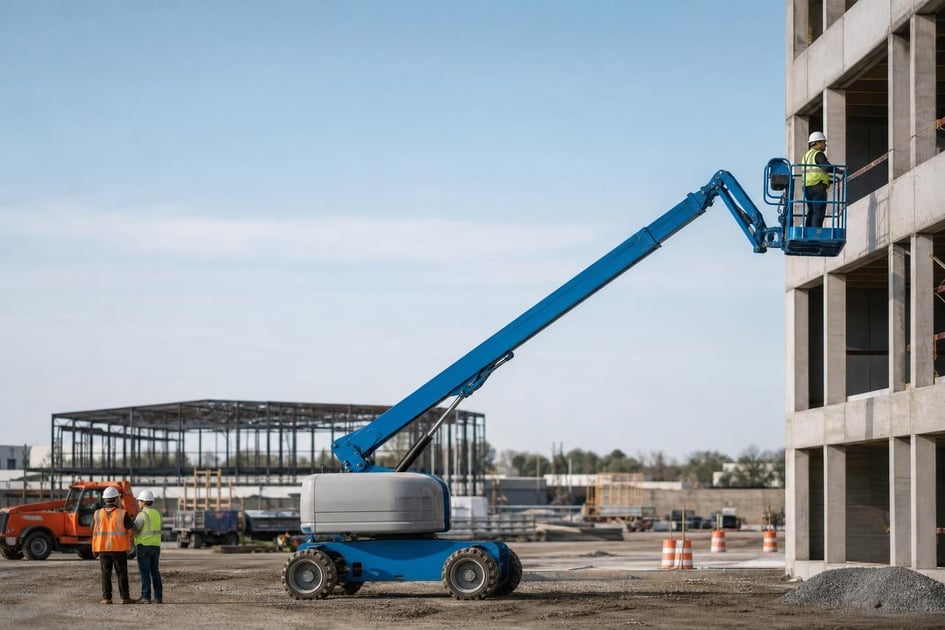
For contractors considering aerial equipment, Boom Lifts financing offers a way to spread the purchase cost over time while the machine starts generating revenue immediately. Most lenders structure the deal as an equipment loan or lease, with the boom lift itself serving as collateral. That security keeps rates competitive and often reduces the paperwork burden compared with unsecured borrowing. You can typically finance both new and used units, with amounts ranging from $5,000 up to $5 million depending on the purchase price and your business qualifications. If you are weighing a specific machine, see what financing you qualify for on that boom lift in just a few minutes.
How Boom Lift Financing Works
Boom lift financing is a secured transaction. The lender holds a security interest in the aerial work platform until the final payment clears. Because the equipment backs the deal, lenders are generally willing to finance a larger share of the purchase price than they would for an unsecured working-capital loan. Borrowers usually put down 0% to 20% of the equipment cost, though zero-down programs exist for well-qualified buyers. The repayment term typically mirrors the useful life of the asset—often 36 to 84 months for boom lifts—so you are not paying for the machine long after it has aged out of your fleet.
The application process starts with a short form and basic financial documentation. Many equipment lenders can review the file and issue a decision within one business day, and same-day approvals are possible when the deal is straightforward and the documentation is complete. Once approved, the lender either pays the dealer directly or reimburses you if the unit has already been purchased. You then make fixed monthly payments until the balance is satisfied. At the end of the term, you own the boom lift free and clear. Get a decision on your equipment, possibly the same day, by submitting your application with the equipment invoice in hand.
Rates vary by credit profile, equipment age and term. A borrower with strong credit financing a new unit over 36 months will generally see more favorable terms than a borrower with challenged credit financing a 10-year-old machine over 72 months. The key is to match the repayment schedule to the revenue the lift will generate. If the machine is on a job site five days a week, the cash flow it supports should comfortably cover the monthly payment. The Small Business Administration outlines how secured equipment loans differ from general working-capital products, which is worth reviewing if you are new to equipment finance.
Already have a machine in mind?
Provide Capital finances new and used equipment from $5,000 to $5 million, with same-day decisions possible.
Apply NowWhat Determines Your Financing Terms
Lenders evaluate boom lift applications on a handful of factors. Understanding them ahead of time helps you present a stronger file and avoid surprises.
Credit Profile and Business History
Your personal and business credit scores carry the most weight. Most equipment lenders want to see a personal credit score above 600, though some programs accept lower scores with compensating factors. Time in business matters too. Companies operating for two or more years usually receive the best terms, but established businesses with strong credit and documented revenue can still qualify even if they have been operating for less time. Lenders also look at derogatory items—bankruptcies, tax liens, and recent judgments can limit your options or require a larger down payment. A clean credit profile with consistent revenue often qualifies for the most aggressive structures.
Equipment Age and Condition
New boom lifts from manufacturers like JLG, Genie, or Skyjack are the easiest to finance because the collateral retains value well. Used equipment is financeable too, but lenders set age and hour limits. Many cap financing at units that are 10 to 15 years old at the end of the term, and some require an independent appraisal for machines older than seven years or with more than 5,000 hours. The serial number, maintenance records, and prior inspection reports all factor into the collateral evaluation. A used boom lift with documented service history from a certified dealer is easier to approve than one bought at auction with no records.
Down Payment and Loan Term
A larger down payment reduces the lender’s risk and can unlock better rates or longer terms. A 10% to 20% down payment is standard for used equipment and for borrowers with credit challenges. Well-qualified buyers financing new equipment may be approved with little or nothing down. The term length also affects pricing. Shorter terms mean higher monthly payments but less total interest paid over the life of the loan. Longer terms ease cash flow but increase the total cost of borrowing. Choose the term based on how many productive years you expect from the machine, not just the lowest monthly payment.
Key Insight: Lenders often calculate the boom lift’s residual value at the end of the term. If the loan amortizes faster than the equipment depreciates, you maintain positive equity in the asset. That equity can be leveraged later for a trade-in or as collateral on a future equipment purchase. Maintaining equity also protects you if you need to sell early.
New vs. Used Boom Lifts: Cost and Financing Differences
The decision between a new boom lift and a used one affects not only your upfront cost but also the financing terms available. New machines carry manufacturer warranties, lower maintenance costs in the first few years, and the latest safety features. Used machines cost less upfront but may require more frequent repairs and shorter financing terms. The U.S. Census Bureau construction spending data shows sustained demand for equipment across nonresidential sectors, which supports resale values and makes lenders more comfortable financing used units in active markets.
| Factor | New Boom Lift | Used Boom Lift |
|---|---|---|
| Purchase price range | $50,000 – $300,000+ | $15,000 – $150,000 |
| Typical financing term | 48 – 84 months | 36 – 60 months |
| Down payment | 0% – 10% | 10% – 20% |
| Rate outlook | Most favorable | Varies by age and hours |
| Collateral requirements | Invoice and serial number | Appraisal may be required |
| Tax treatment for 2026 | Full purchase price may qualify for Section 179 | Full purchase price may qualify for Section 179 |
From a financing perspective, new equipment is simpler. The lender knows the exact specifications, the warranty protects against early mechanical failure, and the depreciation schedule is predictable. Used equipment can be a smarter cash-flow move if the unit has low hours and a clean maintenance history, but you should budget for a pre-purchase inspection and set aside reserves for repairs that fall outside any remaining warranty. When comparing two machines, run the numbers on total cost of ownership, not just the monthly payment. A used boom lift with a $1,200 monthly payment and $400 average monthly maintenance is more expensive than a new unit at $1,400 with minimal maintenance.
Boom Lift Financing vs. Leasing: Which Fits Your Business?
Financing and leasing both let you put a boom lift to work without paying the full purchase price upfront, but they differ in structure, tax treatment, and end-of-term options. The right choice depends on how long you plan to keep the machine, how many hours you expect to put on it annually, and your tax strategy for 2026. A Forbes Finance Council overview of equipment financing notes that matching the financing structure to the asset’s useful life is one of the most important decisions an owner-operator makes.
| Feature | Equipment Loan | Equipment Lease |
|---|---|---|
| Ownership | You own the boom lift after the final payment | Lessor owns the equipment; you may have a buyout option |
| Monthly payment | Higher than a lease in some cases | Typically lower than a loan payment |
| Down payment | Often 0% – 20% | Usually one or two payments upfront |
| Tax deduction | Interest expense deductible; depreciation and Section 179 available for 2026 | Lease payments generally fully deductible as operating expense |
| End of term | No balance; you hold title | Return, renew, or purchase at fair market value or a fixed amount |
| Best for | Businesses that keep equipment 7+ years | Fleets that refresh every 3–5 years |
A $5 million equipment financing program can cover multiple boom lifts, scissor lifts, and complementary machines under a single master agreement. That simplifies bookkeeping and often locks in consistent documentation requirements across your fleet. If you expect to run the lift for more than five years or plan to modify it with custom fittings, a loan usually makes more sense because you are building equity. If you need the latest model every few years to satisfy municipal contract requirements, a lease preserves flexibility. Remember that rates vary by credit profile, equipment age and term, so the lease-versus-loan math changes based on your specific situation.
Find the right financing structure
Tell us about the equipment you need and we will show you the options that fit your business.
See Your OptionsTax Treatment for Boom Lifts in 2026
The tax benefits of owning a boom lift can be substantial, but the rules change regularly and the 2026 figures depend on IRS inflation adjustments published in revenue procedures. For the 2026 tax year, Section 179 allows businesses to deduct the full purchase price of qualifying equipment up to an annual limit, with a dollar-for-dollar phase-out once total equipment placed in service exceeds a higher threshold. The exact 2026 limits are set by the IRS; consult a CPA to confirm the current figures before you file.
Bonus depreciation may also apply to boom lifts placed in service during 2026, though the percentage has been stepping down from the 100% level that applied in earlier years. If bonus depreciation is available, you can take it in addition to or instead of Section 179, depending on your taxable income and overall equipment spending. Again, a tax professional can model the optimal strategy for your situation.
If you finance the purchase, you deduct the interest portion of each payment as a business expense while also claiming depreciation or Section 179 on the equipment itself. That dual benefit improves after-tax cash flow in the early years of ownership. Lease payments, by contrast, are typically fully deductible as operating expenses, which simplifies record-keeping but does not generate depreciation recapture when you dispose of the asset.
By the Numbers: For a $75,000 boom lift financed in 2026, a borrower in the 24% federal tax bracket who qualifies for a first-year Section 179 deduction could reduce taxable income by the full equipment cost, subject to IRS limits. The actual tax savings depend on your bracket, state taxes, and whether the phase-out threshold applies. Have your CPA run the scenario before you sign.
Industries That Rely on Boom Lift Financing
Boom lifts are not limited to one trade. Any business that needs temporary, stable elevation uses them, and each industry has its own purchasing patterns and financing considerations.
Construction is the largest market. General contractors, electricians, and HVAC installers use telescopic and articulating boom lifts to reach upper stories, bridge abutments, and steep grades. Demand peaks in spring and early summer, so many contractors buy in winter to secure off-season pricing and have the machine ready when bidding season opens. Construction equipment financing programs are built around these seasonal cash flows, with structures that match payments to revenue cycles.
Facilities maintenance and property management teams use smaller boom lifts for signage, lighting, and exterior repairs. These units often accumulate fewer hours than construction machines, so they retain value longer and are excellent candidates for longer-term financing. Manufacturing plants use boom lifts for overhead conveyor maintenance and plant upgrades. In warehousing and logistics, boom lifts complement forklift fleets for high-bay rack work.
Tree care and forestry contractors need rough-terrain boom lifts with outriggers and non-marking tracks. Because these machines work in mud and on slopes, lenders may require a more detailed condition report before approving used-equipment financing. Municipalities and utilities also finance boom lifts for bridge inspection and traffic-signal maintenance, though they sometimes layer in municipal lease-purchase structures that differ from standard commercial loans.
Pro Tip: Contractors in northern climates often see 40% to 60% of their annual boom lift revenue between May and September. If your cash flow is seasonal, ask about skip-payment structures or seasonal schedules that require lower payments in winter and higher payments during peak construction months.
Common Mistakes When Financing Boom Lifts
Even experienced buyers can misstep. Avoid these pitfalls to keep your financing efficient and your total cost under control.
Buying the wrong spec for the job. An articulating boom lift with a 60-foot reach and jib is overkill for a one-story retail maintenance contract, while a 30-foot electric scissor lift cannot handle the rough terrain of a new construction site. Match the machine to at least 80% of your expected work, not the one odd job that comes up once a year. Over-spec'd machines cost more to finance, insure, and maintain.
Ignoring total cost of ownership. The monthly payment is only one line item. Add insurance, preventive maintenance, replacement wear parts, transport costs, and operator training. A used boom lift with a tempting price tag can become expensive if the hydraulic hoses, bushings, and batteries need immediate replacement.
Stretching the term too long. A 96-month loan on a boom lift with a 10-year useful life leaves you with only two years of reliable service before you still owe a balance. If the machine breaks down in year eight and you are upside-down on the loan, you face a difficult decision between expensive repairs and rolling negative equity into a replacement.
Neglecting to compare multiple offers. Rates and fees vary significantly between lenders. A half-percentage-point difference on a $100,000 loan over 60 months can change the total cost by several thousand dollars. Always compare the total payback, not just the monthly payment or the rate.
Skipping the equipment inspection. For used boom lifts, hire a certified mechanic to inspect the engine, hydraulics, welds, and control systems before the lender funds the deal. Most lenders require an inspection for older units anyway, but doing it early prevents you from wasting time on a machine with hidden structural damage.
What Documentation You Need
Having your paperwork ready speeds up approval and reduces back-and-forth. Most lenders request the following:
- Business tax returns for the last two years
- Current year-to-date financial statements or bank statements
- A completed application with ownership details
- The equipment invoice or purchase agreement, including make, model, year, and serial number
- Proof of insurance covering the equipment
- Driver’s license and voided check for the business account
For transactions above $250,000, lenders may also request an interim balance sheet, accounts receivable aging, and a brief explanation of how the boom lift will be used. If you are buying at auction or from a private seller, be prepared to provide additional photos, an independent appraisal, and proof that the seller holds clear title.
Sole proprietors and single-member LLCs may need to provide personal tax returns and a personal financial statement, especially if the business credit profile is thin. Corporations and partnerships should have corporate resolutions authorizing the borrowing ready to sign.
What Happens After Approval
Once the lender issues an approval, you receive a term sheet detailing the financed amount, monthly payment, term length, and any conditions. Review it carefully. Look for origination fees, documentation fees, prepayment penalties, and UCC filing fees. If the terms match your expectations, sign and return the documents along with any required down payment.
The lender then verifies insurance, pays the seller or dealership, and files a UCC-1 financing statement against the serial number. You take delivery and put the boom lift to work. Most lenders do not hold the title in escrow; instead, they rely on the UCC filing to protect their interest. After the final payment, the lender releases the UCC filing, and you receive a lien release or title certificate depending on your state’s procedures.
Throughout the term, keep the insurance current and notify the lender of any damage or total loss immediately. If you sell the business or the equipment, the loan must be satisfied or assumed with the lender’s written consent. Submit your application and move from quote to job site as quickly as your documentation allows.
Ready to move forward?
More than 10,000 businesses have financed equipment with Provide Capital. See what you qualify for today.
Get StartedFrequently Asked Questions
Can I finance a boom lift from a private seller?
Yes, most equipment lenders finance private-party sales. You will need a bill of sale, the serial number, and usually an independent appraisal. The lender may also require title verification to ensure there are no existing liens.
What credit score do I need to finance a boom lift?
Most programs prefer a personal credit score of 600 or higher, though some lenders specialize in lower scores with larger down payments or shorter terms. Business credit history and cash flow can offset a weaker personal score.
Can I finance a boom lift that is 15 years old?
It is possible but harder. Many lenders set a maximum age of 10 to 15 years at the end of the loan term. A 15-year-old unit may require a larger down payment, a shorter term, or an exception from the lender’s credit committee.
Does the lender need to approve the dealer?
Generally no. Equipment lenders approve the borrower and the collateral, not the dealer. However, they will verify that the seller is delivering clear title and that the invoice matches the equipment being financed.
Can I bundle a boom lift with other equipment on one loan?
Yes. Many lenders offer master equipment financing agreements that cover multiple units. This is common for contractors buying a boom lift, a Scissor Lifts financing package, and a truck on a single line.
What happens if I pay off the loan early?
It depends on the loan agreement. Some lenders charge a prepayment penalty during the first 12 to 24 months. Others apply a fixed percentage fee or no penalty at all. Read the term sheet carefully before signing.
Is a down payment always required?
No. Well-qualified borrowers financing new equipment can sometimes secure 100% financing. Used equipment and borrowers with credit challenges usually need 10% to 20% down.
How long does the approval process take?
Simple deals with complete documentation can be approved the same day. More complex transactions or large dollar amounts may take 24 to 48 hours. The speed depends largely on how quickly you provide the requested documents.
Next Steps
Financing a boom lift is straightforward when you know what lenders evaluate and what documentation to gather. Start by defining the specifications you need—reach, terrain capability, and power source—then gather two years of tax returns and your current bank statements. Compare offers on total cost, not just the monthly payment, and confirm the tax strategy with your CPA before you commit. When you are ready to move forward, start an application in a few minutes and get a decision on your boom lift, possibly the same day.
Disclaimer: The information provided in this article is for general educational purposes only and is not financial, legal, or tax advice. Funding terms, qualifications, and product availability may vary and are subject to change without notice. Provide Capital does not guarantee approval, rates, or specific outcomes. For personalized information about your business funding options, contact our team directly.
