
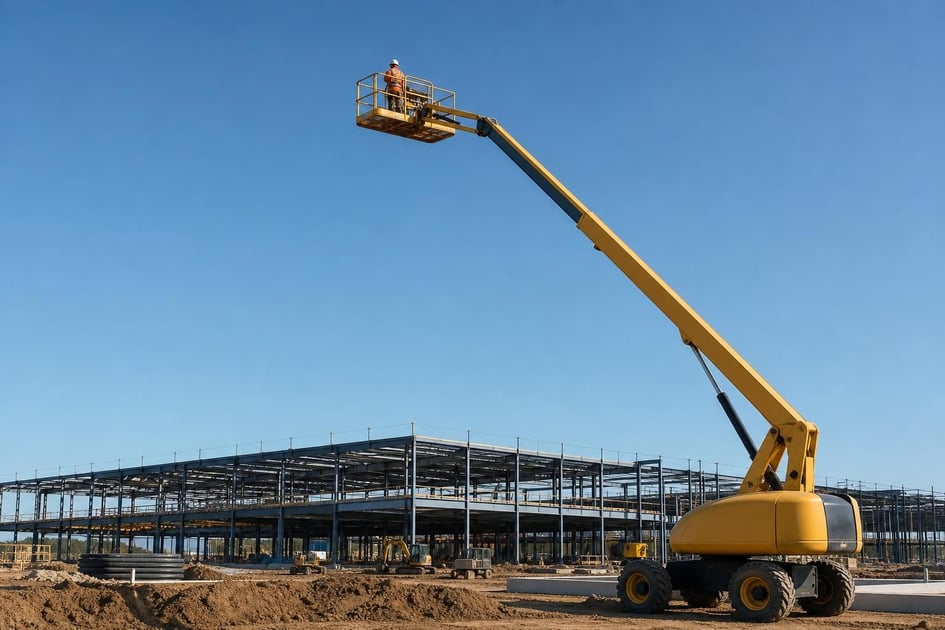
What Boom Lift Financing Actually Requires
Boom lift financing is structured around the equipment itself. Because the lender can recover value from the asset if necessary, borrowers often access better terms than they would with an unsecured business loan. Provide Capital finances new and used boom lifts from $5,000 up to $5 million, with repayment terms typically ranging from 24 to 84 months. Rates vary by credit profile, equipment age and term.
If you are a contractor, facilities manager, or equipment operator preparing to add an articulating or telescopic boom lift, the process is straightforward. You will need to show that your business generates enough cash flow to cover the payment, verify your time in operation, and identify the exact make, model, and year of the lift you want to finance. Same-day approvals are possible when your documentation is complete. See what you qualify for on the boom lift you have picked out—the application takes only a few minutes.
Unlike working-capital loans that rely heavily on personal credit scores, equipment financing weighs the collateral value heavily. A well-maintained JLG 860SJ or Genie S-85 holds resale value, which lowers the lender’s risk. That said, your business revenue, bank statements, and payment history still matter. Lenders want to know you have enough work lined up to keep the machine productive.
Get a fast decision on your equipment
Applying takes just a few minutes, and decisions can come as soon as the same day.
Start Your ApplicationWhat Lenders Evaluate
Credit History and Business Profile
Lenders review both personal and business credit. A score above 680 usually opens the door to the most competitive structures, but approvals are regularly issued for scores in the low 600s, especially when the equipment is newer and the business has healthy deposits. If your operation is younger than two years, expect the underwriter to rely more heavily on personal credit and a personal guarantee.
Time in Business
Most equipment lenders prefer at least two years of operating history. That does not mean startups are never approved, but it does mean the file needs compensating strengths—strong personal credit, a large down payment, or a co-signer. For businesses with five or more years under their belt, documentation requirements often lighten and approval speeds increase.
The Equipment Itself
The make, model, year, and hours matter. A 2024 or 2025 boom lift from a major manufacturer like JLG, Genie, or Snorkel will command stronger terms than a 15-year-old unit from a discontinued line. Lenders check auction results and dealer pricing to estimate residual value. If you are buying from a private seller, expect the lender to require an independent inspection or appraisal.
Down Payment and Collateral
Zero-down offers exist, but they are not universal. More commonly, expect to put down 5% to 20% depending on your credit tier and the equipment’s age. A 10% down payment on a $75,000 boom lift is $7,500. The equipment itself is the collateral, which means you do not need to pledge real estate or other assets. If your business owns multiple pieces of equipment already, some lenders will consider a cross-collateral structure, though that is less common for a single lift purchase.
Key Insight: Lenders often value boom lifts by reference to recent auction data from Ritchie Bros. or IronPlanet before finalizing terms. If you are buying at retail but the wholesale market is soft, the lender may cap the advance at auction value rather than your purchase price.
New vs. Used Boom Lifts
New boom lifts come with manufacturer warranties, the latest safety features, and lower maintenance costs for the first few years. Financing terms on new units usually stretch longer—up to 84 months—because the residual risk is predictable. Monthly payments are lower, but the total financed amount is higher.
Used boom lifts cost less upfront and depreciate more slowly in the first year, but maintenance costs rise faster after the five-year mark. Financing terms on used equipment typically run 36 to 60 months, and older units may require larger down payments. Rates vary by credit profile, equipment age and term, so a 2021 model will usually price better than a 2015 model.
When deciding between new and used, look at your annual utilization. If you plan to run the lift 1,500 hours per year, a new unit under warranty may save money. If you need it seasonally for 400 hours, a well-maintained used lift can be the smarter buy. Many contractors eventually build mixed fleets, pairing Scissor Lifts financing for interior slab work with larger boom lifts for exterior steel.
By the Numbers: A new 60-foot articulating boom lift typically lists between $125,000 and $175,000 depending on options. The same model three years old with under 1,000 hours often trades between $75,000 and $110,000. Financing the difference over 60 months changes your monthly obligation by roughly $1,000 to $1,400, though your exact payment depends on the final rate and structure.
Lease vs. Loan: Which Fits Your Operation?
You can acquire a boom lift through a capital lease, an operating lease, or an equipment loan. Each structure changes who owns the asset, what tax benefits you capture, and what happens at the end of the term. Business owners increasingly favor equipment financing over large cash outlays. As Forbes has reported, preserving working capital through equipment loans or leases allows contractors to maintain liquidity for labor and materials while still adding revenue-producing assets.
An equipment loan is straightforward: you own the lift from day one, build equity, and can sell it whenever you want. A capital lease functions almost like a loan for tax purposes—you claim depreciation and Section 179 deductions—but ownership may transfer at the end for a nominal buyout. An operating lease keeps the lift off your balance sheet as a purchase, which can help preserve credit capacity, but you generally do not claim depreciation.
| Feature | Equipment Loan | Capital Lease | Operating Lease |
|---|---|---|---|
| Ownership | You own immediately | $1 buyout at end | Lessor owns throughout |
| Monthly payment | Higher; builds equity | Moderate | Lowest |
| Tax treatment (2026) | Depreciation + Section 179 | Depreciation + Section 179 | Payment deductible as expense |
| Balance sheet impact | Asset + liability recorded | Asset + liability recorded | Off-balance-sheet |
| Best for | High utilization, long hold | Eventual ownership, cash conservation | Short-term need, fleet flexibility |
If you know you will keep the lift for seven to ten years, a loan or capital lease usually wins. If you need fleet flexibility or expect technology to change quickly—say, electric rough-terrain models become standard—an operating lease preserves optionality. Get a decision on your equipment, possibly the same day, and compare structures side by side.
Tax Treatment for the 2026 Tax Year
For the 2026 tax year, the Section 179 deduction allows businesses to expense qualifying equipment purchases up to an inflation-adjusted limit. Boom lifts used more than 50% for business purposes qualify. Because the exact 2026 ceiling is adjusted annually for inflation and subject to Congressional action, you should confirm the current-year limit with your CPA before finalizing purchase timing.
Bonus depreciation is also available in 2026, though it phases down from prior years. Again, the precise percentage depends on legislation enacted before and during 2026. Your CPA can model whether Section 179, bonus depreciation, or standard MACRS depreciation delivers the best after-tax result for your specific bracket and state.
The key operational point is timing. If you place a boom lift in service before December 31, 2026, you capture the deduction on your 2026 return. Waiting until January pushes the benefit into 2027. For businesses looking to offset a strong revenue year, an end-of-year equipment purchase is a common strategy—provided the financing closes in time.
Pro Tip: If you finance in November or December, get your documentation to the lender by mid-month. Funding and title work can slow down over holidays, and missing the placement-in-service date by even one day shifts your entire deduction to the next tax year.
See what you qualify for
The equipment itself secures the financing, which keeps rates competitive. Checking your options takes minutes.
Check Your OptionsDocumentation You Will Need
Equipment loans remain one of the most common forms of small-business financing. The Small Business Administration publishes guidance showing that equipment-backed lending consistently accounts for a significant share of small-business loan volume because the collateral reduces lender risk. A complete file moves faster. Have these items ready before you apply:
- Business bank statements for the last three to six months
- Current year tax returns or financial statements
- A quote, invoice, or equipment listing showing make, model, year, serial number, and seller information
- Proof of insurance naming the lender as loss payee
- Driver’s license and, for newer businesses, a personal financial statement
If you are buying from a dealer, they often provide the equipment specification sheet. Private sales require more legwork—confirm the serial number matches the title, and verify there are no outstanding liens. Some lenders will run a UCC search to confirm clean title.
Industry-Specific Considerations
Construction remains one of the largest employer sectors in the United States. According to Census Bureau data, the construction industry encompasses hundreds of thousands of employer firms nationwide, many of which rely on aerial equipment to reach high-reach job sites. Construction equipment financing often involves seasonal skip-payment structures for earthmoving fleets, though boom lifts usually qualify for standard installment terms because they are used across multiple trades.
Facilities maintenance and HVAC contractors run boom lifts at lower annual hours but need them on short notice. If that describes your business, emphasize your recurring revenue streams—service contracts, multi-year maintenance agreements—when you apply. Steady cash flow can offset lower utilization.
Tree care and forestry operations use boom lifts for canopy work. These machines take more abuse from branches and off-camber terrain, so lenders may scrutinize condition reports more closely on used units. Boom Lifts financing for forestry applications sometimes requires a higher down payment if the equipment shows above-average wear.
Common Mistakes to Avoid
First, do not shop for equipment without a realistic budget. Know your monthly capacity before you fall in love with a spec. Second, do not assume the seller’s financing is your only option. Dealer rates vary and are not always the most competitive. Third, avoid buying a boom lift with outdated safety features—ANSI standards evolve, and older controls can limit resale value or job-site acceptance. Fourth, never skip the inspection on a used unit. A $300 inspection can save you from a $15,000 hydraulic repair.
Another frequent error is failing to coordinate the insurance binder. Lenders will not fund without proof of coverage. If your current policy does not cover aerial lifts, get a quote early. Finally, do not overstate your annual hours. Underwriters use utilization estimates to judge whether the payment is sustainable. If you say the lift will work 1,000 hours but your contracts support 300, the mismatch raises questions.
Key Insight: Some contractors finance the boom lift through their business but insure it under a personal policy. This creates a coverage gap if the lender is not named as loss payee. Always confirm that your certificate of insurance lists the financing party correctly before requesting funding.
What Happens After Approval
Once approved, you will receive a term sheet outlining the payment, term, down payment, and any documentation still required. Review it carefully. If the structure includes a prepayment penalty or an up-front fee you did not expect, ask questions before signing.
After you sign and return the closing package, the lender typically pays the seller directly via wire or draft. If you are buying from a private party, the lender may hold funds until a title search clears. You take possession once payment is confirmed. Your first payment is usually due 30 to 45 days later, depending on the funding date.
Most lenders report your payment history to business credit bureaus. On-time payments strengthen your business credit profile, which makes the next equipment purchase easier and often cheaper.
Put the right equipment to work
From $5,000 to $5 million, new or used, Provide Capital helps businesses nationwide finance the equipment they need.
Apply TodayFrequently Asked Questions
Can I finance a boom lift with bad credit?
Yes, but the terms change. Credit scores below 620 often require a larger down payment, a shorter term, or a strong co-signer. Because the equipment serves as collateral, lenders have more flexibility than they would with an unsecured loan. Rates vary by credit profile, equipment age and term, so improving your score by even 30 points before applying can shift your offer meaningfully.
How long does approval take?
Same-day approvals are possible when your file is complete and the equipment is straightforward. More complex deals—private-party sales, older units, or applications with weak cash flow—may take 24 to 72 hours. You control part of the timeline by having bank statements, tax returns, and the equipment quote ready upfront.
Do I need a down payment?
Not always, but most borrowers put down 5% to 20%. Zero-down programs exist for strong credits and new equipment. The down payment reduces the lender’s risk and often lowers your rate. On a $100,000 boom lift, a 10% down payment means you finance $90,000 instead of the full amount.
Can I finance a boom lift from a private seller?
Yes. Private-party financing is common, though it adds steps. The lender will verify clean title, confirm the serial number, and may require an independent appraisal. Funding sometimes takes an extra day or two while title clearance is confirmed. Dealership purchases are faster because dealers are accustomed to working with lenders.
What is the longest term available?
New boom lifts can be financed up to 84 months. Used equipment usually tops out at 60 months, and units older than ten years may be limited to 36 or 48 months. The goal is to match the term to the equipment’s remaining useful life so you are not making payments on a machine with no value.
Is the interest tax-deductible?
For the 2026 tax year, interest on business equipment loans is generally deductible as a business expense. In addition, you may be able to deduct the full purchase price under Section 179 or take bonus depreciation, subject to the current-year limits. Speak with your CPA to confirm how these rules apply to your situation.
Can I pay off the loan early?
Most equipment loans allow early payoff, but some structures include a prepayment penalty or a minimum interest clause. Read the term sheet carefully. If early payoff is important to you, ask your financing manager to structure the deal without a penalty before you sign.
Does financing affect my other business credit lines?
An equipment loan appears as an installment obligation on your business credit report. It reduces your available credit capacity slightly, but it also diversifies your credit mix. Lenders generally view equipment debt more favorably than revolving credit card debt because it is tied to a revenue-producing asset.
Moving Forward With Your Boom Lift Purchase
A boom lift is a major tool purchase that can open new revenue streams or make existing contracts more profitable. The financing process is simpler than most borrowers expect, especially when you understand what the lender needs before you apply. Gather your documentation, know the equipment you want, and be realistic about your monthly budget.
Provide Capital works with contractors, facilities operators, and maintenance businesses across the country to finance new and used boom lifts from $5,000 to $5 million. Whether you need an articulating unit for tight job sites or a telescopic lift for high-reach steel work, the right structure is available. Start an application in a few minutes and get back to running your business while we handle the rest.
Disclaimer: The information provided in this article is for general educational purposes only and is not financial, legal, or tax advice. Funding terms, qualifications, and product availability may vary and are subject to change without notice. Provide Capital does not guarantee approval, rates, or specific outcomes. For personalized information about your business funding options, contact our team directly.
