
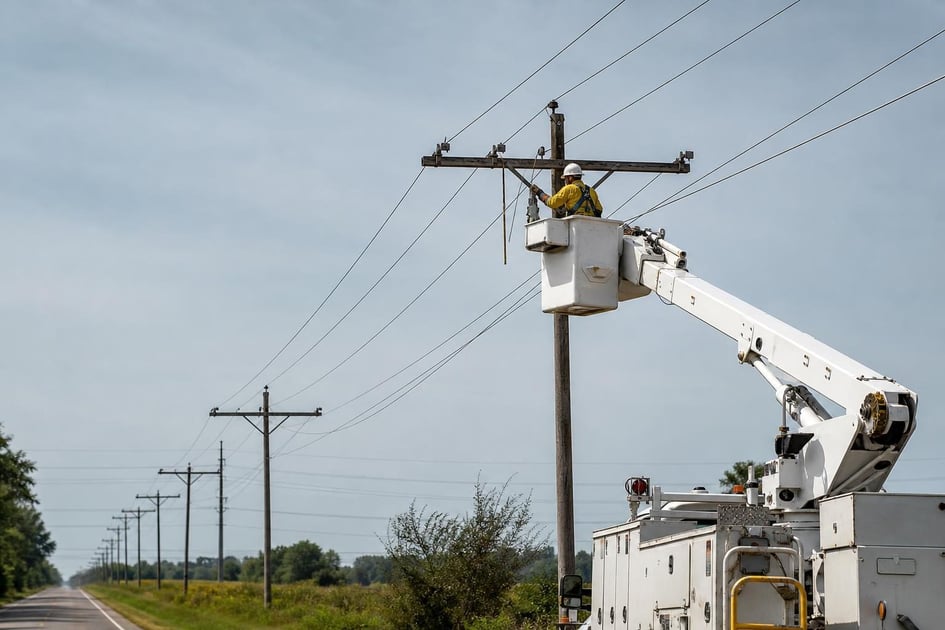
Financing a Bucket Truck in Illinois
Bucket truck financing in Illinois lets electricians, tree services, telecom crews, and sign contractors add height to their capabilities without draining operating cash. Illinois stretches more than 350 miles from the Wisconsin border to the confluence of the Ohio and Mississippi, and contractors in every region need reliable elevation. In Chicago, low-profile bucket trucks navigate alleyways for sign repair. Downstate, insulated models keep line workers safe along Ameren’s distribution network. Whether you are bidding ComEd maintenance contracts in Rockford or trimming oaks in the Chicago suburbs, the right aerial lift is often the difference between winning and losing a job.
Rather than tying up $100,000 or more in a single asset, equipment financing spreads that cost across monthly payments while the truck earns revenue immediately. Provide Capital finances new and used bucket trucks from $5,000 to $5 million, using the equipment itself as collateral to help keep rates competitive. Rates vary by credit profile, equipment age, and term length. Same-day approvals are possible. According to U.S. Census Bureau data on Illinois construction firms, the state consistently ranks among the top ten for utility and specialty contractor activity, which helps explain why demand for aerial lifts stays strong year-round. If you have a specific truck in mind, you can see what financing you qualify for in a few minutes.
Get a fast decision on your equipment
Applying takes just a few minutes, and decisions can come as soon as the same day.
Start Your ApplicationWhat Illinois Contractors Pay for Bucket Trucks
New Aerial Lifts
New bucket trucks from manufacturers like Altec, Terex, and Versalift typically range from $95,000 for a light-duty, 36-foot model to over $200,000 for a heavy-duty tandem-axle unit with a 60-foot or greater working height. Insulated models, which protect crews working near live electrical lines, command a premium of 15 to 25 percent over non-insulated units. Delivery to Illinois from southern manufacturing centers adds freight costs that buyers should factor into the total project cost. If you are adding toolboxes, pole grabs, or material handlers to the order, those upfits can add another $5,000 to $15,000 and should be included on the same invoice so they can be financed together.
Used Units in the Midwest Market
The Midwest used market is active, with fleet turnover from major utilities and national telecom providers supplying quality pre-owned units. Used bucket trucks with service records and under 150,000 miles generally start around $45,000 and climb to $110,000 depending on age, chassis brand, and boom configuration. Auction units can sell for less, but financing a truck bought at auction requires extra scrutiny. Most lenders want a recent inspection and clear title before funding. Illinois buyers should also verify that the truck meets the state’s emissions standards if it is coming from a jurisdiction with looser requirements.
By the Numbers: A new 55-foot bucket truck from Altec or Terex typically runs between $125,000 and $185,000 delivered to Illinois. Quality used units with documented maintenance and under 100,000 miles on the chassis start around $55,000, while higher-mileage fleet retirees can be found near $40,000 if you are paying cash. Monthly finance payments on a $100,000 truck over five years vary widely by credit profile but often land in the low four-figure range.
Lease vs. Loan: How to Structure the Deal
There are two primary ways to acquire a bucket truck: an equipment loan or a finance lease. An equipment loan puts the title in your name immediately, with the lender holding a lien on the truck until the final payment. A finance lease, sometimes called a $1 buyout lease or a fair market value lease, structures the transaction differently. With a $1 buyout lease, you own the truck at the end for a nominal payment. With a fair market value lease, you return the truck or purchase it at its then-current value.
For Illinois contractors planning to keep a truck for ten to fifteen years, a loan or $1 buyout lease makes the most sense because you capture the full depreciation and residual value. If you expect rapid technology changes, such as hybrid or electric bucket trucks becoming standard in urban Chicago work zones, a fair market value lease preserves flexibility. The table below breaks down the practical differences.
| Factor | Equipment Loan | Finance Lease ($1 Buyout) | Fair Market Value Lease |
|---|---|---|---|
| Ownership | You own; lender holds lien | You own at end | Lessor owns; option to buy |
| Down payment | Often 0–20% | First and last payment common | First and last payment common |
| Monthly payment | Usually lower total cost | Similar to loan | Lowest monthly option |
| Tax deduction | Section 179 and depreciation | Section 179 eligible | Lease payment deduction |
| Mileage/use limits | None | None | May have restrictions |
| Best for | Long-term ownership | Eventual ownership with structure | Short-term or uncertain needs |
Who Qualifies for Bucket Truck Financing
Credit Profile
Most equipment financing programs look for a personal credit score in the mid-600s or higher for established businesses. If your score is lower, you may still qualify by adding a co-signer, increasing your down payment, or selecting a newer truck. Because the bucket truck itself serves as collateral, lenders can be more flexible than with unsecured business credit. Bankruptcies discharged within the past two years or active tax liens usually require explanation and additional documentation. The key is transparency; hiding a derogatory item delays the process more than disclosing it upfront.
Time in Business and Revenue
Two or more years in business is the standard benchmark, but some programs accept younger companies with strong personal credit and a sizable down payment. Provide Capital evaluates the overall financial picture rather than relying on a single data point. If you have verifiable contracts, such as a multi-year vegetation management agreement with a municipal utility, that revenue stability can offset a shorter operating history. The Small Business Administration guidance on equipment loans notes that using the underlying asset as collateral is one of the most accessible ways for established firms to borrow, a principle that applies directly to bucket truck financing.
Lenders typically want to see monthly revenue sufficient to cover the new payment by a comfortable margin. A common threshold is $15,000 to $25,000 in monthly gross revenue for a single truck acquisition under $150,000. For larger fleet additions, expect to provide business tax returns and interim financial statements.
Pro Tip: Illinois buyers purchasing from out-of-state dealers should confirm the seller has a valid resale license and can provide a clear title. Some financing sources restrict vendor geography or require additional verification for auction purchases. Have the truck’s serial number, year, make, model, and lift capacity ready before you apply; underwriters often issue a term sheet faster when the equipment is already identified.
Tax Treatment for Illinois Buyers in 2026
The 2026 tax year offers several incentives for Illinois businesses acquiring bucket trucks. Section 179 allows qualifying taxpayers to deduct the full purchase price of eligible equipment, subject to an annual limit that adjusts for inflation each year. Because the exact 2026 limit is set by inflation indexing, you should verify the current-year ceiling with your CPA before finalizing a transaction. Bonus depreciation, which has been phasing down from 100 percent, continues to decline in 2026, so the timing of your purchase matters. Consult your tax professional for the precise percentage applicable to the 2026 tax year.
Illinois state income tax is a flat rate, and equipment depreciation generally follows federal schedules, but the state does not conform automatically to every federal bonus depreciation change. If you are a pass-through entity operating in Chicago, remember that the city imposes personal property replacement taxes that can affect your effective rate. The key point is that financing the truck does not prevent you from claiming Section 179 or depreciation; you deduct the full equipment cost even if you have not paid off the loan or lease. A finance lease structured as a $1 buyout generally qualifies for Section 179, while a true lease allows you to deduct the lease payments as a business expense. Check with your CPA to determine which structure minimizes your 2026 tax liability.
The Documentation You’ll Need
You will need a completed application, which takes less than ten minutes, plus three to six months of business bank statements. For loans above $100,000 or for applicants with complex ownership structures, expect to provide the most recent two years of business tax returns and a year-to-date profit and loss statement. The equipment itself requires documentation too: a quote or purchase agreement from the dealer or private seller, the truck’s VIN, and photos showing the overall condition and the boom. If you are buying at auction, the auction listing and condition report substitute for a dealer invoice.
For Illinois-specific requirements, make sure the seller can provide a certificate of origin or title that matches the VIN exactly, because the Illinois Secretary of State will not register a truck with title discrepancies. You should also have proof of insurance lined up. Most lenders require a certificate of insurance naming them as loss payee before they will release funds. If you are upgrading from a smaller truck, your current agent can usually add the new unit and provide the certificate the same day.
See what you qualify for
The equipment itself secures the financing, which keeps rates competitive. Checking your options takes minutes.
Check Your OptionsWhat Happens After You Apply
Once you submit a complete application, initial review typically takes a few hours to one business day. Same-day approvals are possible when the equipment is clearly identified and the file is clean. Upon approval, you receive a term sheet outlining the monthly payment, term length, and any conditions such as down payment or personal guaranty. After you accept and return the signed documents, the lender issues a funding letter or direct payment to the seller. Most deals fund within 24 to 72 hours of document completion.
If the truck is out of state, arrange an independent inspection before funding; Provide Capital can coordinate this as part of the closing process. Once funded, you take delivery, register the truck in Illinois, and add it to your commercial insurance policy. Because the equipment serves as collateral, the lender will file a UCC-1 lien, which is standard practice and releases automatically when the obligation is satisfied. Once you have your paperwork together, get a decision on your equipment, possibly the same day.
Industries That Rely on Bucket Trucks Across Illinois
Utilities and Electrical Contractors
ComEd, the largest electric utility in northern Illinois, maintains thousands of miles of overhead distribution lines. Contractors serving ComEd, as well as Ameren downstate, use insulated bucket trucks daily for line maintenance, transformer replacement, and storm restoration. Bucket Trucks financing is a routine tool for these contractors because utility work is contract-driven and equipment-intensive. Storm seasons in Illinois, from summer thunderstorms to winter ice events, create surge demand that rewards contractors who can mobilize immediately.
Tree Care and Forestry
The Chicago metropolitan area and collar counties have dense tree canopy that requires ongoing maintenance. Arborists and tree removal companies use bucket trucks to reach hardwood canopies safely, especially on residential lots where climbing is impractical. Seasonal demand spikes after spring storms and ahead of winter ice events, making equipment access time-sensitive. Forestry work in southern Illinois also relies on aerial lifts for timber stand improvement and right-of-way clearing along power corridors.
Telecommunications and Sign Installation
5G small-cell deployment continues across Illinois municipalities, and the crews installing line-powered radios need compact, non-insulated bucket trucks that can maneuver city streets. Sign companies installing and servicing illuminated storefront signage also depend on aerial lifts for second and third-story work. Transportation equipment financing supports not just the bucket truck itself but also the flatbeds and service trucks that move materials to the job site. Many Illinois contractors pair their aerial fleet with Dump Trucks financing for hauling brush, concrete, or excavated material.
Key Insight: ComEd’s vegetation management contractors often see peak demand after summer storms and ahead of winter ice season. Financing approval before the rush lets you capitalize on emergency response contracts. Illinois buyers should also note that the state’s flat corporate income tax and personal property replacement taxes affect how you structure the deal; a CPA familiar with Illinois tax rules can model whether a loan or lease leaves more cash in the business after state and federal obligations.
Seasonal Demand and Illinois Weather Patterns
Illinois weather creates distinct buying patterns for bucket trucks. Winter ice storms downstate and around the Quad Cities drive emergency response contracts that require immediate equipment availability. Contractors who wait until January to shop often find the best used inventory already sold. Spring and early summer bring construction ramp-ups and tree growth that keep arborists busy from Naperville to Peoria. Fall is the traditional fleet renewal season for municipal utilities operating on calendar budgets. Financing ahead of these seasonal peaks gives you negotiating leverage when sellers are less rushed.
Pro Tip: Illinois buyers shopping in late fall can sometimes capture municipal fleet trade-ins before they hit the wholesale market. These units often have complete maintenance histories and sell before December 31 as agencies rush to close budget cycles.
Common Mistakes When Financing Aerial Lifts
One frequent error is underestimating the total cost of ownership. The monthly payment is only part of the equation; insurance for a bucket truck, especially one used near energized lines, runs higher than a standard commercial auto policy. Maintenance on the hydraulic boom and outriggers is non-negotiable from a safety standpoint, and neglect voids most warranties. Another mistake is buying a truck with insufficient reach. A 36-foot boom works for street lighting but leaves you short for transmission work or mature tree canopies. Match the lift height to your target contract mix.
Third, some buyers assume a used truck always saves money. Forbes reporting on commercial vehicle acquisition costs has noted that maintenance inflation on heavy trucks has outpaced general inflation, making warranty coverage on new units more valuable than the simple purchase price suggests. If a used unit requires immediate hydraulic overhaul, the savings evaporate. Get an independent inspection. Fourth, failing to line up financing before shopping weakens your negotiating position. Sellers prefer cash buyers; having an approval letter in hand lets you act like one. Finally, do not forget to verify that the truck’s GVWR matches your drivers’ CDL classifications. A heavy tandem-axle bucket truck may require a Class B or Class A license, and putting an under-licensed driver behind the wheel creates liability exposure.
New vs. Used: What Illinois Buyers Should Consider
New bucket trucks come with manufacturer warranties, the latest safety features, and lower maintenance costs in the first three years. They also command the strongest resale value when it is time to refresh the fleet. For Illinois contractors working inside corporate safety programs or utility vendor pools, a new truck may be a requirement. Used trucks offer lower entry costs and faster availability. A one-owner fleet unit with complete service records can deliver 80 percent of a new truck’s utility at 50 percent of the price.
However, financing terms on used equipment typically run shorter, and rates vary by credit profile and equipment age. Most lenders cap the financing term at the remaining useful life of the truck. A ten-year-old chassis with 200,000 miles might be limited to a 36-month term, which pushes the monthly payment higher than a five-year term on a newer unit. When evaluating a used bucket truck, check the boom certification date. OSHA requires periodic re-certification, and an expired certification is a hidden cost that can run several thousand dollars. Ask the seller for the most recent dielectric test certificate if the truck is insulated.
Put the right equipment to work
From $5,000 to $5 million, new or used, Provide Capital helps businesses nationwide finance the equipment they need.
Apply TodayFrequently Asked Questions
Can I finance a bucket truck with bad credit?
It depends on the severity and recency. Bankruptcies older than two years with re-established credit, or scores in the low 600s with strong revenue, can often be approved with a larger down payment or a co-signer. The equipment itself is collateral, which gives lenders flexibility they do not have with unsecured credit.
How long does approval take?
Same-day approvals are possible for straightforward applications with identified equipment. More complex files, such as those requiring tax returns or involving multiple owners, may take one to two business days.
Do I need a down payment?
Not always. Well-qualified buyers can finance 100 percent of the purchase price plus soft costs like delivery and inspection. If your credit profile or the equipment age pushes risk higher, a 10 to 20 percent down payment may be required.
Can I buy from a private seller?
Yes, but the process requires extra steps. The lender needs a clear title, a bill of sale, and usually an independent inspection. Private-party transactions also take longer to fund because there is no dealer to facilitate the paperwork.
What insurance do I need?
Commercial auto liability is mandatory. Most lenders also require physical damage coverage on the truck itself, naming the lender as loss payee. If you are doing utility work, consider additional umbrella coverage for elevated operations near power lines.
Is leasing better than buying for tax purposes?
Both can work. A loan or $1 buyout lease generally lets you claim Section 179 and depreciation on the 2026 tax return. A true lease lets you deduct the lease payments as an operating expense. Your CPA can run the numbers for your specific tax bracket and entity structure.
Can I finance the outrigger pads, toolboxes, and other upfits?
Yes, if they are part of the original purchase and listed on the invoice. Most lenders will include soft costs and upfits in the total financing amount, keeping your out-of-pocket expense limited.
What happens if I want to pay off the loan early?
Most equipment loans have no prepayment penalty, but you should verify this before signing. Some leases use a fixed schedule that is less favorable to early payoff. Read the term sheet carefully or ask your financing advisor to point out the relevant clause.
Next Steps
Ready to add a lift to your fleet? Start by identifying the truck that matches your contract mix, then gather your basic financial documents. The application takes a few minutes, and you can have terms in hand before you make an offer to the seller. Start an application for bucket truck financing in Illinois and see how quickly you can get to work at height. Whether you are replacing an aging unit or expanding to meet storm-season demand, spreading the cost over time keeps your cash flow healthy and your crews productive.
Disclaimer: The information provided in this article is for general educational purposes only and is not financial, legal, or tax advice. Funding terms, qualifications, and product availability may vary and are subject to change without notice. Provide Capital does not guarantee approval, rates, or specific outcomes. For personalized information about your business funding options, contact our team directly.
