
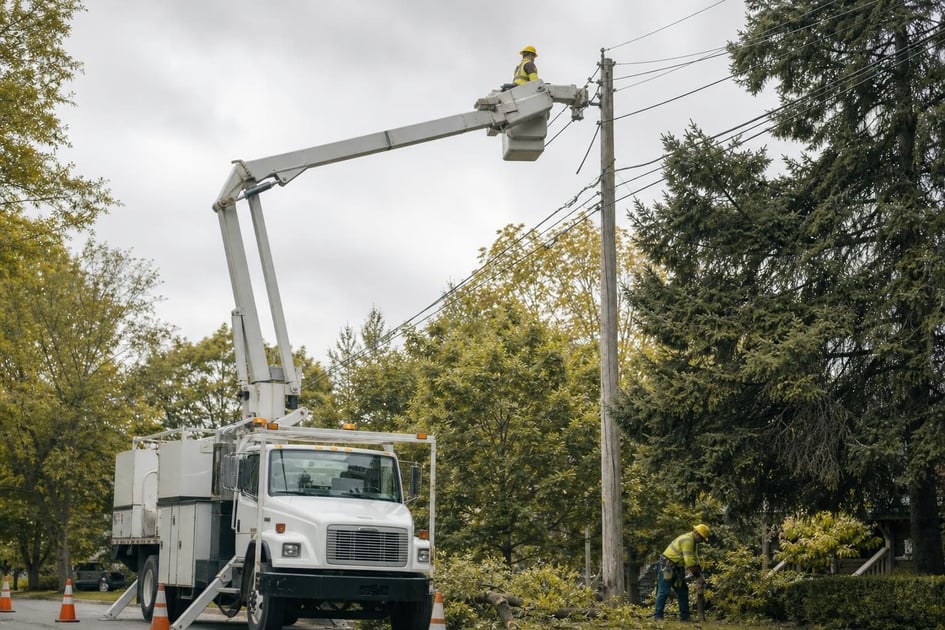
If you run a tree service, sign company, or utility contracting business in Michigan, a bucket truck is not optional equipment. It is the tool that lets your crews reach 40, 50, or 60 feet safely without rigging scaffolding or climbing. The question is not whether you need one, but how to acquire it without tying up the cash reserves you rely on for payroll, fuel, and insurance during the slow months. Bucket truck financing spreads the cost across monthly payments matched to your revenue cycle, and because the truck itself serves as collateral, you can often secure competitive rates even if your credit history has a few dings. If you are weighing a purchase, see what financing structure you qualify for on the unit you have in mind — approvals can come back the same day.
Why Michigan Contractors Rely on Bucket Trucks
Michigan’s economy still leans heavily on physical infrastructure. The two major electrical utilities maintain tens of thousands of miles of distribution line across the Lower and Upper Peninsulas. Telecommunications contractors are busy running fiber to homes and businesses from the industrial corridors of the southeast to the tourist regions of the north. Arborists face a persistent backlog of tree maintenance in older neighborhoods and in the suburbs where emerald ash borer removal gave way to ongoing canopy management. Sign companies install and service parking lot lighting, highway signage, and building facades that require elevated access. All of these operators need a stable platform with an insulated or non-insulated boom, and buying outright is rarely the most efficient use of capital.
Michigan’s construction and utility employment base remains significant according to U.S. Census Bureau data, which tracks steady demand for skilled trades that require aerial access. When a line crew or tree service has to turn down a job because they lack reach, the lost revenue often exceeds the monthly payment on a financed truck.
Seasonal Demand Patterns
Michigan weather shapes when bucket trucks earn. Tree care ramps up in March and runs hard through November. Utility contractors see emergency call-outs after ice storms from November through March. Sign and lighting crews work year-round but slow in January and February when daylight is short and temperatures drop below freezing for weeks at a time. Because revenue is uneven, a financing structure with fixed monthly payments can create cash flow pressure in deep winter. Some borrowers choose a seasonal skip structure if the lender offers it, or they time the start of the loan to coincide with the spring revenue surge so the first three payments align with the busiest quarter.
Key Industries and Equipment Pairings
The heaviest users in the state are utility line contractors, telecom installers, tree care companies, and municipal public works departments. Less obvious buyers include holiday lighting installers who serve wealthy suburban neighborhoods, billboard maintenance crews along the interstate corridors, and agricultural operations that need to maintain tall grain storage or irrigation equipment. Each use case demands a different boom height, material handling capacity, and insulation rating. Some tree care operators also haul chips or logs, and may look at Dump Trucks financing to keep debris removal revenue in-house rather than subcontracting it.
Key Insight: In Michigan, a bucket truck with an insulated boom rated for electrical work typically commands a higher resale value on the secondary market than a non-insulated forestry model, because utility contractors are willing to pay a premium for equipment that meets utility safety standards set by the major regional power companies.
Get a fast decision on your equipment
Applying takes just a few minutes, and decisions can come as soon as the same day.
Start Your ApplicationWhat Determines Your Financing Terms
No two bucket truck deals are identical. A 2024 International with a 60-foot Altec boom and low miles will qualify for different terms than a 2012 Ford F-550 with a 45-foot lift and 150,000 miles. Lenders look at your credit profile, the equipment age and condition, and the length of term you request. Rates vary by credit profile, equipment age and term. Provide Capital finances new and used business equipment from $5,000 to $5 million, so a single bucket truck or a fleet addition both fit the program.
Credit Profile
Strong personal and business credit unlocks longer terms and lower rates. That said, the equipment itself is the collateral. A borrower with a 650 credit score and two years in business can still qualify, though the down payment may be higher and the term shorter than for a prime-credit applicant. Underwriters also look at recent derogatory events. A bankruptcy discharged three years ago is viewed differently than a current tax lien.
Equipment Age and Condition
Lenders price risk partly based on how long the collateral will remain useful. A new unit carries a full manufacturer’s warranty and predictable maintenance costs, so the lender’s downside is limited. A used unit may require a larger down payment or a shorter amortization period. Independent inspections are common on units older than seven years or with more than 100,000 miles. The inspection covers the chassis, engine, transmission, hydraulics, boom structure, and safety systems.
Term Length
Most bucket truck loans run 36 to 72 months. A longer term lowers the monthly payment but increases total interest paid over the life of the contract. A shorter term builds equity faster and reduces the total cost of borrowing. If you expect to run the truck for a decade, a 60-month term is often the balanced choice between manageable payments and reasonable total interest.
| Factor | New Bucket Truck | Used Bucket Truck (5–10 Years) |
|---|---|---|
| Down payment | Often 0–10% | Typically 10–20% |
| Interest rate | Lower end of range | Higher end of range |
| Warranty coverage | Full manufacturer warranty | Limited or expired |
| Immediate availability | May require factory order | Available now from dealer or auction |
| Depreciation schedule | Straight-line over useful life | Accelerated, depending on prior use |
| Inspection requirement | Minimal | Third-party inspection recommended |
| Expected useful life | 10–15 years | 5–10 years, depending on condition |
By the Numbers: A $125,000 bucket truck on a 60-month term with a 15% down payment leaves a $106,250 balance. Depending on credit and equipment age, monthly payments typically fall between $1,900 and $2,400 for a borrower with established revenue and standard amortization.
Lease vs. Loan: Which Fits Your Michigan Operation
You can acquire a bucket truck through a capital lease, an operating lease, or an equipment loan. The right choice depends on your tax strategy, how long you plan to keep the asset, and your balance sheet preferences.
With an equipment loan, you own the truck from day one. You claim depreciation and any applicable Section 179 deduction on your 2026 tax return, and the truck appears as an asset with a corresponding liability. At the end of the term, you hold clear title and can trade the unit, sell it, or continue operating it payment-free.
A capital lease functions similarly to a loan for tax purposes but may offer a lower monthly payment because the lessor retains legal ownership until the final buyout. At the end of the lease, you typically pay a nominal amount—often $1 or 10% of the original cost—to take ownership. This structure works well if you want a lower monthly outlay but intend to keep the truck long-term.
An operating lease is closer to a rental. You return the truck at the end of the term with no ownership obligation. This makes sense if the technology is changing rapidly or if you only need the unit for a specific contract duration. For bucket trucks, which have long useful lives and stable technology, operating leases are less common unless the lessor is a specialized fleet management company.
For most Michigan owner-operators who plan to run the truck for seven or more years, a loan or capital lease is the more economical path. Start an application in a few minutes to compare structures side by side based on the specific unit you are considering.
Tax Treatment for the 2026 Tax Year
Tax strategy matters. Under Section 179 of the Internal Revenue Code, you may be able to deduct the full purchase price of qualifying equipment in the year you place it into service, subject to an annual limit set by Congress for tax year 2026. The exact dollar limit for 2026 is established by statute and adjusted for inflation; consult your CPA to confirm the current-year ceiling and whether your taxable income is sufficient to absorb the deduction. Bonus depreciation may also apply, though its availability and percentage depend on legislation in effect for 2026. Your CPA can model whether Section 179, bonus depreciation, or standard MACRS depreciation produces the best outcome for your specific situation.
Do not take tax advice from a financing company. The rules change, and Michigan’s state tax treatment of Section 179 recapture can differ from federal rules if you later sell the asset before the end of its recovery period.
Pro Tip: If you finance a bucket truck in December 2026 but do not put it into service until January 2027, the deduction shifts to the 2027 tax year. To claim the write-off on your 2026 return, the truck must be both purchased and placed in service by December 31, 2026. Plan your delivery date accordingly.
Find the right financing structure
Tell us about the equipment you need and we will show you the options that fit your business.
See Your OptionsQualification Criteria in Detail
Provide Capital works with businesses across the credit spectrum, but knowing what underwriters review helps you prepare. The SBA business guidance on preparing financial documentation applies broadly to equipment financing applications.
Time in Business
Two years of operating history is the standard benchmark. Established companies with tax returns and bank statements showing consistent revenue have the smoothest path. If your business is younger than two years, a strong co-signer, additional collateral, or a larger down payment may be required to offset the limited track record.
Revenue Requirements
There is no fixed revenue floor published, but the lender needs evidence that your cash flow can cover the new payment. Most underwriters look for monthly revenue that is at least 1.2 to 1.5 times the proposed equipment payment. If your business generates $20,000 in gross monthly revenue, a $2,000 truck payment is generally well within range. Seasonal businesses may need to show a full year of bank statements to demonstrate that winter lows are offset by spring and summer peaks.
Documentation Needed
Expect to provide the last three months of business bank statements, a year-to-date profit and loss statement, and the prior year’s business tax return. For larger transactions, you may also need an equipment appraisal or a purchase invoice from the dealer. If the truck is used, be ready with the VIN, hour meter reading, and maintenance records. Having these ready before you apply shortens the decision timeline from days to hours. If your books are not current, update them before applying—a clean financial picture speeds approval.
New vs. Used Bucket Trucks in the Michigan Market
New inventory is available from Altec, Terex, Versalift, and Elliott dealers, but lead times can stretch to several months for chassis and body combinations, especially if you need a custom upfit. Used inventory moves faster, especially in late winter when fleet operators trade in ahead of the spring rush. Market conditions for commercial vehicles shift with broader economic cycles, and Reuters business coverage of the transportation sector continues to track inventory levels across commercial truck markets.
Inspecting Used Units for Rust and Corrosion
Michigan’s road salt is notorious. A bucket truck that spent its life in the Upper Peninsula or on the highway corridors of the southern counties may have frame corrosion, outrigger pitting, or rust in the boom sections. Check the outrigger pads, the boom base, and the undercarriage. A $500 pre-purchase inspection by a certified mechanic is cheap insurance against a $20,000 structural repair or a failed safety inspection that grounds the unit.
Warranty Considerations
New trucks come with chassis and aerial device warranties. Used trucks may carry a dealer warranty or be sold as-is. Some third-party warranty companies cover major components on used bucket trucks, but read the exclusions carefully—boom cables, hydraulic systems, and control electronics are often excluded or subject to high deductibles.
Industry-Specific Use Cases in Michigan
Bucket trucks are not one-size-fits-all. The 45-foot forestry package favored by a mid-Michigan tree service differs from the 60-foot material-handler unit a Transportation equipment financing customer might use for highway sign maintenance.
Arborists and Tree Care
Michigan’s urban tree canopy is dense in the university towns, the western suburbs, and the older neighborhoods of the southeast. Arborists need chip boxes, rear-mounted booms, and non-insulated platforms. They often buy used forestry packages because the units are lighter and more maneuverable in residential alleys and on tight city streets.
Utility and Telecom Contractors
Line crews need insulated booms rated for the voltages they encounter. The major regional power companies often require contractors to meet specific safety certifications. These trucks are heavier, more expensive, and hold value longer. Bucket Trucks financing through an equipment lender lets these contractors scale fleet size to match contract awards without waiting for utility payment cycles that can stretch 45 or 60 days.
Sign and Lighting Maintenance
Parking lot lighting and highway signs require 50- to 60-foot reaches. These operators often work nights and weekends to avoid traffic, so they value reliability above all. A breakdown during a scheduled lane closure on a major interstate is expensive in lost time and penalties. Newer trucks with lower maintenance profiles make sense here, even at a higher monthly payment, because uptime is directly tied to contract profitability.
Common Mistakes Buyers Make
Buying on price alone is the first error. A cheap truck with a cracked boom, a rebuilt title, or a salvage history may be uninsurable or ineligible for financing. Failing to match boom height to actual job requirements is another. A 40-foot boom cannot safely reach a 45-foot light pole. Overlooking weight ratings is a third—Michigan bridge laws and GVWR limits can turn an overloaded truck into a citation magnet.
Some buyers also fail to factor in insurance costs. A financed bucket truck must carry physical damage coverage naming the lender as loss payee. If your current policy does not cover specialized equipment, get a quote before you sign so the premium does not erase your monthly cash flow projection.
Key Insight: Michigan buyers sometimes purchase a truck with a GVWR over 26,000 pounds without realizing their drivers need a commercial driver’s license. If your crew lacks licensed operators, a lighter single-axle unit under the CDL threshold may generate more billable hours with fewer staffing headaches and lower insurance costs.
What Happens After Approval
Once approved, you receive a term sheet specifying the rate, payment, and any conditions such as insurance requirements or inspection contingencies. Review it carefully. The lender then issues a purchase order or funds directly to the seller. You take delivery, insure the unit, and begin payments according to the schedule. Most lenders report to business credit bureaus, so on-time payments strengthen your company’s credit profile for the next acquisition. If you need a second truck six months later, your established payment history works in your favor. Funding typically occurs within 24 to 48 hours of final document execution.
Ready to move forward?
More than 10,000 businesses have financed equipment with Provide Capital. See what you qualify for today.
Get StartedFrequently Asked Questions
Can I finance a bucket truck with challenged credit?
Yes, though terms will reflect the risk. Expect a higher down payment and a shorter term. The equipment itself is collateral, which gives the lender security beyond your credit score. Rates vary by credit profile, equipment age and term.
How long does approval take?
Same-day approvals are possible if you submit complete documentation—bank statements, tax return, and equipment details—early in the day. Delays usually come from missing paperwork or a slow seller response, not from the underwriting decision itself.
Do I need a down payment?
Not always for new trucks or strong-credit borrowers. Used trucks and challenged credit typically require 10% to 20% down. The down payment reduces the lender’s risk and your monthly obligation.
Can I finance a truck from a private seller?
Many equipment lenders allow private-party purchases, though they may require an independent appraisal and a title search to verify no liens exist. The process adds a few days but opens up auction and classified inventory that dealers do not carry.
What boom height do I actually need?
Measure your typical job plus 10 feet of working clearance. If you maintain 40-foot light poles, a 50-foot boom gives you safe margin. Arborists working on mature oaks may need 55 or 60 feet. Undersizing is expensive; oversizing by 15 feet adds weight and fuel cost you do not need.
Is it better to buy from a dealer or at auction?
Dealers offer warranties, financing assistance, and sometimes delivery. Auctions offer lower prices but less protection. If you buy at auction, budget for a thorough inspection and potential immediate maintenance such as hydraulic fluid changes and cable replacement.
Can I pay off the loan early?
Most equipment loans allow early payoff, but some charge a prepayment penalty or require you to pay a portion of remaining interest. Ask for the specific policy before you sign so you know the true cost of exiting early.
Does the truck have to be insured?
Yes. The lender requires physical damage coverage and to be named as loss payee. General liability does not satisfy this requirement. You will need a commercial auto policy that specifically covers the aerial device.
Next Step
A bucket truck can expand your Michigan business from jobs you turn away to revenue you bank. The financing process is straightforward if you know what to expect and have your paperwork ready. Whether you are replacing an aging unit or adding capacity ahead of the spring rush, the next move is to get a decision on the specific truck you want. Get a decision on your equipment, possibly the same day, by starting your application now.
Disclaimer: The information provided in this article is for general educational purposes only and is not financial, legal, or tax advice. Funding terms, qualifications, and product availability may vary and are subject to change without notice. Provide Capital does not guarantee approval, rates, or specific outcomes. For personalized information about your business funding options, contact our team directly.
