Bucket truck financing rates depend on three main factors: your credit profile, the age and condition of the equipment, and the length of the term you choose. Because the truck itself serves as collateral, lenders can keep rates competitive compared with unsecured borrowing. At Provide Capital, we finance new and used bucket trucks from $5,000 to $5 million, and same-day approvals are possible once we have a complete file.
If you are preparing to buy an aerial lift or bucket truck for your tree service, utility contracting, or sign installation business, understanding how these variables interact will help you budget accurately and avoid surprises during the application process.
What Determines Your Financing Rate
No two bucket truck deals price exactly the same. Lenders look at the overall risk of the transaction, and the rate reflects that assessment.
Credit Profile and Business History
Your personal and business credit histories are the starting point. A stronger profile—higher scores, clean trade-line history, and low revolving utilization—generally positions you for more favorable terms. Time in business matters as well. An owner-operator with three or more years of operating history and documented revenue will typically see better offers than a newly formed entity with limited financial records.
Lenders also review your debt-service coverage ratio, which measures whether your existing cash flow can comfortably handle the new payment. If your business already carries significant equipment debt, adding a large monthly bucket truck payment may shift the rate upward or require a larger down payment to balance the risk. SBA research on small business lending consistently shows that equipment-secured loans carry lower loss rates than unsecured credit, which helps explain why collateral-based financing often produces more competitive rates for qualified borrowers.
Equipment Age and Condition
The truck itself is a major variable. New or late-model bucket trucks with low hours and strong manufacturer support tend to command lower rates because the collateral holds its value. Older units—especially those over ten years old or with high mileage—may still qualify, but the term may shorten and the rate may adjust to account for faster depreciation.
A well-maintained used truck with documented service records will almost always finance more easily than a distressed unit bought at auction with unknown history. If you are comparing two similarly priced trucks, the one with a clean inspection report and verifiable maintenance history is likely to win you better terms.
Term Length and Payment Structure
Shorter terms carry less risk for the lender, which can translate to a lower total cost of borrowing. However, the monthly payment will be higher. Stretching the same balance over a longer term reduces the monthly burden but increases the total interest paid over the life of the agreement.
Most equipment finance agreements for bucket trucks fall in the 36- to 72-month range, though shorter and longer structures exist depending on the equipment age and your preferences. Matching the term to the useful life of the truck is a practical way to avoid owing money on an asset that is no longer in service.
Key Insight: A lender will often order an independent equipment appraisal for bucket trucks over $75,000 or for units older than seven years. Having the serial number, hour meter reading, and recent inspection report ready when you apply can cut days off the timeline and prevent a last-minute renegotiation of terms.
Already have a machine in mind?
Provide Capital finances new and used equipment from $5,000 to $5 million, with same-day decisions possible.
Apply NowNew vs. Used Bucket Trucks: Financing Differences
Both new and used bucket trucks are financeable, but the terms differ in meaningful ways. Your decision should balance purchase price, depreciation, availability, and how long you plan to keep the unit in your fleet.
| Factor | New Bucket Truck | Used Bucket Truck |
|---|---|---|
| Purchase price | Higher upfront cost, typically $100,000 to $300,000+ depending on spec | Lower upfront cost, often 40-60% less than new after five years |
| Financing term | Longer terms available, up to 84 months in some cases | Terms usually capped at the remaining useful life, often 36-60 months |
| Rate | Generally lower due to stronger collateral value | Slightly higher to reflect faster depreciation and potential maintenance risk |
| Down payment | Can be as low as zero for strong credits; first payment due at closing | May require 10-20% down depending on age, mileage, and credit profile |
| Tax treatment | Eligible for Section 179 and bonus depreciation in 2026 | Also eligible for Section 179 and bonus depreciation if newly acquired |
| Availability | Factory lead times may apply for specialized chassis or boom configurations | Immediate availability; wider selection on the secondary market |
If you run a utility contracting operation and need a specialized insulated bucket truck with a non-standard chassis, buying new may be your only option. If you are an arborist expanding a second crew, a three- to five-year-old chipper-and-bucket combo from a reputable dealer may deliver better cash flow.
By the Numbers: A used bucket truck that sold new for $180,000 might list for $85,000 to $110,000 at five years old with under 50,000 miles. Financing $90,000 over 60 months at a competitive equipment rate produces a monthly payment materially lower than leasing a comparable new unit, though maintenance reserves should be factored into the comparison.
Lease vs. Loan: Choosing the Right Structure
Bucket trucks can be acquired through an equipment loan or a lease. The right choice depends on your tax strategy, balance sheet preferences, and whether you want to own the asset at the end.
An equipment loan is a straightforward installment structure. You make monthly payments, and at the end of the term you own the truck free and clear. The truck appears as an asset on your balance sheet, and you may be able to claim depreciation and interest deductions. This structure works well for established contractors who plan to keep the unit for its full useful life and want to build equity in their fleet.
A finance lease, sometimes called a $1 buyout lease, functions similarly to a loan for accounting and tax purposes. You make payments over the term and own the equipment at the end for a nominal amount. The main difference is contractual: the lessor holds title during the term, which can simplify some balance-sheet presentations depending on your accountant’s advice.
An operating lease, or true lease, is a rental structure. You pay for the use of the truck over a set period and return it at the end, though some agreements include a purchase option at fair market value. Monthly payments on operating leases are often lower than loan payments because you are not paying off the full value of the truck. This structure suits businesses that refresh equipment frequently or want to preserve capital for other investments.
If you also finance dump trucks or other heavy equipment, matching the financing structure to the asset’s role in your fleet keeps your bookkeeping clean. Dump Trucks financing follows similar logic, though dump trucks often depreciate on a different schedule depending on their duty cycle.
Tax Treatment for Tax Year 2026
How you finance your bucket truck affects your tax position, and the rules for 2026 differ in important ways from prior years. Under current law, bonus depreciation continues its scheduled phase-down for tax year 2026, which means the immediate first-year deduction percentage is lower than it was in 2024 and 2025. Section 179 remains available, with inflation-adjusted annual limits that apply to the total amount of qualifying equipment placed in service during the year.
If you use an equipment loan or finance lease, you generally claim depreciation on the truck and deduct the interest portion of your payments. With an operating lease, you typically deduct the full lease payment as a business expense. The exact treatment depends on your entity structure, total equipment purchases for the year, and whether you are subject to the Section 179 taxable-income limitation.
Because these provisions interact in complex ways and Congress periodically revises them, any tax figure cited for 2026 should be verified against current IRS guidance. Speak with a CPA before you file to confirm which strategy—accelerated depreciation, Section 179, or expense deduction—delivers the best outcome for your specific situation. Forbes analysis of business equipment tax strategy consistently emphasizes that the interaction between depreciation methods and entity structure produces widely different outcomes for otherwise similar businesses, which is why personalized advice matters.
Pro Tip: If you are nearing the Section 179 spending cap for 2026, consider placing the bucket truck in service in January of the following tax year rather than December. A single day can shift the deduction to the next year and prevent you from losing part of the benefit. Your CPA can model the timing against your projected revenue and tax bracket.
See what you qualify for
The equipment itself secures the financing, which keeps rates competitive. Checking your options takes minutes.
Check Your OptionsQualifying for Bucket Truck Financing
Understanding the rate is only half the battle. You also need to know what documentation to gather and what pitfalls to avoid.
What Lenders Review
Besides credit scores, lenders want to see that your business generates enough revenue to cover the payment. Two years of tax returns, recent bank statements, and a current profit-and-loss statement are standard requests. If your business is seasonal—common in tree care and some utility contracting—be prepared to explain your revenue cycle and show how you manage cash flow during slower months.
The equipment quote itself is also part of the underwriting package. The lender needs to know the make, model, year, serial number, and seller information. For private-party sales, an additional layer of verification may be required to confirm that the title is clean and the seller has the legal right to transfer ownership.
Documentation Checklist
- Driver’s license and signed credit application
- Business tax returns for the prior two years
- Recent bank statements (usually the last three months)
- Current equipment quote or purchase agreement
- Business license or registration
- Proof of insurance coverage for the new unit
Having these items ready before you apply can move you from application to approval in a single business day. Delays usually happen when applicants submit incomplete financials or when the equipment quote lacks required details like the VIN or hour meter reading.
Common Mistakes to Avoid
One frequent error is shopping for the truck before checking whether your business profile supports the monthly payment. Getting pre-qualified based on your actual revenue and credit picture helps you shop with a realistic budget and avoids the disappointment of losing a truck because financing falls through.
Another mistake is ignoring the total cost in favor of the monthly payment. A longer term may produce an attractive monthly number, but if the truck is out of service before the note is paid off, you will be making payments on equipment that is no longer generating revenue. Align the term with your realistic plans for the asset.
Finally, some buyers try to hide poor credit by submitting only partial financials. This almost always backfires. Underwriters will discover the missing information, and the resulting delays can cost you the deal—especially on a used truck with multiple interested buyers.
If your operation runs across multiple vehicle types, you may also want to explore how Transportation equipment financing structures differ for highway versus off-road units. The collateral evaluation process and insurance requirements vary by asset class.
Industry-Specific Use Cases
Bucket trucks serve a narrow set of industries, and financing terms often reflect the stability of the revenue model in each sector. Census Bureau data on the construction and utilities sectors shows that specialty trade contractors represent a significant share of equipment-intensive small businesses, which helps explain why lenders maintain dedicated underwriting programs for these industries.
Arborists and tree care companies use bucket trucks to access tall hardwoods in residential and commercial settings. Demand for tree services tends to spike after storms and in the spring growing season. Lenders like to see that you carry general liability and workers’ compensation insurance at levels appropriate for elevated work. A seasonal business with strong recurring commercial contracts will generally underwrite more favorably than one dependent entirely on storm-response revenue.
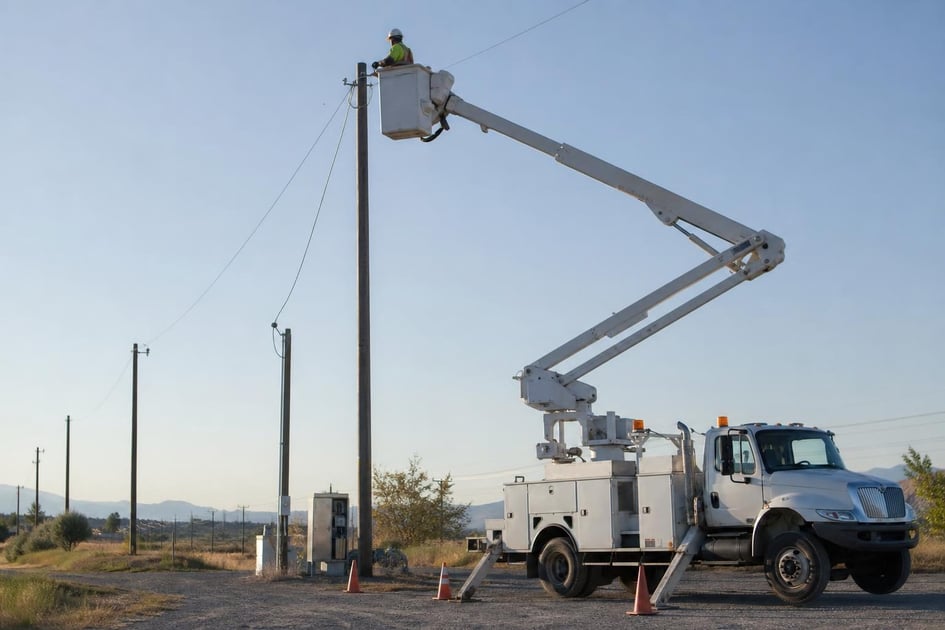
Utility contractors deploy insulated bucket trucks for electrical transmission and distribution work. These units command higher prices—often $200,000 or more—but they also serve long-term master service agreements with municipal or investor-owned utilities. If you can document recurring revenue from a utility contract, the lender may view the collateral more favorably despite the higher dollar amount.
Sign and lighting companies use smaller bucket trucks with lower boom heights, typically in the 36- to 50-foot range. These units cost less than their utility-grade counterparts and may qualify for more flexible terms. Because sign companies often work on project-based schedules, lenders may look for a diversified customer list rather than reliance on a single large account.
Telecommunications contractors install and maintain cellular and fiber infrastructure using bucket trucks configured for telecom payloads. The equipment is specialized, and resale markets are narrower. Financing terms may be slightly more conservative for highly customized units unless you can demonstrate a long-term contract with a major carrier.
What Happens After Approval
Once you accept the financing offer, the closing process typically takes one to three business days. The lender verifies the equipment, finalizes the UCC filing to perfect its security interest in the collateral, and sends funds directly to the seller or dealership. You receive the title or title documentation once the filing is complete.
Your first payment is usually due 30 to 45 days after funding, though some structures offer a 90-day deferred first payment for businesses that need time to put the unit to work before cash flow begins. Ask about this option if your project start date is fixed and you want to align the first payment with expected revenue.
During the term, you are responsible for maintaining insurance on the truck, typically with the lender listed as loss payee. If you sell or trade the unit before the end of the term, you must satisfy the remaining balance. Some agreements allow for early payoff with a modest prepayment discount; others apply a fixed schedule with no penalty. Review this language before you sign.
At Provide Capital, we also finance related Bucket Trucks financing for chipper bodies, outrigger packages, and accessory booms. Bundling these items into a single agreement simplifies your bookkeeping and may improve your overall rate compared with financing each component separately.
Key Insight: Most equipment finance agreements for bucket trucks include a blanket UCC filing on your business assets, not just the truck itself. This is standard practice and does not prevent you from borrowing elsewhere, but it means any future lender will see the lien. If you plan to stack multiple equipment purchases in the same year, disclose the existing filing upfront to avoid last-minute surprises.
If you have found the right truck and want to move quickly, see what you qualify for before you negotiate the final price. A pre-approval letter strengthens your position with the seller and helps you close before another buyer steps in.
Ready to move forward?
More than 10,000 businesses have financed equipment with Provide Capital. See what you qualify for today.
Get StartedFrequently Asked Questions
What credit score do I need to finance a bucket truck?
There is no universal minimum. Borrowers with stronger credit and longer time in business generally receive more favorable rates and lower down-payment requirements. Some programs work with credit challenges but may require additional collateral or a larger down payment. The best way to know is to apply and review the specific offer.
Can I finance a used bucket truck?
Yes. Both new and used bucket trucks are eligible for financing through Provide Capital. Used units are evaluated based on age, mileage, condition, and the presence of maintenance records. Older trucks may qualify for shorter terms or require a larger down payment, but they remain a practical option for buyers who want to control upfront costs.
How long can I finance a bucket truck?
Terms typically range from 36 to 72 months, though the exact range depends on the equipment age and your credit profile. Newer trucks and stronger credits may qualify for longer terms, while older units are often amortized over shorter periods to match remaining useful life.
Is a down payment always required?
Not always. Strong applicants financing newer equipment may qualify with no money down beyond the first payment. Applicants with credit challenges or those financing older trucks may be asked for 10% to 20% down. The requirement is deal-specific and determined during underwriting.
Can I get same-day approval on bucket truck financing?
Same-day approvals are possible when your application is complete and the equipment details are clear. Delays usually occur when financials are missing, the equipment quote lacks required information, or the seller is slow to respond to verification requests. Having your documentation ready before you apply is the fastest path to a quick decision.
What is the difference between a lease and a loan for a bucket truck?
A loan gives you ownership of the truck once the balance is paid. A finance lease works similarly for tax purposes but involves the lender holding title during the term. An operating lease is a rental structure with lower monthly payments and no ownership at the end unless you exercise a purchase option. The right choice depends on your tax strategy and how long you plan to keep the unit.
How does the equipment serve as collateral?
The bucket truck itself secures the financing agreement. If you default, the lender can repossess and resell the unit to recover its losses. Because the loan is secured by a tangible asset with measurable resale value, lenders can offer more competitive rates than they would for an unsecured business loan. You are still personally responsible for the debt in most cases, so the collateral does not eliminate your obligation.
Can I finance accessories like outriggers, toolboxes, or chipper bodies in the same agreement?
Yes. Related equipment and accessories can often be bundled into the same financing agreement, provided they are part of the same purchase and are itemized on the invoice. Bundling simplifies your payment structure and may improve your overall terms compared with financing each item separately.
Ready to Finance Your Next Bucket Truck?
Bucket truck financing rates are driven by your credit profile, the age and condition of the equipment, and the term you select. Understanding these variables before you shop lets you negotiate from a position of strength and avoid surprises at closing. Whether you are buying new or used, financing through a loan or a lease, the key is to match the structure to your business model and cash flow.
Provide Capital finances bucket trucks and related equipment nationwide, with amounts ranging from $5,000 to $5 million. The equipment itself serves as collateral, which helps keep rates competitive, and same-day approvals are possible for well-prepared applicants.
If you have a quote in hand and want to move forward, get a same-day decision on your equipment today. A specialist will review your file, answer your questions, and help you structure the agreement around how your business actually operates.
Disclaimer: The information provided in this article is for general educational purposes only and is not financial, legal, or tax advice. Funding terms, qualifications, and product availability may vary and are subject to change without notice. Provide Capital does not guarantee approval, rates, or specific outcomes. For personalized information about your business funding options, contact our team directly.