
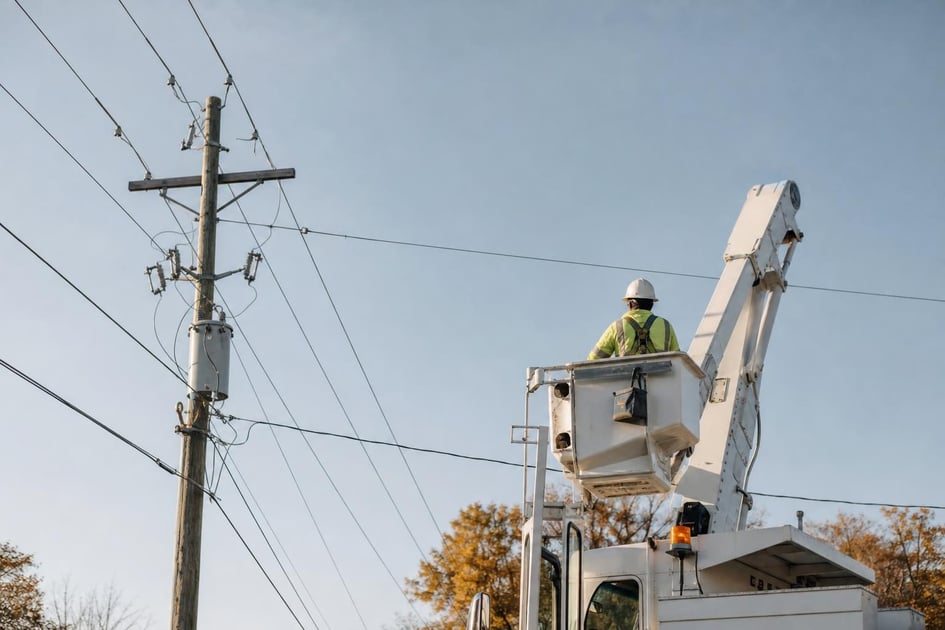
Bucket Truck Financing Terms in Plain Language
Most bucket truck financing terms run between 24 and 72 months, with the equipment itself serving as collateral. Down payments typically range from 0% to 20% of the purchase price, depending on your credit profile, time in business, and whether the truck is new or used. Because the lender secures the loan with the bucket truck, rates are often more competitive than unsecured borrowing, though exact rates vary by credit profile, equipment age and term length.
Financing is available for transactions from $5,000 up to $5 million, covering everything from a single used bucket truck for a tree service to a fleet of insulated aerial lifts for a utility contractor. If you are weighing a purchase, see what financing you qualify for on that bucket truck before you visit the dealer. Knowing your budget ceiling keeps negotiations focused and prevents you from overcommitting cash reserves.
Key Insight: Lenders price bucket truck deals based on the asset's remaining useful life. A 2024 insulated aerial lift with under 50,000 miles may qualify for a 60-month term, while a 2010 non-insulated unit with 150,000 miles might be capped at 36 months, even if the borrower has strong credit. The equipment's condition often drives the term more than the borrower's score.
Get a fast decision on your equipment
Applying takes just a few minutes, and decisions can come as soon as the same day.
Start Your ApplicationWhat Drives Your Approval and Rate
Credit History and Business Financials
Your personal and business credit histories are the starting point. Most lenders look for a personal credit score in the mid-600s or higher, but approvals are possible below that threshold with compensating factors such as a larger down payment or strong business cash flow. Underwriters will review three to six months of business bank statements to verify revenue consistency. They want to see that your existing cash flow can cover the new monthly payment without straining operations.
Equipment Age and Mileage
The bucket truck's model year, engine hours, and boom inspection status matter significantly. Newer units with documented maintenance histories carry lower risk, which translates to longer available terms and lower down payment requirements. Units older than 10 to 15 years may still qualify, but usually require 10% to 20% down and shorter repayment schedules. If the truck has a known manufacturer recall or a expired aerial inspection certification, expect the lender to ask for repairs before funding.
Time in Business
Businesses operating for two or more years generally receive the most favorable terms. Startups are not eligible for this program, but companies with at least one year of operating history and documented revenue can often still qualify with additional documentation. The longer your track record, the more comfortable the lender is extending a 60-month or 72-month term.
Down Payment Size
A down payment of 10% to 20% improves your approval odds and can lower your monthly obligation, though 0% down options exist for well-qualified buyers financing newer equipment. Putting money down also reduces your total interest cost over the life of the agreement. If you are buying a $100,000 bucket truck, a 15% down payment cuts the financed amount to $85,000, which meaningfully changes the monthly outlay.
New vs. Used Bucket Truck Financing
New bucket trucks arrive with manufacturer warranties, the latest safety features, and longer available financing terms. Used trucks cost less upfront and depreciate more slowly in the first year, but may carry higher rates or shorter terms if the unit is more than five to seven years old. The right choice depends on your annual mileage, maintenance capabilities, and how long you plan to keep the asset.
When you finance a new unit, you are typically borrowing between $75,000 and $250,000 for a standard single-bucket chassis. Used units can range from $35,000 for an older forestry body to $150,000 for a late-model insulated utility boom. Bucket Trucks financing through Provide Capital covers both categories, with terms adjusted to match the equipment's remaining value.
| Factor | New Bucket Truck | Used Bucket Truck |
|---|---|---|
| Typical financed amount | $75,000 – $250,000 | $35,000 – $150,000 |
| Common term range | 48 – 72 months | 24 – 60 months |
| Down payment | 0% – 15% | 10% – 20% |
| Rate factor | More competitive | Varies by age and mileage |
| Best for | High-mileage fleets, warranty needs | Lower monthly cost, shorter payback |
Pro Tip: If you are buying used, request the prior operator's maintenance logs and a current boom inspection certificate. Lenders frequently require a clean inspection report for units older than 8 years, and having it ready can cut 24 to 48 hours off your approval timeline.
Lease or Loan: Choosing the Structure
Bucket truck financing generally falls into three structures: an equipment loan, a $1 buyout lease, or a fair market value (FMV) lease. Each changes who owns the asset, how the payments are treated for tax purposes, and what happens at the end of the term. As Forbes explains in its overview of business loan mechanics, equipment loans are typically secured by the asset itself, which affects both pricing and approval speed.
An equipment loan puts the title in your name from day one. You make monthly payments, and once the loan is satisfied you own the truck free and clear. This structure works well for owners who plan to keep the bucket truck for 7 to 10 years and want to claim depreciation and interest deductions. It differs from SBA 7(a) loans, which can also finance equipment but often involve more paperwork and longer closing timelines.
A $1 buyout lease functions almost identically to a loan for accounting purposes. You make fixed payments, and at the end you pay $1 to transfer ownership. The primary difference is that the lessor holds title during the term, which can simplify balance-sheet presentation for some businesses. This is often the structure behind Transportation equipment financing for fleet operators who want a predictable path to ownership.
An FMV lease treats the bucket truck as a rental. You make lower monthly payments, return the equipment at the end of the term, and walk away or buy it at its then-determined fair market value. This option suits businesses that plan to upgrade every 3 to 5 years to avoid major maintenance on aging booms.
By the Numbers: On a $100,000 bucket truck, a 60-month equipment loan at a competitive rate might run around $1,900 to $2,200 per month with 10% down. The same truck on a 60-month FMV lease could run $1,500 to $1,800 per month, but you would owe a residual payment or return the unit at month 60. The $400 monthly spread adds up to roughly $24,000 over five years.
See what you qualify for
The equipment itself secures the financing, which keeps rates competitive. Checking your options takes minutes.
Check Your Options2026 Tax Treatment for Bucket Trucks
For tax year 2026, Section 179 allows eligible businesses to deduct the full purchase price of qualifying equipment up to an inflation-adjusted annual limit. Because the IRS updates this limit yearly, consult your CPA for the precise 2026 figure before you file. Bucket trucks used more than 50% for business generally qualify, and the deduction applies to both new and used units as long as they are placed in service by December 31, 2026.
If you finance the purchase with an equipment loan, the interest portion of your payments is deductible as a business expense. On a $1 buyout lease, you may be able to deduct the full lease payment, though the exact treatment depends on whether the IRS classifies the agreement as a true lease or a finance lease. An FMV lease is typically treated as a rental expense, making each payment deductible, but you cannot claim depreciation because you do not own the asset. A CPA can walk you through which structure delivers the best after-tax outcome for your specific situation.
Pro Tip: If you are close to the year-end threshold, the date you take delivery matters more than the date you sign. A bucket truck delivered on December 30, 2026, counts for the 2026 tax year, while one delivered on January 2, 2027, falls into the next year. Plan your funding timeline with your dealer and lender so you do not miss the window.
Documentation You'll Need to Apply
Having paperwork ready before you apply prevents delays. Most lenders will request the last three to six months of business bank statements, a copy of your driver's license, a voided business check, and your business formation documents. If the bucket truck is used, you may also need the current inspection certificate and a recent appraisal or equipment listing.
The lender will also need an equipment quote or invoice from the seller. This should list the chassis year, make, model, mileage, boom manufacturer, boom reach, and any recent service history. For private-party sales, expect the underwriter to verify the seller's identity and confirm that the title is free of liens. Get a decision on your equipment, possibly the same day, by submitting a complete file upfront rather than piecemeal.
The Funding Timeline
Same-day approvals are possible when the file is clean and the equipment is standard. In most cases, a decision arrives within 24 to 48 hours. After approval, the lender issues a funding package or pays the vendor directly. If the seller is a dealer, payment typically goes out via wire within 1 to 3 business days of receiving signed documents. Private-party transactions can take an extra day or two while the lender verifies title and coordinates the lien filing.
Before releasing funds, the lender will require proof of commercial auto insurance listing them as a loss payee. The policy should cover the full replacement value of the bucket truck, including the boom and any auxiliary equipment. If you do not yet have coverage, start shopping immediately after approval, because the dealer will not release the truck without it.
Common Mistakes Buyers Make
One frequent error is shopping for the truck before understanding what you can afford. Getting pre-approved sets a realistic ceiling and strengthens your negotiating position. Another mistake is selecting a unit that is too old for the lender's policy. A 2008 bucket truck with 200,000 miles might seem like a bargain at $25,000, but many lenders cap equipment age at 10 to 15 years, and some require an independent inspection before they will fund it.
Buyers also forget to budget for soft costs. Delivery, licensing, upfit modifications, and the first insurance premium can add $3,000 to $8,000 to the total project. If you need the lender to cover these costs, mention it early; some programs allow you to roll certain soft costs into the financed amount, while others restrict funding to the equipment itself. Finally, do not assume that Tow Truck financing terms are identical to bucket truck terms. Different asset classes carry different residual curves and risk profiles, so the structure that works for a rollback may not be optimal for an aerial lift.
Industry Use Cases
Telecommunications and electrical contractors use bucket trucks daily for line maintenance and pole work. These buyers often prioritize insulated booms and dual buckets, and they tend to finance on 60-month terms to match the truck's revenue cycle. Tree care companies, part of the broader forestry and logging sector, frequently buy rear-mounted chipper bodies with integrated booms. They may choose 48-month terms because the equipment takes a beating and they want to own it free and clear before major repairs stack up.
Sign companies and lighting maintenance contractors run lighter-duty units with aluminum bodies and 36-foot to 45-foot reach. Their financed amounts are often in the $60,000 to $120,000 range, and many opt for used units to keep overhead low. Construction firms use bucket trucks for site lighting, temporary power, and building envelope work. According to Census Bureau construction spending data, utility and infrastructure work remains a steady demand driver for aerial equipment. For contractors already managing equipment debt on excavators and loaders, adding a bucket truck on a shorter 36-month term can keep total leverage in check.
Put the right equipment to work
From $5,000 to $5 million, new or used, Provide Capital helps businesses nationwide finance the equipment they need.
Apply TodayFrequently Asked Questions
What credit score is needed for bucket truck financing?
Most lenders prefer a personal credit score in the mid-600s or higher. Approvals are possible below that range with compensating factors such as a larger down payment or strong cash flow, but terms will be shorter and the required down payment larger.
Can I finance a used bucket truck?
Yes. Used bucket trucks are financed routinely. Expect terms of 24 to 60 months depending on age, mileage, and condition. Units older than 10 to 15 years may require a larger down payment and a current boom inspection.
How long can you finance a bucket truck?
Terms typically range from 24 to 72 months. New trucks and well-qualified borrowers can reach 72 months, while older used units or lower credit profiles may be limited to 36 or 48 months.
Is a down payment required?
Not always. Well-qualified buyers financing newer equipment may qualify for 0% down. Most used transactions require 10% to 20% down to offset the lender's risk. A larger down payment lowers your monthly obligation and total cost.
Can I finance the truck body and the chassis separately?
In most cases the lender treats the assembled unit as a single collateral package. If the body and chassis were built by different manufacturers, provide documentation for both so the underwriter can verify the total value and ensure the boom meets safety standards.
What happens if I pay off the loan early?
Many equipment loans carry no prepayment penalty, but some leases include a minimum interest charge or early termination fee. Ask your lender to disclose any prepayment language before you sign so you know the exact cost of an early payoff.
Do I need commercial insurance before funding?
Yes. The lender will require proof of insurance listing them as loss payee before releasing funds. The policy must cover the replacement value of the bucket truck, including the boom and any mounted equipment.
Can I get approved if my business is less than two years old?
Businesses with at least one year of operating history and documented revenue can often qualify with additional documentation. Startups and new businesses are generally outside the approval criteria for standard equipment finance programs.
Ready to Move Forward?
Understanding bucket truck financing terms before you shop saves time, preserves cash flow, and keeps you from overpaying. Start by gathering your bank statements and equipment quote, then start an application in a few minutes to see what structure and term fit your business. A quick decision lets you lock in the truck and get back to work.
Disclaimer: The information provided in this article is for general educational purposes only and is not financial, legal, or tax advice. Funding terms, qualifications, and product availability may vary and are subject to change without notice. Provide Capital does not guarantee approval, rates, or specific outcomes. For personalized information about your business funding options, contact our team directly.
