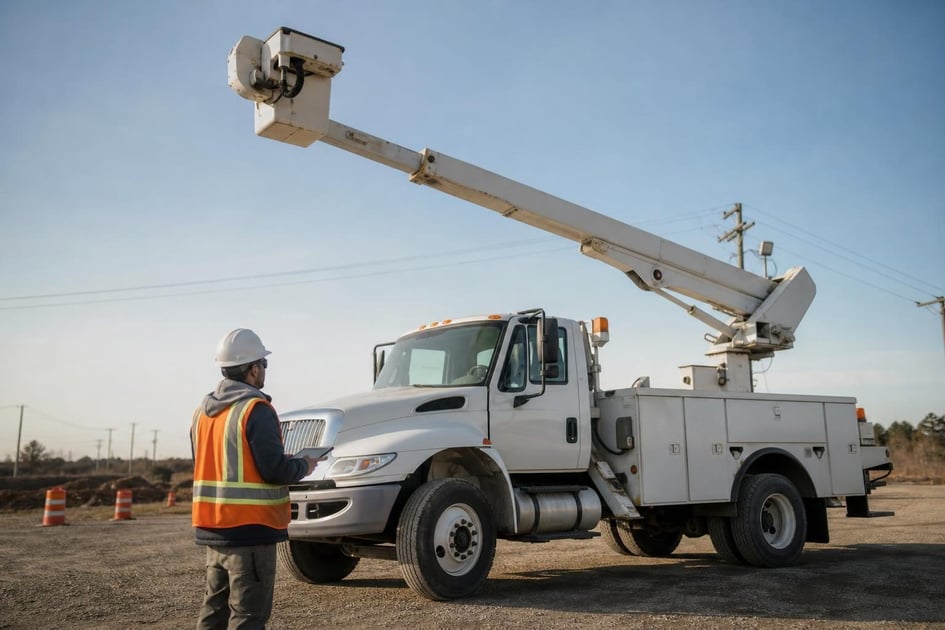
Used bucket trucks typically cost 40% to 60% less than new units, and financing them means keeping that upfront cash in your business rather than tying it to a single vehicle. At Provide Capital, we finance used bucket trucks starting at $5,000, with the equipment itself serving as collateral. That structure keeps rates competitive, though your specific rate will vary by credit profile, equipment age and term length. Same-day approvals are possible once your documentation is complete, and we work with arborists, telecom contractors, sign companies and utilities nationwide. If your operation also moves heavy material, we offer Dump Trucks financing under the same equipment-secured structure.
Why Used Bucket Trucks Dominate the Market
The secondary market for bucket trucks is larger than most owner-operators realize. Utility fleets, large telecom contractors and municipal agencies rotate equipment on regular cycles, flooding the market with well-maintained units that have years of service left. For a growing contractor, these trucks represent an opportunity to add capacity without absorbing the depreciation hit that hits new chassis the moment they leave the lot.
A new 60-foot Altec mounted on a medium-duty chassis can run $180,000 to $240,000 depending on spec. A five- to seven-year-old comparable unit with documented maintenance often sells for $85,000 to $140,000. That gap leaves room for a down payment, a year's worth of insurance, and still leaves working capital on the balance sheet. The question is not whether used equipment saves money—it does. The question is how to structure the financing so the truck starts generating revenue before the first payment is due.
Key Insight: Fleet buyers often replace bucket trucks at 10 to 12 years not because the boom is worn, but because federal and state safety inspection standards tighten on older hydraulic systems. A used unit with a recently re-certified boom can operate another decade in private contractor service at a fraction of the original cost.
Already have a machine in mind?
Provide Capital finances new and used equipment from $5,000 to $5 million, with same-day decisions possible.
Apply NowHow Used Bucket Truck Financing Works
Equipment financing uses the bucket truck as collateral. This is different from an unsecured working capital loan or a line of credit. Because the lender has a secured interest in the asset, the approval process weighs the equipment's value and condition more heavily than an unsecured product would. That is why a borrower with a challenged credit profile can still qualify for used Bucket Trucks financing if the truck holds value and the down payment is sufficient.
Provide Capital finances new and used business equipment from $5,000 up to $5 million. For used bucket trucks, the sweet spot falls between $35,000 and $175,000—roughly the range of a 5-to-10-year-old single-boom unit on a Class 6 or Class 7 chassis. Terms typically run 36 to 72 months, though longer amortizations are available for higher-dollar units. The equipment age at the end of the term usually cannot exceed 12 to 15 years, depending on the program.
Loan vs. Lease: Which Structure Fits?
Most buyers assume they want a loan because they intend to own the truck long-term. But a lease—particularly a $1 buyout lease or a 10% PUT lease—can make sense if the truck is a speculative purchase for a new contract or if you want to match the deduction schedule to the contract length.
| Feature | Equipment Loan | $1 Buyout Lease | Fair Market Value Lease |
|---|---|---|---|
| Ownership at end | You own the truck outright | You own it for $1 | You return or buy at FMV |
| Down payment | 0% to 20% typical | First + last payment | First payment only |
| Collateral | The truck secures the loan | Lessor holds title | Lessor holds title |
| Tax treatment (2026) | Section 179 or bonus depreciation | Section 179 eligible | Payments deducted as expense |
| Best for | Long-term core fleet | Certain ownership with low upfront | Short-term or seasonal work |
The key difference is who holds the title during the term. With a loan, you hold title and the lender files a UCC-1 lien. With a lease, the lessor holds title and you treat the truck as a leased asset. For contractors who plan to put 15,000 miles a year on a chassis and run the boom daily, ownership through a loan or $1 buyout lease is usually the smarter play.
Pro Tip: If you are buying a used bucket truck from a private seller rather than a dealer, ask the seller to provide the last two years of inspection certificates for the boom and chassis. Lenders view documented maintenance history as a risk reducer, and it can trim the rate by a meaningful margin.
What Determines Your Monthly Payment
Rates vary by credit profile, equipment age and term. Three additional factors move the number significantly:
- Equipment age and hours. A 2019 unit with 50,000 miles and 2,000 boom hours is easier to finance than a 2012 unit with 200,000 miles. Lenders use auction data and guidebooks to estimate residual value. The closer the truck is to the lender's residual floor, the higher the rate or down payment required.
- Source of the unit. Dealer purchases come with warranties, reconditioning records and sometimes delivery. Private-party purchases save money upfront but carry more unknowns. Some lenders apply a slightly higher rate to private-party deals or require a third-party inspection.
- Your business financials. Two years in business with tax returns showing consistent revenue will earn better terms than a six-month-old operation with bank statements only. That said, we do work with younger businesses when the credit profile and down payment are strong.
A $95,000 used bucket truck on a 60-month term might carry a monthly payment between $1,650 and $2,100 depending on these variables. A shorter 48-month term pushes that to $2,000 to $2,550 but cuts total interest paid. A 72-month term drops the payment toward $1,350 to $1,750 but extends the obligation on an asset that is already depreciating.
Qualifying for Used Bucket Truck Financing
Approval is not automatic, and no one qualifies purely because they found a truck. Lenders look at four pillars:
Credit Profile
A FICO score above 650 opens the door to standard programs. Scores between 600 and 650 often still qualify but may require 10% to 15% down. Below 600, options narrow to specialized credit programs with shorter terms and higher rates. Bankruptcies discharged less than two years ago add friction, though they do not always disqualify if recent payment history is clean.
Time in Business
Two years is the standard threshold. Businesses between one and two years can qualify with strong personal credit or a solid down payment. Under one year, expect to provide a personal guarantee and possibly cross-collateral. We do not work with startups or new businesses that lack an operating history. The Small Business Administration emphasizes that two years of operating history is the standard benchmark for equipment finance eligibility.
Equipment Condition and Age
The truck must pass a basic condition review. Lenders want to know the boom manufacturer (Altec, Terex, Versalift, Elliott), the chassis class, the mileage, the boom hours, and whether any structural welds or hydraulic replacements have been performed. Units older than 12 years are harder to place but not impossible if the price is right.
Down Payment or Trade Equity
0% down programs exist for strong borrowers buying from dealers. Most used bucket truck deals close with 5% to 15% down. If you have a trade-in, the equity counts toward the down payment requirement.
If you have been shopping trucks and know the year, make and price, see what you qualify for before you negotiate. A pre-approval letter gives you leverage at the dealership or auction.
New vs. Used: The Real Trade-Offs
New bucket trucks come with warranties, the latest safety features, and lower maintenance costs in the first three years. They also depreciate 20% to 30% in year one. Used trucks carry higher maintenance risk but preserve capital and often allow faster ROI. Reuters business coverage has documented how contractors are shifting to used equipment to manage rising capital costs.
For a tree service adding a second truck, a used unit financed over five years often pays for itself within 18 to 24 months if utilization is high. For a utility contractor bidding on a five-year municipal contract with strict uptime clauses, a newer unit with warranty coverage may be the safer bet.
The financing itself differs slightly. New truck lenders sometimes offer promotional rates through captive finance arms, but those programs often require excellent credit and large down payments. Independent equipment finance companies like Provide Capital compete on speed and flexibility rather than promotional teaser rates. We can fund a used truck in the time it takes a captive lender to schedule a committee meeting.
By the Numbers: A $120,000 used bucket truck financed at 60 months with 10% down leaves a $108,000 note. Depending on credit and equipment age, monthly payments typically fall between $1,950 and $2,450. Over the term, total out-of-pocket runs roughly $129,000 to $147,000, after which you own a truck still worth $35,000 to $50,000 in the wholesale market.
Find the right financing structure
Tell us about the equipment you need and we will show you the options that fit your business.
See Your OptionsTax Treatment for the 2026 Tax Year
The tax advantages of equipment financing are real, but the specifics depend on your entity structure, taxable income and the advice of your CPA. For the 2026 tax year, Section 179 allows eligible businesses to deduct the full purchase price of qualifying equipment up to a limit set by Congress for 2026. Bonus depreciation may also apply at a percentage set for 2026. Both provisions are subject to phase-outs and taxable income limitations.
Because tax law changes frequently, do not rely on a blog post for the exact 2026 Section 179 limit or bonus depreciation rate. Talk to your CPA about how the 2026 limits apply to your situation and whether a loan or lease structure produces the better deduction.
One point that catches buyers off guard: if you finance a used bucket truck in December 2026, it must be placed in service by December 31 to count for the 2026 tax year. Delivery delays, inspection holdups or title issues can push you into January, shifting the deduction to 2027. If you are buying used at year-end, start the financing process early.
Key Insight: Section 179 deductions cannot create a net operating loss for most businesses. If your 2026 taxable income is $75,000 and the truck costs $95,000, you may only deduct up to $75,000 in 2026, with the remainder carried forward. Your CPA can model whether bonus depreciation—which may allow a larger first-year write-off—fits your 2026 return better.
Industry-Specific Use Cases
Bucket trucks are not a monolithic market. The right truck for a sign installer differs from what a telecom lineman needs. Utility and construction sectors employ millions of workers nationwide, according to U.S. Census Bureau data.
Telecommunications and Utilities
Telecom contractors working on 5G small-cell installations need insulation and upper controls. A used Altec TA55 or similar non-insulated unit priced at $70,000 may work for general construction but fail utility safety standards. These buyers should budget $110,000 to $160,000 for a used insulated unit. Transportation equipment financing programs cover these higher-ticket units, often with terms stretching to 72 months to keep payments manageable.
Arborists and Tree Care
Tree services run trucks hard for eight months and park them for four. A used chipper-body bucket truck with a rear-mounted boom is ideal. These units see heavy depreciation in the first five years, so buying used at year six or seven captures the steepest part of the depreciation curve. A $55,000 to $85,000 used chip truck financed over 48 months fits the seasonal cash flow of most tree services.
Sign, Lighting and HVAC Installation
Sign installers need material racks and a lower working height—often 36 to 45 feet. Lighting maintenance crews need a stable platform and 200-pound basket capacity. HVAC contractors mounting units on commercial rooftops need all-terrain capability and outriggers. Each spec changes the price. Used sign trucks start around $45,000; used material-handling bucket trucks with higher capacity can run $100,000 plus. Matching the spec to the job prevents over-buying.
Common Mistakes When Financing Used
We see the same errors repeat across applications:
- Skipping the boom inspection. A clean chassis does not mean the hydraulics, lower bearings and fiberglass are sound. A $400 boom inspection from a certified shop can save a $15,000 repair.
- Overlooking outrigger condition. Outrigger pads and pins wear. Replacement is not expensive, but if the inspection reveals cracks in the mounting boxes, you are looking at frame-level work.
- Financing the full purchase price without taxes and delivery. Soft costs add 8% to 12% to the deal. If you finance only the truck price, you are paying taxes and transport out of pocket. Some lenders allow you to fold these into the financing; others do not. Ask upfront.
- Buying too much truck for the job. A 75-foot over-center boom looks impressive but costs more to insure, maintain and fuel. If 90% of your work is under 45 feet, buy a 45-foot unit and rent for the occasional tall job.
- Ignoring the lender's age cap. If a lender will not finance a truck older than 10 years, do not shop for 12-year-old units expecting an exception. Age caps exist because residual value models break down beyond certain thresholds.
Documentation You'll Need
Same-day approvals are possible, but only when the file is complete. Have these ready:
- Business tax returns for the last two years, or personal returns if the business is younger.
- Bank statements for the last three to six months showing consistent deposits.
- Equipment quote or purchase agreement with the VIN, year, make, model, mileage, boom hours and seller information.
- Proof of insurance quoting the lender as loss payee. Most agents can produce this in an hour.
- Driver's license and a voided check for identity verification and ACH setup.
For transactions over $250,000, expect to provide a current balance sheet and profit-and-loss statement. For transactions under $100,000, the process is lighter and often requires only bank statements and a credit check.
What Happens After Approval
Once approved, you receive a term sheet detailing the payment, term, collateral description and any conditions. Review it for prepayment penalties, late fees and default provisions. Most equipment finance agreements allow prepayment without penalty, though some apply a small remaining-interest charge.
After you sign and return the term sheet, the lender wires funds directly to the seller or issues a check. You take delivery, verify the title transfer, and add the truck to your insurance policy with the lender listed as loss payee. The first payment is typically due 30 to 45 days after funding, giving you time to put the truck to work.
If you are buying at auction or through an online marketplace, coordinate the inspection and pickup timeline with the funding date. Sellers rarely hold trucks for free while financing clears. A delay of even 48 hours can cost storage fees or, worse, the truck.
Put the right equipment to work
From $5,000 to $5 million, new or used, Provide Capital helps businesses nationwide finance the equipment they need.
Apply TodayFrequently Asked Questions
Can I finance a bucket truck from a private seller?
Yes. Private-party sales are common in the bucket truck market. The lender will still require a purchase agreement, title verification and usually a third-party inspection. The rate may be slightly higher than a dealer purchase, but the savings on the truck price often offset the financing cost.
How old can a used bucket truck be to qualify for financing?
Most programs cap the equipment age at 10 to 12 years at the time of financing, with a maximum age of 15 years at the end of the term. Older trucks can still qualify if the purchase price is low relative to value or if the borrower brings a larger down payment.
Does financing a used truck require a larger down payment than new?
Not necessarily. Down payment requirements are driven more by credit profile and transaction size than by new versus used. Strong credit borrowers can finance used bucket trucks with 0% to 5% down. Weaker credit or higher-mileage units may require 10% to 20%.
Can I finance the soft costs—taxes, delivery, upfitting?
Many lenders allow soft costs to be included, usually up to a percentage of the equipment cost—often 10% to 15%. Ask your financing specialist whether taxes, delivery and installation can be rolled into the note or must be paid separately.
What credit score do I need for used bucket truck financing?
A score of 650 or above opens standard programs. Scores from 600 to 650 often qualify with additional documentation or a larger down payment. Below 600, options exist but terms are shorter and costs higher. We evaluate the full file, not just the score.
How long does approval take?
Same-day approvals are possible when the application and documentation are complete. Complex files—those involving multiple entities, large dollar amounts or challenged credit—may take 24 to 48 hours. Pre-approvals are available if you want to shop with confidence.
Can I pay off the loan early?
Most equipment finance agreements allow early payoff. Some use a simple-interest structure where you pay only the remaining principal plus accrued interest. Others charge a small prepayment fee equal to a percentage of the remaining balance. Review your term sheet before signing.
Is a personal guarantee required?
For businesses operating less than two years or with limited financial documentation, a personal guarantee is standard. Established businesses with strong tax returns and cash flow may qualify without one, particularly on loans under $150,000.
Ready to Add a Used Bucket Truck to Your Fleet?
Used bucket trucks offer one of the fastest paths to expanding capacity without draining cash reserves. The financing process is straightforward if you understand the variables—equipment age, credit profile, structure and documentation—and plan accordingly. Rates vary by credit profile, equipment age and term, so the best way to know your numbers is to run the scenario with your specific truck and financials.
Whether you are bidding your first municipal contract or adding a third crew, we can help you structure the deal. Get a same-day decision on your equipment and find out how much truck your business can carry.
Disclaimer: The information provided in this article is for general educational purposes only and is not financial, legal, or tax advice. Funding terms, qualifications, and product availability may vary and are subject to change without notice. Provide Capital does not guarantee approval, rates, or specific outcomes. For personalized information about your business funding options, contact our team directly.