
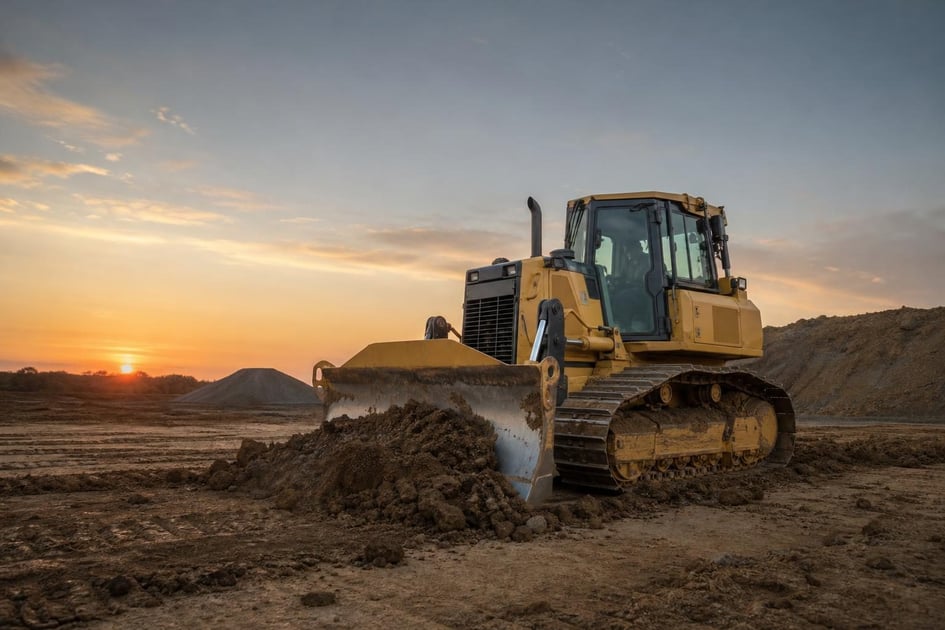
What to Expect When Financing a Bulldozer
If you are buying a bulldozer for your earthmoving business, the financing process is straightforward. The lender secures the loan against the machine itself, which keeps rates competitive because the equipment serves as collateral. You can finance new or used bulldozers from $5,000 up to $5 million, with terms that typically run 24 to 84 months depending on the machine's age, your credit profile, and the term you select. Same-day approvals are possible once you submit a complete package, but most decisions arrive within one to three business days.
Unlike unsecured working capital, equipment financing is asset-backed. That means the lender cares as much about the bulldozer's make, model, year, and hours as they do about your personal credit score. A well-maintained Caterpillar D6 with 3,000 hours is viewed differently than a 15-year-old off-brand dozer with 12,000 hours and no service records. Rates vary by credit profile, equipment age and term, so your exact payment depends on the full picture.
If you already have a machine picked out, you can see what you qualify for on that bulldozer in just a few minutes and receive a decision without affecting your credit.
Key Insight: Lenders classify bulldozers by horsepower and operating weight, not just brand. A 150-horsepower dozer is viewed as lower risk than a 500-horsepower model because the resale market is deeper, which often translates to a longer available term and lower down payment requirement.
Get a fast decision on your equipment
Applying takes just a few minutes, and decisions can come as soon as the same day.
Start Your ApplicationEquipment Financing Structures Compared
Not every bulldozer deal is structured the same way. The three most common products are an Equipment Finance Agreement, a $1 buyout lease, and a fair market value lease. Each treats ownership, monthly payment, and tax deductibility differently.
An Equipment Finance Agreement (EFA) works like a traditional term loan secured by the bulldozer. You own the machine from day one, and the lender files a UCC-1 lien against it. You make fixed monthly payments, and at the end of the term the lender releases the lien and you hold clear title. This is the most common structure for owner-operators who plan to keep the dozer for its full useful life.
A $1 buyout lease is functionally similar to an EFA, but it is structured as a lease for accounting purposes. You make payments over the term and then purchase the bulldozer for $1 at the end. For tax year 2026, the IRS generally treats a $1 buyout lease as a purchase, meaning you may be eligible for Section 179 and depreciation deductions, though you should confirm the details with your CPA.
A fair market value (FMV) lease gives you the lowest monthly payment, but you do not automatically own the bulldozer at the end. You can return it, renew the lease, or buy it at its then-current fair market value. This structure makes sense if you expect to upgrade to a newer model every few years or if the dozer is for a specific project with a defined endpoint. Most grading and excavation companies that plan to keep a machine for five or more years will find an EFA or $1 buyout lease more economical over time.
To understand which structure fits your books and cash flow, get a decision on your equipment, possibly the same day, and compare your options side by side.
| Feature | Equipment Finance Agreement | $1 Buyout Lease | FMV Lease |
|---|---|---|---|
| Ownership | You own from day one | You own after final $1 payment | Lender owns; you return or buy at FMV |
| Monthly Payment | Moderate | Moderate | Lowest |
| Typical Term | 24 to 84 months | 24 to 84 months | 12 to 60 months |
| Best For | Owners who want equity | Owners who want ownership with lease accounting | Short-term projects or frequent upgrades |
| End of Term | Title released | Title transferred for $1 | Return, renew, or purchase |
By the Numbers: A $125,000 used bulldozer on a 60-month Equipment Finance Agreement might carry a monthly payment in the low $2,000s, while a 36-month term could push that figure closer to the mid-$3,000s. Rates vary by credit profile, equipment age and term.
What Drives Your Rate and Monthly Payment
Several variables determine where your deal lands on the pricing spectrum. Understanding them before you apply helps you set realistic expectations and, in some cases, improve your offer.
Credit History and Business Financials
For owner-operators and small grading companies, personal credit is often the primary underwriting factor, especially if the business has fewer than three employees. A personal credit score in the mid-600s is typically the practical minimum for standard programs, while scores above 700 generally unlock longer terms and lower down payments. Lenders also look at business bank statements to verify cash flow. Three to six months of statements are standard, and they want to see revenue that comfortably covers the proposed payment.
Equipment Age, Hours, and Resale Value
The collateral itself matters. A bulldozer that is three years old with 2,500 hours carries less risk than a 12-year-old machine with 9,000 hours. Most lenders cap terms based on the equipment's remaining useful life. For example, a new dozer might qualify for 84 months, while a machine that is eight years old may be limited to 48 months. Caterpillar, John Deere, and Komatsu models typically command better terms than lesser-known imports because of parts availability and resale depth.
Term Length and Down Payment
A longer term lowers your monthly payment but increases the total interest paid over the life of the deal. A shorter term saves total cost but demands higher monthly cash flow. Down payments range from zero to 20 percent depending on credit and equipment age. A 10 percent down payment on a $200,000 dozer is $20,000, which can improve your rate and signal skin in the game to the underwriter.
Pro Tip: Before you apply, obtain the serial number, hour meter reading, and a detailed photo set of the undercarriage and blade. Lenders price risk partly on remaining useful life, and a well-documented machine with a recent maintenance history can improve your offer more than a marginal bump in your personal credit score.
New vs Used Bulldozers: Financing Considerations
The choice between new and used is one of the biggest decisions an owner-operator faces, and it affects financing terms as much as it affects the job site.
Financing a New Bulldozer
New machines come with full manufacturer warranties, predictable maintenance schedules, and the latest emissions and technology packages. From a financing perspective, new bulldozers qualify for the longest terms, often up to 84 months, and may be eligible for zero-down programs for qualified borrowers. The downside is the steeper acquisition cost. A new mid-size dozer can easily run $250,000 to $500,000 depending on attachments and specifications, which means a larger total financed amount and higher absolute interest cost even at a competitive rate.
Financing a Used Bulldozer
Used equipment offers a lower entry point, which is why the majority of Bulldozers financing applications are for machines in the 3-to-8-year-old range. A five-year-old Caterpillar D6 or Komatsu D51 often delivers 80 percent of the productivity at 50 percent of the cost of a new unit. Terms for used equipment typically max out at 60 to 72 months for machines under 5,000 hours, and lenders usually require an independent inspection if the unit is being purchased at auction or from a private party. If you are also expanding your fleet with support equipment, consider bundling your application with Dump Trucks financing or Skid Steers financing to simplify your paperwork and potentially improve your overall structure.
Find the right financing structure
Tell us about the equipment you need and we will show you the options that fit your business.
See Your OptionsQualification Criteria Explained
Equipment lenders evaluate a handful of core factors. Meeting or exceeding them does not ensure a specific offer, but it positions you for the best possible terms.
Time in Business
Most programs prefer two or more years of operating history. If your company has less history, you may still qualify with a strong personal credit profile, a larger down payment, or a co-signer. Some lenders specialize in deals for businesses with one year of history, though the rates and down payment requirements reflect the additional risk.
Credit Profile
Personal credit scores are heavily weighted for owner-operators because the business and the owner are often financially intertwined. A score in the low 600s may be workable with compensating factors, while a score in the 700s opens up more competitive structures. Bankruptcies, active tax liens, and recent judgments are generally disqualifying unless they are fully resolved and explained.
Revenue and Cash Flow
Lenders want to see that your business generates enough revenue to cover the new payment. As a rule of thumb, your existing monthly equipment debt plus the new bulldozer payment should not consume more than a reasonable percentage of your gross monthly revenue. Exact thresholds vary by lender and program, so if your debt-service coverage is tight, be prepared to offer a larger down payment or a co-applicant.
Down Payment and Collateral
The bulldozer itself is the collateral, which is why rates stay lower than unsecured alternatives. Zero-down programs exist for well-qualified buyers, but a down payment of 10 to 20 percent is common for used equipment, challenged credit, or first-time buyers. The down payment reduces the lender's exposure and demonstrates your commitment to the asset.
For contractors in the earthmoving space, Construction equipment financing programs are designed around the realities of the job site, including seasonal cash flow and the need to mobilize quickly after winning a bid.
Key Insight: If you are adding a bulldozer to an existing fleet, lenders may approve the deal based on your business's historical equipment revenue rather than your personal credit. Bring a trailing 12-month profit-and-loss statement showing earthmoving income and you may bypass a personal guaranty requirement on deals below $500,000.
Tax Treatment for Tax Year 2026
How you structure the purchase affects your tax picture for 2026. Always review equipment transactions with a CPA who knows your specific situation, but here is how the rules generally apply.
Section 179. For tax year 2026, the Section 179 deduction limit and phase-out threshold have been adjusted for inflation. You may be able to deduct the full purchase price of qualifying bulldozer equipment up to the annual limit set by the IRS for 2026, subject to your taxable income. Because the exact dollar figures change with inflation indexing, consult your CPA to confirm the 2026 limit and whether your net income supports the deduction.
Bonus Depreciation. For 2026, bonus depreciation may be available at a percentage lower than the 100 percent level seen in prior years, as the phase-down schedule under the Tax Cuts and Jobs Act continues. The exact percentage for 2026 depends on current law, so verify the rate with your tax advisor before you rely on it for cash-flow planning.
Financing the bulldozer does not change your eligibility for these deductions. Whether you use an EFA or a $1 buyout lease, you are generally considered the owner for tax purposes and can claim the benefits. With a true FMV lease, the lessor typically claims the depreciation, which is why your monthly payment is lower.
According to U.S. Census Bureau construction spending data, nonresidential construction activity remains a significant economic driver, supporting demand for earthmoving fleets. For broader financing context, the SBA loan programs page outlines how government-backed options compare to direct equipment financing. Industry demand is further illustrated by a recent Reuters report on Caterpillar construction equipment demand, which noted strong North American sales growth in 2026.
Documentation You Need to Close
A complete file moves faster. When you apply for bulldozer financing, gather the following before you start.
Business and Personal Information
You will need a valid driver's license, a voided business check for ACH setup, and your business entity documents such as articles of incorporation or your operating agreement. If you are a sole proprietor, your Social Security number and a DBA certificate are usually sufficient.
Equipment Details
Provide the invoice, purchase agreement, or equipment listing. Include the make, model, year, serial number, and hour meter reading. If the machine is used, add photos of the undercarriage, engine bay, and cab. An independent appraisal may be required for private-party sales or auction purchases.
Financial Records
Most lenders request three to six months of business bank statements. For deals above $150,000, you may also need two years of business tax returns and a current year-to-date profit-and-loss statement. If your business has less operating history, be prepared to provide personal tax returns and a personal financial statement.
Once you have these items together, start an application in a few minutes and avoid the back-and-forth that delays approvals.
Common Mistakes to Avoid
Even experienced contractors can trip over these pitfalls when financing heavy equipment.
Shopping Without a Pre-Approval
Negotiating with a seller before you know your budget is risky. You might commit to a machine you cannot finance, or you might overpay because you cannot walk away. Get a pre-approval or a firm quote before you make an offer.
Ignoring Total Cost of Ownership
The monthly payment is only part of the equation. Fuel, maintenance, insurance, and transport add thousands of dollars per year. A $2,500 monthly payment might be manageable, but if the machine burns $1,200 in fuel and needs $800 in undercarriage maintenance each month, your real cost is much higher.
Buying at Auction Without Inspection
Auction prices are tempting, but auction purchases are almost always as-is. If the transmission fails in 30 days, you still owe the lender. Always inspect the bulldozer in person or hire a certified mechanic, and confirm that the title is clean before you bid.
Ready to move forward?
More than 10,000 businesses have financed equipment with Provide Capital. See what you qualify for today.
Get StartedFrequently Asked Questions
- Can I finance a bulldozer if I have bad credit?
Possibly. Credit scores in the low 600s can qualify with compensating factors such as a larger down payment, strong business revenue, or a co-signer. However, rates vary by credit profile, equipment age and term, so expect a higher down payment or shorter term if your credit is challenged.
- How long can I finance a used bulldozer?
Terms depend on the machine's age and hours. A used dozer that is less than five years old with under 5,000 hours may qualify for 60 to 72 months. Older machines or those with high hours may be limited to 36 or 48 months.
- Is it better to lease or finance a bulldozer?
It depends on how long you plan to keep it. If you intend to run the machine for five or more years, an Equipment Finance Agreement or $1 buyout lease usually costs less overall. If you upgrade frequently or need the dozer for a single project, an FMV lease may make sense despite not building equity.
- Can I include attachments in the financing?
Yes. Ripper attachments, winches, GPS machine control systems, and blades can often be bundled into the same financing package if they are part of the initial purchase. The total financed amount must fit within the lender's guidelines.
- What happens after I apply?
The lender reviews your credit, business bank statements, and equipment details. If everything is in order, you may receive a same-day approval. After approval, the lender issues a funding letter or purchase order to the seller, and you sign the closing documents. Funds are typically sent directly to the seller within 24 to 48 hours.
- Do I need a down payment?
Not always. Zero-down programs exist for well-qualified borrowers financing new or low-hour used equipment. However, a down payment of 10 to 20 percent is common for used machines or borrowers with credit below 700.
- Can I finance a bulldozer from a private seller?
Yes. Private-party and auction purchases are financeable, but they require extra diligence. The lender will need a bill of sale, a clean title search, and often an independent inspection. The funding process may take an extra day or two while the title is verified.
- Does the bulldozer need to be new to qualify for tax deductions in 2026?
No. Both new and used qualifying equipment can be eligible for Section 179 and bonus depreciation in tax year 2026, subject to the current limits and your taxable income. Confirm the exact 2026 figures with your CPA.
Ready to Add Earthmoving Power to Your Fleet?
Financing a bulldozer is one of the most straightforward ways to expand your capacity without draining your operating account. Whether you are buying a $50,000 used track dozer or a $400,000 new machine with a full warranty, the right structure keeps your cash flow intact and puts you to work faster.
Gather your equipment details, your last three months of bank statements, and see what financing you qualify for on that dozer today. Decisions are often possible within hours, and you can close as soon as the title clears.
Disclaimer: The information provided in this article is for general educational purposes only and is not financial, legal, or tax advice. Funding terms, qualifications, and product availability may vary and are subject to change without notice. Provide Capital does not guarantee approval, rates, or specific outcomes. For personalized information about your business funding options, contact our team directly.
