
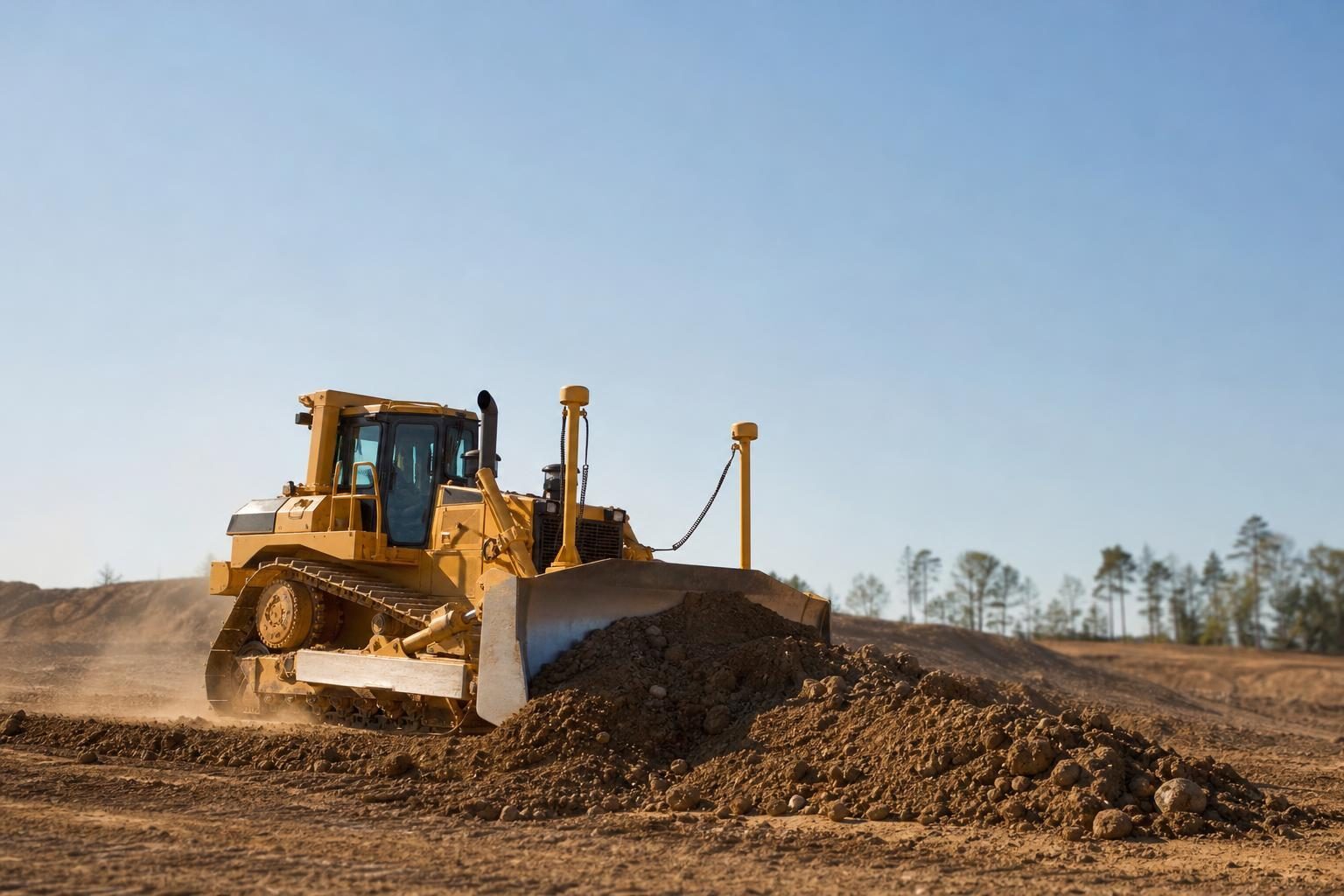
Financing for a bulldozer typically covers the machine itself, delivery, and often attachments like rippers or winches, with the equipment serving as collateral. Most deals fall between $75,000 and $750,000, though programs exist from $5,000 up to $5 million depending on the unit and your operation. Because the bulldozer secures the note, rates vary by credit profile, equipment age and term length rather than relying solely on real estate or personal guarantees. If you are weighing a purchase, see what financing you qualify for on that dozer in a few minutes.
What Bulldozer Financing Covers
Bulldozers financing works for crawler dozers, wheel dozers, and compact models from dealers, auctions, and private sellers. Lenders generally distinguish between new and used units. New machines carry longer terms and lower down payment requirements because the residual value is predictable. Used dozers—especially those between five and ten years old—can still qualify, but lenders may require a recent inspection or limit the advance to a percentage of auction value.
Attachments matter. A bare dozer blade is standard, but financing can also cover a rear ripper, winch, or GPS grade-control system if the invoice bundles them with the base machine. Lenders rarely finance attachments purchased separately after the fact unless they are added within a short window of the original closing. If you are buying at auction, have the auction invoice and the equipment condition report ready; private-party deals require a clear title search and a bill of sale that matches the lender’s lien requirements.
Key Insight: Auction purchases often close within 48 hours of the winning bid, but financing approval must be in hand before you raise your paddle. Most auction houses require immediate payment or a substantial deposit, so starting the application before the sale is not optional—it is operational necessity.
Already have a machine in mind?
Provide Capital finances new and used equipment from $5,000 to $5 million, with same-day decisions possible.
Apply NowWhat Lenders Actually Review
Qualification centers on four factors: time in business, credit profile, revenue consistency, and the equipment’s value. Two years in business is the standard benchmark, though some programs accept 12 months with compensating strengths. A credit score in the mid-600s opens more term options, but scores below that do not automatically disqualify you; they simply shift the structure toward a shorter term or a larger down payment.
Monthly revenue should cover the proposed payment with room left for overhead. Lenders typically look for the last three to six months of bank statements to confirm cash flow. For requests above $250,000, expect to provide two years of tax returns and a current year-to-date profit and loss statement. The bulldozer itself is the collateral, which means the lender files a UCC-1 lien on the equipment until the obligation is satisfied. This secured structure is why financing can be competitive even for borrowers with imperfect credit. Business owners exploring every option should know that the SBA maintains small business resource hubs outlining general capital programs, though equipment finance agreements typically move faster because the collateral is identified upfront.
New vs. Used Bulldozers: Financing Differences
New dozers usually qualify for terms up to 84 months, while used machines rarely stretch past 60 months and often top out at 48. The reason is depreciation. A new Caterpillar D6 loses roughly 20 to 30 percent of its value in the first two years, but the curve flattens after that. A ten-year-old dozer has already absorbed most of its depreciation, so the lender’s risk is lower in absolute dollars but higher as a percentage of remaining useful life.
| Factor | New Bulldozer | Used Bulldozer (5–10 Years) |
|---|---|---|
| Typical term range | 36–84 months | 24–60 months |
| Down payment | 0–10% | 10–20% |
| Rate structure | More competitive | Varies by age and hours |
| Required documentation | Invoice, insurance | Inspection, title, maintenance records |
| Tax treatment | Full Section 179 / bonus eligibility | Same, based on purchase price |
Used units also require more scrutiny of meter hours. A dozer with 8,000 hours and a spotty maintenance history is harder to finance than one with 12,000 hours and dealer service records. If the machine is over 15 years old, some lenders cap the advance at 50 percent of fair market value or require a cosigner.
Lease vs. Loan: How the Structure Changes Your Costs
An equipment finance agreement functions like a loan: you own the bulldozer from day one, build equity, and claim depreciation. A true lease—particularly a fair market value lease—means the lender owns the asset, and you return it at term end unless you exercise a purchase option. The monthly payment on a lease is often lower because you are only paying for the portion of the asset’s life you use, but you do not own the equity unless you buy out.
For tax year 2026, both financed purchases and certain lease structures may offer deductible payments, but the exact treatment depends on whether you structure the deal as a capital lease or an operating lease. Section 179 and bonus depreciation rules apply to purchases and some capital leases, while operating leases typically deduct as rental expenses. Because the 2026 inflation-adjusted limits and phase-out thresholds are set by the IRS annually, you should confirm the current-year ceiling with your CPA before deciding.
Most contractors who keep equipment for seven to ten years prefer an equipment finance agreement. If you expect to upgrade every three years as technology changes—for example, moving from a conventional dozer to one with integrated GPS grading—a fair market value lease preserves flexibility. Before you choose, get a decision on your equipment, possibly the same day, and compare the amortization side by side.
Pro Tip: If you plan to put high hours on the machine quickly, a loan or equipment finance agreement is usually cheaper over the full lifecycle. A lease with an hours-overage penalty can turn a low monthly payment into an expensive balloon at the end if you exceed the annual limit by even 500 hours.
Typical Costs and Payment Scenarios
Bulldozer prices vary widely. A compact dozer under 100 horsepower might cost $75,000 to $120,000 new. A mid-size crawler in the 150 to 250 horsepower range runs $250,000 to $450,000. Large mining-class dozers can exceed $1 million, though most financed deals in construction stay below $500,000.
Assume you finance a $300,000 used dozer with 15 percent down. You are borrowing $255,000. On a 60-month term, the monthly payment depends on your credit tier and the equipment’s age, but structuring over 48 months instead of 60 raises the payment while cutting total interest cost. Conversely, a $120,000 compact dozer with 10 percent down over 72 months keeps the monthly obligation lower, though you pay more over the life of the contract. Rates vary by credit profile, equipment age and term, so the only way to know your exact numbers is to run the application.
By the Numbers: A $400,000 dozer financed over 60 months with a 12 percent down payment leaves a balance of $352,000. On a 48-month structure, the same down payment still leaves $352,000, but the shorter term cuts the total cost of financing by roughly 15 to 20 percent compared with the 60-month option, assuming the same rate.
Find the right financing structure
Tell us about the equipment you need and we will show you the options that fit your business.
See Your OptionsIndustry Applications Beyond Grading
Bulldozers are not limited to commercial site prep. In agriculture, they clear land, build terraces, and maintain drainage ditches. Forestry crews use them for logging road construction and firebreaks. Demolition contractors pair dozers with protective packages to push debris. Each use case affects how a lender views the collateral. A dozer working in rocky quarry conditions accumulates undercarriage wear faster than one pushing topsoil, which can influence residual value estimates and insurance requirements.
Construction equipment financing represents the largest share of bulldozer funding, but seasonal patterns matter. In northern states, contractors often buy in late winter to secure equipment before spring bidding starts. Lenders know this rhythm and staff accordingly, which is why same-day approvals are more common in February and March than during the holiday season. National construction spending data from the U.S. Census Bureau is a useful barometer for contractors deciding when to expand fleets, and Associated Press construction sector coverage regularly notes that backlog and hiring trends influence equipment demand. If your operation also runs Skid Steers financing or dump truck fleets, bundling multiple units under one approval can simplify paperwork and sometimes improve terms.
Common Mistakes That Delay Approval
Buyers often slow their own deals by skipping three steps. First, they do not verify the seller can produce a clear title. If the dozer has an outstanding lien from a previous deal, the new lender cannot perfect its security interest until the old lien is released. Second, they underestimate insurance costs. Lenders require physical damage and sometimes inland marine coverage naming them as loss payee; if your current policy does not cover the new asset, the funding stalls until it does. Third, they buy the wrong size machine for the work. A compact dozer cannot handle production grading, and upgrading six months later means selling an upside-down asset.
Another error is financing only the base machine and paying cash for attachments, then discovering the lender requires the invoice to be unified to secure the entire package. If you plan to add a ripper or GPS system, include it in the original finance request.
The Documentation Checklist
Gather these items before you apply to avoid back-and-forth delays:
- Completed application with business and personal details
- Last three to six months of business bank statements
- Equipment invoice or purchase agreement showing serial number, year, make, model, and hours
- Two years of business tax returns for requests above $250,000
- Current year-to-date profit and loss statement
- Proof of insurance listing the lender as loss payee
- For private-party sales, the seller’s title or lien release letter
For straightforward deals under $250,000 with strong credit, some programs approve on an application plus the invoice alone. Larger requests or challenged credit profiles trigger deeper review. Having the file complete before submission shortens the timeline from days to hours.
What Happens After You Apply
Once submitted, the lender reviews credit, verifies revenue, and appraises the equipment value. For deals under $250,000, this can wrap the same business day. Larger or more complex files may take 24 to 48 hours. Upon approval, you receive a term sheet outlining the payment, term, down payment, and any collateral requirements.
After you accept, the lender coordinates with the seller to pay out funds. If you bought from a dealer, the dealer receives payment directly. For private-party or auction sales, the lender may issue a check or wire to the seller once title verification is complete. The lender files a UCC lien on the equipment, and your first payment is typically due 30 to 45 days after funding. There is no lengthy real estate closing; the equipment itself is the security, so the process moves faster than conventional commercial lending.
Key Insight: Some lenders allow a 90-day deferred first payment for seasonal contractors. If your cash flow is back-loaded into the summer construction season, ask whether deferral is available. It can cost slightly more in total interest, but it preserves working capital during the pre-construction bidding phase.
Put the right equipment to work
From $5,000 to $5 million, new or used, Provide Capital helps businesses nationwide finance the equipment they need.
Apply TodayFAQ
Can I finance a bulldozer from a private seller?
Yes. Private-party sales are common, but the lender must verify clear title and may require a third-party inspection. The seller will need to provide a bill of sale and a lien release if the machine was previously financed.
What credit score do I need to qualify?
There is no fixed minimum, but a score in the mid-600s opens the most competitive structures. Lower scores are workable with additional down payment, shorter terms, or stronger revenue documentation. Rates vary by credit profile, equipment age and term length.
How long does approval take?
Straightforward applications under $250,000 can receive same-day approval. Larger deals or files needing additional documentation typically resolve within 24 to 48 hours.
Can I finance attachments with the bulldozer?
Yes, if they are on the same invoice and purchased simultaneously. Most lenders will not retroactively finance attachments bought separately after the original closing.
Is a down payment always required?
Not always. New equipment with strong credit sometimes qualifies with zero down. Used equipment and lower credit profiles usually require 10 to 20 percent down to align the loan-to-value ratio with the lender’s risk parameters.
Can I deduct the payments on my taxes?
For tax year 2026, equipment purchases may qualify for Section 179 expensing or bonus depreciation, while lease payments may be deductible as rental expenses. The exact benefit depends on your entity structure, taxable income, and how the deal is documented. Speak with a CPA to confirm the current-year limits and phase-out thresholds.
What happens if I want to pay off the financing early?
Most equipment finance agreements allow early payoff, though some include a prepayment schedule or a nominal fee during the first 12 to 24 months. True leases may have different buyout rules. Review the term sheet before signing.
Does the lender require a specific insurance policy?
Lenders require physical damage coverage naming them as loss payee. Inland marine or equipment-specific policies are common for bulldozers because standard commercial auto policies do not cover off-road machinery. Verify coverage before funding to avoid delays.
Ready to Move Dirt?
Buying a bulldozer is a capital decision that affects your bidding power, crew productivity, and balance sheet for years. The right financing structure preserves cash, matches payments to revenue cycles, and gets the machine working before the next job starts. If you have the invoice or auction listing in hand, start an application in a few minutes and see how the numbers look for your specific dozer and credit profile.
Disclaimer: The information provided in this article is for general educational purposes only and is not financial, legal, or tax advice. Funding terms, qualifications, and product availability may vary and are subject to change without notice. Provide Capital does not guarantee approval, rates, or specific outcomes. For personalized information about your business funding options, contact our team directly.
