
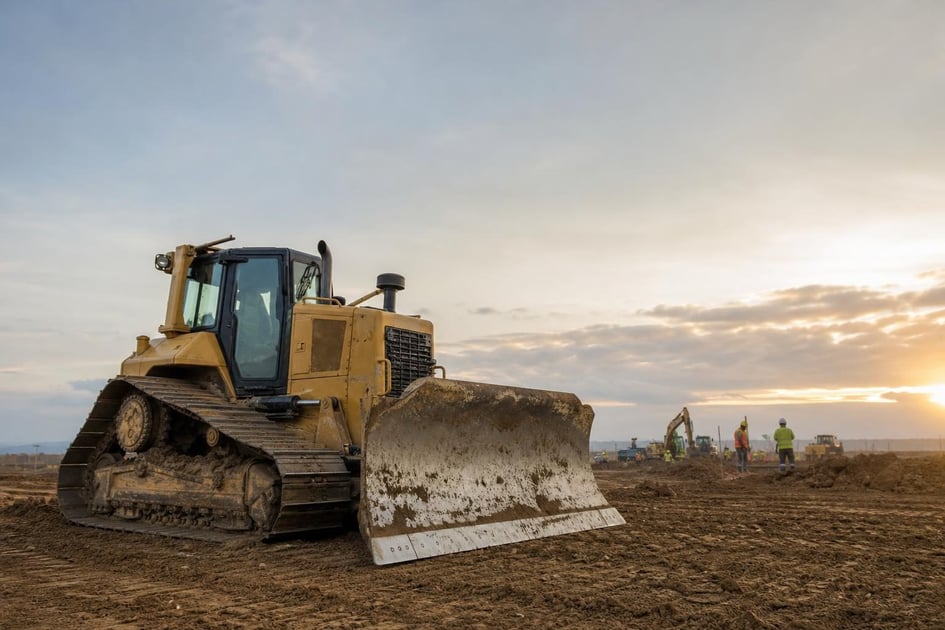
Why Financing Used Bulldozers Differs from New
When you research bulldozers financing used equipment rather than factory-fresh units, the underwriting focuses on collateral value instead of manufacturer incentives. Used machines have already taken their steepest depreciation hit, which lowers your total cost but changes how lenders assess risk. The equipment itself is the collateral, which keeps rates competitive, though rates vary by credit profile, equipment age and term.
A new mid-size dozer can lose 20 to 30 percent of its value in the first two years. For an owner-operator running a grading or site-prep crew, that depreciation is someone else’s opportunity. Used bulldozers give you the blade hours and pushing power you need without the upfront cash drain of a factory-fresh machine. The market is deep: late-model Caterpillar D6 and D8 units, Komatsu D51 and D155 models, and John Deere 850K and 1050K dozers move through dealer lots and auction yards every week.
The decision usually comes down to utilization. If the machine will run 800 to 1,200 hours per year, a well-maintained used unit with 4,000 to 8,000 hours can deliver another decade of service. The key is matching the undercarriage condition, hour meter, and recent maintenance history to your workload. Financing closes the gap between the cash price and your working capital, letting you preserve liquidity for payroll, fuel, and bonding.
Key Insight: Lenders view bulldozers as strong collateral because of standardized resale values and broad auction demand, but they will cap financing at the lower of the purchase price or wholesale book value. If you overpay at auction by $20,000, expect to cover that gap with a larger down payment.
Already have a machine in mind?
Provide Capital finances new and used equipment from $5,000 to $5 million, with same-day decisions possible.
Apply NowWhat "Used" Actually Means for Financing
Not every used dozer qualifies for the same terms. Lenders segment the market into tiers based on age and hours, and those tiers directly affect your down payment, rate range, and term length.
Standard financeable tier: Under 10 years old with fewer than 10,000 hours. These units qualify for the widest range of programs, including low-down-payment options for established borrowers. The equipment itself is the collateral, which keeps rates competitive, though rates vary by credit profile, equipment age and term.
Near-term tier: 10 to 15 years old. Financing is still available, but lenders typically require 10 to 20 percent down and may shorten the maximum term to 36 or 48 months to avoid outliving the collateral.
Legacy tier: 15 to 20 years old. You will need stronger credit, a larger down payment, or additional collateral. Some lenders decline these outright unless the machine has documented recent rebuilds.
Beyond 20 years: Most equipment finance companies treat these as cash-only or specialty collateral. Provide Capital generally finances new and used business equipment, but extremely aged assets may fall outside standard parameters.
If you are evaluating a specific machine, you can see what financing you qualify for in a few minutes by submitting the serial number, year, and seller details.
Loan vs. Lease: What the Structure Means for You
Used bulldozers can be financed through an equipment loan or a lease structure. The difference is not just semantics; it affects balance-sheet reporting, tax timing, and what happens at the end of the term.
| Feature | Equipment Loan | $1 Buyout Lease | Fair Market Value (FMV) Lease |
|---|---|---|---|
| Ownership at end | You own it outright | You own it for $1 | Return or purchase at FMV |
| Down payment | Often 0–10% | Often 0–10% | Usually 0–5% |
| Term range | 24–72 months | 24–60 months | 24–48 months |
| Balance sheet | Asset and liability | Asset and liability | May stay off balance sheet |
| Best for | Long-term keepers | Certain ownership | Short-term or upgrade-heavy fleets |
For a used dozer you intend to run for seven or more years, a loan or $1 buyout lease is usually the better fit. You build equity in a machine whose major depreciation has already occurred. An FMV lease makes more sense if you expect to return the unit before the undercarriage needs a full turnaround.
By the Numbers: A 2019 Caterpillar D6 with 5,000 hours might sell for roughly $275,000 to $325,000 at a dealer. The same model with 8,000 hours and a fresh undercarriage could trade 15 percent lower. On a 60-month term, the monthly payment difference between those two price points can be $400 to $700, depending on credit profile and down payment.
How the Financing Process Works
Application and Documentation
The application starts with the basics: business name, time in operation, approximate revenue, and the equipment details. For used bulldozers, the lender needs more than a price. You will need a detailed invoice or purchase agreement listing the serial number, year, make, model, exact hours, and seller information. If the unit has aftermarket attachments—rippers, winches, or GPS grade-control systems—those should be itemized because they can affect collateral value.
Most lenders also request three to six months of business bank statements and may ask for a recent tax return if the transaction exceeds $250,000. The equipment itself is the collateral, which keeps the documentation lighter than an unsecured business loan. You do not typically need real estate collateral or a blanket lien on all business assets. The Small Business Administration notes that equipment loans are among the most common forms of small-business financing because the collateral reduces lender risk.
Approval Timelines
Clean deals can move fast. When the paperwork is complete and the equipment specs are standard, same-day approvals are possible. Complicated deals—older machines, private-party sellers with title questions, or borrowers with thin credit files—may take 24 to 72 hours. The bottleneck is usually verifying collateral value or clearing a title lien, not the credit decision itself.
Once you have the seller’s details and the serial number, get a decision on that dozer, possibly the same day—especially if the unit is less than ten years old and sold through a licensed dealer.
Realistic Cost Ranges and Payment Expectations
Used Bulldozer Prices by Class
Prices vary by brand, region, and undercarriage condition, but the following ranges reflect late-2026 dealer and auction markets for machines with documented maintenance:
- Small dozers (under 100 hp): $35,000 to $85,000
- Mid-size dozers (100 to 200 hp): $125,000 to $275,000
- Large dozers (200 to 400 hp): $250,000 to $450,000
- Crawler loaders and specialized swamp models: $80,000 to $200,000
These are cash-sale ranges. Financing spreads the cost over the useful life of the machine.
Payment Ranges
Because rates vary by credit profile, equipment age and term, exact payments cannot be quoted without an application. However, borrowers with established credit and two or more years in business can often secure terms where a $200,000 used dozer carries a monthly payment in the low-to-mid four figures over 60 months. A larger down payment or shorter term reduces the total cost. Provide Capital finances new and used business equipment from $5,000 to $5 million, so a single used dozer or a bundled package of machinery both fit within standard programs.
Pro Tip: Before you bid at auction, ask the seller for the Equipment Serial Number (ESN) and a spec sheet. Lenders will run the serial number through valuation guides. If the auction estimate is 20 percent above wholesale book, you will need to bring that difference as a down payment or renegotiate the price.
Tax Treatment for the 2026 Tax Year
The tax advantages of buying used equipment are substantial, but the rules change year by year. For the 2026 tax year, Section 179 allows businesses to deduct the full purchase price of qualifying equipment up to an annual limit, with a phase-out threshold based on total equipment purchases. The deduction cannot exceed taxable income from active business operations. Because the exact inflation-adjusted dollar limits for 2026 depend on IRS guidance, consult a CPA to confirm the specific ceiling and income cap before you file.
Bonus depreciation is also available in 2026, though it has been phasing down from the higher percentages available earlier in the decade. For 2026, the percentage is lower than in prior years, making Section 179 the more prominent first-year deduction tool for many buyers. Again, your CPA can model whether Section 179, bonus depreciation, or straight-line MACRS delivers the best outcome for your 2026 return.
Lease payments, by contrast, are typically written off as operating expenses month by month. The tax structure you choose should match your income timing and your accountant’s advice. Never let a tax strategy override the operational need for the right machine at the right price.
See what you qualify for
The equipment itself secures the financing, which keeps rates competitive. Checking your options takes minutes.
Check Your OptionsWho Qualifies for Used Bulldozer Financing
Provide Capital serves construction, healthcare, dental, restaurant and food service, manufacturing, transportation, agriculture, HVAC and forestry nationwide. Within construction, qualification for used equipment hinges on a few concrete factors.
Time in business: Two or more years is the sweet spot. Startups face tighter requirements and larger down payments, and this post is focused on established owner-operators and small fleets.
Credit history: A FICO score in the mid-600s opens the door to standard programs. Scores above 700 unlock the best terms and lowest down payments. Scores below 600 are not automatically declined, but expect to put 15 to 20 percent down and show stronger cash flow.
Revenue and cash flow: The lender wants to see that the payment is manageable relative to deposits. A common guideline is that the equipment payment should not consume more than 15 to 20 percent of monthly gross revenue, though exceptions exist for seasonal contractors with strong backlog visibility.
Equipment condition: The collateral must be insurable and resalable. A recent inspection report from a certified mechanic helps, especially for private-party transactions.
New vs. Used: When Used Makes Sense
New bulldozers offer factory warranties, the latest emissions compliance, and integrated telematics. They also command prices that can top $600,000 for large models. Used units trade at a discount that often covers several years of maintenance reserves.
Buy used when:
- The machine will run fewer than 1,500 hours per year
- You have an in-house mechanic or a trusted service relationship
- The model has a reputation for longevity (Cat D6, D7, D8; Komatsu D65, D85)
- You can verify hour-meter accuracy and undercarriage percentage
Buy new when emissions regulations in your state mandate Tier 4 Final compliance, or when you need factory grade-control and GPS integration that is cost-prohibitive to retrofit. For most earth-moving and site-prep contractors, a five- to seven-year-old dozer with 3,000 to 6,000 hours hits the sweet spot between price and reliability.
Common Mistakes to Avoid
Skipping the title search. Used equipment can carry hidden liens. A UCC search and a verified lien release from the prior lender are essential before you close.
Ignoring undercarriage costs. A cheap dozer with 80 percent worn tracks and rollers can saddle you with a $25,000 to $40,000 rebuild in year one. Budget for it or negotiate the price down.
Overextending the term. Financing a 12-year-old dozer over 72 months means you may still owe money when the machine needs major work. Match the term to the realistic remaining life of the asset.
Buying sight unseen. Photos hide leaks, cracks, and play in the blade pins. If you cannot inspect personally, hire an independent third party.
Industry Context: Construction Demand in 2026
Construction spending influences used dozer prices and availability. According to U.S. Census Bureau data, infrastructure and private nonresidential activity continues to shape equipment demand across the country. When public project funding is robust, mid-size dozers move quickly and prices firm. In slower quarters, auction volume rises and buyers gain leverage. Timing your purchase to the seasonal lulls—late fall and early winter in many regions—can improve selection and pricing.
Market watchers at CNBC have noted that contractors facing higher interest rates have shifted capital strategies toward used equipment, supporting resale values for quality machines while widening the discount for rough units. That bifurcation makes inspection and documentation even more important.
For contractors building roads, subdivisions, or commercial pads, Construction equipment financing covers the full range of yellow iron, from dozers to excavators. Many firms bundle a bulldozer with complementary machines like Dump Trucks financing or Bulldozers financing under a single facility to streamline paperwork and lock in volume pricing.
Preparing Your Documentation Package
A clean file moves faster. Gather these items before you apply:
- Detailed equipment invoice with serial number, year, make, model, and hours
- Seller contact information and, for private sales, a copy of the current title
- Evidence of insurance coverage or a quote binding the equipment
- Three to six months of business bank statements
- Last two years of business tax returns (for requests above $250,000)
- A brief explanation of how the machine will be used and the revenue it will generate
The last item is underrated. Lenders are not just underwriting collateral; they are underwriting your ability to pay from cash flow. A short note stating the dozer will be deployed on a six-month grading contract worth $400,000 can strengthen a marginal file.
Key Insight: Seasonal contractors in the northern states should request a payment structure that skips or reduces payments during winter months. Not all lenders offer skip-season schedules, but Provide Capital can structure seasonal cash-flow matches for established borrowers with documented revenue cycles.
Ready to move forward?
More than 10,000 businesses have financed equipment with Provide Capital. See what you qualify for today.
Get StartedFrequently Asked Questions
Can I finance a bulldozer purchased from a private seller?
Yes. Private-party sales are common in the used equipment market. The lender will verify title, run a lien search, and may require a third-party inspection. The process adds 24 to 48 hours compared with a dealer sale, but it is routine.
What credit score do I need to finance a used dozer?
There is no hard cutoff. Mid-600s and above generally qualify for standard programs. Below that, larger down payments and stronger cash-flow documentation can still secure approval. Rates vary by credit profile, equipment age and term.
How old is too old for financing?
Most lenders prefer units under 10 years old. Machines aged 10 to 15 years are still financeable with larger down payments. Beyond 15 to 20 years, you will need excellent credit or additional collateral. Each lender sets its own collateral guidelines.
Is a down payment always required?
Not always. Established businesses with strong credit can sometimes finance 100 percent of the purchase price, plus soft costs like delivery. Borrowers with newer businesses, lower credit scores, or older equipment should expect to put 10 to 20 percent down.
Can I include attachments in the same financing?
Generally yes, as long as the attachments are itemized on the invoice and have measurable resale value. Rippers, winches, and GPS systems are commonly bundled. Consumables like fuel or maintenance contracts are usually excluded.
How fast can I get approved?
Same-day approvals are possible when the file is clean and the equipment is standard. Complicated titles, private sellers, or missing documents can stretch the timeline to two or three business days. Submitting a complete package upfront is the best way to speed things up.
What is the difference between a lease and a loan for tax purposes?
With a loan, you typically claim depreciation and possibly Section 179 or bonus depreciation in the 2026 tax year. With a true lease, you deduct lease payments as you make them. The best structure depends on your tax situation, which is why the post repeatedly points you to a CPA.
Can I pay off the financing early?
Most equipment loans allow early payoff, though some structures include a prepayment penalty or a minimum interest charge in the first 12 to 24 months. Ask your financing advisor to disclose any prepayment provisions before you sign.
What Happens After Approval
Once approved, the lender issues a commitment letter outlining the term, payment, and any conditions. You review and sign. The lender then pays the seller directly—either the dealer or the private party—after verifying title and insurance. You take delivery and the first payment is typically due 30 to 45 days later.
If you are financing through Provide Capital, the process is managed by a dedicated advisor who coordinates with the seller, the insurance agent, and your accounting team. The goal is to get the machine on your job site without tying up your cash reserves.
Next Steps
Used bulldozer financing is not exotic. It is a straightforward secured transaction where the machine itself protects the lender and keeps your rates competitive. The variables are the equipment age, your credit profile, and how well you document the deal.
If you have a specific dozer in mind, pull together the serial number, hour meter reading, and seller’s invoice. Then start an application in a few minutes and see what terms are available. Whether you need $75,000 for a small crawler or $400,000 for a production dozer, Provide Capital finances new and used business equipment from $5,000 to $5 million nationwide, with same-day approvals possible when the file is ready.
Disclaimer: The information provided in this article is for general educational purposes only and is not financial, legal, or tax advice. Funding terms, qualifications, and product availability may vary and are subject to change without notice. Provide Capital does not guarantee approval, rates, or specific outcomes. For personalized information about your business funding options, contact our team directly.
