
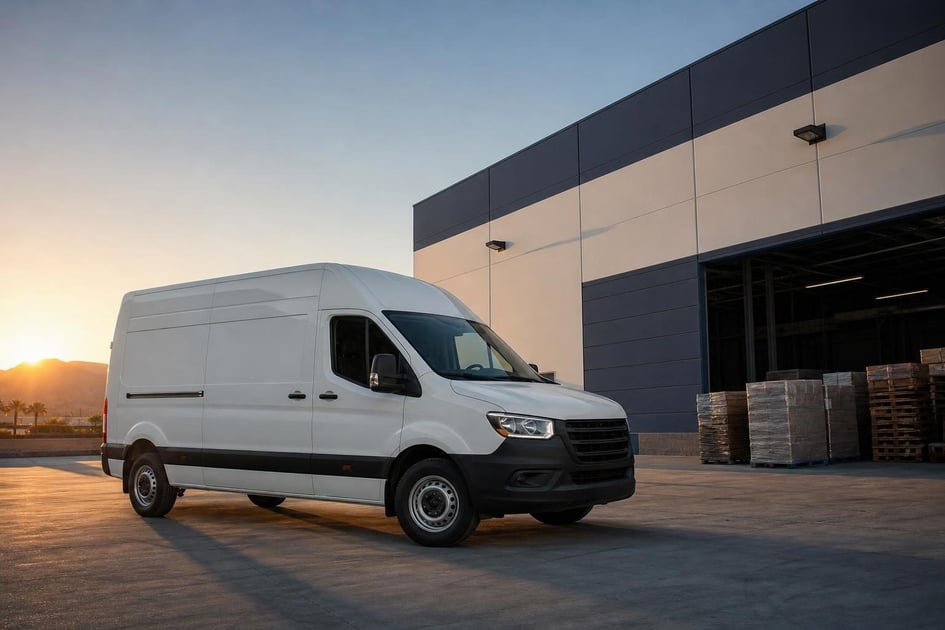
Yes. If you need a cargo van for your Arizona business, you can finance it with the van itself as collateral. That keeps rates competitive and lets you spread the cost across months instead of draining working capital. Same-day approvals are possible, and loan amounts range from $5,000 up to $5 million depending on the vehicle and your credit profile. Get a decision on your cargo van financing, possibly the same day you apply.
Arizona's economy runs on trucks and vans. From the warehouse corridors around Phoenix-Mesa Gateway Airport to the construction sites in Scottsdale and the dental supply routes in Tucson, cargo vans move tools, parts, perishables, and people. Whether you run a two-van HVAC crew or a growing last-mile fleet, the right financing structure lets you add capacity without tying up cash.
Why Arizona Businesses Depend on Cargo Vans
Arizona is not a generic Sun Belt market. The state's freight economy is shaped by cross-border trade, e-commerce warehousing, and specialized construction. According to Census Bureau data, Maricopa County alone now holds more than 4.6 million residents, while Pinal County is among the fastest-growing counties in the nation. That population growth translates into more roofs, more roads, and more deliveries. The 2026 Arizona State Freight Plan notes that transportation and warehousing employment has outpaced national averages, driven by logistics growth in Maricopa and Pinal counties. That growth translates directly into demand for reliable commercial vans.
Last-Mile Delivery in Phoenix and Tucson
Phoenix added millions of square feet of warehouse space over the past three years, concentrating distribution activity along the I-10 and Loop 202 corridors. Small-packaged freight is now the fastest-growing air cargo commodity at Phoenix Sky Harbor. Local delivery contractors need fuel-efficient cargo vans to handle high stop counts in dense neighborhoods and gated communities from Gilbert to Glendale. A refrigerated cargo van handles pharmacy deliveries and specialty foods; a standard high-roof model carries parcels and dry goods. Refrigerated Cargo Van financing works the same way as standard cargo van financing, with the equipment securing the note.
Construction and HVAC Contractors
Arizona's construction cycle runs nearly year-round, with summer heat pushing more work into early mornings and shoulder seasons. Contractors in roofing, plumbing, electrical, and HVAC need vans that carry tools, ductwork, and fittings to job sites across Maricopa County and into Pinal County's growing subdivisions. A properly upfitted service van replaces a less efficient pickup-and-trailer combination, saving fuel and cutting parking headaches on tight residential streets. Service Vans financing covers these upfitted builds because the vehicle and interior shelving count as a single equipment purchase.
Healthcare and Mobile Service Fleets
Mobile dental clinics, diagnostic services, and home health agencies operate across Arizona's sprawling metro areas and rural stretches. A passenger van conversion or a cargo van with specialized racking keeps equipment secure and clinicians comfortable between stops. These vans often cost more than standard delivery builds because of electrical inverters, climate control, and custom cabinetry, but they still fall well within the $5,000 to $5 million range that equipment finance companies serve.
Key Insight: Arizona contractors who buy vans in November and December often beat the spring rush. Fleet upfitters in Phoenix and Tucson book solid by February, and lead times on popular models stretch to eight weeks. Financing approved in Q4 lets you order before inventory tightens.
Get a fast decision on your equipment
Applying takes just a few minutes, and decisions can come as soon as the same day.
Start Your ApplicationNew vs. Used Cargo Vans — What Arizona Buyers Should Know
The new versus used decision is not just about sticker price. It affects your monthly payment, tax timing, maintenance reserve, and resale value at the end of the term.
| Factor | New Cargo Van | Used Cargo Van (2–5 Years) |
|---|---|---|
| Financing term | Up to 7 years | Usually 3–5 years |
| Interest profile | Rates vary by credit profile, equipment age and term; new units typically see the most favorable end of the range | Rates vary by credit profile, equipment age and term; older units carry slightly higher pricing |
| Warranty coverage | Full manufacturer warranty | Powertrain may remain, or you buy an extended service contract |
| Section 179 eligibility | Yes, for 2026 tax year | Yes, if purchased and placed in service in 2026 |
| Maintenance reserve | Lower in first three years | Higher; budget $1,500–$3,000 annually |
| Upfit compatibility | Latest chassis; upfitters have brackets and harnesses | Verify fitment; some older chassis lack current mounting patterns |
New Van Financing
New vans from Ford, Ram, Mercedes-Benz, and GM carry full factory warranties and the latest fuel-economy ratings. For Arizona fleets running 30,000 miles a year across desert highways, the improved efficiency and reduced downtime often justify the higher acquisition cost. Lenders view new collateral favorably, which can translate into longer terms and lower monthly obligations relative to the equipment value. If you need a specialized build, starting with a new chassis guarantees that shelving, ladder racks, and refrigeration units will fit without modification.
Used Van Financing
A two- or three-year-old cargo van with 40,000 to 60,000 miles can cost 30% to 45% less than a new equivalent. That lower capital base means a smaller loan and faster equity buildup. The trade-off is maintenance. Arizona heat is hard on batteries, tires, and air conditioning compressors. A used van may need immediate service, so budget for those costs outside the loan. Lenders will still finance used units, but the term shortens as the vehicle ages. A five-year-old van rarely qualifies for more than a three-year note.
Pro Tip: Before you finance a used cargo van in Arizona, pull a vehicle history report and have a diesel or fleet mechanic inspect the cooling system. Desert heat kills radiators and AC compressors, and replacing either on a Sprinter or Transit can top $2,500. That inspection is cheap insurance against a bad collateral decision.
Lease vs. Loan for Cargo Vans
The financing structure matters almost as much as the vehicle. Arizona owner-operators should understand the difference between an equipment loan and a lease before signing.
Equipment Loans
A loan puts the title in your name immediately. You depreciate the van over its useful life and may deduct interest expense. At the end of the term, you own the equipment outright with no balloon payment. This works well for contractors who plan to run a van for eight to ten years or who want the flexibility to upfit without lender restrictions. Cargo Vans financing through an equipment loan typically covers the vehicle, upfit, and delivery fees in a single note.
Fair Market Value Leases
A fair market value lease is essentially a rental with a purchase option at the end. Monthly payments are lower than a loan because you are only paying for the portion of the vehicle's value used during the lease term. At the end, you can return the van, buy it at fair market value, or extend the lease. This structure suits delivery fleets that refresh equipment every three to four years to avoid maintenance risk and preserve warranty coverage.
$1 Buyout Leases
A $1 buyout lease looks like a loan for tax purposes but is structured as a lease on paper. You make fixed payments and own the van for one dollar at the end. This is useful if your accountant wants you to take accelerated depreciation in year one while keeping payments predictable. Ask your CPA whether a $1 buyout lease or a traditional loan makes more sense for your 2026 tax position.
By the Numbers: A $45,000 cargo van financed over five years on a loan might carry a monthly payment roughly in the high $800s to low $1,000s, depending on credit and term. The same van on a four-year fair market value lease could run in the mid $600s to mid $800s monthly, but you would owe a residual payment or return the unit at the end. Rates vary by credit profile, equipment age and term.
Find the right financing structure
Tell us about the equipment you need and we will show you the options that fit your business.
See Your OptionsQualifying for Cargo Van Financing in Arizona
Equipment lenders underwrite the business, the equipment, and the credit profile together. You do not need perfect credit, but you do need to show that the van will generate revenue and that your business can support the payment. The U.S. Small Business Administration publishes resources on preparing financial documentation, which can help first-time borrowers organize their files before applying.
Credit and Time in Business
Most equipment finance companies prefer two or more years in operation, though some will work with younger businesses if the owner has strong personal credit or significant industry experience. A FICO score in the mid-600s or higher generally opens competitive terms. Below that, financing is still available, but expect a larger down payment or a shorter term. Bankruptcy or recent repossessions make approval harder, though not always impossible if you can explain the circumstances and show current cash flow.
Documentation You'll Need
Have these ready before you apply:
- Business tax returns for the past two years
- Current year profit and loss statement
- Bank statements for the past three to four months
- Copy of the invoice or quote for the cargo van
- Driver's license and proof of insurance
If you are buying from a private seller rather than a dealership, the lender may require an independent appraisal or a bill of sale with a VIN-specific description.
What Happens After Approval
Once approved, the lender issues a purchase order or funds directly to the seller. You take delivery, insure the van with the lender listed as loss payee, and start making payments. The whole process can move quickly. Start an application in a few minutes and see what financing structure fits your cargo van purchase. Many Arizona buyers close within 24 to 48 hours if the documentation is complete and the seller is responsive.
Tax Treatment for the 2026 Tax Year
The tax benefits of buying a cargo van can be substantial, but the rules change, and the details belong in front of a CPA.
For the 2026 tax year, Section 179 allows businesses to deduct the full purchase price of qualifying equipment up to a specified dollar limit in the year it is placed in service. Cargo vans with a gross vehicle weight rating above 6,000 pounds generally qualify. The exact 2026 limit will be indexed for inflation from the prior year. If you are reading this before the IRS releases the final 2026 figure, plan qualitatively: the deduction is designed to encourage capital investment, and vans used more than 50% for business are eligible. Consult your CPA for the precise 2026 limit and income requirements.
Bonus depreciation may also apply in 2026, though it has been phasing down from the 100% level allowed in earlier years. Again, the exact percentage for 2026 depends on federal guidance. Your CPA can model whether Section 179, bonus depreciation, or standard MACRS depreciation produces the best outcome for your business. Do not guess at these numbers; a wrong election can cost you thousands.
Pro Tip: If you buy a cargo van in December 2026 and place it in service before December 31, you can claim the 2026 deduction. If delivery slips to January, the deduction moves to 2027. Arizona dealers near year-end often have incentive stock, but do not let tax urgency push you into the wrong vehicle. See what financing you qualify for on that cargo van so you can order early and still close by year-end.
Common Mistakes Arizona Buyers Make
Buying Before Financing Is Set
It is easy to fall in love with a van on the lot and assume financing will follow. That assumption can backfire. The seller may not wait while you gather tax returns, or you may discover that the used van you picked does not meet the lender's collateral requirements. Secure your approval or at least a conditional approval before you commit to the purchase. This also gives you leverage in price negotiation.
Underestimating Upfitting Costs
Shelving, ladder racks, refrigeration units, and electrical systems can add $5,000 to $25,000 to the base vehicle price. If you only finance the van and pay cash for the upfit, you strain working capital. A better approach is to roll the upfit into the equipment loan so the entire build is amortized over the term. Just make sure the lender knows the total project cost upfront.
Ignoring Seasonal Demand
Arizona's economy has seasonal rhythms. Landscaping and pool service vans sell quickly in February and March. HVAC vans move in May as temperatures climb. If you shop during peak season, selection is thin and prices firm. Shop in late fall or early winter for the best combination of inventory and negotiating room.
Ready to move forward?
More than 10,000 businesses have financed equipment with Provide Capital. See what you qualify for today.
Get StartedFrequently Asked Questions
Can I finance a cargo van if my business is less than two years old?
Yes, though terms may be tighter. Lenders will look at your personal credit, industry experience, and current revenue. A strong down payment or a co-signer can help.
Do you finance private-party sales, or only dealerships?
Both. Private-party sales require additional documentation, such as a bill of sale and often an independent appraisal, but the rates and structures are similar.
Can I include shelving and refrigeration in the same loan?
Yes. Equipment loans cover the vehicle plus permanently attached upfits. Just provide a single invoice or a detailed quote showing the van and the equipment together.
What credit score do I need for cargo van financing?
There is no hard cutoff. Mid-600s and above generally see the most favorable range of rates and terms. Below that, expect to put more money down or accept a shorter term. Rates vary by credit profile, equipment age and term.
How long does approval take?
Many applications receive a decision within hours. Same-day approvals are possible when the file is complete. Funding usually follows within 24 to 48 hours after approval and document verification.
Can I pay off the loan early?
Most equipment loans allow early payoff, but some carry a prepayment penalty or a minimum interest charge. Read the loan agreement carefully and ask your representative to explain the payoff structure before you sign.
Is a cargo van eligible for the 2026 Section 179 deduction?
Generally yes, if the van's gross vehicle weight rating exceeds 6,000 pounds and it is used more than 50% for business. The exact 2026 dollar limit is set by the IRS. Consult your CPA before you rely on the deduction for cash-flow planning.
Do you finance Sprinter vans and high-roof Transit models?
Yes. Sprinter Van financing and Transit financing are both available, including high-roof and extended-wheelbase configurations. These models are popular with Arizona contractors because of their cargo capacity and standing room.
What to Do Next
Cargo van financing in Arizona is straightforward when you work with a lender that understands equipment. Whether you need a single high-roof Transit for a plumbing crew or a five-van refrigerated fleet for cross-valley delivery, the equipment itself secures the financing. That keeps rates competitive and lets you preserve cash for payroll, fuel, and growth.
Gather your last two tax returns, a current profit and loss statement, and the quote for the van you want. Then start an application in a few minutes and get a decision on your Arizona cargo van financing. Same-day approvals are possible, and you can be on the road before your competitors finish shopping.
For broader context on how equipment financing fits into the transportation sector, see our overview of Transportation equipment financing. And if your routes carry perishables through the desert heat, explore Refrigerated Cargo Van financing to protect both your product and your margins.
Sources: Reuters business coverage of logistics and transportation trends; U.S. Census Bureau population and business data; SBA guidance on small business financial preparation.
Disclaimer: The information provided in this article is for general educational purposes only and is not financial, legal, or tax advice. Funding terms, qualifications, and product availability may vary and are subject to change without notice. Provide Capital does not guarantee approval, rates, or specific outcomes. For personalized information about your business funding options, contact our team directly.
