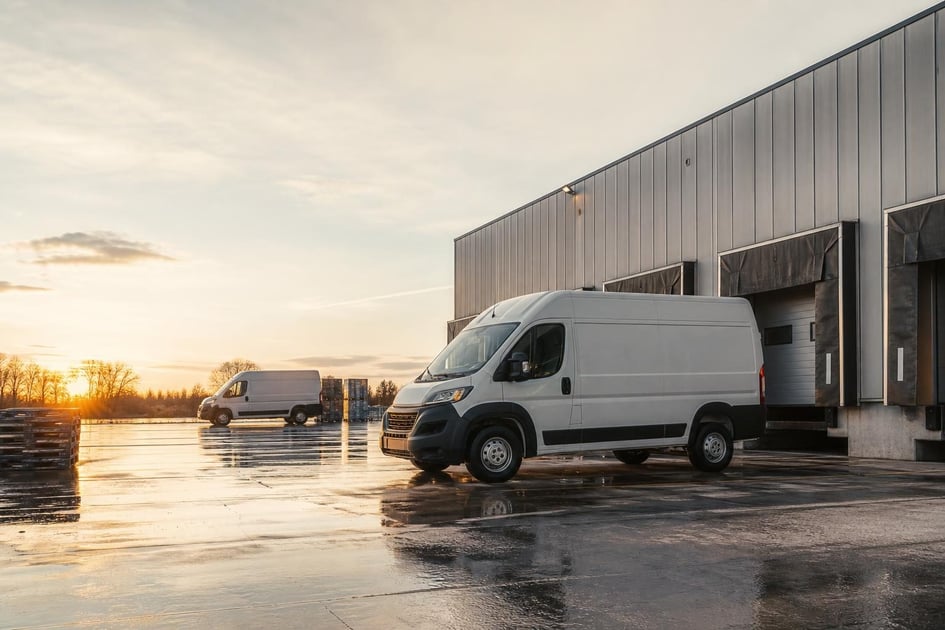
Financing a cargo van for your small business typically means securing a term loan or equipment lease where the vehicle itself serves as collateral. You can finance new or used vans, often with minimal down payment, and receive a decision the same day if your documentation is complete. Rates vary by credit profile, equipment age and term, and most lenders prefer to work with businesses that have at least two years of operating history.
Key Insight: Many owner-operators assume they need a 20% down payment to finance a commercial vehicle. In practice, first-payment-only structures are common for qualified buyers financing vans under $50,000, because the collateral is straightforward to value and remarket.
What Cargo Van Financing Actually Covers
Cargo van financing is not limited to the chassis alone. Lenders understand that a bare van rarely generates revenue on its own. Most equipment finance agreements can bundle the vehicle, upfit packages, shelving, refrigeration units, ladder racks, and graphics into a single monthly payment. This is especially useful for contractors, delivery services, and mobile medical providers who need a turnkey solution.
At Provide Capital, we structure Cargo Vans financing for transactions ranging from $5,000 to $5 million. A single high-roof cargo van with interior buildouts usually falls between $35,000 and $65,000, while a small fleet of three to five units can quickly reach $200,000 or more. The equipment itself secures the note, which helps keep financing accessible even if your business carries existing debt.
New vs. Used Vans
New cargo vans offer the latest fuel-efficiency standards, full manufacturer warranties, and longer useful lives. Lenders typically extend terms up to 84 months on new units, which lowers the monthly payment but increases total interest paid over time. Because new vehicles depreciate rapidly in the first 24 months, some borrowers find themselves underwater if they need to sell early. Analysis from Forbes on fleet acquisition strategies notes that buyers who track total cost of ownership often prefer slightly used units to avoid the steepest depreciation curve.
Used vans, particularly those two to four model years old, often represent the best value. They have already absorbed the steepest depreciation, yet usually remain under powertrain warranty. Financing terms on used commercial vehicles generally run 36 to 60 months depending on mileage and condition. A used 2023 Ford Transit 250 with 40,000 miles might price at $32,000 compared to $48,000 new, which materially reduces your monthly obligation.
Upfits and Modifications
If you need interior shelving, partition walls, or a refrigeration unit, consider wrapping those costs into the financing package. Separating the van purchase from the upfit financing often creates a paperwork headache and two different payment schedules. A bundled equipment finance agreement simplifies bookkeeping and may improve your effective rate because the total collateral package is larger.
Pro Tip: Order your upfit package before the lender funds the deal. If you add $8,000 in shelving and refrigeration three months after closing, you will likely need a separate unsecured loan or credit line at a higher rate because the original lien already covers the vehicle.
Already have a machine in mind?
Provide Capital finances new and used equipment from $5,000 to $5 million, with same-day decisions possible.
Apply NowHow the Financing Process Works
The application process for commercial vehicle financing is more straightforward than many owner-operators expect. Because the collateral is titled, insured, and easy to value, lenders can move quickly once they verify your business financials.
Application and Approval Timeline
Most applications start with a one-page credit application and a quote or invoice for the specific van. For requests under $150,000, many lenders offer streamlined underwriting that reviews your business bank statements and a personal credit report. Same-day approvals are possible when the file is clean and the requested documentation arrives before noon.
Larger requests—those approaching $500,000 or more—may require two years of business tax returns, a current year-to-date financial statement, and a debt schedule. Even then, a well-organized borrower can often move from application to funding in 48 to 72 hours. Delays usually stem from incomplete paperwork or title issues on a used vehicle, not from the credit decision itself.
Documentation You'll Need
Having your documents ready before you apply eliminates the back-and-forth that slows deals. Expect to provide:
- A completed credit application
- Business bank statements for the last three to six months
- A quote or purchase agreement from the dealer or private seller
- Proof of insurance listing the lender as loss payee
- Business tax returns for the prior two years (on larger transactions)
- A copy of your driver's license and, in some cases, a commercial driver's license
The Small Business Administration advises owners to maintain organized financial records before seeking equipment financing, because incomplete documentation is the most common cause of funding delays. If you are purchasing from a private party rather than a dealership, the lender will also require a title search to verify no existing liens. Private-party transactions add 24 to 48 hours to the timeline while the title clears.
By the Numbers: A delivery contractor in Ohio recently financed two used Mercedes-Benz Sprinter 2500 vans at $38,500 each. With a 60-month term and rates varying by credit profile, equipment age and term, the total monthly payment fell under $1,600. The collateral-backed structure meant no additional business assets were pledged.
Leasing vs. Buying: Which Fits Your Business?
Choosing between a loan and a lease depends on how long you plan to keep the van, how many miles you drive annually, and whether you want to claim depreciation on your tax return.
An equipment finance agreement (EFA) functions like a loan: you own the van at the end of the term, and the lender releases its lien. A true lease, sometimes called a fair market value lease, gives you lower monthly payments but requires you to return the vehicle or buy it at the residual value when the term ends. The residual on a three-year-old cargo van with 90,000 miles is often 35% to 45% of the original cost.
| Factor | Equipment Finance Agreement (Loan) | Fair Market Value Lease |
|---|---|---|
| Ownership | You own the van after final payment | Return or purchase at residual value |
| Monthly Payment | Higher; you are paying off full cost | Lower; you pay for use, not full value |
| Mileage Limits | None | Typically 20,000 to 30,000 per year |
| Customization | No restrictions | Limited; must be removable |
| Tax Treatment | Depreciation and interest deduction | Lease payments deductible as expense |
| End-of-Term | Free and clear title | Balloon payment or walk away |
For a courier logging 35,000 miles per year, a loan is usually the better fit because mileage penalties on a lease would erode the monthly savings. For a local florist making eight stops a day within a ten-mile radius, a lease keeps payments low and allows a new van every three years.
If you are unsure which structure aligns with your cash flow, talk to a specialist about your specific van and mileage needs. An experienced equipment finance team can model both scenarios side by side before you sign.
What Qualifies You for Cargo Van Financing?
Lenders evaluate three core factors: credit history, time in business, and the cash flow available to service the new payment. No single factor is disqualifying on its own, but weakness in one area usually requires strength in another.
Credit Profile
Personal credit scores above 680 generally unlock the best terms and lowest down payment requirements. Scores in the 620 to 679 range are still financeable, though you may need to provide a larger down payment or a shorter term. If your score is below 620, lenders will focus heavily on your business cash flow and may cap the advance at 80% of the van's value.
Bankruptcies discharged within the last two years make approval more difficult, but they are not an automatic denial if your business has since generated consistent revenue and you can explain the circumstances. Recent late payments on existing vehicle debt are a bigger red flag than an older bankruptcy.
Time in Business
Most equipment lenders prefer at least two years of operating history because it demonstrates you can survive seasonal cycles and economic fluctuations. Companies operating under two years face higher scrutiny, and many lenders require a personal guarantee plus a 15% to 20% down payment until a longer track record is established. If you have strong industry experience—say, fifteen years as a fleet manager before opening your own delivery company—underwriters may relax the time-in-business requirement.
Down Payment and Collateral
Because the cargo van itself serves as collateral, many transactions close with little to no money down beyond the first monthly payment. However, a down payment of 10% to 15% almost always improves your rate and reduces the likelihood that you will owe more than the van is worth in the first eighteen months. For used vans over five years old or with more than 100,000 miles, expect a minimum down payment of 10% to offset the lender's resale risk.
Find the right financing structure
Tell us about the equipment you need and we will show you the options that fit your business.
See Your OptionsTax Treatment for the 2026 Tax Year
Business owners should understand the tax implications of their financing choice before they close. Under the 2026 tax year rules, Section 179 allows you to deduct the full purchase price of qualifying equipment in the year you place it in service, subject to annual limits. Bonus depreciation is also available, though the percentage has stepped down from prior years. The exact 2026 Section 179 limit and bonus depreciation percentage are set by the IRS; consult a CPA to confirm the current figures and how they apply to your specific tax situation.
If you finance the van through an equipment loan, you can typically claim Section 179 or bonus depreciation on the full equipment cost even if you have not yet paid off the balance. You may also deduct the interest portion of your monthly payments. With a true lease, you generally deduct the lease payments as a business expense rather than depreciating the asset. Both paths reduce taxable income, but the timing and cash-flow impact differ.
Key Insight: Placing a van in service on December 31 versus January 1 changes which tax year claims the deduction. If you are near the 2026 Section 179 threshold and expecting a strong year, accelerating delivery by one day could meaningfully reduce your tax bill, but only if your CPA confirms you have taxable income to absorb the write-off.
Cost Examples and Monthly Payment Ranges
Below are realistic scenarios for owner-operators considering cargo van financing. These figures assume rates vary by credit profile, equipment age and term, and are intended only as directional guidance.
Scenario A: Single New Mid-Roof Cargo Van
- Equipment cost: $46,000
- Term: 60 months
- Estimated monthly payment: $850 to $1,050
Scenario B: Single Used Cargo Van (Three Years Old)
- Equipment cost: $31,000
- Term: 48 months
- Estimated monthly payment: $720 to $880
Scenario C: Small Fleet (Three New Vans with Shelving)
- Equipment cost: $165,000
- Term: 72 months
- Estimated monthly payment: $2,600 to $3,100
These ranges exclude sales tax and registration, which vary by state. Some lenders allow you to finance soft costs like delivery fees and initial insurance premiums; others cap the advance at 100% of the invoice price. Ask your lender what is included before you compare quotes.
Industry-Specific Use Cases
Cargo vans are the backbone of several industries that rely on predictable local routes and protected cargo. The right configuration depends on what you haul and where you stop.
Delivery and Last-Mile Logistics
E-commerce growth has turned cargo vans into the standard vehicle for last-mile delivery. According to U.S. Census Bureau retail trade data, online sales continue to claim a growing share of total commerce, which increases demand for localized delivery fleets. A high-roof Ford Transit or Ram ProMaster offers 6 feet 4 inches of interior standing height, which reduces driver fatigue during 100-stop days. Transportation equipment financing is designed for exactly this use case, letting couriers add vehicles as they win new routes rather than waiting until they have cash on hand.
Last-mile operators should prioritize vans with automatic emergency braking and backup cameras. Insurance carriers increasingly discount premiums for fleets with advanced driver-assistance systems, and those savings compound across five to ten vehicles.
HVAC and Trade Services
Plumbers, electricians, and HVAC technicians need more than empty cargo space. Interior shelving, parts bins, and lockable drawers keep inventory organized and reduce the time spent searching for fittings on a job site. A refrigerated cargo van is unnecessary for most trades, but a climate-controlled cabin protects temperature-sensitive adhesives and sealants in extreme weather. Service Vans financing can bundle the vehicle and upfit into one agreement.
Mobile Healthcare
Mobile vaccination units, dental hygienist vans, and veterinary clinics convert cargo vans into rolling exam rooms. These builds require electrical inverters, fresh water tanks, and medical-grade surfaces. Because the equipment value inside the van can equal or exceed the chassis cost, lenders treat these as specialized medical equipment transactions rather than standard vehicle loans. Expect to provide detailed build specifications and proof of liability insurance covering mobile medical services.
Common Mistakes to Avoid
Even experienced business owners make predictable errors when financing commercial vehicles. Avoiding these pitfalls saves money and frustration.
Buying based on monthly payment alone. A 72-month term on a used van with 80,000 miles means you may still owe payments after the vehicle needs major drivetrain work. Match the term to the van's expected reliable lifespan.
Skipping a pre-purchase inspection on used units. A clean Carfax is not a mechanical guarantee. Have a diesel or commercial vehicle mechanic inspect the transmission, turbo, and rear differential before you commit.
Failing to verify GVWR requirements. A half-ton cargo van cannot legally haul what a three-quarter-ton model can. Overloading leads to premature brake and suspension wear, and your insurer may deny claims if the van was operated above its rated capacity.
Neglecting to shop the insurance early. Commercial auto insurance for a cargo van used for business purposes costs substantially more than a personal auto policy. Get a binder quote before you apply for financing so the lender can verify coverage and you can budget accurately.
Forgetting to title the van in the business name. Titling a commercial vehicle in your personal name and then trying to deduct the payments creates a tax and liability mess. Complete the title work correctly at purchase, even if the lender requires a personal guarantee.
Ready to move forward?
More than 10,000 businesses have financed equipment with Provide Capital. See what you qualify for today.
Get StartedFrequently Asked Questions
Can I finance a cargo van with bad credit?
Yes, but expect a larger down payment and a shorter term. Most lenders can approve scores in the low 600s if your business bank statements show steady deposits. Below 600, you may need to add a co-signer or collateralize additional equipment.
How long does approval take?
For transactions under $150,000 with complete paperwork, same-day approvals are possible. Larger deals or requests requiring tax returns typically take 24 to 72 hours. Private-party purchases add time for the title search.
Do I need a commercial driver's license?
For vans with a gross vehicle weight rating under 26,000 pounds, a standard driver's license is sufficient in most states. If you are towing a heavy trailer or the loaded van exceeds 26,000 pounds, a commercial driver's license may be required.
Can I finance the upfit and graphics?
Yes. Most equipment finance agreements allow you to roll shelving, refrigeration, ladder racks, and wrap graphics into the same note. The total financed amount must remain within the lender's advance guidelines relative to the van's value.
What happens if I want to pay off the loan early?
Most equipment finance agreements allow early payoff, but some include a prepayment penalty or a minimum interest charge. Ask for the prepayment language in writing before you sign. A loan with no prepayment penalty gives you flexibility if you sell the business or replace the van sooner than expected.
Is a down payment always required?
No. Many cargo van transactions close with first-payment-only due at signing for qualified borrowers. However, a down payment of 10% to 15% improves your rate and protects you from negative equity.
Can I buy from a private seller?
Yes, but the lender will require a clean title and may order a vehicle history report. You will also need to arrange an independent inspection. Dealership purchases are simpler because the dealer handles title and lien perfection directly.
Does the van have to be new?
No. Used cargo vans are commonly financed, often with favorable terms up to five or six model years old. The lender will cap the term based on mileage and age to ensure the loan does not outlast the van's useful life.
Ready to Add a Cargo Van to Your Fleet?
The right cargo van keeps your crew efficient, your cargo protected, and your customers satisfied. Whether you need one refrigerated unit for pharmaceutical delivery or a fleet of service vans for your HVAC expansion, equipment financing lets you put the vehicle to work immediately while preserving cash for payroll and fuel.
Gather your bank statements, insurance quote, and vehicle invoice, then get a same-day decision on your equipment. A specialist can review your scenario, compare loan and lease structures, and lock in terms before the van you want sells to another buyer.
For businesses moving goods or services across town every day, waiting until you have saved the full purchase price means leaving revenue on the table. See what you qualify for and take the next step toward expanding your fleet.
Disclaimer: The information provided in this article is for general educational purposes only and is not financial, legal, or tax advice. Funding terms, qualifications, and product availability may vary and are subject to change without notice. Provide Capital does not guarantee approval, rates, or specific outcomes. For personalized information about your business funding options, contact our team directly.