
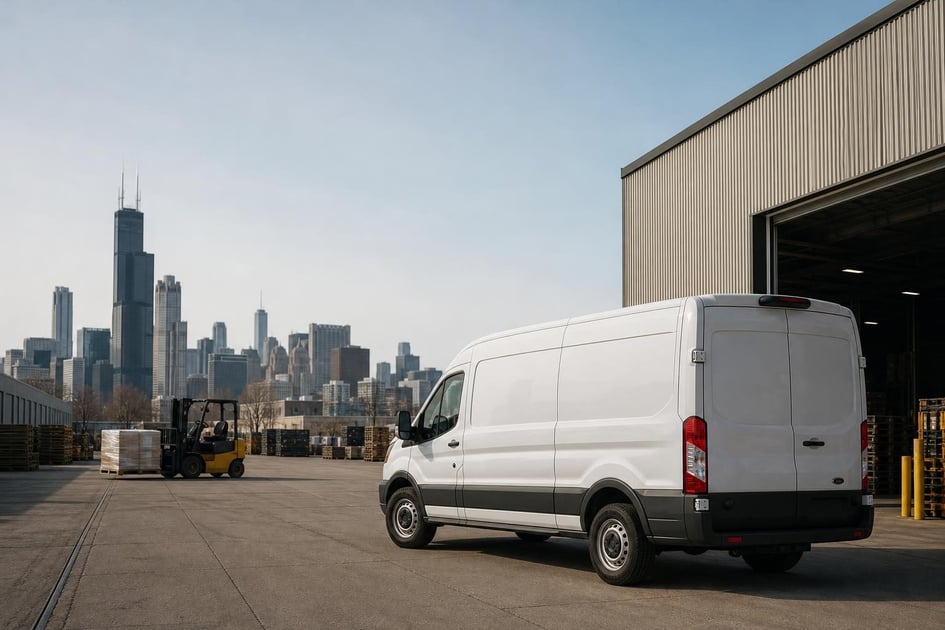
Cargo Vans Financing in Illinois
Financing a cargo van in Illinois means turning a major equipment purchase into a predictable monthly payment while the vehicle starts earning the same week. Whether you run a three-truck HVAC crew in Naperville, a last-mile delivery route through Chicago's South Side, or a mobile repair operation serving farms downstate, the right financing structure keeps your cash reserves intact and your fleet growing. Provide Capital finances new and used cargo vans from $5,000 up to $5 million, using the equipment itself as collateral to keep rates competitive. Same-day approvals are possible once your documentation is in order, and we serve businesses statewide from the Wisconsin line to the Kentucky border.
If you are comparing quotes on a Ford Transit, Mercedes-Benz Sprinter, or Ram ProMaster, see what financing you qualify for on that van before you commit to a purchase price. Knowing your approved term and down payment lets you negotiate with the dealer as a cash buyer.
Already have a machine in mind?
Provide Capital finances new and used equipment from $5,000 to $5 million, with same-day decisions possible.
Apply NowWhy Illinois Businesses Choose Cargo Vans Over Pickups or Box Trucks
Illinois presents a specific set of constraints that make the cargo van the workhorse of choice for owner-operators. In Cook County and the Chicago collar counties, parking footprint matters. A standard cargo van fits a residential driveway or a tight commercial loading dock in ways a box truck cannot. For contractors working inside the city limits, the maneuverability on narrow streets and alleyways translates directly into billable hours saved. The U.S. Census Bureau tracks business density across the state, and the concentration of service firms in the Chicago-Naperville-Elgin metro explains why compact commercial vehicles dominate local fleets.
Downstate, the math changes but the van still wins. A technician driving from Springfield to service accounts in Decatur, Peoria, and Champaign needs enclosed cargo space to protect tools and inventory from road grime and weather. Unlike an open pickup bed, a Cargo Vans financing arrangement gives you lockable, weatherproof storage with a vehicle that does not require a commercial driver's license for most configurations under 10,000 pounds GVWR.
Seasonal patterns in Illinois also drive the decision. HVAC contractors see demand spike in July and again in January, when polar vortex events push furnaces to their limits. Catering companies run hard from May through October, when Chicago's festival season, suburban wedding schedules, and county fair circuits overlap. A financed van lets you scale into those peaks without draining the operating account during slow months. Landscapers in Lake County and roofers in the Rockford area face the opposite cycle: frantic spring and summer schedules followed by winter hibernation. Financing preserves the cash you need to make payroll in December when the snow flies.
Choosing the Right Van for Illinois Roads and Weather
The three dominant models in the Illinois market are the Ford Transit, Mercedes-Benz Sprinter, and Ram ProMaster. Each carries different implications for financing, maintenance, and resale.
The Ford Transit offers the broadest dealer network in Illinois, which matters when you need service in a hurry. Ford's commercial truck centers are scattered from Schaumburg to Marion, and parts availability is excellent. Transits also hold resale value well in the Midwest, which improves the collateral position for your lender and may qualify you for slightly better terms.
The Mercedes-Benz Sprinter commands a higher purchase price but offers diesel efficiency and a reputation for longevity. For owner-operators logging 30,000 miles a year on I-55 and I-80, the fuel savings add up. The downside is service cost. Sprinter specialists are fewer and farther between outside Chicago and St. Louis, so a breakdown in Quincy or Carbondale can mean a tow to the nearest authorized center.
The Ram ProMaster sits at the value end of the spectrum. Its front-wheel-drive layout performs adequately in light snow, though it lacks the traction of rear-wheel or all-wheel-drive competitors. For urban delivery routes where pavement is clear within 24 hours of a storm, this is acceptable. For rural routes on gravel township roads, it is less ideal.
Illinois buyers should also pay attention to roof height. Chicago's downtown parking garages often cap clearance at six feet eight inches. A high-roof van that cannot fit into your client's garage is a liability, not an asset. Measure your typical job site before you commit to a high-roof configuration.
Key Insight: Illinois fleet managers report that vans with factory-applied galvannealed steel bodies hold up roughly 30 percent longer in downstate salt conditions than standard steel panels. If you are buying used, ask the seller for the build sheet to confirm the body material before you finance. A van that rusts through in year four destroys the value you are paying down.
New vs. Used Cargo Vans: A Practical Breakdown
New vans carry full manufacturer warranties, up-to-date telematics, and lower maintenance reserves for the first three years. For a business with established revenue and predictable route density, new makes sense. You avoid downtime, you know the service history from mile one, and you can often negotiate fleet pricing if you buy two or more units. A new van also qualifies for the full Section 179 deduction in the 2026 tax year, subject to IRS limits, because there is no prior depreciation to consider.
Used cargo vans, typically two to four model years old, slash the financed amount and can shorten the term. A $28,000 used Ford Transit financed over 36 months carries a lower total cost than a $52,000 new unit over 60 months, even after accounting for slightly higher maintenance. For a new route you are testing, or for a second vehicle that only runs three days a week, used is often the smarter leverage. The Small Business Administration publishes guidance on managing equipment lifecycle costs that applies directly to this decision.
The Illinois climate should factor heavily into your choice. Road salt used from November through March accelerates undercarriage corrosion. A used van imported from a southern state may look clean on the lot but have hidden frame issues from humidity or hurricane flooding. Conversely, a one-owner Illinois fleet vehicle with documented undercoating and wash records can be a better bet than a cosmetically cleaner out-of-state unit. Always insist on a frame inspection by an independent mechanic before you close on a used van in this state.
Leasing vs. Financing: Which Structure Fits Your Operation?
The choice between a lease and an equipment loan comes down to mileage, customization, and balance-sheet preference. With a loan, you own the van outright at the end of the term. You can upfit the interior with custom shelving, refrigeration, or ladder racks without worrying about return conditions. You also build equity in an asset you can sell or trade when you need the next unit.
A lease typically offers a lower monthly payment but imposes mileage caps and wear-and-tear clauses. If you drive 35,000 miles a year across Illinois Interstate corridors, overage charges can erase the monthly savings. Leases also restrict modifications; remove a partition wall or install a specialized rack, and you may face penalties at turn-in.
| Factor | Equipment Loan | Operating Lease |
|---|---|---|
| Ownership at end | Yes — you hold the title | No — return or buy at residual |
| Monthly payment | Higher, but builds equity | Lower, but no equity |
| Mileage limits | None | Strict annual caps |
| Upfit/Customization | Unlimited | Restricted or prohibited |
| Tax treatment | Depreciation + interest deduction | Payment expensing (with limits) |
| Best for | High-mileage, custom upfit, long-term hold | Short-term needs, frequent turnover |
For most Illinois owner-operators who plan to keep a van five years or more, the equipment loan wins. The state's mix of urban stop-and-go traffic and long highway hauls puts serious wear on vehicles, so holding onto a well-maintained van until year six or seven often beats the lease turnover cycle. If you need a temporary capacity spike — say, a six-month contract delivering medical supplies to Rockford clinics — a short-term lease may be worth exploring. Get a decision on your equipment, possibly the same day, and we can structure either product around your tax and cash-flow goals.
Qualification Criteria: What Underwriters Actually Review
Provide Capital looks at three pillars: credit history, business revenue, and the equipment itself. You do not need a perfect credit score. We finance A-through-D credit tiers, and because the cargo van serves as collateral, the deal is secured by the asset rather than your personal real estate.
Time in business matters. Two years or more of filed tax returns makes the file straightforward. Businesses with less than one year of revenue history face tighter scrutiny, and we generally do not write startup-only deals. If you have twelve to twenty-four months of operation, expect to provide a larger down payment or a stronger personal guaranty.
Revenue consistency is critical in Illinois, where winter slowdowns hit construction and outdoor service trades hard. Underwriters want to see that your bank accounts can handle a slow February and still cover the payment. We typically look for the proposed monthly payment to stay below a reasonable percentage of monthly gross revenue, though exact ratios vary by credit profile, equipment age, and term.
The equipment must be commercially titled or titled to the business entity. Personal-use vans do not qualify. We also require a clear description of the intended use — delivery, service, transport — because that affects residual value and insurance requirements. The van's age and mileage must fit our collateral guidelines; generally, vans older than ten model years or with more than 150,000 miles require exception approval.
Pro Tip: If your business is seasonal, request a skip-payment structure at origination. Some Illinois landscaping and paving contractors arrange for no payments in January and February, when snow and frozen ground shut down operations. Building this into the note upfront is easier than restructuring later, and it protects your credit during the off-season.
Tax Treatment for the 2026 Tax Year
Under Section 179 of the Internal Revenue Code for the 2026 tax year, you may be able to deduct the full purchase price of a qualifying cargo van in the year you place it into service, subject to annual limits and business-income thresholds. Bonus depreciation may also apply depending on the van's gross vehicle weight rating and your business's taxable income position. Because IRS figures adjust annually for inflation, you should confirm the exact 2026 limits with a CPA before you structure your purchase.
If you finance the van rather than pay cash, you still claim the depreciation or Section 179 deduction as if you bought it outright. You also deduct the interest portion of each payment as a business expense. This dual benefit — full equipment write-off plus interest deduction — is one reason equipment financing remains popular even for businesses that have the cash to buy outright. Your CPA can model whether Section 179 or bonus depreciation yields the better outcome for your 2026 return, especially if you are near the phase-out threshold.
Illinois state tax treatment follows federal depreciation schedules in most cases, but the state does not conform automatically to every federal incentive. Check with your accountant to see if the state Section 179 cap differs from the federal treatment for the 2026 tax year.
See what you qualify for
The equipment itself secures the financing, which keeps rates competitive. Checking your options takes minutes.
Check Your OptionsIllinois Industries Putting Cargo Vans to Work
Illinois's economy is not monolithic. The vehicle that serves a downtown Chicago courier is not the same one a Marion electrician needs. Here is how different trades use financed cargo vans across the state.
HVAC and Mechanical Contractors
Heating and cooling crews in the Chicago metro and downstate corridors run vans stocked with furnaces, coils, refrigerant, and sheet-metal tools. A high-roof cargo van with interior rack systems keeps parts organized and protects them from temperature swings. For crews that handle restaurant refrigeration, Refrigerated Cargo Van financing adds a cold-chain capability that opens doors to institutional kitchen contracts. In January, when boiler failures spike across the lake-effect snow belts, having the right parts on the truck is the difference between a one-hour service call and a lost customer.
Last-Mile Delivery and Logistics
With distribution hubs in Joliet, Rochelle, and the I-55 corridor, Illinois is a logistics state. Independent contractors delivering for regional parcel networks need vans that meet fleet vehicle specifications while remaining affordable for a single owner-operator. Transportation equipment financing through Provide Capital covers these units, whether you are buying one van or adding a fourth to your delivery route. The rise of e-commerce fulfillment, tracked by Reuters and other business outlets, has kept demand for local delivery capacity strong even as national freight trends fluctuate.
Electrical, Plumbing, and General Service Trades
Service Vans financing is built for tradespeople who treat the vehicle as a mobile warehouse. Electricians running conduit, wire, and panels need deep shelves and conduit carriers. Plumbers carry PVC, copper, and fittings that must stay dry and secure. A properly upfitted cargo van reduces the number of trips back to the shop, which matters when your shop is in Waukegan and your job site is in Arlington Heights. Time spent on I-94 or the tollway is time you cannot bill.
Mobile Medical and Diagnostic Services
Mobile phlebotomy, veterinary vaccination clinics, and dental equipment transport all use cargo vans as controlled environments. The flat load floor and stand-up interior of a Sprinter or Transit make patient and equipment access easier than a low-roof alternative. These operators often need climate control that maintains a narrow temperature band, which adds to the upfit cost but is essential for compliance.
Real-World Cost Scenarios
The following examples illustrate how financing structures work at common price points. Rates vary by credit profile, equipment age, and term, so treat these as directional illustrations, not quotes.
By the Numbers: A $35,000 used cargo van on a 48-month term might land in the mid-three-figure monthly range for a borrower with strong credit and two years in business. A $55,000 new high-roof van on a 60-month term could run in the low-to-mid-four-figure range. For a $75,000 refrigerated unit with a upfit, expect a 60-month payment in the upper four figures, with the refrigeration unit financed together with the chassis. A $5,000 down payment on the used unit or a $10,000 down payment on the new unit would reduce those payments accordingly.
Down payments typically range from zero to 20 percent depending on credit tier and equipment type. Used vans older than seven model years or with more than 100,000 miles may require a larger down payment or a shorter amortization because residual value is harder to predict. Borrowers in the strongest credit tiers can sometimes finance 100 percent of the van plus soft costs like delivery and initial registration.
Do not forget the cost of commercial auto insurance, which in Illinois runs higher than personal coverage. Cook County registrations and city vehicle stickers add recurring fees. If you plan to operate inside Chicago proper, check whether your route crosses into Evanston or other home-rule municipalities with their own sticker requirements. Illinois tolls on the Jane Byrne Interchange, the Tri-State Tollway, and the I-PASS system add up for drivers covering the metro daily. Budget $150 to $300 per month in tolls if your route is toll-dependent.
Common Mistakes Illinois Buyers Make
Buying the wrong roof height is the most expensive error. A contractor who chooses a low-roof van to save on garage clearance later discovers he cannot stand upright to reach tool racks, adding minutes to every service call. Measure your typical load and your garage door before you sign.
Ignoring payload capacity is the second mistake. A van rated for 3,500 pounds of payload sounds generous until you load it with steel shelving, a generator, four technicians, and a pallet of supplies. Exceeding GVWR routinely stresses brakes, voids warranties, and creates liability exposure. Illinois State Police commercial vehicle enforcement does weigh stations and roadside checks on state highways.
Financing a van without verifying the title status is another pitfall. Illinois rebuild titles and flood-totaled units from southern states sometimes appear on wholesale lots. A salvage or rebuilt title kills financing eligibility and resale value. Always run a vehicle history report and have a mechanic inspect the undercarriage for salt damage before you apply.
Finally, do not treat the monthly payment as your only cost. Fuel, tolls, maintenance, and eventual tire replacement all flow from the decision to add a van. A set of four commercial tires for a heavy-duty Sprinter can run $1,200 or more. Budget for total cost of ownership, not just the note.
What Documentation You'll Need
A clean application moves faster. Gather the following before you start:
- A government-issued driver's license for the guarantor
- Your business entity documents (articles of incorporation or LLC operating agreement)
- Three months of recent business bank statements
- The most recent year of business tax returns (two years preferred)
- An equipment quote or invoice from the dealer or private seller
- Proof of insurance quote or current commercial auto policy
If you are buying from a private party rather than a dealership, we also need a bill of sale and a clear title search. Private-party transactions take slightly longer because of the added verification steps, but they are fully financeable. Illinois requires a notarized title for private sales, and the seller must provide a signed odometer disclosure if the van is less than ten model years old.
What Happens After Approval
Once approved, Provide Capital issues a funding authorization. If you are buying from a dealer, we send funds directly to the seller via wire or certified check. If it is a private party, we coordinate with the title office to ensure lien perfection. In Illinois, this means filing the lien with the Illinois Secretary of State Vehicle Services Department and adding Provide Capital as the loss payee on your commercial auto insurance policy. You will also need to pay Illinois sales tax at the time of title transfer, which ranges depending on your county but generally sits at 6.25 percent plus local home-rule taxes.
You typically take possession within one to three business days of funding. Your first payment is due roughly 30 days later, though seasonal skip structures can shift that timing. We report to business credit bureaus, so on-time payments help build your company's credit profile for the next equipment purchase. Many of our Illinois clients return in eighteen to twenty-four months to finance a second or third van once the first unit is generating consistent revenue.
Ready to move forward?
More than 10,000 businesses have financed equipment with Provide Capital. See what you qualify for today.
Get StartedFrequently Asked Questions
Can I finance a cargo van with challenged credit?
Yes. Provide Capital works with credit profiles across the spectrum. Because the van itself serves as collateral, we can often approve deals that unsecured lenders decline. Expect a higher down payment or a shorter term if your credit history includes recent delinquencies or a past bankruptcy.
How long does approval take?
Same-day approvals are possible when your file is complete and the equipment is standard. Complex deals — such as private-party sales, rebuilt-upfit configurations, or borrowers with thin credit files — may take 24 to 48 hours.
Do you finance vans for independent delivery drivers?
Yes, provided the van is commercially registered and used for business income. We finance contractors serving regional parcel networks, medical couriers, catering operators, and service trades.
Can I include upfit costs in the financing?
In most cases, yes. Shelving, refrigeration units, ladder racks, and interior lighting can be rolled into the same note as the chassis, provided the upfit is installed by a qualified vendor and documented on the invoice.
Is there a penalty for paying off the note early?
Provide Capital offers several term options. Some structures include a prepayment discount; others carry a standard earned-interest clause. Ask your account manager to model both scenarios so you understand the cost of early payoff before you sign.
What if I need to add a second van in six months?
Repeat customers with clean payment history often qualify for streamlined re-approvals. We keep your entity information on file, so the second application typically moves faster than the first.
Do I need a commercial driver's license?
For most cargo vans under 10,000 pounds GVWR, a standard Illinois Class D license is sufficient. If you are financing a heavy-duty cutaway or a van chassis with a large custom body, check the GVWR before you buy.
Can I buy out of state and register in Illinois?
Yes. We routinely finance purchases from Indiana, Wisconsin, and Michigan dealers for Illinois-based businesses. You will need to handle Illinois sales tax and registration at the Secretary of State office in your home county.
Ready to Put a Cargo Van to Work?
Adding a cargo van to your Illinois operation should not require draining your operating account or waiting months to save cash. With the equipment itself securing the note, competitive rates, and terms tailored to your revenue cycle, you can move now while the opportunity is open. Start an application in a few minutes and get a decision on your next cargo van, possibly the same day.
Disclaimer: The information provided in this article is for general educational purposes only and is not financial, legal, or tax advice. Funding terms, qualifications, and product availability may vary and are subject to change without notice. Provide Capital does not guarantee approval, rates, or specific outcomes. For personalized information about your business funding options, contact our team directly.
