
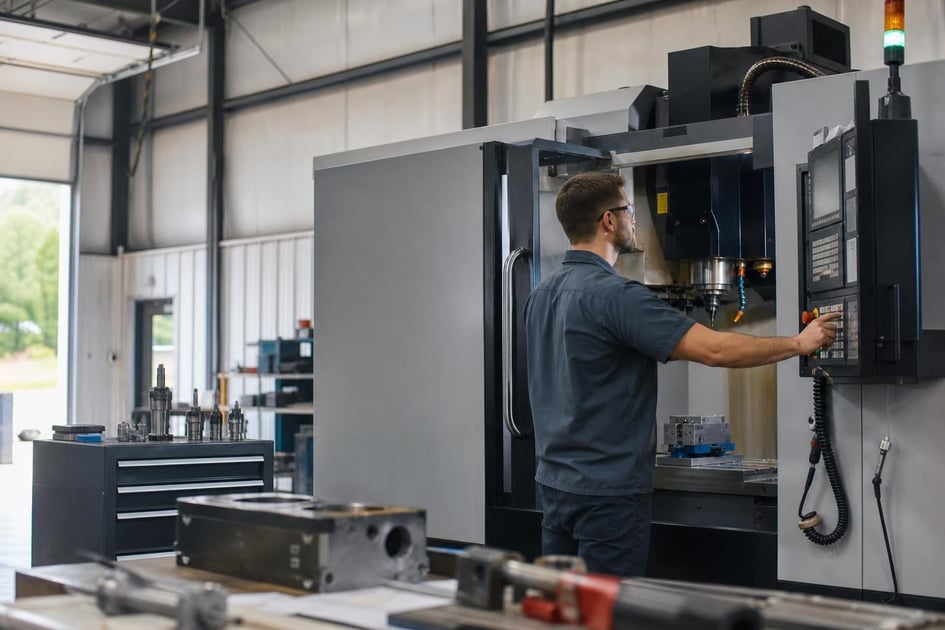
Yes, You Can Finance a CNC Machine in Tennessee Without Tying Up Cash
Tennessee shop owners do not need to drain their operating accounts to buy a CNC machine. Equipment financing uses the machine itself as collateral, which keeps rates competitive and lets you preserve cash for payroll, materials, and growth. Whether you run a three-person job shop in Chattanooga or a production facility supplying automotive plants in Smyrna, financing options exist from $5,000 up to $5 million. see what financing you qualify for on that CNC machine in just a few minutes.
The state's manufacturing base is deep and varied. According to the U.S. Census Bureau QuickFacts: Tennessee, the state supports nearly 150,000 employer establishments and over 2.9 million employees across all sectors. Manufacturing remains a pillar, with strong concentrations in automotive, aerospace, metal fabrication, and medical devices. That density of industrial activity means CNC machines move fast on the secondary market, lenders understand the collateral value, and shops can often secure same-day approvals when their paperwork is clean.
Key Insight: Tennessee's automotive supplier network—anchored by major OEMs in Middle Tennessee—creates a unique seasonal pattern. Many shops see their heaviest equipment purchasing in Q1 and Q3, timed to automotive production cycles. Lenders active in the state expect this rhythm, so applying during these windows rarely slows approval.
Get a fast decision on your equipment
Applying takes just a few minutes, and decisions can come as soon as the same day.
Start Your ApplicationWhy Tennessee Shops Are Buying CNC Equipment Now
Several forces are pushing shop owners to upgrade or expand their machining capacity. Reshoring continues to bring work back to U.S. soil. A Forbes analysis of manufacturing reshoring trends notes that onshore operations are expected to rise to 48% in the coming years, with manufacturers prioritizing supply chain resilience. Tennessee's central location and established industrial infrastructure make it a natural landing spot for that work.
At the same time, the labor market for skilled machinists remains tight. Shops cannot always hire their way out of a production bottleneck. A new 5-axis machining center or an automated lathe with bar feeder can replace multiple manual operations, reduce scrap rates, and let existing employees focus on setup and inspection rather than standing at a machine all day. Financing spreads that capital cost over the useful life of the equipment, matching the payment to the revenue the machine generates.
New vs. Used CNC Machines: What to Know Before You Decide
The choice between new and used equipment affects your down payment, monthly payment, tax treatment, and how quickly you can put the machine to work. New machines come with warranties, training, and the latest controls, but they depreciate the moment they are installed. Used machines cost less upfront and may already be past the steepest part of the depreciation curve, though they can carry hidden maintenance costs if you do not inspect them carefully.
| Factor | New CNC Machine | Used CNC Machine |
|---|---|---|
| Typical down payment | 0% to 10% | 10% to 20% |
| Financing term | 3 to 7 years | 2 to 5 years |
| Warranty coverage | Full manufacturer warranty | Limited or expired |
| Tax depreciation | Full Section 179 or bonus depreciation | Section 179 applies if new to you |
| Lead time | 3 to 6 months for some models | Immediate to 30 days |
| Ideal buyer | High-volume shop with stable contracts | Job shop or first-time buyer testing capacity |
The equipment itself serves as collateral in either case. Lenders care more about the machine's fair market value, its remaining useful life, and whether it can be resold if needed than about whether it is fresh from the factory. A well-maintained 2019 Haas VF-2 with documented maintenance history can finance just as cleanly as a new model, sometimes with better terms because the lender's collateral risk is lower.
Pro Tip: If you are buying used, get the machine under power before the lender's appraiser visits. A CNC machine that can run a test cut and produce clean chips commands a higher collateral value than one sitting cold on a dealer's lot. Bring your own machinist to the inspection, not just the seller's technician.
Lease vs. Loan: Choosing the Right Structure
Equipment financing generally takes one of two forms: a capital lease (or $1 buyout lease) that acts like a loan, or a true lease (fair market value buyout) that functions more like rental. The right structure depends on your tax strategy, how long you plan to keep the machine, and whether you want to own it outright at the end.
| Feature | Equipment Loan / Capital Lease | True Lease (FMV Buyout) |
|---|---|---|
| Ownership at end | You own the machine | Return, renew, or buy at fair market value |
| Monthly payment | Higher | Lower |
| Tax deduction | Depreciation and interest | Full lease payment as expense |
| Balance sheet | Asset and liability recorded | Off-balance-sheet in many cases |
| Best for | Long-term production equipment | Technology that may become obsolete quickly |
For most Tennessee machine shops, a loan or capital lease makes more sense. CNC machines have long useful lives—often 15 to 20 years with proper maintenance—and the controls do not change so rapidly that a three-year-old machine is obsolete. Owning the asset means you build equity, you can sell it later to fund the next upgrade, and you capture the full depreciation benefit. Rates vary by credit profile, equipment age, and term, so your specific rate will depend on those factors.
For major fixed-asset projects that include real estate, the SBA 504 loans program offers long-term, fixed-rate financing, though most standalone CNC purchases are handled through conventional equipment lenders.
What Lenders Look For: Qualification Criteria
Equipment financing is collateral-driven, which means lenders are willing to work with a broader range of credit profiles than unsecured lenders. That does not mean approval is automatic. Lenders still underwrite the deal, and understanding what they want makes the process faster.
Time in Business
Most equipment lenders prefer two years in business, though some programs accept one year with strong financials. Startups are generally outside the scope of standard equipment financing. If you have been operating for less than two years, a larger down payment or a personal guarantee may be required.
Credit Profile
A credit score in the mid-600s or higher opens the most competitive terms, but scores in the low 600s are not automatically disqualified. Lenders look at the full credit picture: recent bankruptcies, tax liens, and collections matter more than a single late payment from three years ago. If your personal credit has taken hits, be prepared to explain the circumstances and show how the business is stable now.
Revenue and Cash Flow
Lenders want to see that your monthly revenue can cover the new payment. Many require three to six months of bank statements. They are not looking for a specific debt-service coverage ratio in every case, but they do want evidence that the machine will help generate the income needed to pay for it. If you are financing a $250,000 vertical machining center, the lender may ask for a brief explanation of the contracts or customers that will use that capacity.
Equipment Appraisal
The lender will verify the machine's value, either through a third-party appraisal or an internal valuation model. For common brands like Haas, Mazak, Okuma, DMG Mori, and Doosan, valuations are straightforward because the resale market is active. For specialty or imported machines, the process may take longer. The appraisal protects both you and the lender from overpaying.
By the Numbers: A typical mid-range CNC vertical machining center in Tennessee costs between $75,000 and $175,000. Horizontal machining centers and 5-axis machines start around $200,000 and can reach $500,000 or more for high-end configurations. Swiss-type lathes for medical work often fall in the $150,000 to $350,000 range. Monthly payments on a $150,000 machine over five years generally range from roughly $2,800 to $3,400, though rates vary by credit profile, equipment age, and term.
Tax Treatment for the 2026 Tax Year
The tax advantages of equipment financing are significant, but the rules change, and you should always confirm specifics with a CPA who knows your situation. For the 2026 tax year, Section 179 allows businesses to deduct the full purchase price of qualifying equipment up to a limit set by Congress for that year. Bonus depreciation may also apply, though the percentage has been phasing down from its peak. The exact 2026 Section 179 limit and bonus depreciation rate should be verified with your CPA or the IRS, as legislative adjustments can occur late in the year.
Whether you choose a loan, capital lease, or true lease affects how you claim these benefits. With a loan or capital lease, you generally take depreciation on the asset. With a true lease, you deduct the lease payments as an operating expense. Both approaches can produce meaningful tax savings, but the timing differs. A CPA can model which structure leaves more cash in your business over the life of the agreement.
Find the right financing structure
Tell us about the equipment you need and we will show you the options that fit your business.
See Your OptionsCost Examples: Real-World Scenarios for Tennessee Shops
These examples illustrate how financing works for different machine types and buyer profiles. They are not quotes—your actual terms will depend on credit, equipment age, and term—but they show the scale of the commitment.
Scenario 1: Job Shop Adding First VMC
A two-year-old job shop in Knoxville buys a used Haas VF-2SS for $85,000. With 10% down and a five-year term, the monthly payment falls in a range that leaves room for tooling and materials. The shop uses the machine to win a contract producing brackets for an HVAC manufacturer.
Scenario 2: Medical Device Manufacturer Upgrading Lathe Capacity
A Nashville shop financing a new Swiss-type lathe at $320,000 spreads the cost over six years. The longer term keeps the monthly payment manageable while the shop ramps up production of surgical instrument components. The machine's precision and throughput justify the investment within the first year.
Scenario 3: Large Fabrication Shop Expanding 5-Axis Capacity
A Chattanooga fabricator financing a $450,000 5-axis machining center uses a 72-month term. The machine handles complex aerospace components that previously required outsourcing. Keeping the work in-house improves margins and reduces lead times for the shop's largest customer.
Industry-Specific Use Cases in Tennessee
Tennessee's economy is not uniform. The equipment you need and the customers you serve vary by region, and lenders who understand those differences can move faster.
Automotive Suppliers in Middle Tennessee
The corridor from Nashville to Smyrna to Spring Hill is dense with automotive OEMs and tier-one suppliers. Shops in this space often need high-volume turning centers, horizontal machining centers, and robotic loading systems. Financing terms tend to be favorable because the end customers are stable, and the collateral retains value well. Manufacturing equipment financing programs in this region are built around those production realities.
Aerospace and Defense in East Tennessee
Knoxville and the surrounding area support aerospace machining for components ranging from turbine housings to structural brackets. These parts demand tight tolerances and traceable materials, which often means 5-axis machines, CMM-equipped shops, and substantial investment in quality systems. Equipment financing lets these shops acquire the precision machinery without delaying certification.
Medical Device Manufacturing in Memphis and Nashville
Tennessee's medical device sector continues to grow, driven by an aging population and a cluster of healthcare companies. CNC Swiss lathes, multi-axis mill-turn centers, and wire EDM machines are common purchases. The margins in medical work are strong, but the regulatory environment demands consistent quality. Financing preserves cash for ISO certification, inspection equipment, and cleanroom infrastructure.
Metal Fabrication and Job Shops Statewide
Smaller job shops serve construction, agriculture, and general industry across the state. These shops often start with a single mill or lathe and add capacity as contracts come in. Cnc Machines financing helps them scale without taking on unsecured debt or diluting ownership. Some fabrication shops also handle site work and maintain fleets that include Skid Steers financing alongside their CNC investments.
Key Insight: Tennessee's lack of a state income tax on wages makes it attractive for skilled machinists, but local property taxes on equipment vary by county. Some counties offer payment-in-lieu-of-tax agreements for manufacturers that expand. Before you finance a $500,000 machine, check whether your county assesses personal property tax on equipment and whether any abatements apply. This affects your total cost of ownership more than most buyers expect.
Common Mistakes to Avoid
First-time equipment buyers and even experienced shop owners can trip over the same issues. Avoiding these mistakes saves money and frustration.
- Buying the wrong machine for the work. A VMC with 40-taper tooling is fine for aluminum brackets but will struggle with hardened steel aerospace work. Match spindle power, taper size, and axis travel to your actual parts, not your aspirational parts.
- Ignoring installation costs. Rigging, power, coolant systems, and foundation work can add $10,000 to $50,000 to the project. Lenders may not cover these soft costs unless you ask upfront.
- Overlooking used-machine due diligence. Hours on the spindle, ball-screw condition, and control obsolescence matter more than paint. A cheap machine that needs $30,000 in repairs is not a bargain.
- Waiting too long to apply. If you have a contract starting next month, start the financing conversation now. Same-day approvals are possible, but they require clean paperwork. Waiting until the week before delivery creates unnecessary stress.
What Documentation You Need
The faster you gather documents, the faster the lender can decide. Most equipment financing applications require:
- Business tax returns for the last two years
- Three to six months of business bank statements
- An equipment quote or invoice from the seller
- A brief description of how the machine will be used
- Personal financial statement or personal tax returns if a guarantee is required
For larger transactions—approaching $1 million or more—lenders may also request interim financial statements, an accounts receivable aging report, and a business debt schedule. Having these ready before you apply can shorten the process from weeks to days. get a decision on your equipment, possibly the same day, by having your paperwork organized before you start.
What Happens After Approval
Once the lender issues a term sheet and you accept, the process moves quickly. The lender will order a UCC filing to perfect their lien on the equipment, verify insurance coverage, and arrange payment to the seller. For new equipment, the manufacturer or dealer often handles delivery coordination. For used equipment, you may need to arrange rigging and transport.
After the machine is installed and operational, your payments begin according to the schedule. Most lenders do not charge prepayment penalties, though some apply a small fee in the first year. If your business outperforms expectations and you want to pay the balance early, ask your lender about their specific policy. Some Tennessee shops use early payoff as a strategy to clear debt before applying for the next machine.
Ready to move forward?
More than 10,000 businesses have financed equipment with Provide Capital. See what you qualify for today.
Get StartedFrequently Asked Questions
Can I finance a CNC machine if I have been in business less than two years?
It is possible but harder. Lenders may require a larger down payment, a stronger personal guarantee, or additional collateral. Some programs accept one year of operating history if revenue is consistent and the buyer has relevant industry experience.
Does the equipment need to be purchased from a dealer?
No. Private-party sales, auction purchases, and dealer sales can all be financed. The lender will still appraise the machine and verify the title is clear. Private-party transactions sometimes take an extra day or two for paperwork.
Can I include tooling, software, and installation in the financing?
Often yes, up to a percentage of the equipment cost. Some lenders package soft costs into the transaction; others require them to be paid separately. Ask before you sign the quote so there are no surprises at closing.
What credit score do I need for CNC machine financing?
Scores in the mid-600s and above typically receive the most competitive terms. Lower scores are not automatically declined, but they may trigger a higher down payment or a shorter term. The equipment's value and your business revenue also influence the decision.
How long does approval take?
For transactions under $500,000 with clean paperwork, approval can come the same day or within 24 hours. Larger transactions or those requiring third-party appraisals may take three to five business days. Submitting complete documentation upfront is the best way to avoid delays.
Can I finance a CNC machine from an auction?
Yes, but timing matters. Auction purchases often require payment within days. Pre-approval from your lender lets you bid with confidence. Tell your lender you are shopping auctions so they can structure the approval accordingly.
Is a personal guarantee always required?
For most transactions under $1 million, yes. The personal guarantee aligns the owner's interest with the lender's risk. For very strong borrowers or larger transactions with substantial business assets, the lender may waive the requirement.
What happens if I want to sell the machine before the loan is paid off?
You can sell it, but the lender's lien must be satisfied first. The buyer or their lender will pay off the balance as part of the transaction, and the lender will release the lien. Coordinate with your lender early in the sale process to avoid delays.
Next Steps for Tennessee Shop Owners
Financing a CNC machine is a straightforward way to add capacity without draining cash. The key is matching the right machine to the right financing structure for your specific situation. Tennessee's manufacturing economy supports this investment—whether you supply automotive, aerospace, medical, or general industry, demand for machined parts remains strong.
Before you shop, define the parts you need to make, the tolerances you must hold, and the volume you expect. Get quotes from multiple sellers. Gather your financial documents. Then start an application in a few minutes and see what terms are available for the machine that fits your shop. The equipment itself is the collateral, which keeps the process simpler than most owners expect.
Disclaimer: The information provided in this article is for general educational purposes only and is not financial, legal, or tax advice. Funding terms, qualifications, and product availability may vary and are subject to change without notice. Provide Capital does not guarantee approval, rates, or specific outcomes. For personalized information about your business funding options, contact our team directly.
