
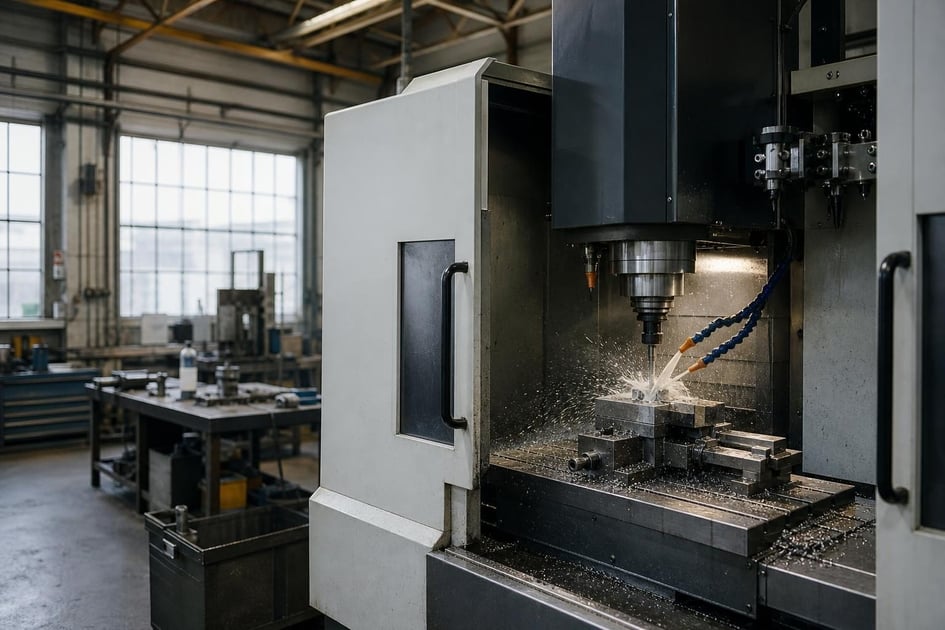
CNC Machines Financing in Pennsylvania: A Buyer's Guide for Manufacturers
Pennsylvania manufacturers looking to add or replace CNC equipment can finance everything from entry-level mills to multi-axis machining centers without tying up working capital. Whether you run a job shop in Pittsburgh, an aerospace supplier near Philadelphia, or a custom cabinetry business in Lancaster, equipment financing lets the machine itself secure the loan, keeping rates competitive based on your credit profile, equipment age and term. You can see what financing you qualify for on that CNC router or mill in minutes, with same-day approvals possible depending on your file.
Get a fast decision on your equipment
Applying takes just a few minutes, and decisions can come as soon as the same day.
Start Your ApplicationWhy Pennsylvania Manufacturers Finance CNC Machines
Pennsylvania ranks among the top states for manufacturing output, with facilities scattered from the Mon Valley to the Lehigh Valley. The sector employs hundreds of thousands across the commonwealth, according to Census Bureau manufacturing data, and remains the backbone of regional economies in counties like Allegheny, Chester, and Berks. For these shops, a CNC machine is not a luxury; it is the primary production asset. Financing preserves cash for payroll, raw materials, and the unexpected repair.
When you pay cash for a $180,000 vertical machining center, you drain the reserve you might need when a customer slows payment or steel prices spike. Financing spreads that cost over 24 to 60 months, matching the expense to the revenue the machine generates. That alignment is why owner-operators from Erie to York prefer equipment loans over large capital outlays.
The State's Manufacturing Landscape
Pennsylvania's manufacturing base is diverse. In the western part of the state, you find heavy metal fabrication and tooling tied to the energy and defense sectors. Moving east toward Philadelphia, precision machining for medical devices and aerospace dominates. Central Pennsylvania houses substantial woodworking, plastics, and food processing operations. Each of these segments uses CNC equipment, though the specifications differ widely. A metal shop needs rigid, high-torque mills with flood coolant systems, while a cabinet maker looks at nested-based CNC routers with vacuum hold-down tables.
This geographic diversity affects financing needs. A shop in Scranton buying a used 3-axis mill for $45,000 faces a different structure than a Delaware County contractor adding a $400,000 5-axis machining center. Lenders evaluate the equipment type, age, and resale market in the region when structuring terms.
When Cash Purchase Doesn't Make Sense
Paying cash feels safe, but it can stall growth. If you spend $120,000 on a CNC lathe, you lose liquidity that could fund three months of payroll or a new contract's material buy. Equipment financing leaves that cash untouched. Because the equipment serves as collateral, lenders can offer terms that vary by credit profile, equipment age and term, without requiring a second lien on your real estate in many cases.
Key Insight: Pennsylvania shops often see the strongest equipment deals in the fourth quarter, when sellers clear inventory before year-end and buyers aim to place machinery in service for tax purposes. Financing lets you lock in the purchase price while preserving cash for the 2026 tax year's operational needs.
What CNC Machines Can Be Financed
Provide Capital finances new and used business equipment from $5,000 to $5 million, which covers the full range of CNC machinery. This includes vertical and horizontal machining centers, CNC lathes and turning centers, 5-axis mills, CNC routers for wood and composites, EDM machines, and Swiss-style screw machines. The equipment itself is the collateral, which keeps rates competitive.
New vs. Used Considerations
Both new and used CNC machines can be financed, but the terms differ. New equipment typically commands longer terms and lower rates because the lender's collateral risk is lower. Used machines, especially those over seven years old or with obsolete controls, may require shorter terms or larger down payments.
| Feature | New CNC Machines | Used CNC Machines |
|---|---|---|
| Financing term | 24–60 months | 12–48 months |
| Down payment | Often 0–10% | Often 10–20% |
| Collateral value | High, predictable | Varies by brand, hours, control |
| Ideal buyer | High-volume, long-term contract shop | Startup phase, second machine, backup |
| Warranty coverage | Manufacturer warranty | Limited or third-party only |
New machines come with training, warranty, and the latest controls, but they depreciate sharply in the first two years. Used machines offer immediate availability and lower acquisition cost, though you should budget for retrofitting controls or replacing spindles. If you are unsure which fits your shop, CNC Machines financing specialists can structure either option.
Pro Tip: Before financing a used CNC machine, obtain the maintenance log and verify the control software is still supported by the manufacturer. A $35,000 mill with a discontinued control can cost $15,000 to retrofit, erasing the savings. Always factor retrofit costs into your total financed amount if the lender allows.
How Equipment Financing Works for CNC Machines
Equipment financing is straightforward. You identify the machine, submit an application, and the lender evaluates your credit, business financials, and the equipment's value. Approval can come the same day for well-qualified buyers, though more complex files may take 24 to 48 hours. Once approved, the lender pays the vendor or private seller, and you take delivery.
Unlike general working capital loans, equipment financing uses the machine as collateral. This means the lender files a UCC-1 lien on the equipment rather than placing a blanket lien on all business assets. For Pennsylvania manufacturers who may already have lines of credit secured by receivables or real estate, this separation is valuable.
Lease vs. Loan Trade-offs
You can acquire a CNC machine through a finance lease, an equipment loan, or a fair market value lease. Each has different balance-sheet and end-of-term implications.
In an equipment loan, you own the machine from day one. You claim depreciation and any available Section 179 deduction for the 2026 tax year, and the loan appears as a liability on your balance sheet. At the end of the term, you hold clear title.
A finance lease, or capital lease, also usually transfers ownership at the end for a nominal buyout. For accounting purposes, it may be treated similarly to a loan under current standards. A fair market value lease, sometimes called a true lease, lets you return the machine at the end of the term. This works well if you expect technology to change rapidly or if you need the machine for a specific multi-year contract.
For most Pennsylvania job shops, the equipment loan or finance lease makes more sense because CNC machines have long useful lives—often 10 to 15 years with proper maintenance—and the resale value remains strong if you need to sell later.
By the Numbers: A $150,000 CNC machining center financed over 60 months with a typical structure might carry a monthly payment in the low thousands, preserving roughly $120,000 in cash versus a cash purchase. Over the same period, if the machine adds $400,000 in incremental revenue, the financing cost is typically recovered well before the note matures.
If you have a machine picked out, you can get a decision on your equipment, possibly the same day, by submitting a short application.
Tax Treatment for 2026
The tax treatment of CNC machine acquisitions changed significantly with the Tax Cuts and Jobs Act, and the rules for 2026 require careful attention. Section 179 allows businesses to deduct the full purchase price of qualifying equipment in the year it is placed in service, subject to an annual limit that adjusts for inflation. For the 2026 tax year, consult your CPA for the exact limit, as it is indexed annually and may differ from prior years.
Bonus depreciation, which allowed 100% expensing in previous years, has begun phasing down. For 2026, the bonus depreciation percentage is lower than in prior years, and the precise rate should be confirmed with your accountant. If you place a CNC machine in service before December 31, 2026, you may still benefit from accelerated depreciation, but the exact deduction depends on the total cost of equipment placed in service during the year and your taxable income.
Section 179 and Bonus Depreciation
To claim Section 179 for 2026, the equipment must be purchased and placed in service by December 31, 2026. The deduction cannot exceed your taxable business income, and it phases out once total equipment purchases exceed a threshold that your CPA can provide. Financing the machine does not reduce your eligibility; you can still take the full Section 179 deduction even if you have not paid off the loan.
Bonus depreciation works in tandem with Section 179. You apply Section 179 first, then bonus depreciation to the remaining basis, then regular MACRS depreciation. However, because bonus depreciation is phasing down, the 2026 tax year's benefit is smaller than in prior years. Your CPA can model whether Section 179 alone, bonus depreciation, or standard MACRS over five years produces the best outcome for your Pennsylvania shop.
Small Business Administration resources on equipment acquisition can help you understand these trade-offs before meeting with your tax advisor.
Find the right financing structure
Tell us about the equipment you need and we will show you the options that fit your business.
See Your OptionsQualifying for CNC Machine Financing
Lenders evaluate three things: the borrower, the business, and the equipment. You do not need perfect credit, but your profile affects the structure. Same-day approvals are possible when the file is clean and documentation is complete.
Credit and Financial Documentation
Most lenders look for a personal credit score in the mid-600s or higher for the best terms, though lower scores do not automatically disqualify you. The lender will also review your business bank statements, typically for the last three to six months, to verify cash flow. If you are buying a machine over $100,000, expect to provide two years of business tax returns and a current year-to-date profit and loss statement.
For businesses with less than two years of history, qualifying is more difficult. The underwriter may require a larger down payment or a shorter term to offset the limited track record. If your business shows consistent deposits and manageable existing debt, you can often overcome a shorter operating history.
Time in Business Requirements
Equipment financiers generally prefer two years in business, but exceptions exist for strong credits or low-loan-to-value deals. If you have been operating for five years and show steady revenue, you will likely qualify for 0% down and terms up to 60 months. A newer shop may be asked for 10% to 20% down and a 36-month term.
The equipment's age also matters. Financing a 2024 or 2025 CNC mill is easier than financing a 2010 model with a Fanuc control that is no longer supported. The lender considers how easily they could resell the machine if needed. Popular brands like Haas, Mazak, Okuma, and DMG Mori retain value well in the Pennsylvania market, which improves your terms.
Industry-Specific Use Cases in Pennsylvania
Pennsylvania's economy is not monolithic. The CNC machine you need in Williamsport differs from what a shop in Bristol requires.
Metal Fabrication and Machining
Western Pennsylvania's legacy in steel and energy translates to a robust metal fabrication sector. Shops in Pittsburgh, Washington, and Butler counties produce components for oil and gas, defense, and general industrial use. These businesses typically finance CNC mills, lathes, and multi-axis machining centers capable of cutting hardened steels and exotic alloys. A 5-axis mill with a pallet system allows unattended machining overnight, doubling effective spindle time without doubling labor costs.
Woodworking and Cabinetry
Central and northern Pennsylvania host a significant concentration of custom cabinetry, architectural millwork, and furniture manufacturers. These shops favor nested-based CNC routers with automatic tool changers and drill banks. A used CNC router in the $40,000 to $80,000 range is often the second major purchase after a wide-belt sander. Financing lets the owner preserve cash for exotic hardwood inventory, which can tie up $50,000 or more in a single job.
Plastics and Composites
From medical device housings to aerospace interior components, Pennsylvania's plastics processors use CNC machines to mill, turn, and finish engineered polymers. These applications require specific spindle speeds, dust collection, and sometimes climate-controlled environments. Financing the CNC equipment separately from building improvements keeps the capital structures clean and makes it easier to upgrade when customer specifications change.
According to Reuters industry analysis, US manufacturers continue to invest in automation despite interest rate volatility, with machining and fabrication seeing sustained demand.
Common Mistakes Buyers Make
Even experienced shop owners stumble during the financing process. Avoid these errors to keep your purchase on track.
First, underestimating total cost. The machine's purchase price is only part of the expense. Rigging, electrical work, coolant, tooling, and training can add 15% to 25% to the total project. Ask your lender whether these soft costs can be included in the financing arrangement.
Second, ignoring the control ecosystem. A new machine with an unfamiliar control forces a learning curve that costs you setup time. If your operators know Haas or Fanuc, switching to a proprietary control may erase productivity gains for months.
Third, stretching the term too long to lower payments. A 72-month term on a machine with a 10-year life seems attractive, but you may owe more than the machine is worth if you need to sell in year four. Match the term to the machine's realistic useful life and your contract horizon.
Fourth, failing to check the seller's reputation. When buying used, verify that the dealer has a service department in Pennsylvania or a neighboring state. A CNC machine without local service support becomes expensive quickly.
Fifth, neglecting to time the purchase for tax purposes. If you place the machine in service on January 2, 2027, you lose the 2026 tax benefit. Plan delivery and installation so you can start using the machine before December 31, 2026, if you intend to claim depreciation for this tax year.
What Happens After Approval
Once your application is approved, the process moves quickly. The lender issues a commitment letter outlining the term, payment, and any conditions. You review and sign, and the lender coordinates payment with the seller. For a dealer purchase, funds usually wire directly to the vendor. For a private-party sale, the lender may pay the seller and file the UCC lien simultaneously.
After funding, your payments begin according to the schedule—typically monthly, though some structures offer quarterly or seasonal payments to match cash flow cycles. Seasonal manufacturers in Pennsylvania, such as those serving the outdoor recreation or agricultural markets, sometimes benefit from skip-payment structures during slow months.
You own the machine and begin using it immediately. If you financed a 2026 delivery, coordinate with your CPA to ensure you capture any available Section 179 deduction or bonus depreciation for the current tax year. Keep your purchase documents, financing agreement, and delivery receipts organized for your tax preparer.
If your shop also relies on material handling or earthmoving equipment, Manufacturing equipment financing covers a broad range of production assets beyond CNC machines.
Put the right equipment to work
From $5,000 to $5 million, new or used, Provide Capital helps businesses nationwide finance the equipment they need.
Apply TodayFrequently Asked Questions
Can I finance a used CNC machine?
Yes. Used CNC machines are commonly financed, though terms may differ from new equipment. Machines under five years old with supported controls typically qualify for standard rates and terms up to 48 months. Older machines may require larger down payments or shorter amortization.
What credit score do I need?
There is no hard minimum, but credit scores in the mid-600s and above generally receive the most favorable structures. Lower scores are considered, especially with strong business cash flow or a larger down payment.
How fast can I get approved?
Same-day approvals are possible for straightforward applications with complete documentation. More complex files, such as those involving used equipment from private sellers or businesses with limited financial history, may take 24 to 48 hours.
Can I include installation and tooling in the loan?
Often yes. Many lenders allow soft costs like rigging, electrical, tooling, and freight to be rolled into the equipment financing, provided the total does not exceed a reasonable percentage of the machine's value. Ask your financing contact for specifics.
Does financing affect my ability to take Section 179 in 2026?
No. Financing the machine does not reduce your eligibility for the Section 179 deduction for the 2026 tax year. You can deduct the full eligible amount in the year the machine is placed in service, subject to the annual limits and taxable income restrictions that apply for 2026. Confirm the exact figures with your CPA.
What industries in Pennsylvania use financed CNC machines?
Metal fabrication, aerospace and defense contracting, medical device manufacturing, woodworking, plastics processing, and automotive suppliers all commonly finance CNC equipment across Pennsylvania.
Should I choose a loan or a lease?
If you intend to keep the machine for its full useful life and want to claim depreciation, an equipment loan or finance lease is usually preferable. If you need the machine for a specific contract and want the option to upgrade in three years, a fair market value lease may fit better.
What documents do I need to apply?
Typically, your last three to six months of business bank statements, a driver's license, and the equipment quote or invoice. For larger transactions, two years of business tax returns and a year-to-date profit and loss statement are usually required.
Closing Next Step
Adding a CNC machine to your Pennsylvania shop is a significant decision, but it does not have to strain your cash reserves. Equipment financing lets you acquire the production capacity you need while preserving liquidity for payroll, materials, and growth. Whether you are replacing an aging manual mill or adding a second shift with automated equipment, the right structure matches your payment to the revenue the machine generates.
Start by identifying the machine and gathering your basic financial documents. Then, start an application in a few minutes to see what terms you qualify for. With approvals possible the same day and financing available from $5,000 to $5 million, you can move from quote to production without the wait.
Shops expanding their fleet often look at complementary equipment as well. If you need material handling or earthmoving capability, consider Skid Steers financing to keep your yard and workflow moving efficiently.
Disclaimer: The information provided in this article is for general educational purposes only and is not financial, legal, or tax advice. Funding terms, qualifications, and product availability may vary and are subject to change without notice. Provide Capital does not guarantee approval, rates, or specific outcomes. For personalized information about your business funding options, contact our team directly.
