
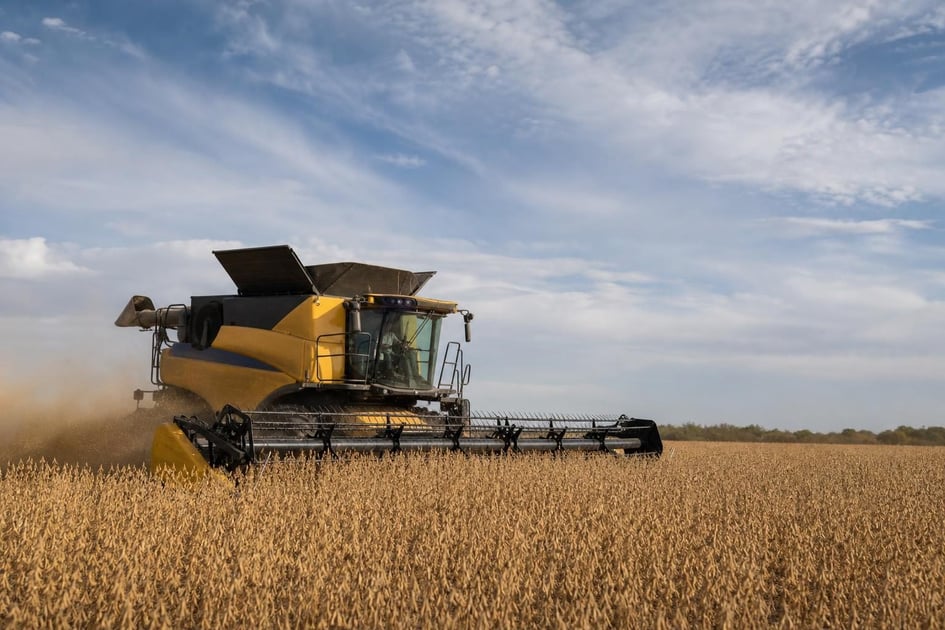
What Drives Your Combine Financing Cost
A new Class 8 combine can run anywhere from $350,000 to well over $700,000 depending on header width, grain-tank capacity, and precision-ag technology. Used machines three to five years old often fall between $180,000 and $400,000, while older units can start around $80,000. The amount you borrow, the age of the machine, and your financial profile all determine what you will actually pay each month.
Lenders structure Combines financing around the collateral value of the combine itself. Because the machine secures the note, rates are typically more competitive than unsecured borrowing, though they still vary by credit profile, equipment age and term. A 720-plus credit score with five years in business will see stronger terms than a newer operation with a 640 score, but both can often be financed.
If you are looking at a specific machine on a dealer lot, you can see what financing you qualify for on that combine without affecting your credit score for an initial quote.
The term length also changes the math. A three-year term keeps total interest lower but pushes monthly payments higher. Stretching to five or six years drops the payment but increases the total cost of borrowing. Most lenders cap terms at the useful life of the equipment, so a 10-year-old combine is unlikely to qualify for a seven-year loan.
Equipment Age and Size
Newer combines carry lower risk for lenders because depreciation is slower and resale value is predictable. A 2024 or 2025 model with under 500 engine hours is viewed as strong collateral. By contrast, a machine with 2,000 hours and 10 years of service will likely require a larger down payment or a shorter term.
Your Credit and Time in Business
Most equipment lenders want to see a personal credit score above 600, though some programs accept lower with compensating factors. Time in business matters because a track record of revenue proves you can cover the note. Two years is a common threshold, but some lenders work with startups in agriculture if the buyer has prior farming experience and a sizeable down payment.
Term Length and Down Payment
Down payments typically range from 0% to 20% for qualified buyers. Zero-down programs exist for strong credits and new equipment, but they raise the financed amount and monthly obligation. A 10% to 15% down payment on a used combine is more common and often improves the rate.
Already have a machine in mind?
Provide Capital finances new and used equipment from $5,000 to $5 million, with same-day decisions possible.
Apply NowNew vs. Used Combine Financing
Price Ranges and What They Mean for Payments
A $500,000 new combine financed over five years with a 10% down payment leaves $450,000 on the note. Depending on credit and term, the monthly payment could land in a wide range. A $250,000 used machine with the same structure cuts the financed amount in half, but the rate may be slightly higher because the collateral is older.
How Lenders View Depreciation Risk
Combines depreciate fastest in the first three years. Lenders account for this by requiring more equity on used units or shortening the amortization. If you plan to trade the machine in after four seasons, new equipment financing may align better because you avoid the steepest part of the depreciation curve. If you intend to run the combine for a decade, a late-model used unit can be the better financial move.
| Factor | New Combine | Used Combine (3-5 years) | Used Combine (8-10 years) |
|---|---|---|---|
| Typical price range | $350,000 – $700,000+ | $180,000 – $400,000 | $80,000 – $180,000 |
| Down payment | 0% – 15% | 10% – 20% | 15% – 25% |
| Term available | 3 – 7 years | 3 – 5 years | 2 – 4 years |
| Rate posture | Most competitive | Standard | Higher, varies widely |
| Best for | High acreage, trade cycles | Balance of cost and reliability | Low-hour operations, backup unit |
Lease vs. Loan: Which Structure Fits Your Operation?
Operating Leases
An operating lease functions like a rental with a buyout option. You make monthly payments for a set term, then return the combine, renew, or purchase at fair market value. This keeps the liability off your balance sheet in some accounting treatments and preserves cash flow, but you build no equity unless you exercise the purchase option.
Equipment Loans and $1 Buyout Leases
A loan or capital lease ($1 buyout) puts you on the path to ownership. At the end of the term, you own the machine outright. This makes sense if you plan to keep the combine past the payoff date and want to capture any remaining resale value. Loans also let you claim depreciation and Section 179 deductions, which can significantly reduce the after-tax cost.
Key Insight: Many farm accountants recommend a loan or $1 buyout lease over a true operating lease for combines because the Section 179 deduction can offset taxable farm income in the purchase year. An operating lease may offer lower monthly payments, but the tax benefits usually favor ownership for profitable operations. Always confirm the structure with your CPA before signing.
Tax Treatment for 2026
For tax year 2026, Section 179 allows businesses to deduct the full purchase price of qualifying equipment up to a limit set by Congress. The exact dollar cap for 2026 is published in IRS guidance, and you should verify the current-year limit with your accountant because it adjusts annually for inflation. Bonus depreciation may also apply, though the percentage has been stepping down in recent years.
The key point is that both new and used combines qualify for Section 179 if they are placed in service during 2026 and used more than 50% for business. If you finance the purchase, you can still take the deduction even though you have not paid the full cash price upfront. The deduction applies to the equipment cost, not the interest you pay over the term.
Before you finalize any structure, get a decision on your equipment, possibly the same day, so you know what terms you are working with when you talk to your tax preparer.
Section 179 Limits for 2026
Because the 2026 limit is subject to inflation adjustments and phase-out thresholds, we do not quote a specific dollar figure here. Instead, discuss the expected purchase price with your CPA and ask how much of the combine cost can be expensed against 2026 income. The deduction cannot create a net operating loss, but it can reduce taxable income to zero.
Bonus Depreciation Considerations
Bonus depreciation allows a percentage of the cost to be deducted in the first year, with the remainder depreciated under normal MACRS schedules. For 2026, the bonus depreciation percentage may differ from prior years, so your accountant should model both Section 179 and bonus depreciation to see which combination yields the lowest tax bill.
Pro Tip: If you are considering a December delivery to capture the 2026 deduction, confirm that the lender can fund and the dealer can deliver before December 31. Many lenders slow down during the holidays, and a January funding date pushes the deduction into tax year 2027. Build at least two weeks of buffer into your closing timeline.
See what you qualify for
The equipment itself secures the financing, which keeps rates competitive. Checking your options takes minutes.
Check Your OptionsQualifying for Combine Financing
Credit Profile
Lenders review both personal and business credit. A FICO score above 680 generally unlocks the best terms, while scores between 600 and 680 still qualify but may carry higher rates or require more money down. Collections, charge-offs, or a recent bankruptcy make approval harder, though not always impossible if the down payment is substantial and the explanation is documented.
Documentation Needed
Most applications require a completed one-page application, last three months of business bank statements, current year financials or tax returns for one or two years, the equipment quote or invoice, and proof of insurance once approved. Some lenders add requirements for larger transactions above $500,000, such as interim financial statements or a personal financial statement.
Time in Business and Revenue
While some programs serve established farms with 10-plus years of history, others work with operations that have only two years under their current entity. Revenue requirements vary, but a common rule of thumb is that the monthly payment should not exceed a reasonable percentage of monthly farm revenue. If your operation is highly seasonal, lenders may look at annual revenue instead of monthly cash flow.
By the Numbers: A combine financed at $400,000 over five years with a 15% down payment leaves $340,000 on the note. Depending on credit profile, equipment age and term, the monthly payment could range widely, but a common landed payment might fall between $6,000 and $7,500 per month. Over the full term, that is roughly $360,000 to $450,000 in payments plus the $60,000 down, meaning the total outlay depends heavily on the rate and fees negotiated at closing.
What Happens After You Apply
Once you submit an application, the lender pulls credit and reviews the equipment details. For transactions under $500,000, many lenders can issue a same-day conditional approval if the credit profile is clean and the equipment meets collateral guidelines. Conditional approval means the lender is ready to move forward pending verification of income and insurance.
After approval, the lender issues a term sheet or finance agreement. You review the payment, term, and any prepayment penalties. Once signed, the lender pays the dealer or private seller directly. You take delivery and begin payments, usually 30 to 45 days after funding. Some lenders offer deferred first payments for seasonal operators, pushing the first installment until after harvest.
Common Mistakes to Avoid
Buying More Machine Than Acres Justify
A Class 9 combine with a 45-foot header and all the technology packages looks impressive, but if you are farming 800 acres, the per-acre cost of ownership is punishing. Match the machine to your actual acreage and crop mix. A smaller Class 7 combine may handle your harvest window at half the capital cost.
Ignoring Total Cost of Ownership
Financing cost is only part of the picture. Factor in fuel, maintenance, insurance, and storage. A $300,000 used combine that needs $40,000 in repairs over two years can cost more than a $400,000 late-model unit under warranty. Ask the dealer for service records and get an independent inspection on any used machine before you commit.
Pro Tip: Always get a pre-purchase inspection from a mechanic who works on the specific brand you are buying. A transmission issue in a high-hour combine can cost $25,000 to $35,000 to rebuild. Lenders rarely finance repair bills, so any major defect becomes an out-of-pocket expense that erodes your first-year cash flow.
Industry Context: Why Combine Sales Matter
Combine sales are a barometer for farm profitability. According to Reuters reporting on the U.S. farm economy, combine sales plunged more than 35% last year as producers delayed capital purchases amid low commodity prices and elevated input costs. When farmers postpone equipment buys, dealer inventories swell and manufacturers scale back production, which can create buying opportunities for operators with stable cash flow.
The U.S. Census Bureau tracks the broader economic health of rural communities where equipment purchases drive local employment. Understanding this cycle helps you time your purchase. In a down market, dealers may offer incentives or accept lower offers on last year's models. In a strong market, inventory is tighter and prices are firmer.
For operators in row-crop agriculture, financing a combine is not just about acquiring iron. It is about maintaining harvest capacity without draining operating lines. Agriculture equipment financing is structured around the reality that farm revenue is seasonal and collateral-dependent. Lenders who understand this cycle can structure payments around your cash flow.
Many lenders see stronger collateral value in combines under five years old with fewer than 1,000 separator hours. If you are buying at auction, verify hours with the monitor rather than the seller's word. Some operators reset hour meters before sale, and lenders may require a third-party appraisal before funding high-value used equipment.
Put the right equipment to work
From $5,000 to $5 million, new or used, Provide Capital helps businesses nationwide finance the equipment they need.
Apply TodayCombine Financing FAQ
Can I finance a combine with no money down?
Yes, zero-down financing is available for qualified buyers with strong credit purchasing newer equipment. However, a down payment of 10% to 20% is more common for used combines and improves your rate and approval odds.
How long can I finance a used combine?
Terms depend on the machine's age and hours. A three- to five-year-old combine may qualify for a four- or five-year term. An eight- to ten-year-old unit is usually limited to two or three years.
Does the lender need to approve the seller?
Most lenders prefer purchases from authorized dealers because the equipment has been inspected and the title is clean. Private-party sales are possible but often require additional documentation, a title search, and sometimes an independent appraisal.
Can I include a header or Precision Ag technology in the same note?
Yes, many lenders allow you to finance attachments and software packages in the same transaction as the combine itself, provided they are itemized on the invoice.
Will financing a combine hurt my operating line?
Because equipment financing is secured by the machine, it sits separately from your revolving operating credit. It can actually preserve your operating line for seed, fertilizer, and labor.
What credit score do I need?
Most equipment lenders prefer a score above 600. The strongest terms typically go to borrowers above 680, but approvals are possible below that with compensating factors such as a larger down payment or strong farm revenue.
Can I pay off the loan early?
Some loans have no prepayment penalty; others charge a fee if you pay off within the first 12 to 24 months. Read the term sheet carefully and ask your lender to disclose any prepayment structure before you sign.
What happens if I have a bad harvest season?
Because the combine secures the note, missing payments puts the equipment at risk of repossession. If you anticipate cash flow trouble, contact your lender before you miss a payment. Some lenders offer seasonal skip-payment options for agricultural borrowers.
Next Steps
Start by defining your acreage, crop mix, and harvest window. That tells you what size combine you need and whether new or used makes sense. Then gather your financials and equipment quote. Start an application in a few minutes to see what terms you qualify for. Same-day approvals are possible, and the equipment itself serves as collateral, which keeps rates competitive compared to unsecured credit.
If you are also adding support equipment, Dump Trucks financing and Skid Steers financing can be structured under separate notes so you do not crowd your operating credit. Every operation is different, so run the numbers with your accountant and choose the structure that preserves your cash flow for the growing season.
The Small Business Administration offers counseling and resources that can help you understand your broader financing picture, especially if you are expanding the operation or bringing a new partner into the business.
Disclaimer: The information provided in this article is for general educational purposes only and is not financial, legal, or tax advice. Funding terms, qualifications, and product availability may vary and are subject to change without notice. Provide Capital does not guarantee approval, rates, or specific outcomes. For personalized information about your business funding options, contact our team directly.
