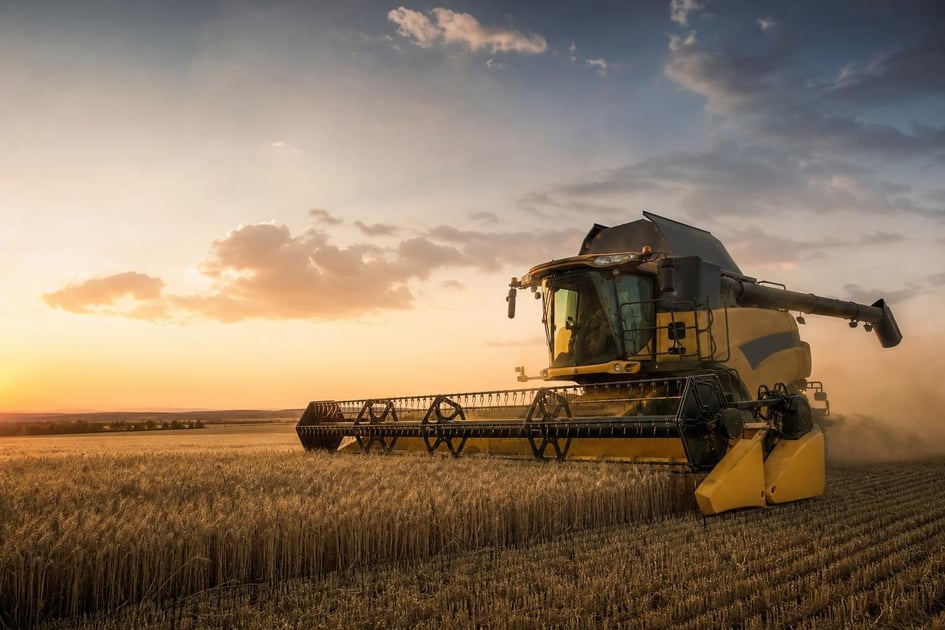
Combine financing lets small agricultural operations acquire harvesting equipment without draining operating cash. Whether you are replacing an aging machine or adding capacity for the season, financing spreads the cost across monthly payments while the equipment itself serves as collateral. Rates vary by credit profile, equipment age and term. Same-day approvals are possible, and loan amounts range from $5,000 to $5 million. Here is what the process actually looks like, what documentation you need, and how to structure the deal for your operation.
What Combine Financing Covers
A combine is one of the largest capital investments on a farm. New Class 8 and Class 9 machines can run well into six figures, while reliable used models from recent model years often fall between $150,000 and $350,000 depending on hours, separator type, and header package. Financing is not limited to the base machine. Lenders typically allow you to roll in headers, precision-ag technology, extended warranties, and delivery into the same note. This matters because a corn head, a flex draper platform, and a yield-monitor subscription can add $50,000 to $100,000 to the total project cost.
Most lenders distinguish between new and used equipment. New combines usually qualify for longer terms—up to seven years in some cases—because the collateral retains value. Used equipment, generally defined as more than two or three model years old or with higher hours, may see slightly shorter amortization and larger equity requirements. The cutoff varies by lender, but a machine with more than 2,000 separator hours is often considered high-use. If you are looking at a 2019 or 2020 model with moderate hours, you can still secure competitive terms, though the rate may adjust upward to reflect residual risk.
Refinancing an existing combine is also an option. If you own the machine outright or have significant equity, a sale-leaseback or equipment-secured term loan can free up working capital for seed, fertilizer, or labor. The key is that the equipment must be free of prior liens or the new lender must agree to a subordination or payoff arrangement. Some farmers use this strategy in years when commodity prices dip and operating credit tightens, turning a paid-off asset back into liquid capital without selling the machine.
Key Insight: Many lenders treat precision-ag hardware bundled at purchase as part of the equipment collateral, but aftermarket technology installed later often requires a separate UCC filing or may not count toward loan-to-value ratios. If you plan to upgrade GPS or telematics after delivery, finance them at the time of sale to keep everything under one simple lien.
Get a fast decision on your equipment
Applying takes just a few minutes, and decisions can come as soon as the same day.
Start Your ApplicationWho Qualifies for Combine Financing
Eligibility depends on three factors: credit history, time in business, and cash flow. Most equipment lenders prefer a FICO score of 650 or higher, though approvals are possible below that threshold with compensating factors. A strong bank balance, low existing debt service, or a significant down payment can offset blemished credit. If your score is under 600, expect a larger equity requirement—sometimes 20 to 30 percent—and a shorter term. Borrowers in the 700s often see the lowest rates and the longest amortization schedules.
Time in business matters because harvesting is seasonal, and lenders want evidence you have managed a cash-flow cycle. Two years in operation is the typical minimum, but some programs accept younger operations if the owner can show prior year tax returns reflecting Schedule F income or can demonstrate substantial experience managing a family farm that has now been formally incorporated. Revenue requirements vary by deal size. A $300,000 loan might require $400,000 to $600,000 in annual gross revenue, while smaller transactions under $100,000 often rely more on credit score and bank-statement cash flow than on formal financial statements.
For Agriculture equipment financing, lenders also look at the farm's debt-service-coverage ratio. This is calculated by dividing net operating income by total debt payments. A ratio above 1.25 is generally preferred. If you carry significant land debt or operating lines, be prepared to show that the new combine payment will not push coverage below that threshold. Lenders may also calculate global cash flow, combining the farm's income with any off-farm wages or other business income if you are a guarantor. The Small Business Administration publishes general guidance on calculating debt-service coverage that can help you prepare before applying.
Business structure affects documentation. Sole proprietors file under their personal credit and tax ID, so personal and business finances are intertwined. LLCs and corporations can sometimes qualify on business strength alone, though personal guarantees are still common for transactions under $500,000. If the farm is a partnership, all partners with more than 20 percent ownership typically must sign personally.
New vs. Used Equipment Considerations
New combines offer the latest efficiency and emissions standards, longer warranties, and the longest available financing terms. Depreciation is steepest in the first two years, so financing a new machine makes the most sense when you plan to keep it for a long cycle—five seasons or more. Used equipment reduces the upfront financed amount and can shorten the payoff period, but maintenance reserves become more important. A lender may require a third-party inspection on used machines priced above $200,000 or more than five model years old. The inspection covers engine compression, rotor and concave wear, feeder-house integrity, and hydrostatic drive performance. A clean inspection report can improve your rate by demonstrating that the collateral is sound.
Lease vs. Loan: Choosing the Right Structure
The decision between a true lease and an equipment finance agreement (EFA) or term loan comes down to ownership intent, tax strategy, and cash-flow timing. With a loan or EFA, you own the combine at the end of the term, and you claim depreciation and any applicable Section 179 deduction. With a true lease, the lender retains title, you make payments, and you may have the option to purchase the equipment at fair market value when the lease ends.
| Feature | Equipment Loan / EFA | True Lease |
|---|---|---|
| Ownership at end | You own the combine outright | Option to buy; lender owns until exercise |
| Tax treatment | Depreciation and Section 179 (if applicable) to the borrower | Lease payments typically deductible as operating expense |
| Monthly payment | Higher; you are paying toward ownership | Lower; no equity buildup |
| Term availability | Up to 7 years for new combines | 2 to 5 years common |
| Down payment | 0% to 20% depending on credit and age | First and last payment, sometimes 10% |
| End-of-term obligation | None; title transfers automatically | Return, renew, or purchase at FMV |
| Early payoff | Usually allowed; penalty varies | Restricted; may owe all remaining payments |
If you trade equipment every three to four seasons to stay under factory warranty, a true lease can preserve cash flow and eliminate resale risk. If you run machines for ten years or more, a loan or EFA builds equity and avoids the balloon payment or fair-market buyout at the end. There is no universally correct choice; the right structure matches your rotation schedule and tax position. Some farmers use a hybrid approach: a loan for the base combine they keep long-term, and a short-term lease for a second header or specialized platform they need only for specific crops.
By the Numbers: A $400,000 new combine on a five-year term at a standard equipment-finance rate can carry a monthly payment between $7,500 and $8,500 depending on credit tier and down payment. The same machine on a three-year true lease might run $5,800 to $6,500 monthly, but you would owe a residual payment or return the equipment at the end. Always model the total cash outlay over your expected holding period, not just the monthly amount.
Tax Treatment and Section 179 for Tax Year 2026
For the 2026 tax year, Section 179 allows businesses to deduct the full purchase price of qualifying equipment in the year it is placed in service, subject to annual limits set by the IRS. The specific dollar cap for 2026 is published in IRS guidance and adjusted periodically for inflation. If you are considering a year-end purchase, consult your CPA to confirm the exact 2026 limit and whether your taxable income is sufficient to absorb the deduction. Section 179 cannot create a net operating loss; the deduction is capped at your business income for the year.
Bonus depreciation is another tool, though the percentage has been phasing down under current law. For 2026, the bonus depreciation rate may be lower than in prior years, and the exact percentage depends on final IRS guidance and any legislative changes enacted before the end of the year. Because these figures are subject to change, you should verify the current rate with a tax professional before structuring a transaction around it.
State tax treatment varies. Some states conform to federal depreciation schedules; others decouple and require add-backs. If you operate across state lines or are organized as a pass-through entity, the interaction between federal and state deductions can change your after-tax cost significantly. A CPA familiar with farm taxation can model whether Section 179, bonus depreciation, or standard MACRS delivers the best outcome for your 2026 return.
Worked Cost Examples
Understanding the math helps you negotiate and budget. Below are three realistic scenarios for small to mid-sized grain operations. Rates vary by credit profile, equipment age and term, so treat these as illustrative ranges rather than quotes.
Scenario A: Used Combine, $175,000
A farmer purchases a 2021 model with 1,200 separator hours. The lender requires 10 percent down, or $17,500, and finances $157,500 over five years. At a mid-tier equipment-finance rate, the monthly payment lands near $3,100. Total payments over 60 months approximate $186,000, meaning total finance charges are roughly $28,500. The lower principal keeps debt-service coverage healthy, and the shorter term matches the remaining useful life of the machine. This farmer also rolls in a 12-month warranty for $4,500, bringing the total financed amount to $162,000 and the monthly payment to approximately $3,200.
Scenario B: New Combine, $450,000
A growing operation buys a current-model Class 8 machine with a 35-foot flex draper and integrated yield mapping. With strong credit and a 5 percent down payment of $22,500, the financed amount is $427,500 on a six-year term. Monthly payments range from $6,800 to $7,200. Over 72 months, total outlay runs roughly $490,000 to $518,000. The longer term preserves working capital for inputs, but the borrower pays more in total interest than on a five-year schedule. If this farmer instead chooses a five-year term, the monthly payment rises to roughly $8,100, but total interest drops by approximately $12,000.
Scenario C: Refinance of Owned Equipment, $200,000
An established farm owns a 2020 combine outright and needs cash for expansion. The lender advances $200,000 against the equipment on a four-year term. Monthly payments fall between $4,600 and $4,900, depending on rate. At the end of 48 months, the lien releases and the farmer retains full ownership. This structure avoids using real estate as collateral and typically closes faster than a mortgage or operating-line increase. The farmer uses the proceeds to buy additional acreage and still has the combine available for harvest.
How Lenders Value Combine Collateral
Unlike real estate or liquid securities, a combine is a specialized piece of agricultural equipment with a narrow resale market. Lenders determine collateral value using auction results, dealer wholesale guides, and proprietary depreciation curves. The make and model matter significantly. A widely supported brand with a dense dealer network in the Midwest commands a higher residual value than a less common import. Hours are the dominant factor: each hour of separator time reduces value, with the steepest depreciation occurring after 1,500 hours.
Condition also affects loan-to-value ratios. A combine with obvious wear, leaks, or outdated emission controls may be downgraded to a lower collateral class, requiring a larger down payment. Lenders may also adjust for technology obsolescence. A machine without telematics or yield mapping may be harder to resell, so the lender may lend less against it even if the mechanical condition is excellent. When you apply, provide detailed photos, maintenance records, and the most recent inspection report to support the highest possible valuation.
See what you qualify for
The equipment itself secures the financing, which keeps rates competitive. Checking your options takes minutes.
Check Your OptionsSeasonal Patterns and Regional Considerations
Combines are a seasonal purchase. The busiest financing window runs from late summer through early fall, as growers prepare for harvest and dealers clear inventory ahead of new-model introductions. Shopping in late winter or early spring can sometimes yield better selection on used machines and more attentive service from lenders with lighter pipelines. If you need the combine for the upcoming fall, start the approval process by July. Same-day approvals are possible, but documentation, inspection, and title work can add several days to the closing timeline.
The dominant crop in your region affects machine specification and therefore financing amount. Corn-and-soybean operations in the Midwest need high-capacity combines with large grain tanks and efficient cleaning systems. Wheat producers in the Plains may prioritize lighter machines and wider headers for dryland harvest. Rice operations in the Delta require specialized tracks and residue-management packages. Lenders familiar with Combines financing understand these differences and will not balk at a $50,000 header package if the total deal is supported by cash flow.
Used-equipment values also vary regionally. A combine with heavy rice-field hours may trade at a discount in the Corn Belt, while a low-hour Midwest machine commands a premium. If you are buying across state lines, factor in transport costs—$3 to $5 per mile for a wide load—which can be financed if arranged through the selling dealer. U.S. Census Bureau data shows how agricultural equipment density tracks with major crop regions, which indirectly influences local resale values and lender collateral assessments.
Documentation You Will Need
Preparation speeds approval. For transactions under $250,000, most lenders ask for a one-page application, the last three months of business bank statements, and a copy of the equipment invoice or purchase agreement. Above $250,000, expect to provide two years of business tax returns, a current balance sheet, and a personal financial statement if the business is closely held. Some lenders also request a schedule of existing equipment and debt, showing make, model, year, and remaining balance on each item.
If you are buying used equipment from a private party rather than a dealer, the lender will need the serial number, year, make, model, and hours. They may require a certified appraisal or an inspection by a qualified mechanic. Private-party deals close more slowly because lien searches and title transfers involve additional steps. Dealer transactions are streamlined because the dealer handles much of the paperwork and may have existing relationships with the lender. Regardless of source, you will need proof of insurance naming the lender as loss payee before funds are released.
Pro Tip: Gather your tax returns, bank statements, and equipment specification sheet before you submit an application. A complete package submitted on Monday morning can move to docs by Wednesday. An incomplete package that triggers follow-up questions can stretch the timeline across two weeks, causing you to miss a dealer incentive or a narrow harvest window.
Common Mistakes to Avoid
The most expensive error is financing too much machine for your acreage. A combine that sits idle eleven months of the year is a poor use of capital. If you harvest fewer than 1,000 acres annually, consider custom hiring or a partnership arrangement before committing to a six-figure payment. If you do buy, right-size the header and options to your actual crop mix. A 40-foot corn head on 500 acres is inefficient and inflates both the purchase price and your per-acre fixed cost.
Another mistake is ignoring the total cost of ownership. Financing the base machine but paying cash for headers, technology, and freight leaves you undercapitalized at planting time. Roll all components into one transaction if possible, or at least budget for them outside the loan. Similarly, borrowers sometimes accept the dealer's captive finance offer without shopping terms. Dealer rates are competitive when manufacturers subsidize them, but independent lenders often provide more flexible structures and faster turnaround on used or private-party deals. It costs nothing to compare.
Finally, do not stretch the term solely to lower the monthly payment. A seven-year loan on a used combine with 1,800 hours may leave you making payments on a machine you have already retired. Match the term to the expected useful life, and aim to have the note paid off while the combine still has trade value. A good rule of thumb is to finance a used machine for no more than half its estimated remaining life. If you expect 4,000 total hours and the machine has 2,000, a three-year term is more appropriate than a five-year term.
Key Insight: Lenders view combines as specialized collateral with a narrow resale market. If you default, the recovery value depends heavily on harvest timing and regional demand. Because of this, lenders often apply stricter loan-to-value ratios to combines than to more liquid equipment like Dump Trucks financing or skid steers. A 10 to 15 percent down payment is common even for strong credits, and used combines older than five years may require 20 percent equity.
What Happens After Approval
Once approved, the lender issues a term sheet or commitment letter outlining the financed amount, monthly payment, term, and any prepayment penalties. Review this carefully. Some equipment finance agreements include a prepayment penalty in the first 12 to 24 months, often calculated as a percentage of the remaining balance or a fixed number of months' interest. Others allow open prepayment with no penalty. If you plan to pay the loan off early with crop proceeds or an inheritance, choose a lender with forgiving prepayment terms.
After you accept the terms, the lender funds the transaction. On a dealer sale, funds are wired directly to the dealership. On a private-party sale, the lender may pay the seller and any existing lienholder simultaneously, then file a UCC-1 financing statement to perfect its security interest in the combine. You receive the title or a memorandum of title showing the lender's lien. Insurance is required, typically with the lender listed as loss payee. Coverage must include physical damage, and some lenders require a binder before funding.
First payment is usually due 30 to 45 days after funding. Many lenders offer seasonal skip-payment programs for agriculture clients, allowing you to skip one or two winter payments and catch up with a larger spring or summer payment. This aligns debt service with cash flow but may increase total interest paid. Ask whether your lender offers this before you sign. Automatic payments from a business checking account often qualify for a small rate discount, typically 0.25 percent, which saves a few hundred dollars per year on a large combine loan.
If you are ready to move forward, see what you qualify for and get a same-day decision on your equipment. A specialist can review your scenario and recommend whether a loan, lease, or sale-leaseback fits your rotation and tax plan.
Ready to move forward?
More than 10,000 businesses have financed equipment with Provide Capital. See what you qualify for today.
Get StartedFrequently Asked Questions
Can I finance a used combine?
Yes. Used combines are financed regularly. Lenders typically prefer machines less than seven model years old with under 2,000 separator hours. Older or higher-hour machines can still qualify but may require a larger down payment and shorter term. A third-party inspection may be required for machines over $200,000 or more than five years old. The inspection should cover engine performance, rotor and concave condition, feeder-house wear, and hydrostatic drive function. A clean report improves both approval odds and pricing.
How long can I finance a combine?
New combines can often be financed for up to seven years. Used equipment usually sees terms of three to five years, depending on age and hours. The term should not exceed the machine's remaining useful life. Stretching a loan too far risks making payments on equipment you no longer use. If you are buying a high-hour used machine, expect the lender to cap the term at three or four years to protect collateral value.
Does combine financing require a down payment?
Down payment requirements vary by credit profile, equipment age and term. New combines with strong credit may qualify for zero down, though 5 to 10 percent is common. Used machines often require 10 to 20 percent. Borrowers with credit challenges should expect to put down 20 to 30 percent to offset collateral risk. Private-party sales sometimes require larger down payments than dealer sales because the lender faces more documentation and title risk.
Can I finance headers and precision-ag technology with the combine?
Yes, if they are bundled in the original purchase invoice. Most lenders allow you to roll headers, software subscriptions, warranties, and delivery into the financed amount. Aftermarket installations added later may need to be financed separately or paid out of pocket. If you are buying from a dealer, ask for a single invoice that itemizes but totals all components so the lender can collateralize the entire package.
What credit score do I need to finance a combine?
A FICO score of 650 or higher opens the most competitive terms. Approvals are possible in the 600 to 649 range with compensating factors such as strong cash flow or a larger down payment. Below 600, options narrow significantly, and you may need to explore alternative structures or add a credit-worthy guarantor. Some lenders also consider business credit scores from agencies like Dun & Bradstreet, though personal credit usually dominates the decision for transactions under $500,000.
Is a lease or loan better for tax purposes?
It depends on your tax position. A loan or equipment finance agreement lets you claim depreciation and Section 179 deductions, which can be valuable in a high-income year. A true lease treats payments as operating expenses, which may be simpler if you lack the taxable income to absorb a large upfront deduction. Consult your CPA to model the after-tax cost of each option for your 2026 return. The best choice often changes year to year based on commodity prices and your other deductions.
Can I pay off combine financing early?
Some lenders allow open prepayment with no penalty. Others charge a prepayment fee, typically in the first 12 to 24 months. The fee may be a percentage of the remaining balance or a fixed number of months' interest. Ask for the specific prepayment language before you sign the term sheet. If you anticipate selling the combine before the term ends, a no-penalty structure will save you thousands.
What insurance do I need?
Physical damage insurance is required, with the lender named as loss payee. The policy must cover the replacement value of the combine and any financed attachments. Some lenders also require liability coverage. You will need an insurance binder before funding can occur. If the combine is stored in a barn that also houses other equipment, verify that the policy does not have per-item sublimits that would leave the combine underinsured.
Moving Forward
Combine financing is a practical tool for small agricultural businesses that need reliable harvesting capacity without tying up working capital. The process is straightforward if you understand the qualification requirements, choose the right structure between lease and loan, and prepare your documentation in advance. Rates vary by credit profile, equipment age and term, so the best way to know your numbers is to run the math with a lender who understands farm equipment. Reuters reporting on agricultural equipment markets confirms that demand for harvesting machinery remains closely tied to commodity price cycles, so timing your purchase and financing when prices are favorable can improve your overall return.
If you are evaluating a purchase for the upcoming season, get a same-day decision on your equipment and talk to a specialist about your specific machine, acreage, and cash-flow cycle. Early approval gives you negotiating power at the dealership and ensures you are ready when harvest arrives.
Disclaimer: The information provided in this article is for general educational purposes only and is not financial, legal, or tax advice. Funding terms, qualifications, and product availability may vary and are subject to change without notice. Provide Capital does not guarantee approval, rates, or specific outcomes. For personalized information about your business funding options, contact our team directly.