
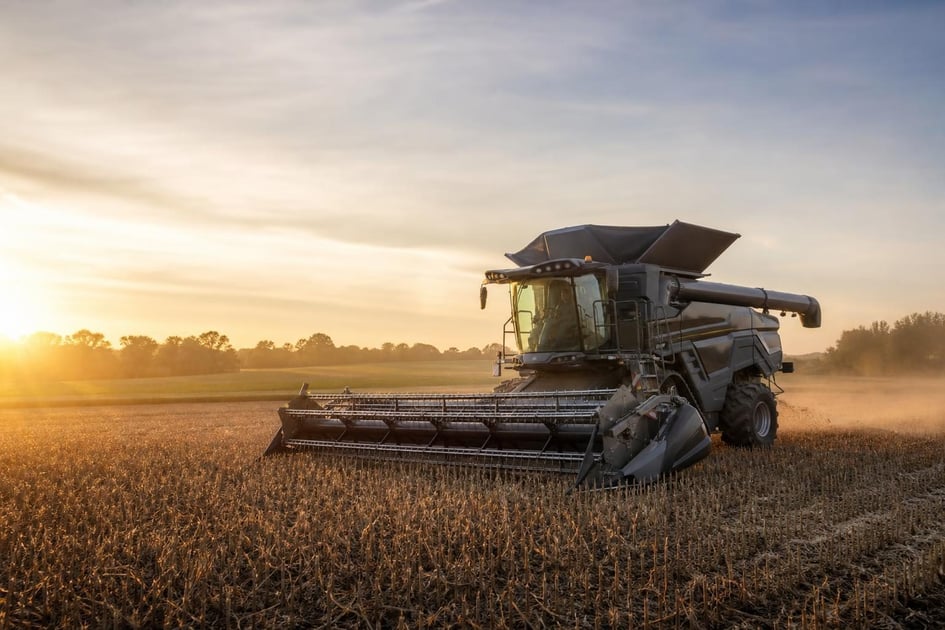
Financing a combine starts with the equipment itself. Lenders evaluate the machine's age, hours, condition, and resale value before they look at your credit profile. For a used combine, most lenders want to see fewer than 3,000 separator hours and a model year within the last 10 to 12 years. For new machines, the requirements shift toward your business financials and down-payment capacity. If you are weighing a purchase, see what financing you qualify for on that combine before you negotiate with the dealer.
What Lenders Evaluate for Combine Financing
A combine is not a generic asset. It is a seasonal, high-value piece of equipment with a specialized resale market. Lenders know that a Class 9 combine held for three years retains value differently than a mid-size unit from a defunct brand. That reality shapes what they ask for. According to SBA family farm statistics for 2026, the vast majority of U.S. farms are small family operations, which means many combine buyers are owner-operators financing a single machine rather than an entire fleet.
Credit Score and Business History
Most equipment lenders prefer a personal credit score of 620 or higher for combine financing. If your score sits below that, you may still qualify, but the required down payment typically rises and the term may shorten. Two or more years in business strengthens your file, though some lenders will work with younger operations if the borrower has prior agricultural experience or a strong co-signer. A bankruptcy within the last three years usually disqualifies the application unless it has been fully discharged and you can show re-established credit.
Revenue and Debt Service Coverage
Lenders want to see that your farm or custom-harvesting operation generates enough cash flow to cover the new payment. A common benchmark is a debt-service coverage ratio of 1.25 or higher, meaning your net operating income exceeds your total debt payments by at least 25 percent. If you are buying the combine to expand into custom harvesting, be ready to present contracts or letters of intent that support the projected revenue.
Down Payment and Collateral
For used combines, expect to put down 10 to 20 percent of the purchase price. New combines may start at 0 percent down for well-qualified borrowers, though 5 to 10 percent is more common for operations with average credit. The combine itself serves as the collateral, which keeps rates competitive compared with unsecured borrowing. If you are financing a second or third combine, the lender may also cross-collateralize other equipment or require a blanket lien on farm assets.
Key Insight: Lenders often value a used combine through an independent appraisal or auction comp rather than the asking price. If the seller wants $280,000 but the appraised wholesale value is $240,000, the lender will base the loan-to-value ratio on the $240,000 figure. That gap becomes your out-of-pocket cost above the standard down payment.
Already have a machine in mind?
Provide Capital finances new and used equipment from $5,000 to $5 million, with same-day decisions possible.
Apply NowNew vs. Used Combines: How Financing Requirements Change
The age and condition of the combine directly affect term length, rate range, and documentation burden. New and near-new units are simpler to finance because the residual value is predictable. Used units require more scrutiny. Census Bureau agriculture data shows that farm equipment values and land use have shifted as average farm sizes have grown, making efficient harvesting equipment essential to covering more acres with fewer machines.
New Combine Financing
New combines typically carry terms of five to seven years, sometimes stretched to eight for machines over $500,000. Because the manufacturer warranty covers the first two to three years, lenders view the risk as lower. You will still need to provide proof of insurance with the lender listed as loss payee, but the inspection process is minimal. Dealer invoices and a purchase agreement are usually sufficient.
Used Combine Financing
Used combines introduce variables. Lenders want maintenance records, a current inspection, and verification of hours. Most cap financing at 10 to 12 years from the model year, meaning a 2016 combine may only qualify for a three- or four-year term in 2026. If the machine has high separator hours or shows evidence of excessive rotor wear, the lender may shorten the term or increase the down payment requirement. Private-party purchases add another layer: the lender will verify that the seller has clear title and may require an escrow process.
For operations that need other machinery alongside the combine, Dump Trucks financing follows a similar collateral-based structure, though vocational trucks often carry shorter terms due to road-use wear.
Pro Tip: If you are buying a used combine at auction, secure your financing approval before you bid. Auction purchases usually require payment within 24 to 72 hours, and a conditional approval letter lets you bid with a hard ceiling instead of guessing what a lender will fund afterward.
Lease vs. Loan: Choosing the Right Structure
Farmers often assume a loan is the only path to a combine, but leasing can make sense depending on your tax posture, usage pattern, and long-term fleet plan. The key difference is ownership at the end: a loan gives you equity; a lease gives you a purchase option or the obligation to return the machine.
| Factor | Equipment Loan | Equipment Lease |
|---|---|---|
| Ownership | You own the combine after the final payment. | You may buy at fair market value or return it. |
| Down payment | Typically 10 to 20 percent for used, 0 to 10 percent for new. | Usually one or two advance payments. |
| Term | Three to seven years, depending on age and cost. | Two to five years, often aligned with warranty. |
| Tax treatment | Section 179 and bonus depreciation apply to owned assets. | Payments are generally deductible as operating expenses. |
| Hours restrictions | None; you control utilization. | Annual hour caps may apply, with per-hour overage fees. |
| End-of-term obligation | None; the lien releases. | Return, renew, or buy at the stated option price. |
If you put heavy hours on your machines each season, a loan is usually the better fit because there are no usage penalties. If you prefer to rotate into a new combine every three years and want lower monthly outlays, a lease may preserve cash flow. Rates vary by credit profile, equipment age, and term, so compare both structures with your accountant before you sign. Get a decision on your equipment, possibly the same day, to see which structure your operation qualifies for.
Tax Treatment for the 2026 Tax Year
Tax strategy is one of the main reasons farmers finance combines rather than paying cash. For the 2026 tax year, Section 179 allows businesses to deduct the full purchase price of qualifying equipment up to a specified limit, subject to a phase-out threshold. Bonus depreciation is also available, though the percentage has continued to step down from prior years. Because these limits and percentages change annually, you should confirm the exact 2026 figures with a CPA before you file.
If you lease, you generally deduct the lease payments as an operating expense. If you take a loan, you deduct the interest and may also depreciate the asset through Section 179 or bonus depreciation. The choice between loan and lease can swing your effective after-tax cost by thousands of dollars, so run the numbers with your tax advisor before you commit.
By the Numbers: A farmer in the 24 percent federal tax bracket who deducts a $400,000 combine through Section 179 in 2026 could reduce tax liability by roughly $96,000, plus any state benefit. That is a simplified illustration; actual savings depend on taxable income, alternative minimum tax, and whether the deduction is phased out. Speak with a CPA for a projection based on your books.
Find the right financing structure
Tell us about the equipment you need and we will show you the options that fit your business.
See Your OptionsReal-World Cost Scenarios
Understanding the monthly obligation helps you decide whether a given machine fits your cash flow. The examples below use representative figures. Rates vary by credit profile, equipment age, and term, so treat these as directional only. Weak farm machinery demand in 2026 has created a buyer's market in some regions, with dealers more willing to negotiate on new combines and auction volumes rising for late-model used machines.
Scenario 1: Late-Model Used Combine
You are buying a 2019 Class 7 combine with 1,800 separator hours for $285,000. The lender approves a five-year term at a rate consistent with your credit tier and requires 15 percent down.
- Purchase price: $285,000
- Down payment: $42,750
- Amount financed: $242,250
- Term: 60 months
- Estimated monthly payment: $4,600 to $5,100
Scenario 2: New Combine
You are ordering a 2026 Class 8 combine for $680,000. With strong credit and two years of tax returns showing solid cash flow, the lender approves a seven-year term with 5 percent down.
- Purchase price: $680,000
- Down payment: $34,000
- Amount financed: $646,000
- Term: 84 months
- Estimated monthly payment: $8,900 to $9,800
These payments do not include insurance, which most lenders require and which can add $800 to $1,500 per month depending on coverage levels and deductible.
Documentation You Will Need
The faster you assemble the paperwork, the faster the lender can move. For same-day approvals, most of this should be ready at submission.
Business and Personal Financials
- Last two years of personal tax returns
- Last two years of business tax returns or Schedule F
- Current personal financial statement
- Three most recent months of business bank statements
- Current accounts receivable and payable aging, if applicable
Equipment Information
- Invoice or purchase agreement with serial number
- Inspection report or dealer checklist for used machines
- Maintenance records, especially for engines, rotors, and feeder houses
- Proof of insurance binder naming the lender as loss payee
If you are buying from a private party, add a title search and a bill of sale. If the combine has an existing lien, the lender will coordinate a payoff letter before funding.
What Happens After You Apply
The approval timeline depends on how complete your file is and whether the combine needs an appraisal.
Initial Review
Many lenders can issue a conditional decision within a few hours if your credit is straightforward and the equipment is standard. Conditional means the lender approves the credit and the structure but still needs to verify collateral value and insurance.
Verification and Funding
After the conditional approval, the lender orders an equipment valuation or accepts the dealer invoice for new machines. You submit the insurance binder. Once both are cleared, the lender prepares the closing documents. Funding usually occurs within 24 to 72 hours after you sign, though private-party sales can take longer if title issues arise.
For farmers building a broader fleet, understanding how Agriculture equipment financing works across different asset types can help you time purchases and manage blanket liens.
Common Mistakes to Avoid
Even experienced operators trip over the same financing hazards.
- Buying before qualifying: Negotiating a price and then hoping for approval puts you at the seller's mercy. Get prequalified first.
- Ignoring hour caps on leases: A lease with a 300-hour annual cap sounds affordable until you log 450 hours in a wet harvest season. Overage fees can exceed $2 per hour.
- Skipping the inspection: Used combines hide expensive problems in the rotor, concave, and cleaning shoe. A $400 inspection can save you from financing a machine that needs $30,000 in repairs before it cuts a single acre.
- Forgetting insurance timing: Lenders will not fund without proof of coverage. If your agent takes 48 hours to issue a binder, that is 48 hours of delay you could have avoided.
- Overlooking tax coordination: Buying a combine in December to capture a 2026 deduction only works if the machine is placed in service before year-end. If funding slips into January, your deduction may shift to 2027.
Pro Tip: If you are trading in a combine as part of the purchase, disclose the trade value to the lender upfront. Some lenders will not finance the full transaction if the trade-in is not documented, and others require the trade to be paid off before the new lien is filed. Clear title on the trade prevents last-minute closing surprises.
Put the right equipment to work
From $5,000 to $5 million, new or used, Provide Capital helps businesses nationwide finance the equipment they need.
Apply TodayFrequently Asked Questions
Can I finance a combine with a 600 credit score?
Yes, but expect a higher down payment, likely 15 to 25 percent, and a shorter term. The lender may also require additional collateral or a co-signer. Rates vary by credit profile, equipment age, and term.
How old of a combine can I finance?
Most lenders cap used combine financing at 10 to 12 years from the model year. A 2015 combine in 2026 may only qualify for a two- or three-year term, which means a larger monthly payment. Some niche lenders will stretch to 15 years for low-hour, well-maintained machines, but the down payment requirement usually increases.
Is a down payment always required?
No. Well-qualified borrowers buying new or near-new combines can sometimes secure 0 percent down. However, most used combine transactions require at least 10 percent down, and borrowers with credit challenges may need 20 percent or more.
Does the lender need to inspect the combine?
For new machines, no. For used machines, most lenders require either a dealer inspection, an independent appraisal, or a recent service report. The inspection focuses on engine health, separator and rotor condition, hours, and overall appearance.
Can I finance a combine from a private seller?
Yes, but the process adds steps. The lender must verify clear title, coordinate a payoff if the seller has an existing loan, and may require an escrow service. Funding can take an extra two to five business days compared with a dealer purchase.
What insurance do I need?
Physical damage coverage is required, usually with a deductible of $2,500 or less. The lender must be named as loss payee. If you store the combine off-farm or transport it between fields, confirm that your policy covers those locations and transit.
Can I pay off the loan early?
Most equipment loans allow early payoff, but some include a prepayment penalty during the first 12 to 24 months. Ask for the specific language before you sign. Leases are generally less flexible; early termination triggers the remaining payments or a stiff penalty.
How does financing a combine differ from financing a tractor?
Combines carry higher price tags and more specialized resale markets, so lenders scrutinize hours and maintenance records more closely than they do for tractors. Terms may also be shorter for used combines because depreciation accelerates after the initial warranty period. Combines financing sits in its own risk category for most lenders.
Ready to Move Forward?
Financing a combine is straightforward if you know what lenders weigh and you prepare the paperwork in advance. Match the machine to your acreage, your cash flow, and your tax plan. Decide whether you need the equity of a loan or the flexibility of a lease. Then gather your tax returns, bank statements, and equipment details before you shop.
When you are ready, start an application in a few minutes and see what terms your operation qualifies for. Same-day approvals are possible, and the equipment itself secures the financing, so you do not need to pledge unrelated assets to bring the combine into your fleet.
Disclaimer: The information provided in this article is for general educational purposes only and is not financial, legal, or tax advice. Funding terms, qualifications, and product availability may vary and are subject to change without notice. Provide Capital does not guarantee approval, rates, or specific outcomes. For personalized information about your business funding options, contact our team directly.
