
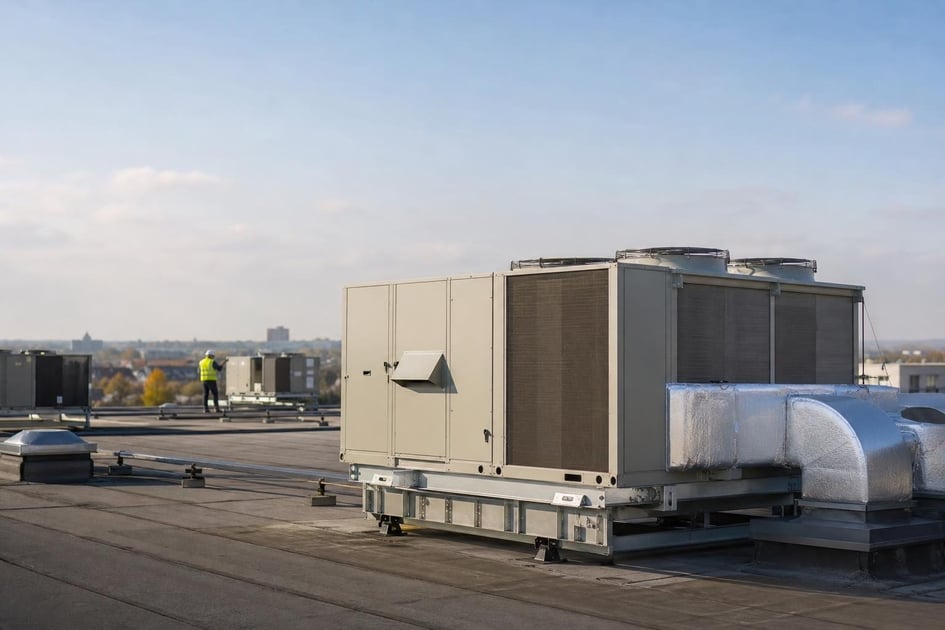
A commercial HVAC system financing calculator gives you a payment estimate in about 30 seconds, but the number it shows is only as good as the assumptions behind it. If you are pricing a 10-ton rooftop unit for a retail strip or a 50-ton chiller for a manufacturing floor, the monthly payment can range from a few hundred dollars to several thousand depending on equipment age, your business history, and the term you choose. Before you trust the first figure you see, it helps to know what actually drives the math and where calculators tend to oversimplify.
Provide Capital finances new and used business equipment from $5,000 to $5 million nationwide, with the equipment itself serving as collateral. That structure keeps rates competitive and means same-day approvals are possible once the right documentation is in hand. If you are mid-purchase and need a realistic sense of the payment, see what financing you qualify for on that unit rather than guessing with generic numbers.
What a Commercial HVAC Financing Calculator Actually Does
An online calculator multiplies the equipment cost by a estimated rate factor and spreads it across a term, usually 24 to 84 months. The output is a rough monthly payment. It does not pull your credit, verify your time in business, or account for seasonal cash flow. Think of it as a starting point, not a quote.
Most calculators ask for three inputs: equipment cost, estimated credit tier, and desired term. Some add a down-payment field. The problem is that commercial HVAC pricing is not uniform. A packaged rooftop unit for a small office might run $2,000 to $3,500 per ton installed, while a chilled-water chiller plant can land at $4,500 to $8,000 per ton according to industry cost surveys. A 10-ton changeout on a retail building typically falls between $22,000 and $45,000 all-in, while a 20-ton unit can clear $40,000 and approach $90,000 once rigging, controls, and electrical work are included. If the calculator assumes a lower equipment cost than your actual bid, your real payment will be higher.
The other gap is rate. Provide Capital does not publish a single APR because rates vary by credit profile, equipment age, and term. A calculator that defaults to a single-digit rate for every user is not reflecting the full range. The only way to get a number you can budget around is to submit the actual equipment quote and a short application.
Get a fast decision on your equipment
Applying takes just a few minutes, and decisions can come as soon as the same day.
Start Your ApplicationVariables That Move the Number
Equipment cost and system type
Tonnage is the biggest driver of cost. A 3-ton packaged unit for a 2,000-square-foot office might total $8,000 to $25,000 installed. A 15-ton system for a restaurant with kitchen makeup air often lands at $32,000 to $65,000. At the high end, a 25-ton or larger unit for industrial or multi-tenant use can run $50,000 to $110,000 or more. VRF and multi-zone systems, common in mixed-use buildings, typically start around $4,000 per ton and can exceed $6,500. Chillers push even higher.
Installation variables matter as much as the box itself. Crane rigging adds $1,500 to $4,500 on most jobs over 10 tons. Curb adapters run $800 to $3,000. Electrical upgrades, roofing patches, and R-22 recovery on legacy equipment can add thousands more. A financing calculator rarely captures those line items. If your bid includes them, make sure you are financing the total project cost, not just the equipment sticker price.
Credit profile and business history
Lenders price risk in tiers. A business with five-plus years of operation, strong bank balances, and clean credit will see lower rates than a newer operation or one with recent delinquencies. That does not mean younger businesses are shut out, but the calculator estimate should shift accordingly. If the tool offers only a "good credit" and "bad credit" toggle, it is probably hiding a 20 to 40 percent swing in monthly payment.
Term length
Stretching the same $50,000 over 36 months versus 60 months can lower the monthly payment by roughly one-third, though the total cost of financing rises. Most commercial equipment loans run 24 to 84 months. HVAC equipment with a 15- to 25-year useful life often justifies a longer term than a laptop or vehicle, but the exact term depends on the lender's policy and the equipment's expected resale value.
Pro Tip: If you are replacing a failed unit in mid-summer or mid-winter, ask your lender whether they can approve the deal and pay the vendor before the peak season ends. Provide Capital can issue same-day approvals when the file is complete, which matters when a building is unusable without climate control.
New vs. Used HVAC Equipment: Financing Considerations
New equipment commands lower rates because the collateral holds more residual value. It also qualifies for the full Section 179 deduction in the year it is placed in service, subject to the 2026 tax-year limits. Used equipment, especially units five to ten years old, can still be financed but may require a shorter term or a slightly higher rate to offset depreciation risk.
The trade-off is upfront cost versus total cost of ownership. A used 10-ton rooftop unit might cost 40 to 60 percent less than new, but if it runs on R-22 refrigerant, you are looking at higher maintenance and eventual replacement costs. Federal data shows that HVAC equipment producer prices rose roughly 60 percent between January 2020 and September 2026, so replacement costs are not going down. Financing a new, efficient unit at a competitive rate can be cheaper over five years than nursing an aging one. Energy costs are part of that equation; average winter heating expenditures have climbed sharply in recent years, and electricity prices have outpaced general inflation.
Lease vs. Loan: A Side-by-Side Look
Both structures get you the equipment, but they treat ownership, tax deductions, and end-of-term options differently. A loan builds equity; a lease preserves cash. Here is how they compare for a typical commercial HVAC purchase.
| Feature | Equipment Loan | Finance Lease |
|---|---|---|
| Ownership | You own the equipment from day one | Lessor owns it; you may have a buyout option |
| Monthly payment | Usually higher than a lease | Usually lower than a loan |
| Tax treatment | Interest deduction + depreciation or Section 179 | Payments often fully deductible as operating expense |
| Down payment | Often 0% to 20% | Often first and last payment upfront |
| End of term | No obligation; equipment is yours | $1 buyout, FMV buyout, or return |
| Best for | Businesses wanting equity and long-term use | Businesses prioritizing low monthly outlay |
The right choice depends on your tax position and cash flow. If you have taxable income to offset, a loan with Commercial Hvac System financing and a Section 179 deduction can deliver a larger first-year write-off. If you need the lowest possible monthly payment to preserve working capital, a lease may fit better. Your CPA can model both scenarios for the 2026 tax year.
Key Insight: A $1 buyout lease and a loan are treated almost identically for tax purposes under current IRS rules, but a fair-market-value lease is different. If your goal is to write off the entire cost quickly, do not assume a lease delivers the same outcome. Ask your accountant whether the structure qualifies for the Section 179 deduction or must be depreciated over the IRS schedule.
Tax Treatment and the Bottom Line
Section 179 and bonus depreciation
For the 2026 tax year, Section 179 allows businesses to deduct the full purchase price of qualifying equipment in the year it is placed in service, subject to an annual dollar limit and a phase-out threshold that adjusts for inflation. The exact 2026 ceilings are set by the IRS; talk to your CPA about the current limit before you count on a specific deduction amount. If your total equipment purchases exceed the phase-out window, the deduction phases out dollar for dollar.
Bonus depreciation, which allowed 100 percent immediate expensing in prior years, has been stepping down. For the 2026 tax year, the percentage is lower than in previous years and continues to decline through 2027 unless Congress acts. Again, the precise percentage for 2026 should be confirmed with your accountant. The key point is that financing the equipment does not reduce your eligibility. You can deduct equipment you bought with a loan or capital lease, provided you meet the other requirements.
Lease tax treatment
With a true operating lease, you generally deduct the monthly payment as a business expense. With a capital lease or loan, you deduct interest and take depreciation or Section 179. The difference can swing your first-year tax savings by thousands of dollars on a $50,000 HVAC system. Because the 2026 rules depend on your entity type, taxable income, and other equipment purchases, a quick online article cannot replace a conversation with your CPA.
By the Numbers: According to federal contract data, thirteen rooftop unit replacements awarded between 2021 and 2026 ranged from $1,520 to $7,356 per ton, with a median of $4,650. A 10-ton system at that median costs roughly $46,500 installed. Financed over 60 months, that produces a very different monthly obligation than a $22,000 light-commercial job or a $90,000 heavy manufacturing install. Always base your calculator input on the actual bid, not a rule of thumb.
See what you qualify for
The equipment itself secures the financing, which keeps rates competitive. Checking your options takes minutes.
Check Your OptionsWhat Lenders Actually Look For
Credit and time in business
Lenders want to see that your business generates enough cash to cover the new payment. Most look for a minimum of one to two years in operation, though exceptions exist for strong credits or well-collateralized deals. Personal credit of the guarantor usually matters, especially for owner-operated businesses. Bank statements, tax returns, and a current profit-and-loss statement help tell the story.
Equipment as collateral
Because the HVAC unit itself secures the financing, the lender cares about what happens if the equipment has to be remarketed. New units from major brands hold value better than obscure or obsolete models. Installation matters too: a rooftop unit on a prime commercial building is easier to repossess and resell than a custom chiller built into a specialized plant. That is why Hvac equipment financing from Provide Capital uses the equipment as collateral, which keeps pricing competitive even when bank lines are tight.
Reuters reported that equipment borrowing surged more than 30 percent in January 2026, which means lenders are active and capital is moving. If you have a solid credit profile and a real equipment quote, get a decision on your equipment, possibly the same day, rather than waiting weeks for a traditional line increase.
Documentation You'll Need
A complete file speeds approval. Most lenders ask for:
- A vendor quote or equipment description showing make, model, year, and serial number if used
- Last three to six months of business bank statements
- Most recent business tax return
- Current profit-and-loss statement
- A brief application with ownership details and personal guarantee
For deals above $100,000, expect to provide a balance sheet and possibly an interim financial statement. If the equipment is used, the lender may want photos or an inspection report. Having these ready before you apply turns a multi-day process into a same-day answer.
Common Mistakes When Using Online Calculators
The first mistake is entering only the equipment sticker price. A 10-ton rooftop unit might list at $16,000, but the installed cost with crane, curb adapter, and electrical can hit $35,000. If you calculate payments on $16,000, you will be shocked when the real financed amount is more than double.
The second mistake is choosing the longest possible term to minimize monthly payments without checking prepayment penalties. Some lenders charge a fee for early payoff; others do not. If your business has seasonal spikes and you plan to pay the loan down in month six, a no-penalty structure saves money.
The third mistake is comparing a calculator result to an SBA loan. The SBA 7(a) loan program can fund equipment purchases up to $5 million, but the process involves more paperwork, longer timelines, and often a lien on business assets beyond just the equipment. Direct equipment financing is usually faster and requires less documentation for deals under $500,000.
Pro Tip: If you are buying multiple units, ask whether bundling them into one financing agreement lowers the rate. A single $75,000 loan often prices better than three separate $25,000 loans because administrative costs are spread across a larger balance, and the collateral package is more attractive to the lender.
Industry-Specific HVAC Financing Scenarios
Different industries buy HVAC at different times and for different reasons. Understanding the seasonal pattern helps you use a calculator with realistic timing.
Restaurants and food-service operators often replace HVAC in early spring or late fall, before the summer rush or winter heating season. A failed walk-in cooler compressor or dining-room unit can shut down service, so speed matters. Financing calculators for restaurant owners should assume higher-than-average installation costs because of kitchen makeup air, grease-duct coordination, and after-hours labor.
Healthcare and dental practices face stricter air-quality and ventilation codes. A medical suite might need a dedicated outdoor-air system and HEPA filtration, pushing the per-ton cost toward the high end of the range. Lenders view medical practices as stable credits, which can offset the higher equipment cost with better rates.
Manufacturing and warehouse buyers often need 20-ton to 50-ton units or multiple RTUs. Because the equipment serves the business directly and the building is usually owned or under a long-term lease, lenders are comfortable with longer terms. If you are financing a chiller for a plant, make sure the calculator reflects the full installed cost, not just the chiller itself.
Transportation and agriculture businesses sometimes need HVAC for maintenance bays, dispatch offices, or processing facilities. These are smaller jobs, often $15,000 to $40,000, but they are essential to operations. A used split system might make sense here if the building is leased and the business does not plan to stay long term.
What Happens After You Apply
Once you submit an application with your equipment quote, the lender reviews credit, verifies time in business, and evaluates the collateral. For deals under $250,000, this can take a few hours. For larger deals, expect a day or two while the underwriter confirms equipment value and inspects financials.
After approval, the lender issues a term sheet or finance agreement. You sign, the vendor is paid directly, and the equipment is delivered and installed. Payments usually start 30 to 45 days after funding. Some lenders offer deferred payment plans, letting you skip the first one to three months while the equipment starts generating savings or revenue.
If you have a vendor quote in hand and want to move quickly, start an application in a few minutes. Provide Capital handles transactions from $5,000 up to $5 million, and because the equipment secures the financing, you do not need to pledge real estate or other assets.
Ready to move forward?
More than 10,000 businesses have financed equipment with Provide Capital. See what you qualify for today.
Get StartedFrequently Asked Questions
How accurate are online HVAC financing calculators?
They are accurate on math but speculative on inputs. If you enter the exact equipment cost, a realistic rate factor, and the correct term, the payment will be close. Most users underestimate equipment cost or overestimate their credit tier, which produces a number that is $50 to $200 lower than the actual approval.
Can I finance installation costs, or just the equipment?
Many lenders allow you to finance soft costs like installation, freight, and controls as long as they are itemized on the vendor invoice. The total financed amount usually cannot exceed the appraised value of the installed system. Ask your lender whether they require the invoice to come from a single vendor or if they will pay multiple contractors.
Does financing HVAC require a down payment?
Not always. Provide Capital offers zero-down options for qualified borrowers. Deals with weaker credit or older used equipment may require 10 to 20 percent down. The calculator should let you adjust the down payment to see how it affects the monthly obligation.
Will financing an HVAC unit hurt my credit?
A hard inquiry may cause a small, temporary dip. The new account will appear on your business credit report and can improve your profile if payments are made on time. The impact is generally minor compared to the benefit of preserving your bank line for working capital.
Can I pay off the loan early?
It depends on the lender and the specific agreement. Some contracts include a prepayment penalty for the first 12 to 24 months; others allow early payoff with no fee. Read the term sheet carefully, and ask your financing contact to confirm before you sign.
What credit score do I need for commercial HVAC financing?
There is no universal cutoff. Strong credits above 700 usually qualify for the best rates, but approvals are common in the mid-600s, especially for established businesses with solid cash flow. If your credit is below 650, expect a shorter term or a request for additional collateral. Rates vary by credit profile, equipment age, and term.
How long does approval take?
For complete files under $250,000, same-day approval is possible. Larger deals or files missing financial statements may take 24 to 72 hours. You can speed the process by submitting bank statements, tax returns, and the vendor quote with the initial application.
Should I lease or loan an HVAC system?
Choose a loan if you want to own the equipment, claim depreciation or Section 179, and plan to keep it for its full useful life. Choose a lease if you need the lowest monthly payment, may want to upgrade at the end of the term, or prefer to treat the payment as an operating expense. Your CPA can tell you which structure saves more tax for the 2026 tax year.
Moving From Estimate to Approval
A commercial HVAC system financing calculator is a useful planning tool, but it is not a substitute for an actual offer. The real numbers depend on your business financials, the specific equipment, and the lender's appetite for that collateral. Start with a detailed vendor quote that includes installation, then run the numbers with realistic assumptions. If the payment fits your cash flow, the next step is to submit the file and get a real decision. Provide Capital finances Hvac System financing nationwide for construction, healthcare, dental, restaurant, manufacturing, transportation, agriculture, and forestry businesses. Bring the quote, and we will show you the actual payment.
Disclaimer: The information provided in this article is for general educational purposes only and is not financial, legal, or tax advice. Funding terms, qualifications, and product availability may vary and are subject to change without notice. Provide Capital does not guarantee approval, rates, or specific outcomes. For personalized information about your business funding options, contact our team directly.
