
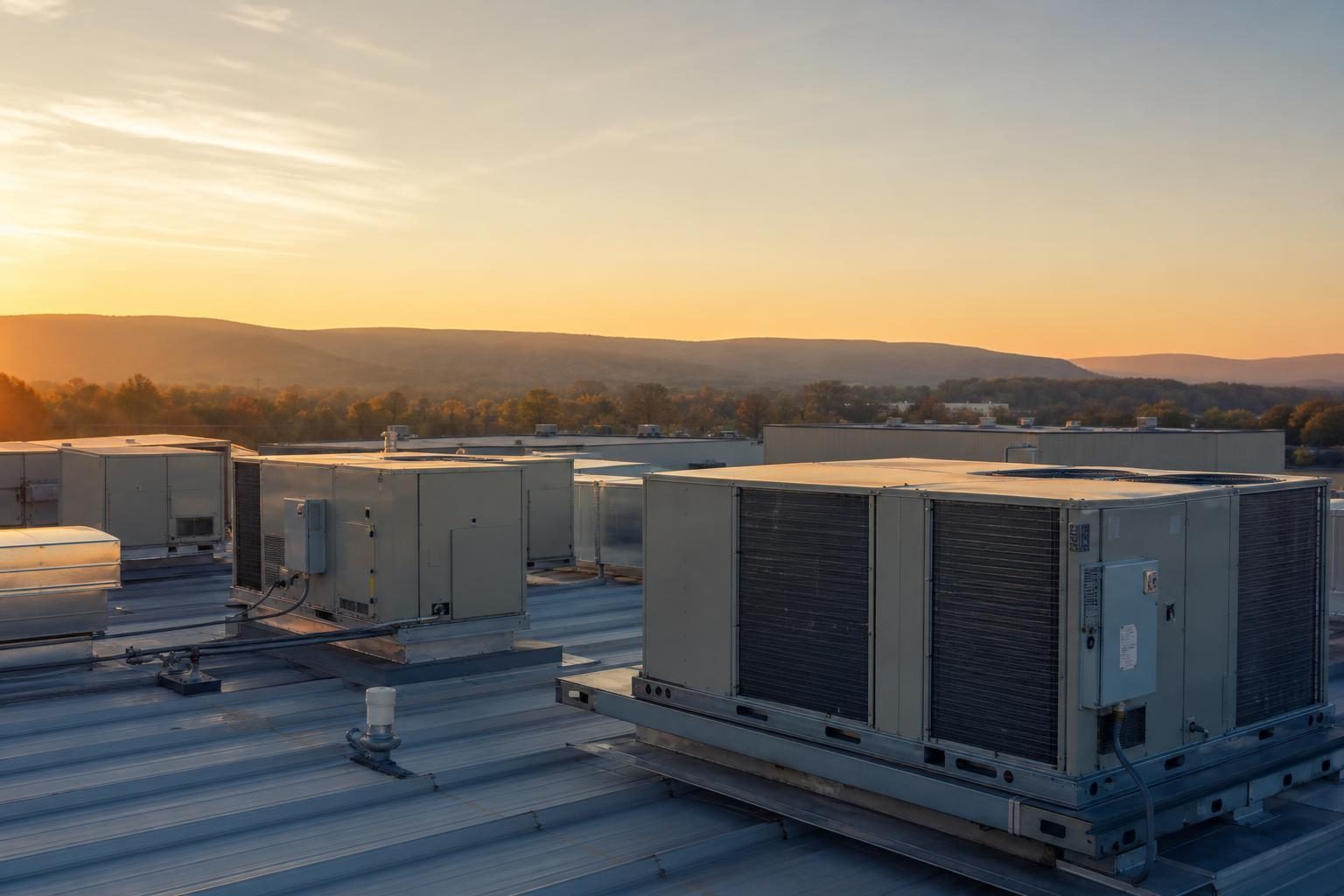
Pennsylvania business owners facing a failing rooftop unit or planning a new build do not need to pay cash upfront for a commercial HVAC system. Equipment financing spreads the cost over predictable monthly payments, using the equipment itself as collateral. Provide Capital finances new and used commercial HVAC units from $5,000 to $5 million for owner-operators statewide, with same-day approvals possible depending on file strength. Many commercial buildings in Philadelphia, Pittsburgh, and smaller markets like Scranton or Lancaster date back decades, with aging mechanical systems that were not designed for today’s occupancy loads or energy codes. Financing lets you replace or upgrade without draining the operating account.
Whether you run a manufacturing plant in Allentown, a healthcare clinic in Philadelphia, or a restaurant in Pittsburgh, the replacement timeline is rarely convenient. Financing keeps your cash reserves intact while the building stays climate-controlled. See what financing you qualify for on that rooftop unit before the next cold front rolls through.
Why Pennsylvania Timing Matters for HVAC Replacements
Pennsylvania’s climate runs from subzero winter snaps to humid summer stretches above 90 degrees. Commercial HVAC systems here work hard eight months of the year, and the shoulder seasons are short. When a chiller or boiler fails in July or January, waiting is not an option. The southeastern part of the state deals with hot, sticky summers along the I-95 corridor, while the western region sees lake-effect snow and prolonged freezes near Erie. A 15-ton rooftop package unit in Pittsburgh faces different demands than a split system in Harrisburg, but both need to maintain occupancy codes and employee safety.
Winter Demand and Summer Humidity
Many Pennsylvania business owners schedule replacements in April or October to avoid peak demand for contractors. But equipment does not always cooperate. A cracked heat exchanger discovered in February or a refrigerant leak in August forces an emergency decision. Financing removes the pressure of finding $40,000 or more in operating cash during an emergency. It also lets you take advantage of off-season contractor availability, when HVAC companies in Philadelphia and Pittsburgh are less slammed and may offer faster install timelines.
Construction Season Alignment
Ground-up construction and major renovations in Pennsylvania concentrate between late April and early November. If your project is tied to a certificate of occupancy, the HVAC install is on the critical path. Delaying the equipment purchase because of cash flow can push your opening into winter, adding carrying costs and missed revenue. Locking in financing early keeps the mechanical contractor on schedule and protects your relationship with the general contractor. According to U.S. Census Bureau data, Pennsylvania maintains a steady pipeline of commercial construction permits, which means contractor backlogs fill quickly in the spring.
Key Insight: Pennsylvania’s Department of Environmental Protection enforces refrigerant and emissions rules that can affect which HVAC units are eligible for install in certain air-quality zones. Before you finance a used system, confirm the refrigerant type and unit age meet current DEP standards for your county, or you may face retrofit costs that financing does not cover.
Already have a machine in mind?
Provide Capital finances new and used equipment from $5,000 to $5 million, with same-day decisions possible.
Apply NowWhat You Can Finance
Commercial HVAC system financing covers more than just the box on the roof. Provide Capital structures loans and leases around the full project cost, including the unit, delivery, rigging, and installation labor. We finance Commercial Hvac System financing and Industrial Hvac System financing for owner-operators across Pennsylvania.
Eligible equipment includes:
- Rooftop package units (RTUs) from 3 to 50+ tons
- Chillers and cooling towers
- Variable refrigerant flow (VRF) and mini-split systems
- Commercial heat pumps and geothermal units
- Boilers, furnaces, and unit heaters
- Make-up air units, exhaust fans, and dedicated outdoor air systems (DOAS)
- Building automation systems tied to the HVAC install
New vs. Used Considerations
New equipment carries full manufacturer warranty and qualifies for the longest financing terms, often five to seven years. Used equipment can cut upfront cost by 30 to 50 percent, but lenders scrutinize age, hours, and condition more closely. Units older than ten years may require shorter terms or a larger down payment. If you are buying used, have a licensed HVAC technician inspect the heat exchanger, compressor, and control board before you commit. A used 10-ton RTU with a cracked heat exchanger is not a bargain at any price. Also verify that replacement parts are still available for the make and model; some older Pennsylvania-installed brands have limited distributor support in the Mid-Atlantic region.
Pro Tip: In Pennsylvania, rigging and crane costs to lift a rooftop unit can add $3,000 to $8,000 to the project, especially in dense urban sites like Philadelphia or Pittsburgh with tight alley access. Bundle these soft costs into your financing request rather than paying them out of pocket.
Loan vs. Lease for Pennsylvania HVAC Equipment
The right structure depends on how long you plan to keep the building, your tax strategy, and whether you want to own the asset outright. An equipment loan makes sense if the HVAC system will serve the same location for more than seven years. A lease or equipment finance agreement (EFA) may fit better if you need lower payments now or expect to upgrade again within five years. Rates vary by credit profile, equipment age and term, so the total cost of ownership depends on your specific situation.
At the end of a loan term, the lender releases its lien and you own the unit free and clear. With a lease, you may have a $1 buyout, a fair-market-value purchase option, or the ability to return the equipment. If you anticipate selling the building before the HVAC unit reaches end of life, a shorter-term lease or EFA can simplify the transition because you are not trying to transfer a loan to a new owner.
| Feature | Equipment Loan | Lease / EFA |
|---|---|---|
| Ownership | You own the unit; lender holds lien | Lessor owns until final payment or buyout |
| Term range | 2 to 7 years typical | 2 to 5 years typical |
| Monthly payment | Higher than lease; builds equity | Lower; preserves cash flow |
| Tax treatment | Interest deduction + depreciation | Payment deduction as operating expense |
| End of term | UCC release; you keep the unit | $1 buyout, FMV buyout, or return |
| Best for | Long-term owner-occupiers | Tenant improvements or short holds |
A borrower with strong credit and a new unit will see more favorable terms than a borrower with challenged credit and a 12-year-old chiller. We do not offer one-size-fits-all quotes because the collateral, the borrower, and the term all move the rate.
By the Numbers: A $75,000 rooftop replacement financed over five years typically runs between $1,400 and $1,700 per month for a well-qualified borrower with new equipment. A 10-year-old used unit on a three-year term might run $2,200 to $2,600 monthly. These ranges shift with credit depth, equipment type, and seasonal demand.
Qualifying for Financing
Provide Capital works with owner-operators who have at least two years in business and verifiable revenue. We do not require a minimum credit score posted on the website because every file is reviewed individually, but stronger credit opens longer terms and larger approvals. The equipment itself is the collateral, which means the lender’s risk is tied partly to the resale value of the HVAC unit if the loan does not perform. Get a decision on your equipment, possibly the same day, by submitting a complete file with your vendor quote.
We look at:
- Time in business: two years or more preferred; shorter histories considered with additional documentation
- Credit history: personal and business profiles reviewed
- Monthly revenue: three to six months of bank statements help us verify cash flow
- Equipment age and type: newer, name-brand units with clear title finance more easily
- Use case: the equipment must be for business purposes, not residential rental or personal use
Documentation You Will Need
Gather these items before you apply to avoid delays:
- One-page application or online submission
- Last three months of business bank statements
- Invoice or quote from the equipment vendor or contractor
- Proof of business entity (articles of incorporation or LLC operating agreement)
- Driver’s license or other government-issued ID
Having the vendor quote ready is critical. The quote confirms the equipment description, serial numbers if available, and total project cost. If the quote includes installation, rigging, or ductwork, itemize each line so the lender can verify what is being financed. Small Business Administration resources recommend keeping organized financial records to speed up any equipment loan application.
See what you qualify for
The equipment itself secures the financing, which keeps rates competitive. Checking your options takes minutes.
Check Your OptionsTax Treatment for the 2026 Tax Year
How you write off the HVAC system depends on whether you borrow or lease. For tax year 2026, businesses that purchase equipment through a loan may be eligible to deduct the full cost under Section 179 expensing in the year the unit is placed in service, subject to annual limits and taxable income ceilings. Alternatively, you can depreciate the asset over its useful life, typically 39 years for non-residential real property, though HVAC components may qualify for shorter recovery periods under certain conditions. Because the exact 2026 Section 179 limit and phase-out threshold depend on inflation adjustments and your tax situation, speak with a CPA before you count on a specific deduction amount.
If you lease the equipment, you generally deduct each monthly payment as an operating expense. This simplifies bookkeeping but does not build depreciable basis. The trade-off is usually lower payments versus long-term ownership benefits. A CPA can model which structure saves more for your 2026 return based on your bracket and existing equipment schedule. You can also review Associated Press business reporting for updates on federal tax legislation that might affect equipment write-offs during the current tax year.
Key Insight: The 2026 tax rules also include energy-efficiency credits for certain clean heat and geothermal systems installed in commercial buildings. If you are considering a heat pump or geothermal unit in Pennsylvania, ask your CPA whether the project qualifies for federal credits under the current tax year before you structure the financing.
Industry-Specific Use Cases in Pennsylvania
Pennsylvania’s economy is not monolithic. The HVAC needs of a dairy processor in Lancaster differ from those of a plastic injection molder near Erie. Provide Capital serves construction, healthcare, dental, restaurant and food service, manufacturing, transportation, agriculture, HVAC contractors, and forestry businesses statewide. Hvac equipment financing is available for contractors expanding their own fleet of installation gear, as well as for end users buying the systems themselves.
Manufacturing and Warehousing
The I-78 and I-81 corridors are packed with distribution centers and light manufacturing. These facilities often need 25- to 50-ton rooftop units to maintain production tolerances and employee comfort. High-bay spaces require destratification fans and makeup air units alongside the main HVAC plant. Financing lets you match the equipment life to the lease term of the building. Many of these facilities operate 24/7, so redundancy is important; some owners finance a primary unit and a backup simultaneously.
Healthcare and Dental
Medical offices in Philadelphia, Pittsburgh, and Hershey require precise temperature and humidity control for imaging equipment and patient comfort. A failed chiller in August can force cancellations and damage expensive machines. Financing a replacement quickly protects appointment revenue and compliance with Joint Commission environmental standards. Dental practices upgrading to larger suites often need additional tons of cooling to handle sterilization equipment and higher occupancy.
Agriculture and Food Processing
Dairies, meat processors, and produce packing houses in central and southeastern Pennsylvania rely on refrigeration and ventilation to maintain product safety. A used 20-ton condenser for a cold room can be financed just like a rooftop unit, keeping working capital available for payroll during harvest season. Reuters business coverage has noted that energy costs remain a significant line item for agricultural processors, making efficient HVAC and refrigeration equipment a priority.
Restaurants and Hospitality
Kitchen hoods, makeup air, and dining room climate control work as a system. A restaurant opening in Pittsburgh’s Strip District or Philadelphia’s Fishtown cannot afford a delay on its mechanical contractor. Financing the HVAC package lets the owner preserve capital for liquor licenses, furniture, and opening inventory. Seasonal outdoor dining enclosures added in Pittsburgh or Philadelphia also require supplemental heating and cooling that can be financed as equipment.
Transportation and Fleet Maintenance
Trucking companies and fleet operators in Pennsylvania often need climate-controlled maintenance bays to protect vehicles and workers during winter. A 20-ton heater and ventilation package for a fleet garage in Scranton or Reading keeps the shop operational when temperatures drop below freezing. The equipment is the collateral, so the loan is not tied to real estate you may not own.
Common Mistakes When Financing Commercial HVAC
- Undersizing the system to save money: A unit that is too small runs continuously, shortens its lifespan, and fails to maintain comfort. Finance the right size from the start, confirmed by a Manual J or Manual N load calculation.
- Ignoring installation and rigging: The crane, ductwork modifications, and electrical upgrades can add 20 to 40 percent to the equipment invoice. Ask your contractor for a turnkey quote and finance the total project.
- Buying without a load calculation: Pennsylvania’s updated energy codes require ACCA Manual J and Manual N calculations for many commercial installs. Lenders may ask for these to confirm the project scope and protect the collateral value.
- Choosing the longest term by default: A seven-year loan lowers the monthly payment but may have you paying for a unit that is already past its useful life. Match the term to the equipment’s expected service life and your hold period on the building.
- Neglecting maintenance records: If you are financing a used unit, the lender may want service records to confirm the compressor and heat exchanger are in working order. Start gathering receipts before you apply.
What Happens After Approval
Once approved, Provide Capital issues a funding letter or pays the vendor directly, depending on the structure. For vendor-direct transactions, we pay the HVAC contractor upon delivery and signed acceptance. For reimbursement deals, we verify the equipment serial numbers and invoice before releasing funds. A UCC-1 filing is recorded against the equipment to secure the lender’s interest. You receive amortization schedules, payment portal login details, and a direct point of contact for any service questions. There are no prepayment penalties on most programs, so you can pay down the balance early if cash flow improves. The entire process is designed to keep your project moving without adding administrative overhead.
Put the right equipment to work
From $5,000 to $5 million, new or used, Provide Capital helps businesses nationwide finance the equipment they need.
Apply TodayFrequently Asked Questions
Can I finance a used commercial HVAC unit in Pennsylvania?
Yes. Provide Capital finances both new and used equipment. Used units up to 10 years old generally qualify for standard terms. Older equipment may need a shorter term or additional inspection documentation. The key is verifying the unit has clear title, a recent service record, and that replacement parts are still available in the Mid-Atlantic market.
How fast can I get approved?
Same-day approvals are possible for well-qualified applicants with complete files. Most decisions arrive within one to two business days after we receive your bank statements and equipment quote. Delays usually happen when the vendor invoice is missing details or the bank statements show inconsistent deposits.
Does the equipment need to be from a Pennsylvania dealer?
No. We work with vendors nationwide. The equipment must be located in or delivered to your Pennsylvania business address, and the seller must provide a clear invoice and proof of ownership. If you are buying at auction or from an out-of-state dealer, let us know early so we can coordinate the UCC and funding timeline.
Can I include installation and ductwork in the financing?
Yes. Soft costs such as delivery, rigging, installation labor, and associated ductwork can often be bundled into the equipment financing agreement, provided they are itemized on the vendor invoice. This is one of the main advantages of equipment financing over a general line of credit, which may only cover the hard asset.
What credit score do I need?
We do not publish a minimum credit score. We review the full profile, including time in business, revenue trends, and credit history. Stronger files receive larger approvals and longer terms. A credit score is one factor among several, not a hard gate.
Is a down payment required?
Not always. Many approved borrowers finance 100 percent of the equipment cost. A down payment may improve your terms or be requested if the equipment is older or the file carries higher risk. If you can put 10 to 20 percent down, you may unlock a longer term or a larger approval amount.
Can I deduct the payments on my 2026 taxes?
If you lease, payments are generally deductible as operating expenses. If you take a loan, you may deduct interest and claim depreciation or Section 179 expensing. Because 2026 tax rules contain specific limits and phase-outs, consult a CPA before you file. Do not assume the deduction structure from a prior year applies unchanged.
What types of Pennsylvania businesses do you serve?
We finance commercial HVAC for manufacturing, healthcare, dental, restaurants, agriculture, transportation, forestry, construction, and HVAC contractors statewide. If the equipment is for business use and fits our collateral guidelines, we will review the file regardless of whether you are in Philadelphia, Erie, or a rural township.
Next Step
Replacing or upgrading a commercial HVAC system in Pennsylvania does not have to drain your operating account. Whether you need a new 20-ton rooftop unit for a warehouse near Allentown or a used chiller for a food processor in Lancaster, equipment financing keeps your cash working while the building stays comfortable. Review your vendor quote, gather three months of bank statements, and start an application in a few minutes. A financing specialist will review your file and call you with options, often the same day.
Disclaimer: The information provided in this article is for general educational purposes only and is not financial, legal, or tax advice. Funding terms, qualifications, and product availability may vary and are subject to change without notice. Provide Capital does not guarantee approval, rates, or specific outcomes. For personalized information about your business funding options, contact our team directly.
