
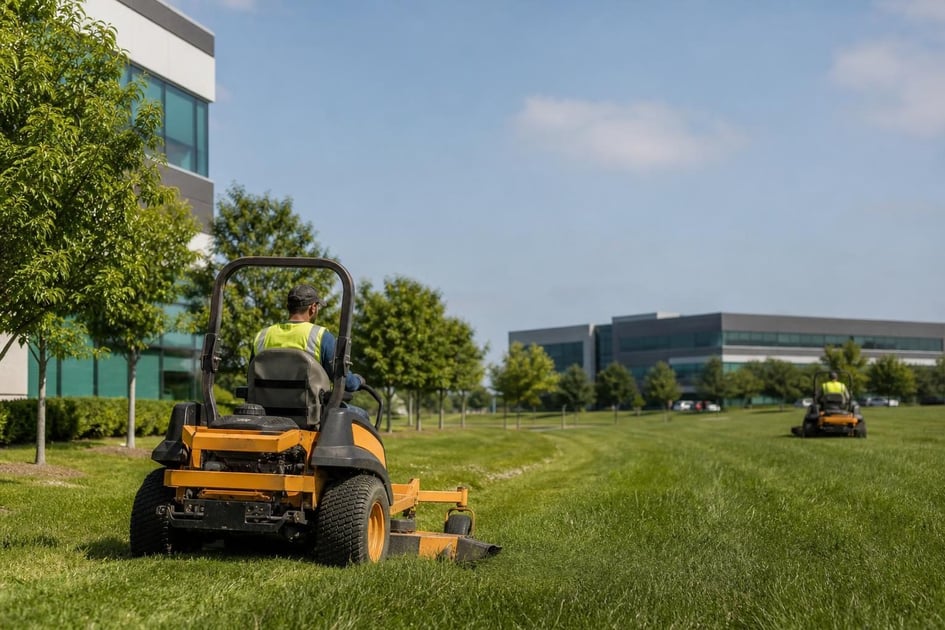
Commercial mower financing typically runs 24 to 60 months, with payments structured around the mowing season rather than a flat calendar. For a landscaping or groundskeeping business buying a zero-turn, stand-on, or walk-behind unit, the equipment itself serves as collateral, which means you do not need to pledge real estate or other assets to secure the loan. If your credit and business history are solid, you can often get a decision the same day you apply, so you can see what financing you qualify for on that mower before the dealer sells the unit you want.
How Commercial Mower Financing Works
Equipment financing for mowers is a secured transaction. The lender buys the equipment from the dealer or private seller and titles it in your business name with a lien attached. You make fixed monthly payments, and at the end of the term you own the machine outright. Because the lender can repossess and resell the mower if necessary, rates tend to be lower than unsecured credit. Provide Capital finances Commercial Mower financing for amounts from $5,000 up to $5 million, which covers everything from a single walk-behind for a solo operator to a full fleet refresh for a multi-crew landscaping company.
Most lenders in this space look at time in business, credit profile, and the age of the equipment. A two-year-old commercial zero-turn financed over 36 months will usually carry different terms than a brand-new model on a 60-month note. The key is matching the repayment schedule to the revenue the mower generates. In lawn care, that revenue is seasonal in most climates, so some structures allow for skip payments or seasonal schedules in the winter months. The secured financing structure used for mowers works the same way for Commercial Range financing or any other qualifying asset: the equipment collateralizes the deal.
Key Insight: Many lenders weight the equipment's resale value more heavily than your personal credit score. A late-model commercial mower from a major brand holds its value well at auction, which can offset a shorter business history or a blemish on your credit report.
Get a fast decision on your equipment
Applying takes just a few minutes, and decisions can come as soon as the same day.
Start Your ApplicationTypical Terms and Payment Structures
Terms for commercial mower financing generally fall between 24 and 60 months. Shorter terms mean higher monthly payments but less total interest paid over the life of the loan. Longer terms drop the monthly obligation, which helps cash flow during the startup or expansion phase, but you will pay more in total finance charges. Down payments range from zero to 20 percent depending on the lender and your risk profile. At Provide Capital, the equipment secures the deal, so down payment requirements are often lower than with unsecured business credit.
You will usually see fixed monthly payments, though some lenders offer seasonal structures where payments drop or pause from November through February. That aligns with the cash-flow reality of northern lawn care businesses. A $15,000 zero-turn on a 48-month term might run a few hundred dollars per month, while a $50,000 fleet package on 60 months will scale accordingly. Rates vary by credit profile, equipment age and term length.
| Term Length | Typical Use Case | Monthly Payment Trend | Total Cost Trend |
|---|---|---|---|
| 24 months | Solo operator, fast payoff | Highest | Lowest |
| 36 months | Standard replacement cycle | Moderate | Moderate |
| 48 months | New crew expansion | Lower | Higher |
| 60 months | Large fleet purchase or tight cash flow | Lowest | Highest |
What Drives Your Financing Cost
Three factors determine where you land on the rate spectrum: your credit history, the equipment's age and brand, and your business's time in operation. A landscaping company with three years of filed tax returns, a 700+ personal credit score, and a history of on-time debt payments will see stronger terms than a brand-new LLC with a 600 score. That does not mean the newer business is shut out. Because the mower serves as collateral, lenders can approve younger companies or lower credit profiles; the trade-off is a shorter term or a larger down payment.
The equipment itself matters. A 2025 or 2026 zero-turn from a major manufacturer with a national dealer network is easier to value and faster to resell than a 2012 model from a defunct brand. Lenders price that certainty into the rate. If you are buying used, expect the lender to require a serial number, photos, and possibly an inspection before funding. Hours matter too. A commercial mower with 800 hours is viewed differently than one with 2,400 hours, even if both are the same model year. Rates vary by credit profile, equipment age and term length.
Pro Tip: If you are buying used, pull the maintenance records before applying. A mower with documented annual service, blade replacements, and engine work is valued higher by lenders than one with a clean exterior and no paper trail. That documentation can shift you into a better risk tier.
New vs. Used Mowers
New equipment offers the latest fuel efficiency, warranty coverage, and technology, but it also depreciates steeply in the first 12 months. A new $20,000 commercial mower might be worth $14,000 the moment it leaves the lot. Used equipment avoids that initial drop, and the lower purchase price means a smaller total financed amount. For a second or third crew, a two- to four-year-old machine often makes more financial sense than a new one.
Warranty coverage is the main risk with used. A mower with 1,500 hours and no remaining factory warranty could face a $3,000 engine repair in year two. Budget for that. Some operators split the difference and buy late-model certified pre-owned units that still carry partial warranty. Whether you choose new or used, Provide Capital finances both, with terms adjusted to the equipment's age and expected remaining life.
Loan vs. Lease for Commercial Mowers
An equipment loan ends with you owning the mower. A lease gives you lower monthly payments but usually requires you to return the equipment or buy it at fair market value when the term ends. For a lawn care business, ownership usually wins. Mowers get beat up. A five-year-old commercial machine with 3,000 hours is not the asset you want to return to a lessor with a wear-and-tear penalty. You want to keep running it or sell it for equity toward the next purchase.
Leases can make sense if you are testing a new service line—say, adding stump grinding or snow removal—and you are not sure the revenue will stick. In that case, a two-year lease limits your exposure. For core mowing operations, though, the $1 buyout lease or equipment finance agreement is usually the better fit. It builds equity, lets you claim depreciation, and avoids mileage or hour restrictions.
| Factor | Equipment Loan | $1 Buyout Lease | FMV Lease |
|---|---|---|---|
| Ownership at end | Yes | Yes ($1 buyout) | No (return or buy at FMV) |
| Monthly payment | Moderate | Moderate | Lowest |
| Depreciation benefit | Yes | Yes | No |
| Wear penalties | No | No | Yes |
| Best for | Core fleet | Long-term ownership | Short-term trial |
Tax Treatment in 2026
For the 2026 tax year, Section 179 allows businesses to deduct the full purchase price of qualifying equipment in the year it is placed in service, subject to an annual limit and a total equipment purchase cap. The precise dollar limits for 2026 are set by inflation adjustments. If your total equipment purchases exceed the phase-out threshold, the deduction begins to reduce. Because these figures change annually and interact with bonus depreciation rules, you should confirm the exact 2026 limits with a CPA before you file.
In addition to Section 179, you can use MACRS depreciation over five to seven years for mowers and related equipment. The interest you pay on the financing is also deductible as a business expense. If you lease, the lease payments are deductible, but you generally cannot take Section 179 or depreciation on leased equipment. The optimal structure depends on your 2026 taxable income, so run the numbers with your accountant before you sign.
Key Insight: If you finance a mower in late December, your accountant may be able to claim the 2026 Section 179 deduction even if the first payment is not due until January. The IRS rule hinges on when the equipment is placed in service, not when payments begin. Always confirm timing with your CPA.
See what you qualify for
The equipment itself secures the financing, which keeps rates competitive. Checking your options takes minutes.
Check Your OptionsWho Qualifies
Lenders look for a few fundamentals. First, a credit profile that shows you manage debt responsibly. That does not mean perfect credit; scores in the mid-600s can qualify, though the rate and term will reflect the added risk. Second, time in business. Many lenders prefer two years, but some will work with younger companies if the collateral is strong and the down payment is sufficient. Third, revenue. You need to show that the business generates enough cash to cover the new payment.
Startups face tougher scrutiny, and this post is not aimed at them. If you have an established lawn care operation with filed tax returns, bank statements, and a clear use for the equipment, you are in the target zone. Provide Capital serves businesses nationwide, so your location is not a barrier unless you are in a state with unusual titling rules.
Industry Context: Landscaping and Groundskeeping
The landscaping industry is highly fragmented. According to Census Bureau data, the majority of lawn care and landscaping firms employ fewer than ten people. That fragmentation means equipment decisions are made at the owner level, not by a corporate procurement team. When a solo operator adds a second crew or a small firm replaces a blown engine, the purchase is urgent and the financing needs to move fast.
Seasonality drives buying patterns. Most purchases happen between February and May, when crews are staffing up for the growing season. Buying in the off-season can sometimes yield better prices from dealers eager to move inventory, and lenders may have more bandwidth to process applications quickly in December and January. The Small Business Administration recognizes equipment financing as a standard method for small businesses to acquire revenue-generating assets. As the Wall Street Journal has reported, business owners increasingly prefer asset-backed financing over unsecured credit to preserve cash flow. Businesses that maintain rural estates, golf courses, or municipal parks sometimes cross over into agricultural terrain, and the financing approach is similar to Agriculture equipment financing in that the machine itself secures the deal.
By the Numbers: A typical solo operator financing a $12,000 walk-behind over 36 months with strong credit might see monthly payments in the low-hundreds range. A multi-crew company financing $120,000 in new zero-turns over 60 months could see payments in the low-thousands range. Rates vary by credit profile, equipment age and term length.
Documentation You Will Need
When you apply, have the following ready: a completed application, the last three months of business bank statements, and a copy of your driver's license. If your business is incorporated, you will need articles of incorporation and an EIN letter. For larger requests—generally above $150,000—lenders may ask for two years of tax returns and a year-to-date profit and loss statement.
For the equipment itself, you need an invoice or purchase agreement from the dealer, the serial number, and photos if it is used. Some lenders also require proof of insurance naming them as loss payee. Getting this together before you apply shaves days off the process. If you are organized, you can get a decision on your equipment, possibly the same day, and pick up the mower within 48 hours.
What Happens After Approval
Once approved, the lender issues a funding letter or purchase order to the dealer. You review and sign the closing documents, which include the finance agreement, UCC-1 filing notice, and automatic payment authorization. The lender then pays the dealer directly. You never handle the lump sum, which simplifies accounting and reduces fraud risk.
The title or certificate of origin is transferred to your business with the lender listed as lienholder. After the final payment, the lender releases the lien and you hold clear title. Most lenders report to business credit bureaus, so on-time payments strengthen your business credit profile for the next purchase. The whole process from application to funding usually takes one to three business days, though same-day turnaround is possible when the file is clean and the dealer is responsive.
Common Mistakes to Avoid
The biggest error is overextending your cash flow. A $400 monthly payment sounds manageable in April when lawns are growing, but if you have three trucks, two trailers, and payroll already committed, that $400 can pinch in October. Match the term to your actual revenue pattern, not your best month.
Another mistake is buying too much machine. A 72-inch zero-turn is impressive, but if 80 percent of your accounts are residential quarter-acre lots, a 36-inch stand-on is more profitable. The payment on the oversized mower eats margin you never recover.
Skipping insurance is a third mistake. If the mower is stolen or totaled and you have no coverage, you still owe the full balance. Finally, do not forget to register the lien release when you pay off the loan. An unrecorded release clouds your title when you try to sell or trade the unit later.
Ready to move forward?
More than 10,000 businesses have financed equipment with Provide Capital. See what you qualify for today.
Get StartedFrequently Asked Questions
What credit score do I need for commercial mower financing?
Most lenders look for a score in the mid-600s or higher. Stronger credit gets better rates and longer terms, but collateral-backed financing means lower scores can still qualify with a larger down payment or shorter term.
Can I finance a used commercial mower?
Yes. Used equipment financing is common. Expect the lender to require details on age, hours, condition, and maintenance history. Rates vary by credit profile, equipment age and term length.
How long can I finance a mower?
Terms typically range from 24 to 60 months. Some lenders stretch to 72 months for large fleet deals, but 36 to 48 months is the sweet spot for most single-unit purchases.
Is it better to lease or buy a commercial mower?
For core operations, buying usually wins. You build equity, avoid hour restrictions, and can claim depreciation. Leasing works better for short-term or experimental service lines.
What is the minimum amount I can finance?
Provide Capital finances equipment starting at $5,000, which covers most commercial walk-behind and stand-on mowers. There is no maximum below $5 million.
Do I need a down payment?
Not always. Many equipment finance deals are approved with zero down, especially for strong-credit borrowers buying new equipment. Riskier profiles or older equipment may trigger a 10 to 20 percent down payment requirement.
Can I get approved the same day?
Same-day approvals are possible when your documentation is complete and the equipment is easy to value. Delays usually come from missing paperwork or slow dealer responses.
What tax benefits apply in 2026?
For the 2026 tax year, you may be able to deduct the full purchase price under Section 179, subject to annual limits and phase-outs. Interest on the loan is also deductible. Confirm the exact figures with a CPA.
Ready to Finance Your Next Mower?
Commercial mower financing is straightforward when you know the variables. Match the term to your revenue, pick equipment that fits your actual accounts, and keep your documentation organized. Whether you are adding your first stand-on or replacing a five-year-old fleet, the right structure keeps your cash flow healthy and your crews mowing. Start an application in a few minutes and get back to bidding jobs.
Disclaimer: The information provided in this article is for general educational purposes only and is not financial, legal, or tax advice. Funding terms, qualifications, and product availability may vary and are subject to change without notice. Provide Capital does not guarantee approval, rates, or specific outcomes. For personalized information about your business funding options, contact our team directly.
