
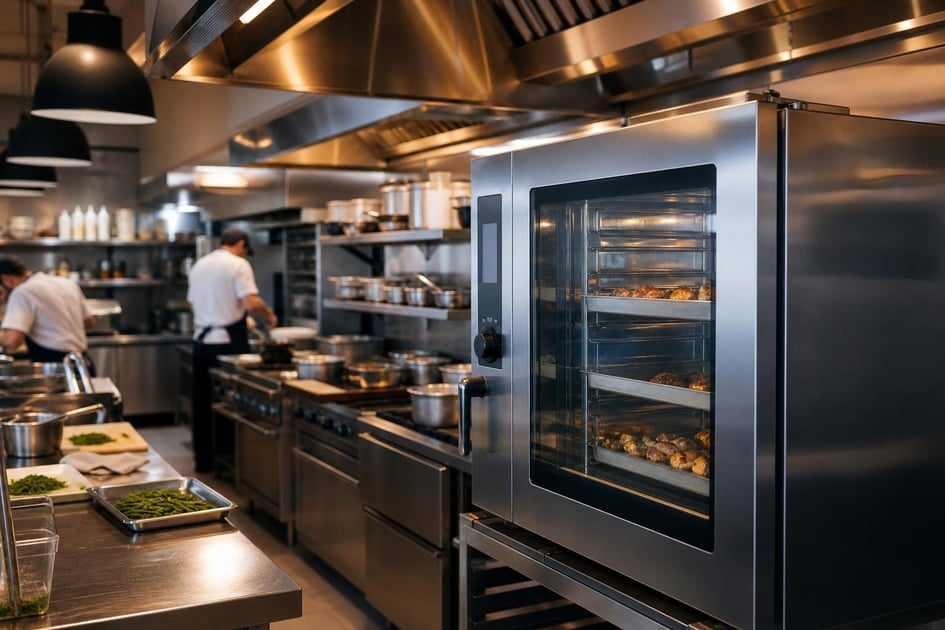
Commercial ovens are one of the largest single equipment purchases a restaurant owner makes, and most cannot write a check for $30,000 to $80,000 without straining cash flow. Financing spreads that cost across months or years, keeps working capital in the register, and turns a capital hurdle into a manageable operating expense. If you are preparing to buy a deck oven, convection oven, or combi oven for your kitchen, this guide explains how the financing process works, what lenders evaluate, and how to position your application for the best structure and rate available to your profile.
Key Insight: Lenders in the equipment-finance space underwrite the equipment itself as primary collateral. Because the oven secures the note, borrowers with less-than-perfect credit or shorter time in business still have paths to approval that unsecured lending rarely offers.
What Commercial Oven Financing Actually Covers
When lenders talk about Commercial Ovens financing, the category is broader than a single box that bakes bread. A financed transaction can include several oven types and the supporting infrastructure needed to install and operate them. The restaurant sector is one of the largest small-business employer categories in the country, according to Census Bureau data.
Oven Types That Qualify
Most equipment finance companies treat the following as standard commercial oven collateral:
- Convection ovens — the workhorse of most American restaurants, using circulated hot air to reduce cook times.
- Deck ovens — preferred for pizza operations and artisan bread baking because the stone or steel deck transfers heat differently than forced air.
- Combi ovens — combination steam and convection units that have become standard in high-volume catering and hotel kitchens.
- Rack and reel ovens — common in bakeries and large-scale production kitchens where batch consistency matters.
- TurboChef or rapid-cook ovens — used in fast-casual concepts where throughput is measured in sandwiches per minute.
- Rotisserie ovens — frequently financed alongside hood and fire-suppression packages in grocery delis and chicken concepts.
Soft Costs You Can Roll In
Many borrowers do not realize that financing can cover more than the invoice price of the unit itself. Depending on the lender and the structure, you may be able to include:
- Delivery and freight charges
- Installation, ventilation, and gas-line work
- Initial warranty extensions or service contracts
- Sales tax on the purchase
- Training for kitchen staff on complex combi or convection units
Adding soft costs protects your cash reserves. Instead of paying $8,000 out of pocket for hood modifications and then financing the oven, you can wrap both into one note with a single monthly payment. Ask your financing contact whether your specific soft costs are eligible, because policies vary by transaction size and equipment type.
Get a fast decision on your equipment
Applying takes just a few minutes, and decisions can come as soon as the same day.
Start Your ApplicationHow Restaurant Owners Use Equipment Financing
The Restaurant Food Service equipment financing market exists because commercial kitchens have predictable equipment lifecycles and because downtime is expensive. A failed oven during Friday dinner service can cost more in lost revenue than a month of finance payments.
Owners typically pursue financing in three scenarios:
- Opening a new location — Build-out budgets are almost always larger than initial projections. Financing the oven preserves capital for permits, signage, and the first payroll cycle before the dining room is full.
- Replacing failed equipment — A convection oven that dies in year eight of its ten-year expected life does not wait for your cash position to improve. Same-day or next-day approvals make it possible to order a replacement before the next service.
- Adding capacity — A catering contract, expanded menu, or second shift may require an additional deck oven or a larger combi unit. Financing lets you match the payment to the revenue the new capacity generates.
If you are staring at a failing unit or a growth opportunity that requires new equipment, start an application in a few minutes to see what structure is available for your situation. Same-day decisions are possible once documentation is complete.
By the Numbers: A standard full-size convection oven runs between $4,000 and $12,000 depending on manufacturer, features, and voltage. A double-stacked combi oven with boiler can exceed $35,000. When you add hood work, gas lines, and installation, total project costs for a single-oven replacement often land between $15,000 and $50,000.
New vs. Used: What the Numbers Look Like
The decision between a new oven with a full warranty and a used unit at half the price affects your financing terms as much as it affects your kitchen.
Financing New Equipment
New ovens command longer terms and lower rates because the collateral retains value. A 2026 model-year convection oven from a major manufacturer is easier for a lender to remarket if the note ever defaults. That lower collateral risk translates into:
- Terms typically ranging from 24 to 72 months
- Higher approval amounts, sometimes up to the full project cost
- More flexibility on time-in-business requirements
Financing Used or Refurbished Equipment
Used equipment is financeable, but the parameters tighten. Lenders want to know the age, the service history, and whether replacement parts are still manufactured. A five-year-old oven from a defunct brand is harder to collateralize than a two-year-old unit from a national manufacturer.
Expect shorter maximum terms on used equipment — often 24 to 48 months — and a larger down-payment requirement, sometimes 10 to 20 percent of the equipment cost. The savings on the purchase price may still make the deal attractive, but run the total cost of ownership including expected maintenance before you decide.
| Factor | New Oven | Used Oven (2–5 Years) |
|---|---|---|
| Typical term range | 24–72 months | 24–48 months |
| Down payment | Often $0 to one payment | 10–20% common |
| Rate position | More competitive | Rates vary by credit profile, equipment age and term |
| Warranty | Full manufacturer warranty | Limited or expired; factor in service contract cost |
| Approval speed | Fast; invoices from dealers are standard | May require additional inspection or appraisal |
Lease vs. Loan: Which Structure Fits Your Kitchen
Equipment finance is not one product. The two most common structures are the equipment loan (or finance agreement) and the equipment lease. Each has different accounting, tax, and end-of-term implications.
Equipment Loan or Finance Agreement
In a loan structure, you own the oven from day one. The lender files a UCC-1 lien against the equipment as collateral, but the title is yours. You depreciate the asset, and if you pay the note off early, the lien releases. This is the most common structure for restaurant owners who plan to keep the oven for its full useful life.
Equipment Lease
In a true lease, the lessor owns the oven and rents it to you for a fixed term. Monthly payments are often lower than a loan covering the same equipment cost, because the lessor is recovering only a portion of the asset value during the term. At the end of the lease, you typically have a purchase option for fair market value, a fixed percentage of original cost, or $1 depending on the lease type.
The $1 buyout lease is functionally a loan with different paperwork. A fair-market-value lease keeps the monthly payment lowest but leaves you with a decision at the end of the term.
| Feature | Loan / Finance Agreement | Fair-Market-Value Lease |
|---|---|---|
| Ownership | You own from day one | Lessor owns; you may purchase at end |
| Monthly payment | Higher | Lower |
| Tax treatment | Depreciation and interest deduction | Lease payments may be deductible as operating expense; consult your CPA |
| End of term | No obligation; equipment is unencumbered | Return, renew, or buy at fair market value |
| Best for | Long-term ownership, established locations | High-turnover equipment, testing new concepts |
Rates vary by credit profile, equipment age and term, so the only way to know which structure costs less for your specific transaction is to compare the amortized total for both options with your actual quote.
What Lenders Actually Evaluate
Equipment lenders look at four factors: the borrower, the business, the equipment, and the transaction size. No single factor disqualifies an application, but weakness in one area usually requires strength in another. The Small Business Administration emphasizes that organized financial records are the foundation of any business financing request.
Personal Credit
Your personal credit score is the fastest signal a lender has. Scores above 680 generally unlock the most competitive terms. Scores between 600 and 680 are still financeable, especially with strong business cash flow or a co-signer. Below 600, expect a larger down payment, a shorter term, or a requirement for additional collateral. The equipment itself is the primary collateral, but personal credit tells the lender how you have managed obligations in the past.
Time in Business
Two years in operation is a common threshold for the best rates, but it is not a hard rule. Restaurants with less than two years of history can still qualify, especially with six to twelve months of verifiable revenue and strong bank statements. The key is demonstrating that the business generates enough cash to cover the new payment.
Business Revenue and Bank Statements
Lenders typically review the last three to six months of business bank statements. They are looking for consistent deposits, positive ending balances, and whether existing debt service already consumes too much of your revenue. If your average monthly revenue is $40,000 and your existing debt payments are $12,000, adding a $900 oven payment may be manageable. If your revenue is $12,000 and debt payments are $8,000, the lender will want to understand how the new equipment increases revenue or reduces costs before approving.
The Equipment Itself
The make, model, year, and condition matter. A reputable brand sold through an established dealer is easier to finance than a private-party sale of an obscure import. Lenders need to know that if they must repossess and resell the oven, there is a liquid market for it. That is why dealer invoices are preferred to private-party transactions, though both are possible.
Pro Tip: Before you shop for a specific oven, ask your lender for a pre-approval range based on your credit and business financials. A pre-approval letter tells the equipment dealer you are a serious buyer and prevents you from falling in love with a unit that your profile cannot support.
Find the right financing structure
Tell us about the equipment you need and we will show you the options that fit your business.
See Your OptionsDocumentation You Should Prepare
The faster you assemble paperwork, the faster you close. Most equipment finance applications require:
- A completed one-page application with basic business and personal information
- Last three to six months of business bank statements
- A quote or invoice for the specific oven and any soft costs you want included
- Voided business check for ACH setup
- Driver's license or other government-issued ID
For larger transactions — generally above $100,000 — lenders may also request:
- Two years of business tax returns
- Year-to-date financial statements or profit-and-loss reports
- A brief business plan or equipment-use narrative explaining how the oven supports revenue
Having these documents ready before you apply can move your file from application to approval in hours rather than days.
Tax Treatment for the 2026 Tax Year
Restaurant equipment, including commercial ovens, is generally depreciable under the Modified Accelerated Cost Recovery System (MACRS) over a seven-year schedule. However, most owners want to front-load deductions to match the front-loaded cash outlay of opening or expanding a kitchen.
For the 2026 tax year, Section 179 allows businesses to deduct the full purchase price of qualifying equipment in the year it is placed in service, subject to an annual limit. In 2026, that limit is expected to be indexed for inflation from prior-year levels, though the exact dollar figure should be confirmed with your CPA before you file. There is also a phase-out threshold that reduces the benefit once total equipment purchases for the year exceed a certain amount.
Bonus depreciation is another tool that may be available in 2026, though the percentage has been declining on a scheduled phase-down from the 100% level that applied several years ago. Changes to equipment depreciation rules are regularly covered by Forbes and other business publications. Because these figures change and interact with your overall tax picture, any specific tax figure for 2026 should be verified with a certified public accountant who understands your entity structure, passive activity rules, and net income position.
If you are comparing a loan to a lease, the tax treatment differs. With a loan, you generally take depreciation and deduct interest. With a true lease, you may be able to deduct lease payments as an operating expense. The better structure depends on your marginal tax rate, your current-year income, and whether you have other deductions to absorb. Again, consult a CPA before making a decision based on tax benefits.
Common Mistakes When Financing Kitchen Equipment
After reviewing thousands of restaurant equipment transactions, lenders see the same errors repeatedly. Avoiding them saves time and money.
Buying the Wrong Size or Voltage
A convection oven that requires 208V three-phase power will not run on the standard 240V single-phase service in an older building. Before you sign a financing agreement, confirm with your electrician and your health department that the unit fits your space, your electrical service, and your hood capacity. Financing a $25,000 oven that cannot be installed is an expensive mistake.
Ignoring Total Cost of Ownership
The monthly payment is only part of the equation. Water and energy consumption, expected maintenance after the warranty expires, and the availability of local service technicians all affect what the oven costs over five years. A cheaper unit with no local dealer network may cost more in emergency service calls than a premium unit with a nearby authorized repair center.
Waiting Too Long to Apply
Some owners wait until the old oven dies completely before exploring financing. Emergency replacements are possible, but rush shipping and after-hours installation cost more. If your convection oven is showing signs of failure — inconsistent temperatures, frequent pilot-light issues, or rust in the cavity — start the financing conversation now so you can replace it on your schedule instead of during dinner service.
Overlooking the End-of-Term Obligation
If you choose a fair-market-value lease, understand what happens when the term ends. Will you need to ship the oven back at your expense? Is there an automatic renewal clause? Read the lease documents carefully, or have your attorney review them, before you sign.
What Happens After Approval
Once your application is approved, the process moves quickly. The typical timeline looks like this:
- Approval and term sheet — You receive a written quote showing the monthly payment, term, and any end-of-term obligations. Review it carefully.
- Acceptance and documentation — You sign the finance agreement or lease documents. The lender may also require a personal guaranty.
- Verification — The lender verifies the equipment details against your invoice and may call the dealer directly.
- Funding — The lender pays the dealer or private seller. In some cases, you pay the dealer and are reimbursed; in others, the lender sends funds directly. Confirm the method before you commit.
- Delivery and installation — The oven ships. You begin making payments according to the schedule, usually within 30 to 45 days of funding.
Throughout this process, you can get a decision on your equipment, possibly the same day, which lets you coordinate delivery with your contractor and health inspector without guessing whether funds will arrive.
Ready to move forward?
More than 10,000 businesses have financed equipment with Provide Capital. See what you qualify for today.
Get StartedFrequently Asked Questions
Can I finance a commercial oven if I have bad credit?
Yes, but the terms will reflect the additional risk. Borrowers with credit scores below 600 may still qualify with a larger down payment, a co-signer, or a shorter term. The equipment itself acts as collateral, which gives lenders more flexibility than unsecured products. Rates vary by credit profile, equipment age and term.
How long does the approval process take?
For transactions under $150,000, many lenders can issue a same-day or next-business-day decision once all documentation is received. Larger transactions or deals involving used equipment from private sellers may take two to five business days while the lender verifies collateral value.
Can I include installation and ventilation in the financing?
Often yes. Most lenders allow soft costs like delivery, installation, and sales tax to be rolled into the equipment note up to a certain percentage of the equipment cost — typically 15 to 25 percent. Ask your financing contact about the specific limits for your transaction size.
Is a down payment always required?
No. Well-qualified borrowers financing new equipment from established dealers can often secure 100 percent financing. If your credit or time in business is below typical thresholds, or if the equipment is used, a down payment of 10 to 20 percent may be requested.
Can I pay off the loan early?
Most equipment finance agreements allow early payoff, but the savings vary. Some loans use a simple interest structure where you save the remaining interest. Others have prepayment penalties or minimum interest charges. Ask for the prepayment policy in writing before you accept the term sheet.
What types of restaurants finance commercial ovens?
Every segment of the industry finances ovens, from independent pizzerias buying deck ovens to hospital cafeterias financing combi units. If you are also equipping a line, Commercial Range financing can be structured on the same application.
Does financing an oven affect my ability to borrow for other equipment?
It can, but equipment lenders typically underwrite each transaction on its own merits. If your business cash flow supports the new payment and the collateral is strong, you can often finance multiple pieces of equipment within the same year. Just be prepared to show that each new payment is offset by revenue or cost savings.
Should I talk to my accountant before I sign?
Yes. The choice between a loan and a lease, the timing of the purchase within your fiscal year, and the interaction with Section 179 and bonus depreciation for 2026 all have tax consequences. A CPA who knows your restaurant can model the after-tax cost of each option in minutes.
Moving Forward With Your Equipment Purchase
Commercial ovens are not optional equipment for a restaurant — they are the engine of your kitchen. Financing lets you acquire the right unit now, match the payment to the revenue it generates, and preserve the cash you need for labor, inventory, and the inevitable surprise expense. Whether you are replacing a failed convection oven or building out a new pizza concept, the process is straightforward: know your numbers, gather your documents, choose the right structure, and move quickly once you find the equipment.
The best time to arrange financing is before you are desperate. If your current oven is aging, your menu expansion requires more capacity, or you are planning a second location, see what financing you qualify for on that oven before you start shopping in earnest. A pre-approval narrows your search to equipment that fits your budget and gives your dealer confidence that the deal will close.
Disclaimer: The information provided in this article is for general educational purposes only and is not financial, legal, or tax advice. Funding terms, qualifications, and product availability may vary and are subject to change without notice. Provide Capital does not guarantee approval, rates, or specific outcomes. For personalized information about your business funding options, contact our team directly.
