
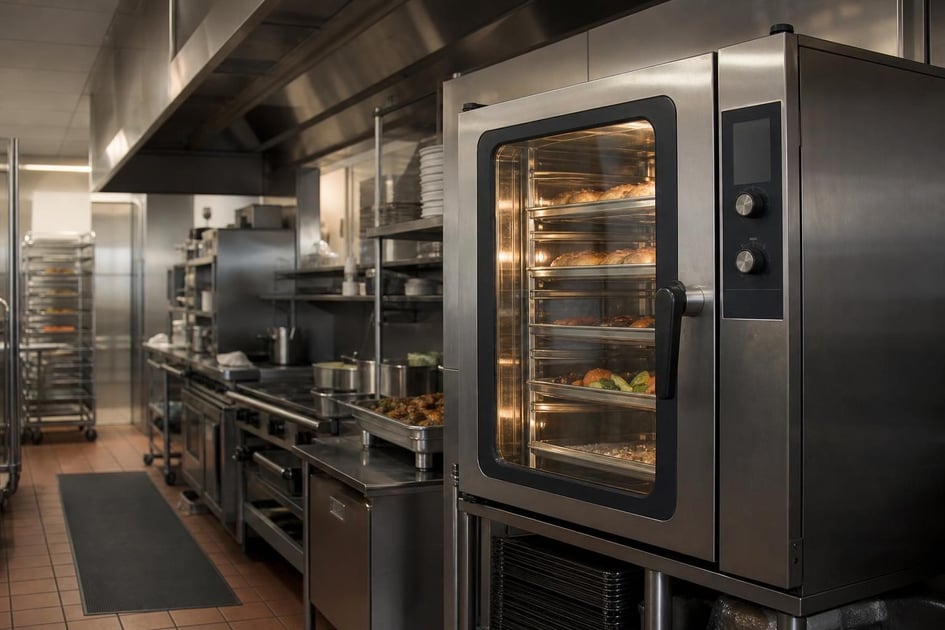
Michigan restaurant and bakery owners looking for commercial ovens financing have several paths to fund equipment ranging from $5,000 convection units to six-figure combination ovens. Whether you run a pizzeria in Detroit, a bakery in Grand Rapids, or a seasonal operation along the Lake Michigan shore, the equipment itself serves as collateral, which keeps financing accessible even when cash reserves are thin. Rates vary by credit profile, equipment age and term, and same-day approvals are possible once documentation is complete. Because the oven secures the transaction, you do not always need real estate equity or perfect credit to move forward. If you are weighing a purchase, see what financing you qualify for on that oven before you commit cash.
The Real Cost of Commercial Ovens in the Midwest Market
Commercial ovens span a wide price spectrum that surprises many first-time buyers. A standard single-deck gas convection oven suitable for a small bakery might start around $8,000 to $12,000 new, while a high-volume combination oven with steam injection can exceed $40,000. Rack ovens designed for artisan bread production often fall between $20,000 and $35,000 depending on capacity and controls. Used and refurbished units typically trade at 40% to 60% below new prices, though availability varies by region and season. In Michigan, where supply chains for food-service equipment flow through Chicago distributors and local dealers in Lansing and Troy, freight charges often add $500 to $1,500 depending on weight, distance, and whether a lift gate is required for delivery.
Convection, Deck, and Combination Models
Convection ovens circulate hot air and suit bakeries, cafes, and catering operations that need even heat distribution. Deck ovens, preferred for artisan bread and Detroit-style pizza, stack in units of one to four chambers and retain heat in stone or steel surfaces. Combination ovens combine steam and dry heat, offering versatility but commanding premium prices and requiring more complex water filtration. Michigan pizzerias in metro Detroit often finance deck ovens, while hotels and institutional kitchens near Ann Arbor and East Lansing gravitate toward combi units. A full-size roll-in convection rack oven for high-volume production can reach $25,000 to $35,000 before freight and installation.
New vs. Used Considerations
New ovens carry full manufacturer warranties and longer useful lives, which lenders favor when structuring multi-year terms. Used ovens can cash-flow immediately at lower monthly payments, but financing terms may shorten if the unit is more than five years old. For equipment approaching ten years, some lenders require larger down payments or restrict term lengths to mitigate residual risk. A three-year-old convection oven from a closed restaurant may qualify for a four- or five-year term, while a 15-year-old deck oven might be restricted to 24 months or require a larger upfront investment. Buyers should request the serial number, maintenance records, and a recent inspection report before applying, as lenders sometimes condition approval on a satisfactory third-party assessment.
By the Numbers: A new single-deck convection oven rated at 240 volts typically costs $8,000 to $14,000 installed, while a comparable used unit runs $4,500 to $8,000. Freight from a Chicago-area distributor to a Michigan Upper Peninsula location can add $800 to $1,400 because of distance and lift-gate requirements.
Already have a machine in mind?
Provide Capital finances new and used equipment from $5,000 to $5 million, with same-day decisions possible.
Apply NowLease vs. Loan: Which Structure Fits Your Kitchen
Choosing between an equipment lease and a loan depends on your tax strategy, balance sheet preferences, and how long you plan to keep the oven in active service. With a loan, you own the equipment outright once the final payment clears, and you record both the asset and the liability on your books. A lease, particularly a $1 buyout lease, functions similarly but may offer different tax treatment depending on how it is structured for accounting purposes. True operating leases keep the debt off your balance sheet but usually cost more over time and may restrict modifications or heavy use.
| Structure | Ownership | Tax Treatment | Best For |
|---|---|---|---|
| Equipment Loan | You own it day one | Depreciation and Section 179 deduction | Long-term ownership, building equity |
| $1 Buyout Lease | You own it at end | Section 179 may apply if structured as a finance lease | Spreading cost with nominal residual |
| FMV Lease | Return or buy at fair market value | Monthly payments often deductible as operating expense | Short-term needs, frequent upgrades |
Michigan buyers who plan to run the same location for a decade typically favor loans or $1 buyout leases because they build equity in a durable asset. Seasonal operators testing a new market, such as a summer-only ice cream and bakery stand in Harbor Springs, sometimes choose fair-market-value leases to preserve flexibility and avoid owning obsolete equipment after a short season. If you expect to log more than 2,000 hours annually on the oven, purchasing usually wins on a total-cost basis.
Qualifying for Commercial Oven Financing in Michigan
Lenders evaluate three primary factors: credit profile, time in business, and equipment type. Owner-operators with two or more years of filed tax returns and a credit score above 640 generally access competitive structures with minimal paperwork. If you have been operating for two-plus years, find out what terms you qualify for on the oven you need. The equipment itself secures the financing, which means personal collateral such as real estate is not always required. For loans above $100,000, lenders may request business tax returns, a current profit-and-loss statement, and a vendor invoice. Smaller requests often clear with a one-page application and three months of bank statements. According to SBA business planning resources, maintaining organized financial records is one of the most effective ways to speed up equipment financing decisions.
Credit and Time-in-Business Requirements
A personal credit score below 600 does not automatically disqualify an applicant, but it typically shifts the structure toward a larger down payment or a shorter term. Businesses operating less than two years may still qualify if the owner has strong personal credit and relevant industry experience. Lenders view restaurants as moderate-risk borrowers because of industry volatility and seasonal revenue swings, so demonstrating consistent monthly revenue through bank statements helps offset thin credit files. A strong vendor invoice from a recognized dealer also reassures underwriters that the collateral holds verified value.
Equipment as Collateral
Because the oven itself serves as collateral, lenders file a UCC-1 lien on the specific equipment rather than on real estate or blanket business assets. This structure protects your property and keeps the approval process focused on the equipment value and your cash flow. If you default, the lender repossesses the oven, not your house. That limited recourse is why many owner-operators choose equipment financing over general business term loans. The lien releases automatically once you satisfy the final payment, though you should request a termination statement for your records.
Pro Tip: If your business bank statements show large seasonal swings—for example, a Traverse City restaurant earning 60% of revenue between June and September—mention this upfront. Lenders familiar with Michigan tourism patterns can structure skip-payment or seasonal schedules that align with your cash flow.
2026 Tax Treatment and Why It Matters
For the 2026 tax year, Section 179 allows businesses to deduct the full purchase price of qualifying equipment in the year it is placed in service, subject to annual limits that adjust for inflation. Bonus depreciation may also apply, though the percentage has stepped down from prior years. Because these figures change annually and interact with your overall tax position, speak with a CPA before you structure a transaction around a specific deduction. The rules differ if you lease versus buy, and if you use the oven less than 50% for business, you may not qualify for accelerated write-offs.
If you finance a $20,000 convection oven in 2026 and place it in service before December 31, you may be able to deduct a significant portion—or potentially all—of that cost against 2026 income, depending on your total equipment purchases for the year and the current inflation-adjusted caps. Leased equipment is generally not eligible for Section 179 on your return; instead, you deduct lease payments as you make them. A CPA can model both scenarios against your expected 2026 revenue and advise whether accelerating deductions makes sense given your bracket and other deductions.
See what you qualify for
The equipment itself secures the financing, which keeps rates competitive. Checking your options takes minutes.
Check Your OptionsMichigan's Local Market and Seasonal Patterns
Michigan's restaurant industry follows distinct seasonal rhythms that affect equipment buying patterns. Summer tourism along Lake Michigan, Traverse City, and the Upper Peninsula creates surge demand for additional ovens in May and June as restaurants expand capacity. Savvy owners finance equipment in February and March to install and train staff before the Memorial Day rush. Conversely, operations in manufacturing cities see steadier year-round demand tied to institutional contracts and hospital cafeterias. According to U.S. Census Bureau data on Michigan, the state maintains a robust small-business population, which supports a competitive market for food-service equipment financing. According to Forbes business analysis, restaurants that align equipment purchases with seasonal cash flow patterns reduce default risk and improve margin stability.
The state's dominant food-service sectors include Restaurant Food Service equipment financing for independent restaurants, hospital and healthcare dining, and university food halls. Each segment prefers different oven types. Healthcare facilities often need NSF-certified convection stacks for patient meal programs, while campus dining halls favor high-volume roll-in ovens capable of handling thousands of covers per day.
Industry-Specific Use Cases
A Detroit-style pizzeria financing a double-deck oven at $18,000 over five years might see monthly payments in the low-to-mid hundreds, preserving working capital for staffing and ingredients. A bakery in Holland replacing a proofer and oven combo at $35,000 could structure a seasonal payment plan that steps up in summer months when tourist traffic peaks. A catering company in Lansing adding a used convection oven for $7,500 might pay it off in 36 months with minimal paperwork. Institutional buyers in Ann Arbor or Lansing purchasing a $45,000 combination oven often spread payments over five to seven years to match capital budgeting cycles and avoid large single-year expenditures that strain department budgets.
Key Insight: Michigan's food-service equipment market sees a secondary surge in October and November as owners replace failing ovens before the holiday catering rush. Inventory tightens during these months, so financing pre-approval in September gives you leverage to reserve equipment before dealers raise prices or run out of popular models.
Common Mistakes Michigan Buyers Make
One frequent error is waiting until equipment fails before seeking financing. Emergency purchases limit your ability to compare vendors, negotiate freight, or arrange favorable installation scheduling. Another mistake is underestimating installation costs: gas lines, ventilation hoods, fire-suppression connections, and electrical upgrades can add 20% to 30% above the oven invoice. Some owners also assume used equipment cannot be financed, but Commercial Ovens financing covers both new and used units from eligible dealers and auction houses.
A third mistake is ignoring total cost of ownership. A cheaper oven with poor energy efficiency may cost more in utilities over five years than a higher-efficiency model. Michigan's energy rates, while moderate compared to coastal states, still reward efficient equipment in 24/7 operations. Finally, buyers sometimes forget to verify that their building's electrical or gas service can handle the new oven before they sign financing documents. An upgrade from a 208-volt to a 480-volt connection, or from natural gas to propane, can add thousands in contractor costs that financing may or may not cover. Ask your lender whether installation and infrastructure count toward the total financed amount.
What Documentation You Need
Gather the following before applying: a signed equipment quote from the vendor showing model, serial number if known, and total delivered price; your most recent two years of business tax returns if available; three months of business bank statements; and a voided business check. If the business owns real estate or additional equipment, an equipment schedule helps, though it is not mandatory for approvals under $150,000. For transactions above $250,000, expect to provide a current year-to-date profit-and-loss statement and a personal financial statement. Having these items ready prevents delays and strengthens your negotiating position with vendors who may hold equipment for buyers with approved financing in hand rather than for shoppers still seeking capital.
What Happens After Approval
Once approved, the lender issues a funding authorization or purchase order to the vendor. If you buy from a dealer, the dealer ships the oven and the lender pays upon delivery confirmation. If you purchase from a private party or auction, an inspection or title verification step may add 24 to 48 hours. You take possession and begin payments according to the schedule. Most lenders file a UCC-1 lien on the equipment itself, not on your real estate or personal assets, assuming you chose an equipment-secured structure. The entire process, from application to vendor payment, often completes within three to five business days for straightforward transactions under $100,000. Larger transactions or those requiring structural modifications may extend to seven to ten days.
Pro Tip: Before you accept delivery, photograph the oven's data plate, serial number, and any shipping damage. Lenders require proof of delivery before funding, and clear documentation prevents disputes if the unit arrives with cosmetic or functional issues that need to be resolved with the vendor.
Put the right equipment to work
From $5,000 to $5 million, new or used, Provide Capital helps businesses nationwide finance the equipment they need.
Apply TodayFrequently Asked Questions
Can I finance a used commercial oven in Michigan?
Yes. Used and refurbished commercial ovens qualify for financing provided they are in working condition and purchased from a reputable vendor or dealer. Terms may be slightly shorter than for new equipment, and the age of the unit affects the maximum term available. A five-year-old oven might qualify for a four-year note, while a 15-year-old unit may be limited to 24 months.
What credit score do I need to finance a commercial oven?
While requirements vary by lender and program, a credit score in the mid-600s and above generally opens competitive options. Lower scores do not automatically disqualify you, but rates and down-payment requirements may adjust accordingly. Strong cash flow and a substantial down payment can offset weaker credit.
How long does approval take?
Same-day approvals are possible when your documentation is complete. More complex requests or transactions above $200,000 may require 24 to 48 hours for review. Delays usually stem from missing paperwork or vendor invoice discrepancies, not from the credit decision itself.
Is the down payment always 10%?
Down payments vary by credit profile, equipment age and term. Well-qualified buyers may secure 0% down on new equipment, while used ovens or challenged credit may require 10% to 20%. The equipment's resale value and your time in business also influence this requirement.
Can I include installation and delivery in the financing?
Many lenders allow you to roll soft costs such as delivery, installation, and sales tax into the total financed amount, provided the equipment itself represents the majority of the transaction. Some cap soft costs at 15% to 20% of the equipment value.
What happens if I want to pay off the loan early?
Some equipment finance agreements include a prepayment discount or allow early payoff without penalty after a certain period. Others use a fixed-sum structure where the remaining balance is due regardless of timing. Ask your financing representative to outline the specific structure before you sign.
Do I need to own the building to finance kitchen equipment?
No. The equipment serves as collateral, so renters and leaseholders can qualify. You simply need the landlord's permission for installation if you do not own the property. Many Michigan restaurants operate in leased spaces and finance ovens without issue.
Can I finance multiple pieces of equipment at once?
Yes. You can bundle an oven with a Commercial Range financing package or add a mixer under a single approval, which simplifies paperwork and may improve terms. Bundling also reduces the administrative burden of tracking multiple payment schedules.
Ready to Upgrade Your Kitchen?
If you are planning a kitchen upgrade or replacing a failing oven, start by gathering your vendor quote and the last three months of bank statements. Review your building's utility capacity and installation requirements so you can include soft costs in the financing request if needed. Then start an application in a few minutes to see what terms are available for your specific credit profile and equipment choice. Financing from $5,000 to $5 million is available nationwide for construction, healthcare, dental, restaurant and food service, manufacturing, transportation, agriculture, HVAC and forestry. The process is designed to keep your cash working in the business, not tied up in depreciating equipment.
Disclaimer: The information provided in this article is for general educational purposes only and is not financial, legal, or tax advice. Funding terms, qualifications, and product availability may vary and are subject to change without notice. Provide Capital does not guarantee approval, rates, or specific outcomes. For personalized information about your business funding options, contact our team directly.
