
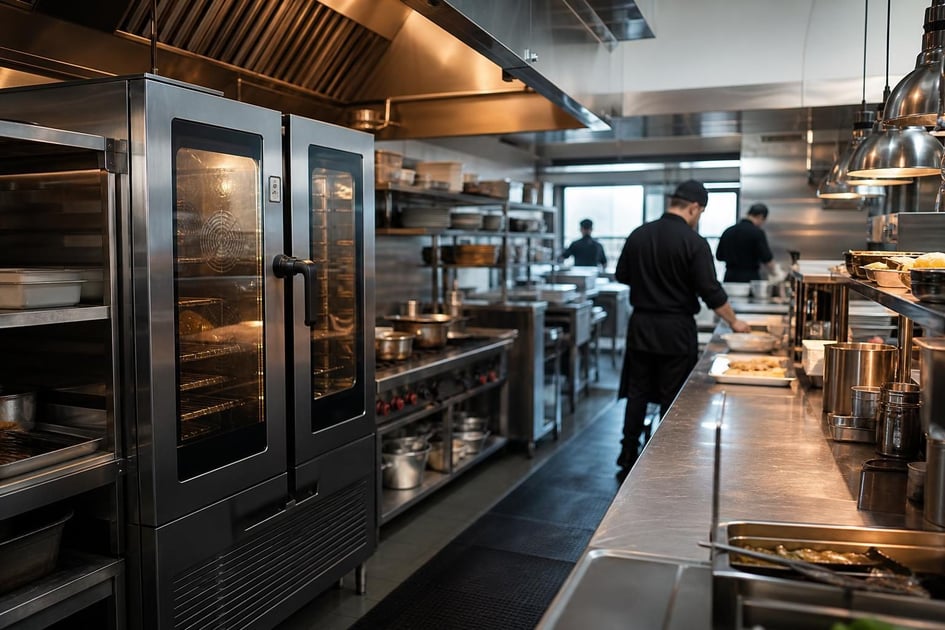
Financing Commercial Ovens in North Carolina's Food Service Market
North Carolina restaurant owners and food producers can finance commercial ovens through equipment lenders that use the oven itself as collateral, keeping rates competitive even for borrowers with imperfect credit. Approval amounts range from $5,000 to $5 million depending on the equipment value and your business financials. Same-day approvals are possible when documentation is complete.
The state's food service landscape stretches from the Piedmont's bustling catering corridors to the coastal plain's seasonal seafood operations and the mountain region's growing craft food sector. Each area drives distinct oven requirements. A bakery in a high-traffic urban corridor needs a different convection setup than a barbecue operation smoking shoulders in a rural county or a coastal resort kitchen handling summer volume spikes. Equipment financing matches these varied needs because the loan is secured by the specific oven or range you are buying, not by real estate or a blanket lien on all business assets. According to U.S. Census Bureau data, North Carolina consistently ranks among the fastest-growing states for small business formations, and food service accounts for a significant share of that growth.
Key Insight: North Carolina's food service equipment buying follows a seasonal rhythm. Many operators purchase ovens in late winter to be installed before the spring tourism season and the summer coastal rush. Lenders active in the state anticipate this cycle, and applicants who submit complete packages during February and March often see faster turnaround because underwriters are staffed for the pre-season volume.
What a Commercial Oven Actually Costs
Commercial oven prices vary widely based on type, size, and fuel source. A standard convection oven suitable for a small catering operation might start around $3,500, while a full combination oven with steam capabilities can exceed $25,000. Conveyor ovens for high-volume pizza operations typically fall between $8,000 and $18,000. Deck ovens, favored by artisan bakeries, range from $10,000 to $35,000 depending on chamber count and construction.
These figures cover the unit only. Installation adds cost. Ventilation hoods, fire suppression systems, gas line work, and electrical upgrades can add $2,000 to $15,000 depending on the existing infrastructure. Used equipment cuts the equipment price by 30 to 50 percent but may carry higher installation costs if the unit requires retrofitting. When you finance through a collateral-based lender, the loan can cover the equipment plus soft costs like delivery and initial installation, as long as the total fits within the lender's advance ratio against the oven's value.
How Commercial Oven Financing Works
Equipment financing for a commercial oven is a secured transaction. The lender files a UCC-1 lien against the specific equipment rather than requiring a blanket lien on your business or a second mortgage on real estate. Because the oven serves as collateral, the lender's risk is tied to the resale value of that asset, which allows more flexible credit decisions than unsecured working capital loans.
Terms typically align with the equipment's useful life. For a new commercial oven, expect financing terms between two and five years. Used equipment with significant operating hours may qualify for shorter terms, often two to three years. Monthly payments are fixed, which helps with cash flow forecasting in a kitchen operation where margins fluctuate with food costs and seasonality.
Rates vary by credit profile, equipment age and term. Borrowers with established business revenue and stronger credit histories generally see the most favorable structures. However, because the equipment secures the loan, businesses with challenged credit can still qualify, though they may see different rate tiers or be required to put more money down. The down payment requirement, if any, depends on the lender's advance rate and your business financials.
By the Numbers: A $15,000 convection oven financed over four years might carry a monthly payment in the low-to-mid three hundreds for a well-qualified borrower, while the same equipment on a two-year term for a riskier profile could run in the mid-to-high six hundreds. The total cost of financing depends heavily on the rate tier assigned, which is why lenders review bank statements, time in business, and credit history together.
New vs. Used Commercial Ovens: A Financing Comparison
The decision between new and used equipment affects not only your monthly payment but also your tax strategy, warranty coverage, and operating risk. New ovens carry full manufacturer warranties and lower maintenance risk in the first years, which matters in a high-volume North Carolina kitchen where downtime during peak season means lost revenue. Used equipment costs less upfront but may require immediate service or replacement parts.
From a financing perspective, new equipment generally qualifies for longer terms and higher advance rates because the collateral value is easier to verify and depreciates on a predictable curve. Used equipment can still be financed, but lenders may cap the term or require a larger equity stake to offset the uncertainty around remaining useful life.
| Factor | New Commercial Oven | Used Commercial Oven |
|---|---|---|
| Equipment cost | Full manufacturer price ($5,000–$50,000+) | 30–50% below new retail |
| Typical financing term | 3–5 years | 2–3 years |
| Warranty coverage | Full manufacturer's warranty | Limited or expired; third-party available |
| Advance rate | Up to 100% of cost including soft costs | 80–90% of appraised value |
| Tax depreciation (2026) | Eligible for Section 179 and bonus depreciation | Eligible for Section 179; bonus depends on prior use |
| Approval speed | Fast; MSRP and spec sheets standardize valuation | Slower; lender may require inspection or appraisal |
If you are opening a second location or replacing a broken unit under time pressure, new equipment financed on a standard term gets you cooking faster with predictable maintenance costs. If you are testing a new menu concept or adding seasonal capacity, a used oven with a shorter financing term preserves capital and limits your commitment. Both paths work with the right lender. As Forbes coverage of restaurant equipment trends has noted, many operators are choosing to finance rather than buy outright to preserve liquidity for labor and ingredient costs in an inflationary environment.
Section 179 and Tax Treatment for 2026
The tax treatment of financed commercial ovens can improve your effective cost. Under Section 179 of the Internal Revenue Code, businesses may deduct the full purchase price of qualifying equipment in the year it is placed in service, subject to annual limits and phase-out thresholds. For the 2026 tax year, the specific dollar limits are set by the IRS and adjusted for inflation. Consult a CPA to confirm the exact 2026 Section 179 limit and whether your business's total equipment purchases fall within the phase-out range.
Bonus depreciation may also apply to new and used commercial ovens placed in service during 2026, though the percentage has been stepping down in recent years. The interaction between Section 179, bonus depreciation, and regular MACRS depreciation is complex. A CPA can model which combination gives your North Carolina operation the best after-tax result, especially if you are also deducting state income taxes paid. SBA guidance on equipment loans also emphasizes the importance of coordinating your financing timeline with your tax planning so you do not miss the year-end placement deadline.
Pro Tip: To claim Section 179 for 2026, the equipment must be placed in service by December 31, 2026, not merely ordered or financed. If you are financing a custom-built oven with a long lead time, confirm the delivery and installation schedule with your dealer before you sign the financing agreement. A delay into January 2027 pushes the deduction into the next tax year.
Lease vs. Loan: Which Structure Fits Your Kitchen?
Equipment financing generally takes one of two forms: a capital lease (finance lease) or an equipment loan. Under a capital lease, you make monthly payments and typically own the equipment at the end of the term for a nominal buyout. The lender retains title until final payment. For tax purposes, a capital lease is often treated similarly to a loan, allowing you to claim depreciation and potentially Section 179 deductions.
An equipment loan gives you title to the oven immediately, with the lender holding a lien. You depreciate the asset and deduct the interest portion of your payments. Structurally, loans and capital leases look similar on your balance sheet, but the documentation and end-of-term options differ. A loan may have a $1 or $101 buyout at the end, while some lease structures include a fixed percentage residual.
A true operating lease, where you return the equipment at the end, is less common for commercial ovens because of the wear and tear in kitchen environments. Most food service operators want to own their cooking equipment. If you anticipate replacing the oven every three years to stay current with energy-efficient technology, ask your lender whether a structure with a built-in upgrade path makes sense. Otherwise, a standard equipment loan or capital lease with a $1 buyout is usually the right tool.
Industry-Specific Use Cases Across North Carolina
Different food service sectors in North Carolina finance ovens for distinct reasons. Understanding how your peers use financing can help you structure your own application.
Bakeries and Artisan Bread Operations
Bakeries in the Piedmont and mountain regions often finance deck ovens and combination ovens that cost between $15,000 and $40,000. These are heavy, permanent installations that become central to the production workflow. Because the equipment is specialized and hard to repurpose, a collateral-based lender will focus on the bakery's cash flow and the oven's resale value in the used market. Established bakeries with two or more years of tax returns generally qualify for the best structures.
Barbecue and Smokehouses
North Carolina's barbecue tradition drives demand for large-capacity smokers and holding ovens. While some pitmasters use wood-fired pits, many commercial operations supplement with gas or electric ovens for sides, catering volume, and health department compliance. Financing allows a smokehouse to add a commercial oven without drawing down the cash reserves needed for meat inventory, which can fluctuate sharply with commodity prices.
Coastal Restaurants and Seasonal Resorts
Kitchens along the coastal plain face intense seasonality. A restaurant that does 60 percent of its annual revenue between Memorial Day and Labor Day needs reliable ovens but may not have steady year-round cash flow to justify a large capital outlay in January. Equipment financing spreads the cost across twelve months, aligning payments with the revenue the oven generates. Lenders familiar with seasonal businesses can structure payments to match your cash flow curve.
Food Trucks and Mobile Caterers
Mobile operations need compact, high-output convection ovens or rapid-cook units. Because food trucks have limited space and power, the oven is often the most expensive single piece of equipment in the build. Financing the oven separately from the truck build allows you to preserve working capital for permits, commissary kitchen fees, and initial inventory. Lenders will want to see your commissary agreement and route schedule alongside standard financials.
Qualification Criteria and Required Documentation
Lenders evaluate three factors for a commercial oven financing request: the equipment, the business, and the borrower. The equipment must have a clear title, a verifiable value, and a remaining useful life that exceeds the financing term. The business must demonstrate revenue sufficient to cover the proposed payment. The borrower's credit history helps determine the rate tier and any down payment requirement.
Most lenders request the following: three to six months of business bank statements, a completed application, an equipment quote or invoice from the vendor, and proof of business ownership or authorization to borrow. For requests above $100,000, two years of business tax returns and year-to-date financials are standard. If the business is newer, a stronger personal credit profile or a larger down payment may offset the limited operating history.
Time in business matters. Operations with two or more years under the same ownership generally see faster approvals and more competitive structures. That said, businesses with as little as one year of revenue history can qualify for smaller requests, particularly if the equipment is new and the seller is a recognized dealer.
See what you qualify for by submitting your equipment quote and recent bank statements. A specialist can review your profile and give you a decision the same day in many cases.
Common Mistakes When Financing Kitchen Equipment
One frequent error is financing equipment without confirming the installation requirements. A $20,000 oven that needs $8,000 in electrical upgrades and hood work creates a cash shortfall if the loan only covers the equipment price. Ask your dealer for a total project quote and request that the lender include allowable soft costs in the financing amount.
Another mistake is buying used equipment from a private seller without a title search or inspection. If the oven has an undisclosed lien or failed health department inspection, you may inherit problems. Reputable dealers provide clear title and spec sheets. If you buy at auction, ask the lender whether they require an independent appraisal before funding.
Finally, some operators stretch their budget to the maximum approved amount without leaving a buffer for the first month's payment, delivery fees, or initial service. A financed oven only improves your cash flow if the total cost of acquisition leaves you with enough working capital to operate until the revenue benefit kicks in.
Key Insight: North Carolina food service operators who finance equipment in the fourth quarter sometimes miss the window for 2026 tax deductions because the oven is not installed and in service by December 31. If you are financing in October or November, confirm the vendor's delivery schedule in writing and build in buffer time for permitting or utility hookups.
What Happens After Approval
Once approved, the lender issues a finance agreement or lease document for your signature. Review the payment schedule, end-of-term options, and any prepayment provisions. Most equipment financing agreements allow early payoff, though some apply a prepayment penalty or retain a portion of the remaining interest. Ask your funding specialist to explain the exact structure before you sign.
After you sign, the lender pays the vendor directly. You take delivery and installation proceeds. The lender files a UCC lien against the serial number of the oven. You begin making monthly payments, usually starting thirty days after funding. If the oven arrives damaged or fails to meet specifications, you must resolve the issue with the vendor; the financing agreement remains in force because the lender funded the transaction. This is why buying from a dealer with a strong service reputation matters.
At the end of the term, once the final payment clears, the lender releases the lien. You own the oven free and clear. If you financed under a capital lease structure, you may need to send a formal buyout request and the nominal final payment to trigger title transfer.
Frequently Asked Questions
Can I finance a used commercial oven in North Carolina?
Yes. Used commercial ovens can be financed, though the terms may be shorter and the advance rate lower than for new equipment. Lenders prefer used equipment sold by established dealers because the dealer provides verification of condition and clear title. Private party sales are possible but may require an independent appraisal.
Does my personal credit score determine whether I am approved?
Your personal credit history is one factor among several. Because the oven serves as collateral, lenders can approve applicants across a wide range of credit profiles. Strong credit generally produces more favorable rate tiers, while challenged credit may result in a shorter term or a down payment requirement. Rates vary by credit profile, equipment age and term.
How fast can I get financing for an oven replacement?
Same-day approvals are possible when your application and supporting documents are complete. Requests under $50,000 with a clean equipment quote and clear business bank statements often close within one business day. Larger requests or used equipment from private sellers may take two to five business days if an appraisal or additional verification is needed.
Can I include installation and delivery in the financing amount?
Many lenders allow soft costs such as delivery, installation, and initial setup to be included in the financing package, provided the total amount does not exceed the advance rate against the equipment value. Ask your lender what percentage of the total project cost they will finance and whether they pay the vendor directly or reimburse you.
What types of commercial ovens can be financed?
Convection ovens, combination ovens, conveyor ovens, deck ovens, rotisserie ovens, and rapid-cook ovens all qualify for equipment financing. The lender cares more about the equipment's value and resale market than its specific cooking method. You can explore Commercial Ovens financing or Commercial Range financing for the specific unit you need.
Is a down payment always required?
Not always. Well-qualified borrowers purchasing new equipment from authorized dealers can sometimes secure 100 percent financing. If the equipment is used, the transaction size is large, or the borrower's financial profile carries more risk, the lender may require 10 to 20 percent down. The specific requirement depends on your credit, time in business, and the equipment details.
Can I deduct a financed oven on my 2026 taxes?
If the oven is placed in service during the 2026 tax year, you may be eligible for Section 179 deduction and bonus depreciation, subject to IRS limits and your business's total equipment purchases. Because the tax rules interact in complex ways, have a CPA confirm the exact treatment for your situation before you file. Do not assume that financing the equipment rather than paying cash changes your eligibility for these deductions.
What industries does Provide Capital serve for oven financing?
Provide Capital finances commercial ovens for restaurants, bakeries, caterers, food trucks, and other food service operations nationwide. You can learn more about our Restaurant Food Service equipment financing programs and how they apply to North Carolina businesses.
Get Your North Carolina Kitchen Equipped
Commercial ovens represent a significant investment, but they are also the revenue engine of a food service operation. Spreading that cost over time through equipment financing preserves the working capital you need for payroll, inventory, and the unexpected expenses that come with running a kitchen. Whether you are buying a new combination oven for a high-volume restaurant or a used convection unit for a catering operation, a collateral-based financing structure keeps the focus on the equipment's value and your business's cash flow.
North Carolina's food service economy continues to grow, driven by population expansion in the Piedmont, tourism along the coast, and craft food development in the mountains. Positioning your kitchen with the right oven at the right time means serving more customers and capturing revenue that a broken or undersized unit cannot handle. Get a same-day decision on your equipment and move from quote to kitchen installation without draining your cash reserves.
Disclaimer: The information provided in this article is for general educational purposes only and is not financial, legal, or tax advice. Funding terms, qualifications, and product availability may vary and are subject to change without notice. Provide Capital does not guarantee approval, rates, or specific outcomes. For personalized information about your business funding options, contact our team directly.
