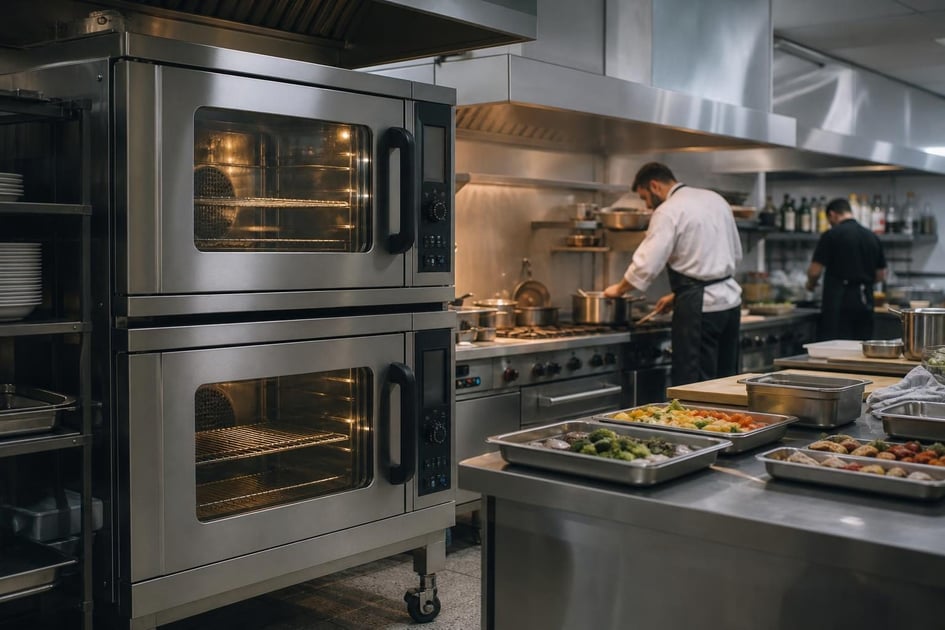
Commercial oven financing rates vary by credit profile, equipment age and term length. Most established operators with solid credit can expect competitive rates because the oven itself serves as collateral, which reduces the lender's risk. Newer equipment and shorter terms generally produce lower rates, while used equipment or longer amortizations may carry slightly higher costs. Same-day approvals are possible once you submit the required documentation.
What Drives Commercial Oven Financing Rates?
Several factors determine where your rate lands on the spectrum. Lenders look at the strength of your business, the specific oven you are buying, and the structure of the deal. Understanding these variables helps you quote-shop with realistic expectations and avoid surprises during underwriting.
Credit Profile and Time in Business
Your personal and business credit history carry the most weight. A track record of on-time payments, low revolving balances, and no recent bankruptcies signals lower risk. Time in business matters too. An operator with three or more years of filed tax returns and steady revenue can access better terms than a newer venture with limited financial history. That does not mean a younger business cannot qualify, but the rate and down-payment requirements may adjust to reflect the shorter track record.
Equipment Age, Type, and Condition
The collateral itself influences pricing. A new convection oven from a major manufacturer holds its value well, so lenders can offer more aggressive terms. A used oven that is five or ten years old may still finance cleanly, but the rate can edge up because the resale value is less certain. Specialty ovens like combination or deck ovens sometimes carry slightly different terms than standard convection units, depending on the lender's familiarity with the brand and the secondary market for that equipment.
Term Length and Down Payment
Shorter terms mean less risk for the lender, which usually translates to a lower rate. A 24-month term will typically cost less in total interest than a 72-month term, though the monthly payment is higher. A down payment of 10% to 20% improves your loan-to-value ratio and can move your rate down. Zero-down options exist for strong borrowers, but putting money into the deal almost always improves the pricing.
Key Insight: Lenders often price equipment financing based on the useful life of the asset. A commercial oven with an expected 15-year lifespan can support a longer term than a computer system, which means the oven's monthly payment can be lower relative to its cost simply because the amortization window is wider.
Already have a machine in mind?
Provide Capital finances new and used equipment from $5,000 to $5 million, with same-day decisions possible.
Apply NowNew vs. Used Commercial Ovens: How Financing Differs
Both new and used ovens can be financed, but the terms and total cost of ownership diverge in important ways. New equipment commands a higher purchase price but typically carries a full warranty, lower maintenance costs in the first few years, and stronger resale value. Used equipment saves 30% to 50% upfront but may require immediate service or replacement parts.
From a financing perspective, new ovens are easier to value and collateralize. The lender knows exactly what the asset is worth today and can estimate its value three years from now. Used ovens may require an independent appraisal or a detailed condition report, especially if they are more than five years old or from a lesser-known manufacturer. That extra due diligence can add a day or two to the approval process.
| Factor | New Oven | Used Oven |
|---|---|---|
| Purchase price | Higher upfront cost | 30%–50% lower |
| Financing rate | Typically lower | Slightly higher |
| Collateral value | Straightforward | May need appraisal |
| Term length | Up to 84 months | Often capped at 60 months |
| Warranty | Full manufacturer coverage | Limited or none |
| Approval speed | Faster | May take 1–2 extra days |
Used equipment can be a smart choice for a second location or a backup oven, but factor in potential repair costs when comparing the total monthly outlay against a new unit.
Equipment Loan vs. Lease: Choosing the Right Structure
A loan and a lease both put the oven in your kitchen, but they treat ownership, taxes, and end-of-term options differently. An equipment loan builds equity. You own the oven outright once the final payment clears, and you can depreciate the asset on your tax return. A lease is essentially a rental agreement with fixed payments over a set term. At the end, you may have the option to purchase the oven for its fair-market value, a fixed residual, or simply return it.
Loans work best when you plan to keep the oven for most of its useful life and want the tax benefits of ownership. Leases work better when you expect to upgrade every few years or want the lowest possible monthly payment. Some lessors include maintenance in the lease payment, which can simplify budgeting.
| Feature | Equipment Loan | Equipment Lease |
|---|---|---|
| Ownership | You own it from day one | Lessor owns it during term |
| Monthly payment | Higher than a lease | Lower |
| Tax treatment | Depreciation and Section 179 | Payments deducted as expense |
| End of term | No balance, free and clear | Return, renew, or buy out |
| Maintenance | Your responsibility | Sometimes included |
| Best for | Long-term use and equity | Short-term or frequent upgrades |
If you are unsure which structure fits your cash-flow pattern, ask your lender to quote both options on the same oven so you can compare the total cost side by side.
By the Numbers: A standard single-deck electric convection oven suitable for a mid-volume restaurant typically costs between $4,000 and $8,000. A double-deck gas model from a premium brand can run $12,000 to $20,000. Combination ovens with steam and convection capabilities often start around $15,000 and can exceed $30,000 depending on capacity and features. A full cooking line—including an oven, range, and hood—can range from $20,000 to $60,000.
Tax Treatment for Commercial Oven Financing in 2026
For the 2026 tax year, business owners who finance or purchase commercial ovens have two powerful tools to accelerate deductions: Section 179 expensing and bonus depreciation. Both allow you to deduct a significant portion—or all—of the equipment cost in the year the oven is placed in service rather than spreading the deduction across several years.
Section 179 lets you elect to expense qualifying equipment up to an annual limit that the IRS adjusts yearly for inflation. The exact 2026 ceiling is set by IRS guidance published for the tax year. Because these limits change and because the deduction is subject to phase-outs based on total equipment purchases, you should consult a CPA to confirm the current-year limit and how it applies to your specific situation. Keep in mind that Section 179 cannot create or increase a net operating loss; the deduction is capped at your aggregate taxable business income.
Bonus depreciation under IRC §168(k) allows businesses to deduct a percentage of qualifying property in the first year. The rules around bonus depreciation have shifted in recent years, and the applicable percentage depends on when the equipment was acquired and placed in service. For ovens placed in service during 2026, bonus depreciation may still be available, but the exact rate depends on legislative changes and acquisition dates. Your CPA can model whether Section 179, bonus depreciation, or regular MACRS depreciation produces the best outcome for your 2026 return.
One detail that catches operators: the IRS cares about when the oven is placed in service, not when it was ordered or paid for. An oven delivered in December 2026 but not installed and operational until January 2027 belongs on your 2027 tax return. If you are timing a purchase for tax purposes, make sure the unit is actually baking before December 31.
Talk to a specialist about your specific oven and we can structure the financing to align with your tax planning.
What Documentation You Will Need
Lenders need a clear picture of your business and the equipment. Having these items ready before you apply can cut the approval time from days to hours.
- A completed application with basic business and owner information
- Last two to three years of business tax returns
- Year-to-date profit and loss statement and balance sheet
- Bank statements for the last three to four months
- An equipment quote or invoice from the vendor
- Proof of business formation and any required licenses
For requests under $150,000, some lenders can approve with just an application and bank statements. Larger requests or more complex credit profiles will trigger a deeper document review. If you are buying used equipment, be prepared to provide photos, serial numbers, and a condition report.
Find the right financing structure
Tell us about the equipment you need and we will show you the options that fit your business.
See Your OptionsQualification Criteria in Detail
Equipment financing is more accessible than many operators assume because the oven itself secures the loan. Still, lenders look at a few standard benchmarks.
Credit score: There is no hard cutoff, but a personal FICO score in the mid-600s or higher opens the door to the most competitive rates. Scores below that do not automatically disqualify you, but the down-payment requirement or rate may adjust.
Time in business: Two or more years of operating history is ideal. Owners with less than two years of operating history face stricter requirements or may need a larger down payment, though some lenders do finance first-time owners with strong credit and a solid business plan.
Revenue: Lenders want to see that your current cash flow can support the new payment. A common rule of thumb is that the equipment payment should not consume more than 15% to 20% of your monthly gross revenue, though this varies by lender and industry.
Down payment: Zero to 20% is the typical range. Strong borrowers with established businesses and excellent credit can sometimes finance 100% of the cost plus soft costs like delivery and installation.
Pro Tip: If you are financing a used oven, ask the seller for maintenance records and the original purchase invoice. A documented service history reassures the lender that the asset has been cared for and is more likely to last the full loan term without major repair.
Common Mistakes When Financing Commercial Ovens
Avoiding these pitfalls can save you money and frustration.
Buying the wrong size or fuel type. A gas oven in a space with only electric hookups creates immediate retrofit costs. Check your utility capacity, ventilation, and hood requirements before signing a financing agreement. The lender will not verify your kitchen layout; that is your responsibility.
Ignoring total cost of ownership. The monthly payment is only one line item. Factor in installation, utility upgrades, maintenance, and the expected lifespan of the unit. A cheaper oven with a higher repair frequency can cost more over five years than a reliable model with a slightly higher payment.
Not comparing structures. Some borrowers automatically choose a loan when a lease would free up cash flow, or vice versa. Get quotes for both and model the tax impact with your accountant.
Overlooking soft costs. Delivery, installation, and training can add $500 to $3,000 to the project. Some lenders allow you to roll these into the financing; others do not. Ask upfront so you are not scrambling for cash at closing.
Industry-Specific Considerations
The type of operation you run affects which oven you need and how you should finance it. According to U.S. Census Bureau retail sales data, food service and drinking places have posted steady sales growth, which means operators who expand kitchen capacity early often capture market share before competitors do.
Restaurant and Food Service
Full-service restaurants typically need versatile ovens that can handle roasting, baking, and finishing. Convection ovens are the workhorse, but high-volume kitchens may need a combination oven or a deck oven for pizza and bread. If you are opening a new location, consider bundling the oven with other Commercial Range financing and Commercial Dishwasher financing into a single package. A single approval for multiple pieces of equipment simplifies paperwork and can improve your overall terms.
Seasonal cash flow is common in food service. A lender that understands Restaurant Food Service equipment financing can structure payments to match your slow and busy seasons, with lower payments in winter and higher payments in summer, or vice versa depending on your market.
Bakery and Specialty Production
Bakeries run ovens harder and longer than most restaurants. A bakery-depth convection oven or a rack oven may run 12 to 16 hours per day. That intensity means reliability matters more than upfront savings. Financing a premium unit with a full warranty often beats buying a cheaper oven that risks downtime during your production window.
Bakeries also tend to have more predictable revenue, which lenders like. If you have long-term wholesale contracts or steady retail traffic, use that stability to negotiate a longer term and lower monthly payment.
Pro Tip: Order lead times for commercial ovens can stretch 8 to 16 weeks for popular models, especially if you need custom configurations or 240V three-phase electrical. Start your financing application before you place the equipment order so your funds are ready when the oven ships. A pre-approved financing package also gives you leverage to negotiate a cash-equivalent price with the vendor.
Government-Backed and Alternative Financing Options
For larger kitchen build-outs or multi-unit expansions, an SBA 7(a) loan backed by the Small Business Administration can finance equipment up to $5 million, though the approval process is more involved than dedicated equipment financing. SBA loans work well when you need to bundle real estate, working capital, and equipment into one long-term facility. If you need only the oven and want a faster decision, dedicated equipment financing is usually the more practical route.
As Forbes notes, equipment financing is one of the most common funding tools for restaurants because kitchen equipment is expensive and essential to daily operations. The key is matching the financing structure to the equipment's expected life and your cash-flow cycle.
What Happens After Approval
Once approved, the lender issues a term sheet or finance agreement detailing the rate, term, payment amount, and any conditions. Review it carefully. Look for prepayment penalties, late fees, and any personal-guarantee requirements. Most equipment lenders do not charge prepayment penalties, but verify before signing.
After you sign, the lender pays the vendor directly or funds your account if you have already purchased the equipment. You take delivery, install the oven, and start making payments. The lender files a UCC-1 financing statement to secure their interest in the collateral. This is standard and does not affect your daily operations.
Throughout the term, keep the oven insured. The lender will require proof of coverage naming them as loss payee. If you sell the business or want to pay off the loan early, contact the lender for a payoff quote and the process to release the lien.
Get a same-day decision on your equipment and move your kitchen project forward without delay.
Ready to move forward?
More than 10,000 businesses have financed equipment with Provide Capital. See what you qualify for today.
Get StartedFrequently Asked Questions
What credit score do I need to finance a commercial oven?
There is no universal minimum, but a personal FICO score in the mid-600s or higher generally qualifies you for competitive rates. Lower scores may still be approved with a larger down payment or shorter term. The equipment itself acts as collateral, which gives lenders more flexibility than they would have with an unsecured loan.
Can I finance a used commercial oven?
Yes. Used ovens are commonly financed, and they can reduce your monthly payment because the total cost is lower. Expect the lender to ask for photos, serial numbers, and possibly an appraisal if the oven is more than five years old. Terms may be slightly shorter than for new equipment.
How long can I finance a commercial oven?
Terms typically range from 24 to 84 months. New ovens can support the longest terms because they have the most remaining useful life. Used ovens or specialized units may cap out at 48 or 60 months. A longer term lowers your monthly payment but increases total interest paid.
Is it better to lease or finance a commercial oven?
It depends on how long you plan to keep the oven and your tax situation. Financing builds equity and lets you claim depreciation or Section 179 expensing. Leasing offers lower monthly payments and may include maintenance, which appeals to operators who upgrade equipment frequently. Compare both options on the same oven before deciding.
What types of commercial ovens can be financed?
Nearly every type qualifies, including convection, combination, deck, conveyor, and rack ovens. Lenders prefer established brands with strong dealer networks because the resale market is more predictable. Custom or imported ovens may still finance but could require additional documentation.
Can I finance other kitchen equipment along with my oven?
Yes. Many lenders allow you to bundle multiple pieces of equipment into one approval. Combining an oven with a range, mixer, or refrigeration unit simplifies paperwork and can improve your rate because the total loan amount is larger. Commercial Ovens financing is often just one part of a larger kitchen build-out package.
How quickly can I get approved for commercial oven financing?
Same-day approvals are possible when you have your documentation ready. Simple deals with strong credit and clear equipment quotes can close in 24 to 48 hours. More complex requests or used equipment purchases may take 3 to 5 business days while the lender verifies collateral value.
Does financing a commercial oven affect my taxes?
Yes, and usually favorably. If you finance with a loan and own the oven, you can depreciate the asset or elect Section 179 expensing for the 2026 tax year, subject to IRS limits and your taxable income. If you lease, you generally deduct the lease payments as a business expense. Talk to your CPA to determine which approach saves you the most on your 2026 return.
Disclaimer: The information provided in this article is for general educational purposes only and is not financial, legal, or tax advice. Funding terms, qualifications, and product availability may vary and are subject to change without notice. Provide Capital does not guarantee approval, rates, or specific outcomes. For personalized information about your business funding options, contact our team directly.