
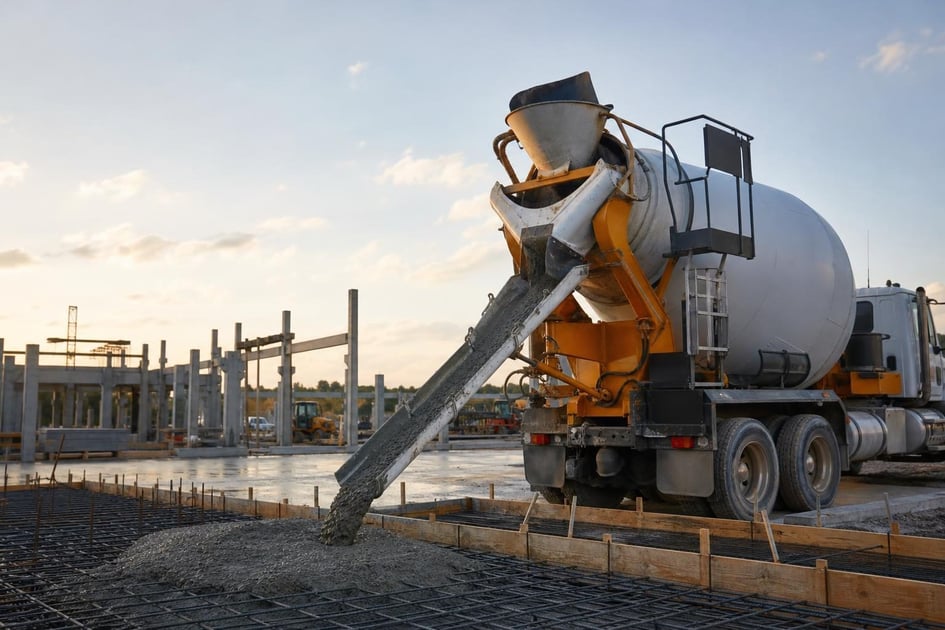
What Determines Your Concrete Mixer Financing Cost
For most contractors, the monthly cost of financing a concrete mixer depends on four things: the equipment price, your credit history, the age of the machine, and how long you stretch the term. Provide Capital finances new and used business equipment from $5,000 to $5 million, with the equipment itself serving as collateral. That collateral structure keeps rates competitive compared with unsecured borrowing, because the lender can offset risk by securing the asset.
Rates vary by credit profile, equipment age and term. A contractor with strong credit financing a two-year-old rear-discharge drum mixer over 48 months will land in a different payment bracket than a startup operator with a thinner file buying a 12-year-old unit over 24 months. The difference can be hundreds of dollars per month. If you already have a quote from a dealer, start an application to get a decision on your mixer, possibly the same day.
The equipment age matters because mixers take a beating. Drum bearings, hydraulic pumps, and engine hours all affect residual value. Lenders price that residual into the deal. A new or late-model mixer holds value longer, which supports a longer term and a lower monthly payment. An older unit with high hours may still qualify, but the term could cap at 36 or 48 months, pushing the payment up.
Your time in business and revenue consistency also shape the offer. Lenders like to see at least one year of operating history, though exceptions exist for borrowers with strong personal credit or significant down payments. Monthly revenue in the $15,000 to $50,000 range is common among approved applicants, but there is no hard floor. Each file is reviewed individually.
By the Numbers: A contractor buying a $90,000 used rear-discharge mixer with 3,000 hours can expect to finance roughly 70% to 80% of the listed price if the unit is under five years old, while a 10-year-old mixer may require a 20% to 30% down payment to offset residual risk.
Get a fast decision on your equipment
Applying takes just a few minutes, and decisions can come as soon as the same day.
Start Your ApplicationNew vs. Used Mixer Pricing and Financing Terms
Concrete mixers range from small tow-behind units to full volumetric trucks. A new towable mortar mixer might cost $15,000 to $30,000. A new rear-discharge drum mixer mounted on a truck chassis often runs $60,000 to $150,000 depending on drum size, chassis brand, and regional freight. Volumetric mixers, which carry raw materials and mix on site, can climb from $200,000 to $400,000 new. Concrete Mixer financing covers all of these categories as long as the equipment is collateralized.
Used mixers trade at 40% to 60% below new retail, but financing terms tighten with age. Most lenders cap used-equipment terms at 60 months for units five to seven years old, and at 48 months for units older than that. New mixers can often be financed up to 84 months, which spreads the capital outlay and preserves operating cash.
| Factor | New Mixer | Used Mixer (5–7 Years) | Used Mixer (10+ Years) |
|---|---|---|---|
| Typical price range | $60,000 – $400,000 | $25,000 – $120,000 | $15,000 – $60,000 |
| Typical down payment | 0% – 10% | 10% – 15% | 20% – 30% |
| Max term | Up to 84 months | Up to 60 months | Up to 48 months |
| Warranty | Full manufacturer | Limited or as-is | As-is |
| Monthly payment example* | $950 – $1,400 | $550 – $850 | $400 – $650 |
*Payments are illustrative. Actual payments depend on credit profile, equipment age and term.
Freight, title fees, and setup costs are often rolled into the financing amount on new units. On used units, lenders may require those costs to be paid upfront so the loan amount stays close to the equipment value. Always ask your dealer for an out-the-door number before you finalize the structure.
Pro Tip: If you are buying used, pull the maintenance records for the drum reducer and hydraulic system before applying. Lenders sometimes request a third-party inspection on units older than eight years, and a clean record can speed underwriting by a day or two.
Lease vs. Loan: How the Structure Changes Your Cost
The word “lease” gets used loosely in equipment finance. A $1 buyout lease and an equipment loan function almost identically: you make monthly payments, own the mixer at the end, and claim depreciation. A fair-market-value (FMV) lease is different. You pay for the use of the equipment and return it at term end, though many contracts include a purchase option.
An FMV lease usually carries the lowest monthly payment because you are not amortizing the full purchase price. However, you also build no equity unless you exercise the buyout. For a contractor who expects to put 4,000 hours a year on a mixer and trade it in three years, an FMV lease can make sense. For an owner-operator who plans to run the machine for eight years, a loan or $1 buyout lease is usually cheaper over the life of the asset.
Before you sign at the dealership, see what financing structure you qualify for so you can compare the total cost side by side. The dealer’s in-house program may not be the only option, and a few percentage points in rate or a longer term can shift your monthly obligation by 15% to 25%.
Key Insight: Many contractors assume a lease always carries a lower payment, but on a 60-month term a $1 buyout lease and an equipment loan often run within a few dollars of each other because both amortize the full purchase price; the real difference appears in tax treatment and end-of-term flexibility.
Tax Treatment for the 2026 Tax Year
Section 179 of the Internal Revenue Code allows businesses to expense qualifying equipment in the year it is placed in service, subject to an annual dollar limit and a phase-out threshold. For the 2026 tax year, the exact limit will be set by IRS guidance. Talk to your CPA about the current-year cap and whether your total equipment purchases place you inside or above the phase-out window.
Bonus depreciation may also be available for concrete mixers placed in service during 2026, though the applicable percentage depends on federal legislation in effect for the tax year. Your accountant can model whether Section 179, bonus depreciation, or straight-line MACRS produces the best outcome for your effective tax rate. SBA guidance on equipment financing and leasing notes that the structure you choose—loan versus true lease—can affect who claims the deduction, so match the paperwork to your tax strategy.
State tax treatment varies. Some states conform to federal bonus depreciation; others decouple. If you operate across state lines, ask your CPA whether registering the mixer in a particular entity or state changes the depreciation recapture picture.
Find the right financing structure
Tell us about the equipment you need and we will show you the options that fit your business.
See Your OptionsWho Qualifies and What Lenders Review
Provide Capital serves construction, manufacturing, transportation, agriculture, and other industries nationwide. Construction equipment financing is one of the largest segments, and concrete mixers are a staple request.
According to Forbes advice on using equipment financing for growth, aligning the financing term with the revenue the equipment generates is one of the most effective ways to preserve working capital while expanding a fleet.
Underwriting looks at three buckets: credit, cash flow, and collateral. A FICO score in the mid-600s or higher generally opens the most competitive programs, but approvals extend below that when revenue is strong or a down payment is provided. Bank statements showing consistent deposits matter more than a single high month. Underwriters often average the last three to six months to smooth out seasonality.
For requests above $150,000, expect to provide two years of tax returns or a current year-to-date financial statement. For requests under $75,000, a one-page application and three months of bank statements are often enough. The equipment itself is the collateral, which means you do not need to pledge real estate or other assets to secure the deal.
Documentation You Need at Closing
Having paperwork ready before you apply shaves days off the process. At minimum, gather:
- A signed equipment quote or invoice from the vendor
- A clear copy of your driver’s license or passport
- A voided business check for ACH setup
- Three months of business bank statements
- Proof of insurance naming the lender as loss payee
For larger transactions or borrowers with complex ownership, add:
- Two years of business tax returns
- An interim balance sheet and profit-and-loss statement
- A brief equipment-use summary explaining how the mixer generates revenue
If you are buying from a private party rather than a dealer, the lender will also need a clear title search. Mixers can carry hidden liens from prior floor-plan financing or repair-shop retainers. A $50 title check at closing is cheaper than discovering a lien after you have already paid the seller.
Pro Tip: Request a 30-day payoff from any existing lienholder before you close. Some lenders will not fund until the prior lien is released, and that process can take five to ten business days if the old lender is slow to issue the clearance letter.
After Approval: What the Timeline Looks Like
Same-day approvals are possible when the file is clean and the equipment is standard. A clean file means complete documentation, no title issues, and a credit decision that does not require manual review. Once approved, the closing package is e-signed and the funds are wired directly to the vendor or private seller. Most deals fund within 24 to 48 hours of final approval.
If the mixer is being transported from out of state, schedule the delivery after the funding date, not before. Lenders want to verify that the collateral exists and matches the invoice before they release funds. A photo of the unit serial plate and a bill of lading are usually enough for out-of-state purchases.
U.S. construction spending remains a leading indicator of mixer demand. According to U.S. Census Bureau construction spending data, private nonresidential activity drives much of the ready-mix and on-site mixing volume. When spending rises, lead times for new mixers stretch, and used prices firm up. Financing early in the season—late winter or early spring—often yields better equipment selection before the construction rush begins.
Common Mistakes to Avoid
First, do not overstate the equipment’s value. Lenders order their own valuation, and the advance rate is based on that number, not the asking price. If you agree to pay $85,000 for a mixer the lender values at $70,000, you will need to cover the $15,000 gap out of pocket or renegotiate with the seller.
Second, avoid skipping the prepurchase inspection on used equipment. Hour meters can be replaced. Check the drum for excessive wear, the chassis for cracks, and the hydraulics for leaks. A $300 inspection can save you from financing a machine that needs $8,000 in repairs in the first six months.
Third, match the term to the useful life. Financing a 15-year-old mixer over 60 months means you may still owe money when the machine is ready for retirement. A shorter term raises the monthly payment but protects you from negative equity. Concrete Equipment financing specialists can help you align the term with realistic replacement cycles.
Ready to move forward?
More than 10,000 businesses have financed equipment with Provide Capital. See what you qualify for today.
Get StartedConcrete Mixer Financing FAQ
Can I finance a concrete mixer with bad credit?
Yes, though the rate and down payment will reflect the added risk. Borrowers with credit challenges often qualify with 15% to 25% down and a shorter term. The equipment collateral helps, but it does not erase the risk entirely.
How long can I finance a used concrete mixer?
Terms up to 60 months are common for mixers five to seven years old. Units older than 10 years usually max out at 36 to 48 months. The lender’s goal is to keep the term inside the remaining useful life of the asset.
Is a down payment always required?
No. Well-qualified buyers purchasing new or late-model used mixers can often secure 100% financing. If the equipment is older, high-hour, or sold by a private party, expect a down payment in the 10% to 20% range.
Can I include taxes, freight, and installation in the loan?
On new equipment, many lenders allow soft costs—freight, tax, and setup—to be rolled into the financed amount up to a cap, often 110% to 115% of the equipment cost. On used equipment, soft costs usually must be paid separately.
Will the lender require a UCC filing?
Yes. The lender files a UCC-1 to perfect the security interest in the mixer. This is standard and does not affect your ability to operate the equipment. The filing releases automatically when the loan is paid off.
Can I pay off the financing early?
Most equipment loans allow prepayment, but some carry a prepayment penalty in the first 12 to 24 months. Ask for the full amortization schedule and the prepayment language before you sign. A lease may have different rules depending on whether it is a $1 buyout or FMV structure.
What types of concrete mixers can be financed?
Drum mixers, volumetric mixers, pan mixers, twin-shaft batch mixers, and mortar mixers all qualify. Mortar Mixer financing is available for smaller units used in masonry and stucco work. The key requirement is that the equipment has a verifiable serial number and a resale market.
How fast can I get funded?
Same-day approvals are possible, and funding often occurs within 24 to 48 hours after closing. Speed depends on how quickly you return documents and whether the equipment title is clear. Deals requiring third-party inspections or out-of-state title transfers take longer.
Next Step: Run the Numbers on Your Mixer
You now have a clear picture of what drives concrete mixer financing cost, from equipment age and credit profile to lease structure and tax timing. The next step is to match your specific quote to a program that fits your cash flow. Check what monthly payment fits your project budget and get a decision without committing to a dealer’s first offer. Whether you need a $20,000 towable unit or a $300,000 volumetric truck, the equipment itself is the collateral, which keeps the process straightforward and the rates competitive.
Disclaimer: The information provided in this article is for general educational purposes only and is not financial, legal, or tax advice. Funding terms, qualifications, and product availability may vary and are subject to change without notice. Provide Capital does not guarantee approval, rates, or specific outcomes. For personalized information about your business funding options, contact our team directly.
