
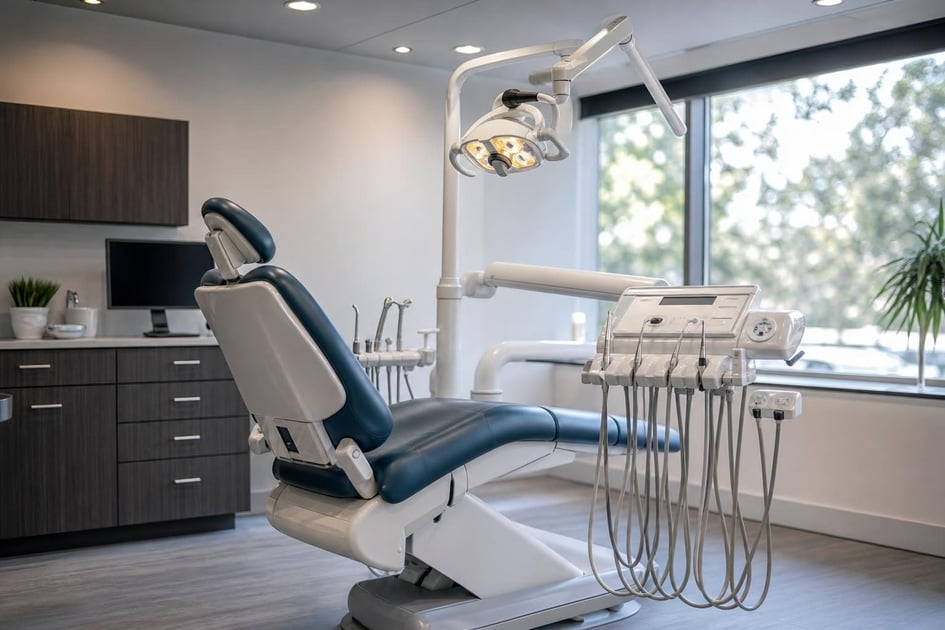
You Can Finance Dental Chairs with Bad Credit, But the Terms Shift
A low credit score does not automatically disqualify you from financing dental chairs. Because the equipment itself serves as collateral, lenders can recover value if a borrower defaults. That collateral protection means financing remains available even when traditional bank loans are not. What changes is the cost structure, the down payment requirement, and the documentation needed to close.
Most equipment finance companies, including Provide Capital, look at the whole picture: how long you have been in practice, your monthly bank deposits, the age and condition of the chairs you want to buy, and whether you are adding equipment to an existing office or opening a new location. A strong cash-flow story can offset a weak credit file.
Key Insight: Lenders often care more about the last three months of bank statements than they do about a credit score from two years ago. Consistent patient revenue and clean deposits carry surprising weight with equipment underwriters.
How Lenders View Dental Equipment Collateral
Dental chairs, delivery systems, and operatory packages hold resale value better than many other medical assets. A used A-dec, Pelton & Crane, or Midmark chair can retain 40 to 60 percent of its original value after five years if it has been maintained properly. That residual value lowers the lender's risk, which keeps rates more competitive than unsecured borrowing options.
According to Forbes, dental practices continue to invest in physical expansion despite interest-rate volatility, which supports strong resale values for underlying equipment collateral. While collateral values differ by asset class—Dump Trucks financing faces steeper seasonal depreciation, for example—dental chairs tend to hold value because demand for oral health services is recession-resistant.
The lender will verify the make, model, year, and serial number of the chairs before funding. For new equipment, the invoice from the dental supply house acts as the valuation document. For used chairs, an independent appraisal or a detailed inspection report may be required, especially on transactions above $75,000. The stronger the collateral, the more willing the lender is to work with credit challenges.
Dental Chairs financing through Provide Capital covers both new installations and replacement units, with the equipment itself securing the note.
What "Bad Credit" Actually Means to an Equipment Lender
Dental practice owners often assume a sub-650 FICO score shuts every door. In equipment finance, the cutoff is more flexible, but the pricing and structure adjust to reflect the added risk.
Credit Score Thresholds
Borrowers with scores above 650 generally qualify for standard equipment finance terms with minimal down payments. Scores between 600 and 650 still qualify at many lenders, though they may trigger a 10 to 20 percent down payment requirement or a shorter initial term. Below 600, approvals are still possible, but the lender will look for compensating factors: longer time in business, higher revenue, or additional collateral.
Unlike unsecured working capital loans, equipment financing does not rely solely on credit score. The presence of a tangible asset changes the underwriting math.
What Else Underwriters Weigh
Beyond the score, underwriters review recent derogatory events. A bankruptcy discharged three years ago is viewed differently than a bankruptcy filed six months ago. Tax liens, judgments, and current collections must be explained, but they do not always kill a deal. Open bankruptcies or unresolved tax liens are typically deal-breakers.
Time in business matters significantly. A practice with three years of tax returns and stable bank deposits has more credibility than a startup with six months of activity. Lenders also verify that the practice's monthly revenue can support the new payment. A common rule of thumb is that the equipment payment should not exceed 15 to 20 percent of monthly gross revenue.
Dental equipment financing specialists understand that a busy practice generating strong collections can absorb a new chair payment even when the owner's personal credit took a hit from a divorce, medical issue, or prior business failure.
Pro Tip: Pull your own credit report before applying. If you find errors or outdated negative items, disputing them can raise your score 20 to 40 points in 30 to 45 days—often enough to shift you into a better pricing tier.
New vs. Used Dental Chairs: Financing Trade-offs
New chairs carry full manufacturer warranties, the latest infection-control features, and longer useful lives. Used chairs cost less upfront but may need refurbishment. From a financing perspective, the choice affects your down payment, term length, and monthly payment.
| Factor | New Dental Chairs | Used Dental Chairs (5–10 Years) |
|---|---|---|
| Typical financing amount | $15,000–$150,000 per operatory | $5,000–$45,000 per unit |
| Down payment with impaired credit | 10–20% | 15–25% |
| Term length | 3–7 years | 2–5 years |
| Warranty coverage | Full manufacturer warranty | Limited or third-party only |
| Residual collateral value | Higher | Lower |
| Approval ease with bad credit | Moderate | Easier (lower total exposure) |
Financing a used chair for $25,000 represents less risk to the lender than a $200,000 new operatory package. If your credit is damaged, starting with one certified pre-owned chair and proving payment history can build the track record you need to finance larger upgrades later.
By the Numbers: A single replacement dental chair financed at $30,000 over five years typically carries a monthly payment between $600 and $900 for a borrower with impaired credit, depending on credit depth, down payment, and equipment age. Rates vary by credit profile, equipment age and term.
Lease vs. Loan: Which Structure Works with Impaired Credit?
Equipment finance agreements (EFAs) and fair-market-value leases are the two most common structures for dental chairs. With an EFA, you own the equipment at the end of the term after making a nominal purchase-option payment. With a lease, you return the equipment or buy it at fair market value.
For practice owners with bad credit, EFAs are usually easier to obtain. Lenders prefer them because the collateral remains clearly titled in the borrower's name, making repossession cleaner if necessary. Leases sometimes require stronger credit because the lessor retains ownership and bears more residual risk.
From a tax standpoint, both structures may offer deductions, but the mechanics differ. An EFA often allows Section 179 expensing or bonus depreciation, while a lease payment is typically deducted as a rental expense. Always confirm 2026 tax year limits with your CPA before structuring a transaction.
Qualification Requirements in Detail
Understanding what the underwriter actually reviews helps you prepare a stronger file and avoid surprises.
Time in Business
Most equipment lenders prefer two years in business, but one year is often sufficient for dental practices because patient revenue tends to be predictable. Startups and new businesses face higher hurdles, so if you are buying into an existing practice or taking over a retiring dentist's patient base, highlight that continuity in your application.
Monthly Revenue Minimums
There is no universal revenue floor, but lenders want to see that the new payment is affordable. A practice collecting $40,000 per month can comfortably absorb a $700 chair payment. A practice collecting $12,000 per month may still qualify, but the lender will scrutinize other debts and fixed costs more closely.
Down Payment Expectations
Standard credit borrowers often finance 100 percent of the equipment cost plus soft costs like installation and freight. With impaired credit, expect to put 10 to 25 percent down, depending on the equipment age and the total transaction size. A larger down payment does more than reduce the lender's risk; it also lowers your monthly payment and total interest cost.
If you cannot produce a large cash down payment, consider trading in old equipment. Many dental supply houses accept trade-ins, and the trade equity can serve the same purpose as cash.
See what you qualify for by submitting a short application and your last three months of bank statements.
Documentation You Will Need
Bad-credit applications succeed when they are complete and organized. Missing documents delay approvals and can push a marginal file into the decline pile. Gather the following before you apply:
- One-page application with ownership details
- Last three to six months of business bank statements
- Current equipment quote or invoice from the vendor
- Most recent business tax return (sometimes two years)
- Personal financial statement or schedule of liabilities
- Copy of your driver's license
If you are buying from a private seller rather than a dental supply company, the lender will also need proof that the seller has clear title to the chairs. A bill of sale and a lien search protect both you and the lender.
Same-day approvals are possible when the file is complete and the transaction is straightforward. Delays usually come from missing bank statements, unsigned vendor quotes, or unresolved credit report disputes.
Tax Treatment for Dental Equipment in 2026
The tax year 2026 offers several avenues to deduct dental equipment purchases, but the exact limits and phase-outs depend on Congressional action and IRS guidance published for the current year. Section 179 expensing allows qualifying businesses to deduct the cost of eligible equipment in the year it is placed in service, subject to an annual limit that adjusts for inflation. Bonus depreciation may also be available at a reduced percentage in 2026 compared to prior years.
Because tax law changes frequently, you should consult a CPA who understands dental practice tax strategy before you decide whether to lease or buy, and whether to accelerate depreciation or spread it over the useful life of the chairs. The wrong structure can cost thousands in after-tax cash flow.
According to Small Business Administration guidance, equipment financing is one of the most common funding methods used by healthcare practices to preserve working capital while still capturing tax benefits.
What Happens After You Apply
Once you submit your application, the lender runs credit, verifies your bank deposits, and reviews the equipment quote. For transactions under $150,000, this is usually automated and takes a few hours. For larger transactions or more complex credit files, a human underwriter may call to ask about a late payment, a tax lien, or a seasonal dip in revenue.
If approved, you receive a term sheet stating the monthly payment, term length, down payment, and any collateral requirements. Read it carefully. Look for prepayment penalties, default provisions, and automatic renewal clauses. Ask questions before you sign.
After you accept the terms, the lender pays the vendor directly or wires funds to escrow. You take delivery of the chairs and begin making payments, usually within 30 to 45 days of funding. The lender files a UCC-1 lien on the equipment, which is standard and releases automatically when the loan is paid off.
According to U.S. Census Bureau data, healthcare and social assistance remains one of the largest employer sectors in the United States, and dental practices continue to expand their physical footprints even in tighter credit environments.
Common Mistakes Dentists Make When Financing with Bad Credit
Avoid these pitfalls to keep your approval on track:
- Shopping too long. Every hard credit pull can lower your score slightly. Apply to one or two specialized equipment lenders rather than shotgun-applications to ten sources.
- Hiding negative information. Underwriters will find the bankruptcy, the lien, or the late mortgage payment. Disclose it upfront with context and evidence of resolution.
- Overleveraging. Financing four new operatories when your patient volume supports two strains cash flow and increases default risk. Match equipment additions to real growth.
- Ignoring soft costs. Installation, electrical, plumbing, and delivery can add 10 to 15 percent to the project total. Make sure your financing covers the complete cost or that you have cash reserved.
- Accepting the first offer. Even with bad credit, terms vary. Compare total cost of financing, not just the monthly payment.
Talk to a specialist about your specific machine and get a same-day decision on your equipment without multiple credit pulls.
How to Strengthen Your Application
If your credit is below 600, take these steps before applying:
- Reduce existing balances. Pay down credit cards to under 30 percent utilization. That single move can lift your score faster than any other.
- Document cash flow. Clean, consistent bank deposits show the lender that patients are paying and the practice is viable.
- Offer a larger down payment. Even 5 percent more down can move a borderline application into the approved column.
- Add a co-signer or guarantor. A partner or spouse with stronger credit can strengthen the file, though they take on personal liability.
- Buy used first. A smaller transaction is easier to approve and gives you a payment history to reference on the next purchase.
These moves do not require years. Some can be executed in 30 to 60 days and meaningfully improve your offer.
Key Insight: Lenders view equipment finance as a relationship, not a transaction. A dentist who pays reliably on a $20,000 used chair loan will often qualify for prime-tier pricing on the next $150,000 full-operatory upgrade. Your first financed deal is a stepping stone, not a life sentence.
Frequently Asked Questions
Can I finance dental chairs if my credit score is under 600?
Yes, but expect a larger down payment and a shorter term. The equipment collateral makes approval possible, but the lender will offset risk by requiring more skin in the game. Rates vary by credit profile, equipment age and term.
Will the lender check my personal credit or business credit?
Both. Most dental practices are structured as pass-through entities, so the lender evaluates the owner's personal credit alongside business bank statements and tax returns. Strong business revenue can compensate for weak personal credit.
How fast can I get approved?
Same-day approvals are possible when your file is complete and the transaction is straightforward. Complex credit histories or transactions above $250,000 may take 24 to 72 hours.
Can I include installation and delivery in the financing?
Yes, most equipment lenders allow soft costs to be rolled into the agreement up to a certain percentage of the equipment value, usually 10 to 20 percent. Ask your financing specialist for the exact limit on your transaction.
Is a lease better than a loan for tax purposes?
It depends on your tax situation in 2026. A loan or EFA may qualify for Section 179 expensing or bonus depreciation, while lease payments are typically deducted as operating expenses. Consult your CPA to model both scenarios for the current tax year.
What happens if I want to pay off the financing early?
Most equipment finance agreements allow early payoff, but some include a prepayment penalty or a minimum interest charge. Review your term sheet carefully before signing. Ask the lender to quote the exact payoff at six months, twelve months, and twenty-four months.
Can I finance used chairs from a private seller?
Yes, but the lender will require proof of clear title and may order an inspection. Private-party transactions take slightly longer because the lender must verify that the seller actually owns the equipment free of liens.
Will financing dental chairs help rebuild my credit?
Yes, if the lender reports to business credit bureaus and you pay on time. Not all equipment lenders report, so ask before you sign. Even without reporting, a paid-off equipment loan becomes a positive reference for your next application.
Your Next Step
Bad credit narrows your options, but it does not close them. Dental chairs are collateral-rich assets in a high-demand industry, and equipment lenders specialize in financing exactly these kinds of purchases for credit-challenged borrowers. The key is to match the right transaction size to your current cash flow, present a complete file, and work with a lender that understands dental practices.
Whether you need one replacement chair or a full operatory rebuild, start with a clear quote and your last three months of bank statements. Get a same-day decision on your equipment and know exactly what you qualify for before you talk to your vendor.
Disclaimer: The information provided in this article is for general educational purposes only and is not financial, legal, or tax advice. Funding terms, qualifications, and product availability may vary and are subject to change without notice. Provide Capital does not guarantee approval, rates, or specific outcomes. For personalized information about your business funding options, contact our team directly.
