
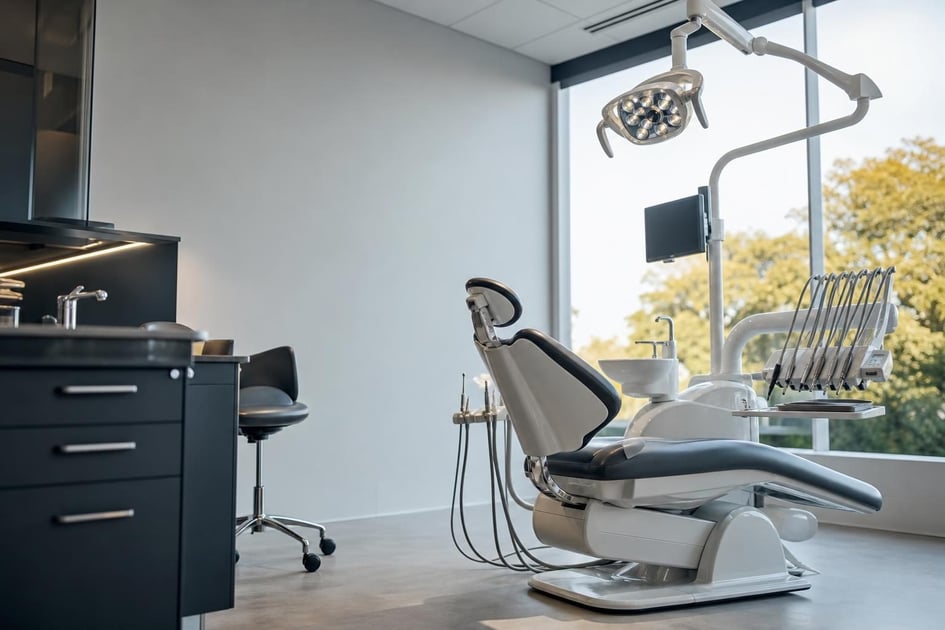
What Financing a Dental Chair Actually Requires
You need a vendor quote, a few months of bank statements, and a credit profile that shows you can handle the payment. That is the core of it. Provide Capital finances Dental Chairs financing from $5,000 up to $5 million, with the chair itself serving as collateral. Because the equipment secures the transaction, rates vary by credit profile, equipment age and term rather than being pegged to unsecured risk benchmarks.
If you already have a chair picked out, see what financing you qualify for and get a decision quickly.
Most approvals move same-day once the documentation is complete. The lender pays the vendor directly after you sign, so you do not have to float the cost on a credit card or drain working capital.
Get a fast decision on your equipment
Applying takes just a few minutes, and decisions can come as soon as the same day.
Start Your ApplicationWhy Lenders Treat Dental Chairs as Strong Collateral
Resale value and asset lifespan
With more than 135,000 dental offices operating nationwide according to U.S. Census Bureau dental office data, the secondary market for chairs remains active. A quality dental chair has a useful life of 12 to 15 years if it is maintained. Even a mid-tier model retains enough resale value that a lender can recover a meaningful portion of the balance in the unlikely event of default. That stability is why equipment financing for dental practices often carries more favorable terms than unsecured working capital loans.
Equipment-specific risk
Lenders look at what the equipment does, not just who is buying it. A dental chair generates revenue directly: every prophy, restoration, or extraction happens in that seat. That revenue connection lowers perceived risk compared to non-income-producing assets. For established practices with steady patient flow, the chair effectively pays for itself over the term.
New vs. Used Dental Chairs: How Requirements Change
New chair financing expectations
Financing a new chair from an authorized distributor is the straight path. The lender receives a clean invoice, a warranty, and a known manufacturer. You can usually expect longer terms and lower down-payment requirements because the collateral value is predictable.
Used and refurbished chair considerations
Used chairs are financeable, but the lender will want to know the model year, the service history, and the refurbisher. If the chair is more than seven years old, the term may shorten to match the remaining useful life. You might also need a larger down payment to offset the faster depreciation. Always get a refurbishment report from the seller.
| Factor | New Dental Chair | Used / Refurbished |
|---|---|---|
| Typical financing term | 3 to 7 years | 2 to 5 years |
| Down payment range | 0% to 10% | 10% to 20% |
| Collateral value stability | High | Moderate |
| Vendor documentation required | Invoice and warranty | Invoice, service history, refurb report |
| Best suited for | Long-term practices, high daily usage | Budget-conscious expansions, backup chairs |
The Qualification Criteria in Detail
Time in business and revenue
Most equipment lenders prefer to see at least two years of operating history. That gives them enough bank-statement data to verify cash flow. If your practice collects $40,000 or more in monthly revenue, you are generally in the conversation for competitive terms. Lower-revenue practices can still qualify, but the lender may ask for a slightly larger down payment or a shorter term.
Equipment financing remains one of the most accessible forms of secured credit for small businesses. According to Forbes small business loan statistics, equipment-backed loans consistently account for a significant share of commercial lending because the collateral reduces lender risk.
Credit profile and down payment
A personal credit score in the mid-600s or higher helps, though it is not the only factor. The lender also looks at business credit, existing debt obligations, and whether you have prior equipment-financing history. If your credit profile is thin, a 15% to 20% down payment can offset the risk. If it is strong, you may see options with minimal money down.
Equipment age and vendor selection
The lender wants to know exactly what it is financing. Buying from a recognized dental distributor with a service department simplifies underwriting. Buying from a private seller at auction adds steps: an appraisal, a condition report, and possibly a UCC lien search to confirm the title is clean.
Key Insight: Lenders often verify that the vendor has a valid resale certificate and is not on a restricted list. If you are buying through a dental equipment broker, confirm they can provide a formal invoice with an equipment serial number. Without that, funding can stall for days while the lender requests additional paperwork.
Lease vs. Loan: What Changes on the Application
Equipment finance agreement
An equipment finance agreement (EFA) works like a loan: you own the chair from day one, and the lender holds a lien on it. You build equity with every payment. At the end of the term, the lien releases and you own the asset free and clear. This is the most common structure for dental practices that plan to keep a chair for its full useful life.
$1 buyout lease
A $1 buyout lease is technically a lease, but functionally it is nearly identical to an EFA. You make monthly payments and own the chair for one dollar at the end. The main difference is how the lessor books the transaction and whether there is a different residual treatment. For tax purposes in 2026, both structures may allow you to claim Section 179 deductions, but confirm the exact treatment with your CPA.
Fair market value lease
An FMV lease is true leasing. You return the chair at the end of the term or buy it out at fair market value. This works best if you plan to upgrade every three to four years to the latest model with integrated imaging. The monthly payment is usually lower than an EFA, but you do not build equity.
Pro Tip: If you are weighing an FMV lease against an EFA, ask your accountant how each structure affects your 2026 tax position. A full Section 179 deduction on an EFA can front-load the tax benefit, while an FMV lease spreads deductions more evenly. The right choice depends on whether you need a large first-year deduction or predictable monthly expenses.
Tax Treatment for Dental Chair Acquisitions in 2026
For the 2026 tax year, the IRS allows businesses to deduct the cost of qualifying equipment under Section 179, subject to an annual dollar limit that adjusts for inflation. Dental chairs generally qualify because they are used more than 50 percent for business. Additionally, bonus depreciation may still be available for the 2026 tax year, though the applicable percentage has been declining under current law. Because both the Section 179 cap and bonus depreciation rates change with federal legislation, talk to your CPA before you rely on a specific number.
Find the right financing structure
Tell us about the equipment you need and we will show you the options that fit your business.
See Your OptionsWorked Cost Examples
Single-chair replacement
Dr. Chen runs a solo practice and needs to replace a 14-year-old chair that is failing. The new model costs $18,500 including delivery. She puts 10 percent down and finances the remaining $16,650 over five years. Her monthly payment lands in the low-$300 range. Over the term she pays roughly $3,800 in finance charges. Because she owns the chair, she plans to claim a Section 179 deduction on her 2026 return, subject to the annual limit, and will confirm the exact amount with her accountant.
Multi-chair new-practice buildout
Dr. Patel is opening a second location with three operatories. Each chair package—chair, delivery system, and light—runs $32,000, for a total equipment cost of $96,000. He finances the full amount with a 12-month deferred-payment structure, then amortizes the balance over six years. His effective monthly cost after the deferral is in the mid-$1,600 range. By structuring the deal this way, he preserves cash flow during the buildout and starts making payments only after the practice sees its first patients.
By the Numbers: A typical dental chair lasts 12 to 15 years. If you finance one over five years, you get seven to ten years of payment-free use afterward. On a $20,000 chair, that means your all-in cost per year of service can be under $2,400 including interest, which is less than one week of production for most general-practice dentists.
Documentation You Will Need to Submit
Business financials
Expect to provide the last three to six months of business bank statements, your most recent tax return, and a current profit-and-loss statement. If your practice is part of a larger entity, include the operating agreement or partnership documents. The lender uses these to verify that your cash flow can absorb the new payment.
Equipment quotes and vendor details
You will need a formal quote or invoice from the vendor. It should list the manufacturer, model number, serial number if available, and a line-item price. If delivery and installation are separate, break those out. Some lenders allow you to roll soft costs like installation into the financing, but they need to see the numbers upfront. Once you have your quotes together, start an application in a few minutes to keep the purchase moving.
Common Mistakes When Financing Dental Chairs
Borrowing more than the equipment supports
Do not wrap a $50,000 line of credit into the same transaction as a $22,000 chair. The lender structures equipment financing around the asset value. If you need working capital for tenant improvements, handle that separately or ask about a split structure. Otherwise, you risk a declined application because the collateral does not cover the total advance.
Choosing the wrong term length
A three-year term on a $35,000 chair gives you a higher monthly payment but builds equity fast. A seven-year term frees up cash flow but leaves you underwater on value if you want to sell early. Match the term to how long you plan to keep the chair. If you expect to upgrade in four years, do not sign a seven-year agreement.
Ignoring soft-cost inclusion rules
Delivery, installation, and initial training are often financeable, but only up to a percentage of the hard equipment cost. If your invoice is $20,000 for the chair and $8,000 for install, the lender may cap soft costs at 20 to 25 percent of the equipment price. Ask your financing contact about the ratio before you sign the vendor contract.
What Happens After You Apply
Same-day review process
Once you submit the application and documentation, an underwriter reviews your bank statements, checks the vendor's credentials, and runs credit. For deals under $150,000, this can happen the same day. For larger buildouts, expect 24 to 48 hours while the lender verifies the practice's financials.
If you are weighing all capital sources, the SBA resource hub for business financing outlines government-backed programs such as 7(a) and 504 loans. Those options can work for large real-estate-and-equipment combinations, though their timelines are typically slower than direct equipment financing.
Funding and vendor payment
After approval, you receive the financing documents to sign electronically. The lender then wires funds directly to the vendor or issues a check. You never handle the capital. This protects both parties and ensures the lender's lien attaches to the correct equipment. Most vendors release the chair for delivery only after they confirm payment.
Ready to move forward?
More than 10,000 businesses have financed equipment with Provide Capital. See what you qualify for today.
Get StartedFrequently Asked Questions
Can I finance a dental chair with a 600 credit score?
You can, though the terms will reflect the risk. Expect a higher down payment—often 15 to 20 percent—and a shorter term. The equipment itself is collateral, which helps, but the lender still wants evidence that you manage debt responsibly.
Is a used dental chair harder to finance than a new one?
Not necessarily, but the lender needs more documentation. A used chair must come with a service history and, ideally, a refurbishment report. Terms may be shorter, and the down payment slightly larger, to match the remaining useful life.
How long can I finance a dental chair?
Terms typically range from two to seven years. New chairs support longer terms because the collateral value holds. Used chairs or those with high hourly usage may top out at four or five years.
Does the lender pay my equipment vendor directly?
Yes. In almost all equipment financing transactions, the lender pays the vendor directly. This ensures the lender's security interest is perfected and prevents misuse of funds.
Can I include delivery and installation in the financing?
Often yes, up to a limit. Most lenders cap soft costs at 20 to 25 percent of the equipment invoice. If your installation quote exceeds that, you may need to pay the difference out of pocket.
What happens if I pay off the financing early?
Some equipment finance agreements include a fixed prepayment schedule or a small remaining-interest charge. Others allow payoff with no penalty after a certain point. Ask for the prepayment language before you sign so you are not surprised later.
Should I lease or finance my dental chair?
Finance if you plan to keep the chair for most of its useful life and want to build equity. Lease—specifically an FMV lease—if you prefer lower payments and expect to upgrade every few years. Your CPA can help you model the after-tax cost of each option for 2026.
Can I finance other equipment at the same time as my dental chairs?
Yes. Provide Capital finances a wide range of business equipment, from Commercial Hvac System financing for your office to delivery vehicles. You can structure multiple pieces on one agreement or separate them to match their useful lives.
Next Steps
Start by getting a formal quote from your dental equipment vendor. Gather your last three months of bank statements and your most recent tax return. Then decide whether you want to own the chair outright or preserve flexibility with a lease.
Dental practices depend on reliable equipment. A broken chair costs you production every hour it is down. If you are staring at a repair bill that is half the price of a new unit, financing the replacement is usually the smarter play. Ready to move forward? Get a decision on your equipment, possibly the same day. Provide Capital offers Dental equipment financing nationwide, with amounts from $5,000 to $5 million and the chair itself standing as collateral.
Disclaimer: The information provided in this article is for general educational purposes only and is not financial, legal, or tax advice. Funding terms, qualifications, and product availability may vary and are subject to change without notice. Provide Capital does not guarantee approval, rates, or specific outcomes. For personalized information about your business funding options, contact our team directly.
