
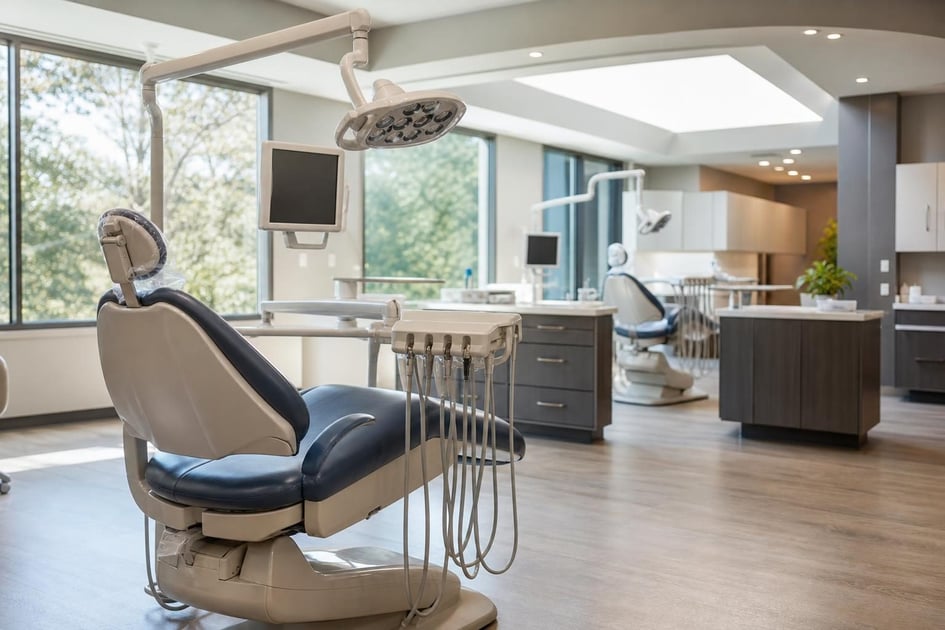
What Financing Terms Actually Look Like for Dental Chairs
A single dental chair typically costs between $3,000 and $15,000 depending on features, with integrated delivery systems and imaging mounts pushing the total closer to $20,000 per operatory. If you are outfitting a three-chair practice, your equipment bill can easily land between $40,000 and $80,000 before you add lights, compressors, or cabinetry. Financing terms for these purchases usually stretch from 24 to 84 months, with the equipment itself serving as collateral. Because the chair secures the financing, lenders can offer competitive rates that vary by credit profile, equipment age and term length. Same-day approvals are possible once you submit a complete application and equipment quote.
Most established dental practices can access financing from $5,000 up to $5 million through equipment lenders, though chair-only transactions generally fall well below that ceiling. The key variables that shape your offer are your time in business, personal credit history, practice revenue, and whether you are buying new or pre-owned equipment. If you already have a chair model and vendor quote in hand, you can see what financing you qualify for in minutes and often receive a decision the same business day.
Key Insight: Lenders usually cap the term at the useful life of the chair. A new unit with a 10-year expected lifespan may qualify for a 60- to 84-month term, while a five-year-old used chair is typically limited to 24 to 36 months because the collateral value declines faster than the payoff schedule.
Get a fast decision on your equipment
Applying takes just a few minutes, and decisions can come as soon as the same day.
Start Your ApplicationWhat Determines Your Dental Chair Financing Terms
Equipment finance companies look at four pillars when they price a dental chair deal: credit profile, equipment age, term length, and debt-service coverage. Your personal credit score carries significant weight, especially if your practice has fewer than three years of tax returns. A strong score with clean trade lines signals lower risk, which translates into longer terms and lower monthly payments. Practice revenue matters too; underwriters want to see that your monthly collections can cover the new payment with room to spare. Industry coverage from AP News notes that technology-oriented dentists increasingly need financing flexibility to grow, which makes understanding these underwriting pillars essential.
The age and condition of the chair directly affect the loan-to-value ratio. New equipment from brands like A-dec, Midmark, or Belmont can often be financed at 100 percent of the invoice because the resale market is deep and predictable. Used equipment may require a 10 to 20 percent down payment if the unit is more than five years old or has high operating hours. Lenders also verify that the seller is a legitimate dealer or dental supply house rather than an individual on an auction site, because warranty and service availability protect the collateral value.
Term length is a trade-off between cash flow and total cost. A 36-month term builds equity quickly and minimizes total finance charges, but the monthly payment is higher. An 84-month term spreads the cost thin, preserving working capital for payroll and supplies, yet you pay more over the life of the agreement. Most practice owners land in the 48- to 60-month range for new chairs, striking a balance between manageable payments and reasonable total cost. Dental equipment financing specialists understand this math and can help you model the payment against your monthly production.
New vs. Used Dental Chairs: How Equipment Age Affects Your Deal
New chairs carry the best financing terms because the collateral risk is lowest. You get longer amortization, lower down payment requirements, and often a streamlined approval because the equipment appraisal is straightforward. Manufacturers and dealers also frequently bundle installation, training, and initial service into the invoice, all of which can be rolled into the financing amount. If you are opening a new location or remodeling an existing operatory, new equipment gives you warranty coverage that protects the lender’s collateral and your cash flow simultaneously.
Used chairs can save 30 to 60 percent off the sticker price of a comparable new unit, but the financing terms tighten accordingly. Lenders want to know the serial number, year of manufacture, total hours of use, and service history. A chair that is seven years old may still be serviceable, yet most lenders will limit the term to 24 or 36 months and require a personal guarantee. You should also budget for reupholstery, new handpiece tubing, or adapter plates, because these soft costs add up and not every lender finances them on used deals.
Refurbished or certified pre-owned chairs sit in the middle. Some dental supply houses remanufacture trade-ins with new upholstery, updated electronics, and limited warranties. These units often qualify for terms closer to new equipment because the dealer stands behind the product. If you are considering used chairs, ask the seller for a refurbishment report and compare the total cost—including any needed upgrades—against a new-chair package before you decide. Dental Chairs financing covers both new and used units, so you can choose the path that fits your budget and timeline.
By the Numbers: A $12,000 new chair financed over 60 months typically carries a monthly payment roughly one-third lower than the same purchase price spread over 36 months, though the longer term increases the total cost of financing. On a used $7,000 chair limited to 36 months, the payment is higher per dollar borrowed because the term is compressed.
Leasing vs. Buying: A Comparison for Practice Owners
Dentists often wonder whether to lease or finance a chair purchase. The right answer depends on your tax strategy, how long you plan to keep the equipment, and whether you want to deal with resale at the end. An equipment loan makes you the owner from day one; you claim depreciation and Section 179 deductions, and you build equity in an asset. A lease gives you lower monthly payments and a simpler upgrade path, but the economics differ depending on the structure.
The two most common lease types are the $1 buyout lease and the fair-market-value lease. A $1 buyout lease is essentially a loan in disguise: you make monthly payments and own the chair for $1 at the end. An FMV lease lets you walk away, renew, or buy the chair at its then-current market value when the term expires. FMV leases work well if you expect rapid technology changes or plan to relocate within three to five years. $1 buyout leases make more sense if you intend to keep the chair for its full useful life.
| Factor | Equipment Loan | $1 Buyout Lease | FMV Lease |
|---|---|---|---|
| Ownership | You own the chair immediately | You own it after final $1 payment | Lessor owns it; you may buy at FMV |
| Monthly payment | Moderate | Moderate to slightly higher | Lowest |
| Term options | 24 to 84 months | 24 to 60 months | 12 to 60 months |
| Tax treatment | Section 179 and depreciation | Section 179 and depreciation | Lease payments deducted as expense |
| End-of-term | Equity remains | Automatic ownership | Return, renew, or purchase |
| Best for | Long-term ownership | Eventual ownership with simple paperwork | Short-term use or frequent upgrades |
If you are unsure which structure fits your cash flow, start an application to get a decision on your equipment, possibly the same day, and compare the payment scenarios side by side before you commit to a vendor.
Tax Treatment for Dental Equipment in 2026
Tax strategy is one of the strongest arguments for financing dental chairs rather than paying cash. For tax year 2026, Section 179 allows qualifying businesses to deduct the full purchase price of equipment in the year it is placed in service, subject to an inflation-adjusted annual limit and a dollar-for-dollar phase-out once total equipment purchases exceed a separate threshold. Because these limits change yearly with inflation indexing, you should consult your CPA to confirm the exact 2026 ceiling and whether your practice qualifies.
Bonus depreciation may also apply to new and used dental chairs placed in service during 2026, though the percentage has been stepping down from prior years. Again, the precise rate for 2026 depends on legislation and IRS guidance, so rely on your accountant for the current figure rather than assuming last year’s rate still holds. If you finance the purchase, you generally still qualify for the full Section 179 or bonus depreciation deduction even though you have not paid the full cash price upfront, because you are considered the owner for tax purposes under a loan or $1 buyout lease.
Lease payments under a true fair-market-value lease are treated differently. Instead of depreciation, you deduct the monthly lease payment as a business expense. This can simplify bookkeeping, but the total deduction over the lease term may be less aggressive than a front-loaded Section 179 write-off. The best choice depends on your 2026 taxable income, other capital expenditures, and whether you need to shelter revenue this year or spread deductions over time.
Pro Tip: If you place a chair in service on December 31, 2026, it generally counts for the full 2026 tax year. If you wait until January 2, 2027, the deduction shifts to the following tax year. Coordinate your delivery and installation schedule with your CPA before you sign the financing documents.
See what you qualify for
The equipment itself secures the financing, which keeps rates competitive. Checking your options takes minutes.
Check Your OptionsDocumentation You Need Before You Apply
Having your paperwork ready is the single biggest factor in whether you get a same-day approval. Lenders need three categories of documents: proof of identity and business ownership, proof of income and cash flow, and proof of the equipment value. At minimum, gather your driver’s license, business license, and two years of personal and business tax returns. If your practice is newer, prepare bank statements covering the last three to six months so underwriters can verify revenue trends. While SBA 7(a) loans can also fund equipment purchases, direct equipment financing often closes faster because the collateral is narrowly defined and the underwriting is specialized.
For the equipment itself, you need a detailed quote or invoice from the vendor. The quote should list the chair model, serial number if used, accessories, delivery charges, and installation fees. Some lenders also require photographs of used equipment and a condition report from the seller. If you are buying from a private party rather than a dealer, the lender may order an independent appraisal, which adds 24 to 72 hours to the timeline.
Finally, expect to provide a personal financial statement and a voided business check. The personal financial statement helps the lender assess your overall liquidity and contingent liabilities, while the voided check sets up automatic payments. Organizing these items before you submit the application prevents back-and-forth requests that can stretch a one-day approval into a week-long process.
How Lenders Evaluate Dental Practice Applications
Underwriters use a consistent scoring model, but they adapt it to healthcare practices. Time in business is the first filter. A practice with three or more years of tax returns is viewed as stable, while a younger practice may still qualify if the principal dentist has prior clinical experience and strong personal credit. Annual revenue of $250,000 or more generally clears most equipment lender thresholds for a chair purchase, though smaller practices can qualify with a larger down payment or a shorter term. The dental industry remains one of the largest outpatient healthcare sectors in the country, with Census Bureau industry profiles tracking tens of thousands of practices nationwide.
Credit profile is next. Most equipment lenders look for a personal FICO score in the mid-600s or higher for prime terms, but programs exist for scores down to the low 600s or even high 500s with compensating factors. Compensating factors include low existing debt, significant liquid reserves, or a co-signer with strong credit. Bankruptcy or recent foreclosure usually requires an explanation and a larger equity stake, but it is not always an automatic denial if the practice cash flow is strong.
Debt-service coverage ratio is the final piece. Lenders divide your practice’s monthly bank deposits by your total monthly debt payments, including the new equipment payment. A ratio of 1.25 or higher is the industry comfort zone, meaning you have $1.25 in cash flow for every $1.00 of debt obligation. If your ratio is lower, you may still get approved by putting 15 to 25 percent down or selecting a longer amortization to reduce the monthly obligation. Commercial Hvac System financing and other practice build-out loans are evaluated the same way, so consider your total capital plan before you lock in a chair payment.
Key Insight: A lender may approve you for $100,000 in total equipment financing but structure it as two separate schedules: one for the chairs and one for auxiliary equipment. This keeps the UCC filing clean and makes it easier to sell or refinance individual pieces later without rewriting the entire agreement.
Mistakes That Delay or Derail Dental Equipment Financing
The most common error is shopping for chairs without a clear budget. Dentists often fall in love with a top-tier model, sign a purchase order, and then discover the monthly payment strains cash flow after payroll and lab bills. Always run a pro-forma payment calculation against your average monthly collections before you commit to a vendor. A good rule of thumb is to keep total equipment payments under 10 to 15 percent of your gross monthly revenue.
Another mistake is ignoring soft costs. Delivery, installation, electrical work, and plumbing adaptations can add $2,000 to $5,000 per operatory. If your financing only covers the chair itself, you pay those costs out of pocket. Make sure your quote includes all ancillary expenses, and ask your lender whether they can be included in the financed amount. Some lenders cap soft costs at 15 to 25 percent of the equipment value, while others require them to be paid separately.
Choosing the wrong term is the third pitfall. A 24-month term on a $50,000 chair package creates a payment that rivals your rent, while an 84-month term on a chair with a seven-year life leaves you paying for equipment that is already outdated. Match the term to the useful life of the asset, and avoid extending the loan beyond the point where you plan to replace the chair. Finally, do not wait until your old chair breaks to apply for financing. Emergency purchases rush the decision, limit your vendor options, and often lead to hasty terms you regret later.
What Happens After You Are Approved
Once the lender issues an approval, you receive a term sheet outlining the financed amount, term, payment schedule, and any conditions. Read it carefully to confirm the equipment description matches your quote exactly. If everything looks correct, you sign the closing documents and the lender issues a purchase order or wires funds directly to the vendor. In most cases, the vendor is paid within 24 to 48 hours of signed documents.
The lender files a UCC-1 financing statement against the equipment, which is standard for any collateralized transaction. This filing does not appear on your personal credit report as a judgment; it is simply a public notice that the lender has a security interest in the chair. Once the final payment clears, the lender releases the UCC filing and you own the equipment free and clear. Some lenders automatically send a release letter; others require you to request it, so ask about their process upfront.
Your first payment is typically due 30 to 45 days after funding, depending on the lender’s billing cycle. Most lenders offer autopay, which often shaves a small amount off the rate or fees. If your practice revenue is seasonal, ask whether you can align your due date with your strongest collection weeks. After six to twelve months of on-time payments, you may become eligible for additional equipment financing without re-submitting a full application, because the lender already knows your profile.
Put the right equipment to work
From $5,000 to $5 million, new or used, Provide Capital helps businesses nationwide finance the equipment they need.
Apply TodayFrequently Asked Questions
Can I finance dental chairs if my practice is less than two years old?
Yes, though terms may be slightly tighter. Lenders will weigh your personal credit, clinical experience, and current bank deposits more heavily. A strong personal score and six months of healthy practice revenue can often offset a short time in business.
Do I need a down payment for dental chair financing?
New chairs can often be financed with zero down. Used chairs older than five years or purchased from private sellers may require 10 to 20 percent down to protect the lender’s collateral position.
How long does approval take?
With complete documentation, same-day approvals are possible. Deals requiring appraisals, missing tax returns, or private-party sales can take 24 to 72 hours.
Will the lender check my personal credit?
Yes, almost all equipment financiers run a personal credit check on the practice owner or guarantor, because the owner’s financial behavior is viewed as a proxy for how the practice will manage its obligations.
Can I include delivery and installation in the loan?
Many lenders allow soft costs such as delivery, installation, and training to be rolled into the financing, usually capped at 15 to 25 percent of the equipment invoice. Ask your lender for their specific policy before you sign the vendor contract.
What happens if I want to pay off the loan early?
Equipment loans may carry a prepayment penalty or a fixed schedule of fees during the first 12 to 24 months. After that, many lenders allow early payoff with no penalty, or with a small remaining-interest charge. Review your term sheet for the exact language.
Is a lease better than a loan for tax purposes?
For tax year 2026, a loan or $1 buyout lease generally lets you claim Section 179 and depreciation, which front-loads your deduction. A true FMV lease lets you deduct the monthly payment as an operating expense. The better choice depends on your current taxable income and your CPA’s advice.
Can I finance chairs from a private seller or auction site?
Some lenders allow private-party sales, but they usually require an independent appraisal, proof of clear title, and a more detailed condition report. Dealer purchases are simpler because the vendor provides standardized invoices and often warranties that protect collateral value.
Moving Forward With Your Equipment Purchase
Financing dental chairs is a straightforward process when you understand the variables. Match your term to the equipment’s useful life, decide whether ownership or flexibility matters more to your practice, and gather your documentation before you apply. Keep your monthly equipment payment in proportion to your collections, and coordinate your closing date with your CPA to maximize your 2026 tax position. Get a decision on your dental chairs today and move forward with the equipment your practice needs.
Disclaimer: The information provided in this article is for general educational purposes only and is not financial, legal, or tax advice. Funding terms, qualifications, and product availability may vary and are subject to change without notice. Provide Capital does not guarantee approval, rates, or specific outcomes. For personalized information about your business funding options, contact our team directly.
