
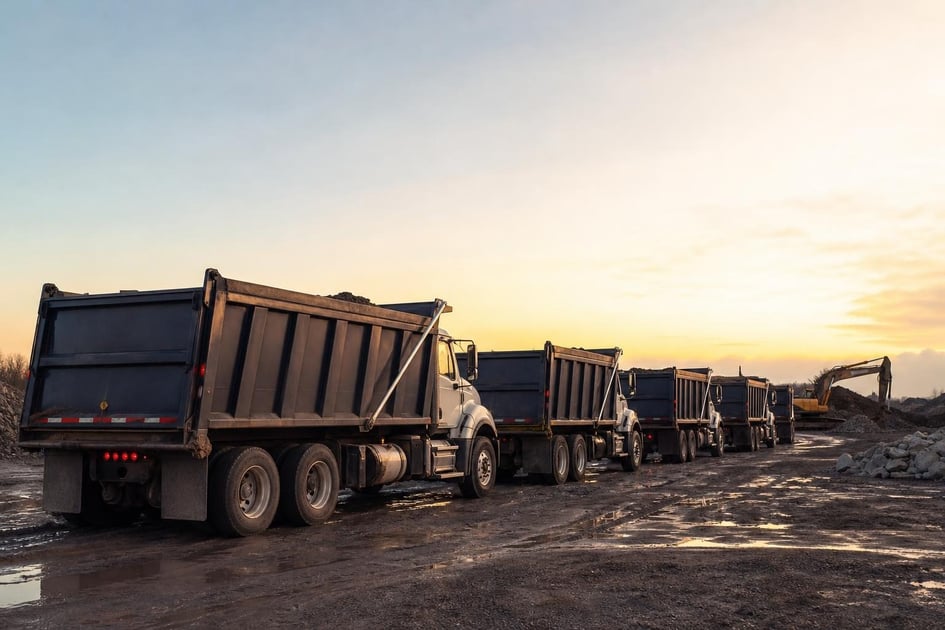
A dump truck financing calculator gives you a monthly payment estimate before you talk to a lender. It is not a binding offer, but it is the fastest way to see whether an $85,000 used tri-axle or a $165,000 new quad-axle fits your cash flow. The calculator runs on a few inputs—equipment cost, your intended down payment, the age of the truck, and your credit profile—and returns an estimated payment range. That range helps you decide whether to keep shopping, negotiate the price, or move forward with an application.
If you already have a truck in mind, you can see what financing you qualify for on that dump truck in just a few minutes.
How a Dump Truck Financing Calculator Works
Most equipment financing calculators ask for the purchase price of the dump truck, your planned down payment, the term length you prefer, and a general sense of your credit tier. Some also ask how long you have been in business, because lenders view two years of operating history differently than six months. The calculator applies a rate range based on those factors and spreads the net financed amount across the term.
The output is usually a monthly payment band, not a single number. A used single-axle dump truck priced at $45,000 might show a lower monthly obligation than a new heavy-duty model at $220,000, but the calculator also reveals how much the term length changes the payment. Stretching the same balance from 36 months to 60 months lowers the monthly cost, yet increases the total outlay. The tool lets you test both scenarios in seconds.
What the calculator cannot do is verify your exact rate. Rates vary by credit profile, equipment age and term. Only a full application with documented financials can produce a firm offer. Think of the calculator as a planning device, not a contract.
Already have a machine in mind?
Provide Capital finances new and used equipment from $5,000 to $5 million, with same-day decisions possible.
Apply NowWhat Information You Need to Run the Numbers
To get a useful estimate, gather the actual equipment quote or listing price. Lenders distinguish between new and used units, so note the model year and mileage. A 2026 Peterbilt with 10,000 miles qualifies for longer terms than a 2018 model with 300,000 miles. Have a rough idea of your down payment. While zero-down options exist for strong credits, putting 10% to 20% down improves approval odds and lowers the monthly cost.
You should also know your approximate credit tier and annual revenue. Lenders typically ask for the last three months of business bank statements and may request tax returns for larger requests. If you are buying from a private party rather than a dealership, mention that upfront. Private-party sales require extra title verification, which can affect timing.
Pro Tip: Run the calculator twice—once with your best-case down payment and once with the minimum you can afford. The gap between the two outputs tells you how much cash reserves matter for your monthly cash flow. Owner-operators who test both extremes rarely get surprised at closing.
New vs. Used Dump Trucks: How Condition Changes the Math
New dump trucks offer warranty coverage, lower maintenance costs in the first years, and longer available financing terms. Lenders view new equipment as stronger collateral, which can improve the structure of the deal. A new heavy-duty dump truck in the $180,000 to $220,000 range can often be financed over five to seven years. The downside is the steeper monthly payment and the rapid depreciation that hits all new commercial vehicles in the first 24 months.
Used dump trucks cost less upfront and depreciate more slowly, but they carry more mechanical risk. Lenders typically cap terms on used equipment based on age at funding. A five-year-old truck might qualify for a four-year term, while a ten-year-old unit may be limited to two or three years. That shorter term raises the monthly payment even though the purchase price is lower. If the used truck has high mileage or shows heavy frame wear, some lenders will require a larger down payment or additional collateral.
Before you commit to a used unit, budget for a professional inspection. A $60,000 truck that needs $15,000 in engine work within six months is not cheaper than an $80,000 truck in solid condition. Factor potential maintenance into your calculator inputs by keeping a cash reserve separate from your down payment.
Key Insight: Auction prices for used dump trucks can run 15% to 25% below retail, but auction units are sold as-is. Lenders may finance auction purchases, yet they often require a third-party appraisal and proof of insurance before funding. Build those steps into your timeline.
Lease vs. Loan: A Side-by-Side Look
Dump truck acquisition usually takes one of two paths: an equipment loan or a finance lease. Under a loan, you own the truck outright once the balance is paid, and the lender places a lien on the title until then. Under a finance lease, the lessor holds title while you make payments, and you may have a buyout option at the end. The choice affects your balance sheet, your tax deductions, and your flexibility to upgrade.
With a loan, you can claim depreciation and, for tax year 2026, potentially elect Section 179 expensing on qualifying new and used equipment, subject to the annual limits set by the IRS. A lease payment is generally deductible as a business expense, but you do not own the depreciation. Loans build equity; leases preserve capital. If you plan to keep the truck for ten years, a loan usually wins. If you replace equipment every three to four years to avoid maintenance risk, a lease can make more sense.
| Factor | Equipment Loan | Finance Lease |
|---|---|---|
| Ownership | You own; lender holds lien | Lessor holds title; buyout may exist |
| Term length | 36–84 months | 24–60 months |
| Down payment | 0%–20% typical | First + last payment, or 0%–10% |
| Monthly cost | Higher with shorter term | Lower for same equipment cost |
| Tax treatment (2026) | Section 179 or depreciation; consult a CPA | Payments generally expensed; consult a CPA |
| End of term | Title released, no balance | Return, renew, or buy at residual |
| Upgrade flexibility | Sell or trade when you choose | Easier to walk into new equipment |
The right structure depends on how long you plan to run the truck and how you want the obligation to appear on your books. A construction contractor with steady backlog may prefer the equity buildup of a loan. A startup-hauler still proving routes may value the lower monthly commitment of a lease. Publications like Forbes regularly note that the choice between leasing and buying depends more on holding period than on monthly payment alone. Either way, rates vary by credit profile, equipment age and term, so compare the total cost over the full life of the agreement, not just the first payment.
Qualifying for Dump Truck Financing
Lenders evaluate four main factors: credit history, time in business, equipment age, and revenue stability. A strong credit profile opens access to longer terms and lower down payments, but subprime options exist for borrowers with recent challenges. Most lenders prefer at least two years in business, though some programs accept one year or less with compensating factors.
The equipment itself matters. A newer dump truck with documented maintenance and clear title is easier to approve than a high-mileage unit with a salvage history. Lenders also look at your debt-service coverage ratio—whether your monthly revenue can comfortably handle the new payment after existing obligations. If your business generates $25,000 per month and your existing debts take $8,000, a $1,200 dump truck payment looks very different than if your current debts already consume $18,000.
Industry experience counts. An owner-operator who has run dump trucks for a decade is viewed differently than someone pivoting from retail. That does not mean newcomers are disqualified, but they may face shorter terms or larger down payment requirements. Construction and transportation remain two of the largest equipment-buying sectors in the country, according to U.S. Census Bureau data. Provide Capital finances new and used business equipment from $5,000 to $5 million nationwide, and same-day approvals are possible when the file is complete.
See what you qualify for
The equipment itself secures the financing, which keeps rates competitive. Checking your options takes minutes.
Check Your OptionsWhat Documentation You'll Need
When you move past the calculator and submit an application, have your paperwork ready. Most requests include a copy of your driver's license, the equipment quote or listing, three months of business bank statements, and your most recent business tax return. For requests above $150,000, expect to provide two years of tax returns and a current year-to-date profit and loss statement.
If you are buying from a dealership, they will supply a detailed invoice with the VIN, year, make, model, and any attachments. If you are buying privately, you need a bill of sale and a title search to confirm no outstanding liens. Lenders also require proof of insurance naming them as loss payee before they release funds. The Small Business Administration offers guidance on organizing business financials before applying for credit. The entire process moves faster when you upload clean, legible documents in a single batch rather than piecemeal.
Once you have your documents together, get a decision on your equipment, possibly the same day.
By the Numbers: Provide Capital finances equipment from $5,000 to $5 million. A typical used dump truck approval falls between $50,000 and $150,000, with terms ranging from 36 to 60 months depending on age and credit. Down payments often run from 0% to 15% for well-qualified borrowers, while newer businesses or challenged credit may see requests for 10% to 20%.
Tax Treatment for Dump Trucks in 2026
For tax year 2026, the IRS allows businesses to deduct the cost of qualifying equipment through Section 179 expensing, bonus depreciation, or regular MACRS depreciation. Section 179 lets you expense the full purchase price in the year the equipment is placed in service, up to an annual dollar limit that adjusts for inflation. The exact 2026 limit has not been finalized in public guidance at the time of writing, so consult your CPA for the current cap and phase-out threshold.
Bonus depreciation for 2026 may also be available at a reduced percentage from prior years, depending on legislative changes. If you do not elect Section 179 or bonus depreciation, you can recover the cost over a five-year MACRS schedule. The equipment must be used more than 50% for business to qualify for any accelerated method, and you must keep mileage logs or job records to prove business use.
Leased dump trucks are treated differently. Lease payments are generally fully deductible as operating expenses, which simplifies bookkeeping but does not provide the large front-loaded deduction of Section 179. The best structure depends on your 2026 taxable income, your projected future earnings, and whether you need to reduce current-year liability. Always review equipment purchase timing with a CPA before you sign.
Common Mistakes Owner-Operators Make
One frequent error is focusing only on the monthly payment and ignoring the total cost of financing. A $950 payment over 84 months costs more in absolute dollars than a $1,400 payment over 48 months. Run both scenarios through the calculator and compare the total outlay before you decide which term fits your operation.
Another mistake is buying too old to qualify for reasonable terms. A $35,000 dump truck from 2012 seems like a bargain until every lender offers only a 24-month term and demands 25% down. The resulting monthly payment can strain cash flow and leave no reserve for repairs. Check with your lender about age caps before you make an offer on a high-mileage unit.
Finally, many buyers forget to budget for insurance, registration, and maintenance in the first 90 days. Financing covers the acquisition, not the operating costs. A new dump truck still needs commercial auto liability, physical damage coverage, and possibly cargo insurance before it can legally haul. Those premiums are often due upfront and can add several thousand dollars to your initial cash need.
Key Insight: Lenders verify equipment value through a third-party appraisal or a standardized pricing guide for requests near the top of their guidelines. If you agree to pay $20,000 above market for a customized dump truck, the lender may still only finance the guide value, leaving you to cover the gap in cash. Always check comparable sales before you negotiate.
What Happens After Approval
Once approved, you receive a term sheet detailing the monthly payment, term length, down payment required, and any fees. Review it carefully. The term sheet is not the final contract, but it locks in the key economics. If you accept, the lender orders a title search or UCC filing to perfect its lien on the equipment.
Funding typically occurs within one to three business days after all conditions are met. The lender wires funds directly to the seller or dealership, or to you if it is a private-party transaction with verified title. Your first payment is usually due 30 to 45 days later. Set up automatic ACH withdrawals if the lender offers them; missing the first payment can trigger default clauses that accelerate the entire balance.
After funding, keep all maintenance records and inspection reports. Should you want to refinance, upgrade, or request additional equipment later, those records prove the collateral value. Many owner-operators who finance one Dump Trucks financing deal return within 18 to 24 months to add a second or third unit as their route book grows.
Put the right equipment to work
From $5,000 to $5 million, new or used, Provide Capital helps businesses nationwide finance the equipment they need.
Apply TodayFAQ
Can I finance a dump truck with bad credit?
Yes, but the structure changes. Subprime approvals often require a larger down payment, a shorter term, or additional collateral. Rates vary by credit profile, equipment age and term. If your credit has recent delinquencies, be prepared to explain the circumstances and show steady revenue for the last six months.
How long can I finance a dump truck?
New dump trucks can often be financed for 60 to 84 months. Used units are typically capped at 36 to 60 months, depending on age at funding. A ten-year-old truck rarely qualifies for more than 36 months. The lender wants the balance paid down while the collateral still holds significant value.
Is it better to lease or buy a dump truck?
Buy if you plan to keep the truck for its full useful life and want to build equity. Lease if you prefer lower monthly payments, predictable upgrade cycles, and minimal maintenance risk. For tax year 2026, purchasing may offer larger first-year deductions through Section 179, subject to IRS limits. Ask your CPA to model both options with your actual projected income.
What credit score do I need to qualify?
There is no universal minimum. Strong credit—generally 680 and above—unlocks the best terms and lowest down payments. Scores in the 600 to 679 range can still qualify with compensating factors like strong revenue or a larger down payment. Below 600, expect to provide more documentation and possibly a personal guarantee.
Can I finance a private-party sale?
Yes. Provide Capital and other lenders fund private-party transactions, but the process includes a title search to verify no outstanding liens and often requires a third-party appraisal. The seller must provide a clear title at closing, and you must secure insurance before funds are released.
Do you finance dump truck attachments like plows or spreaders?
Attachments can often be included in the same financing package if they are part of the original purchase and listed on the invoice. Standalone attachment financing is also available starting at $5,000. Bundling them with the truck simplifies the paperwork and may improve the overall collateral value.
How fast can I get funded?
With a complete file—application, equipment quote, bank statements, and tax returns if required—same-day approvals are possible. Funding usually follows within one to three business days after you accept the terms and satisfy any conditions like insurance or appraisal.
What is the minimum down payment for a dump truck?
Well-qualified borrowers sometimes secure 0% down on new or near-new equipment. More commonly, lenders ask for 10% to 15% down. Startups, challenged credit, or very old trucks may require 15% to 20%. The down payment directly reduces the financed amount and the lender's risk exposure.
Moving Forward
A dump truck financing calculator is the right starting point, but the numbers only become real when you submit an application. If you have a quote in hand and know your target monthly budget, start an application in a few minutes and get back to bidding jobs. Provide Capital serves owner-operators and fleet managers across Construction equipment financing, Transportation equipment financing, and related industries nationwide, with financing from $5,000 to $5 million.
Disclaimer: The information provided in this article is for general educational purposes only and is not financial, legal, or tax advice. Funding terms, qualifications, and product availability may vary and are subject to change without notice. Provide Capital does not guarantee approval, rates, or specific outcomes. For personalized information about your business funding options, contact our team directly.
