
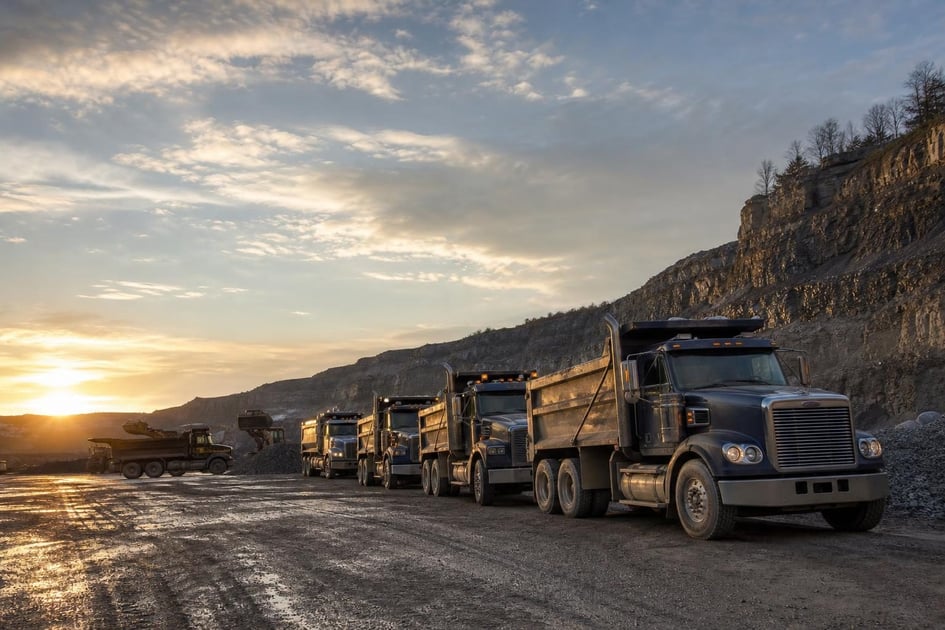
What Dump Truck Financing Looks Like for Tennessee Contractors
Dump truck financing in Tennessee works best when the lender treats the equipment as collateral and moves fast enough to keep your job schedule intact. Whether you are hauling aggregate out of Sevier County or moving demo debris in Nashville, the right financing structure lets you put the truck to work immediately while preserving working capital. Rates vary by credit profile, equipment age and term, and the same equipment-backed structure that keeps those rates competitive also means approvals can come through the same day you apply. If you need a decision quickly on your next truck, start an application to see what you qualify for and possibly get an answer before the dealer sells the unit.
Get a fast decision on your equipment
Applying takes just a few minutes, and decisions can come as soon as the same day.
Start Your ApplicationWhy Tennessee Demand Follows a Distinct Rhythm
Tennessee is not a generic Southern construction market. The state has three distinct equipment corridors. Middle Tennessee around Nashville is driven by commercial and residential building, with highway and infrastructure work layered on top. West Tennessee, anchored by Memphis, functions as a freight and logistics hub where dump trucks serve distribution-center buildouts and intermodal yards. East Tennessee maintains active quarrying, mining, and forestry operations that require off-road and heavy-haul units.
That geography creates a predictable seasonal rhythm. The bulk of dump truck purchases in Tennessee happen between late February and early June, as contractors position fleets ahead of the paving and building season. The winter months from late November through January see slower volume, which creates an opportunity for buyers willing to close when dealers are hungry to move inventory. Snow and ice removal contracts in the Plateau and eastern counties can also justify winter acquisitions if the truck is spec'd with a compatible salt spreader or plow mount.
Local permitting cycles reinforce the pattern. Tennessee Department of Transportation letting schedules peak between March and May, while county road projects in rural areas often break ground after the last frost. Contractors who align their financing timeline with these letting windows avoid the spring bottleneck at body shops and upfitters. National equipment demand remains strong; a Wall Street Journal analysis of construction equipment trends notes that contractors are prioritizing fleet investments over hiring in the current cycle. A truck ordered in April may face a six-week wait for a dump body installation; the same truck ordered in February can often be spec'd and delivered before the first TDOT project breaks ground.
Key Insight: Tennessee Department of Transportation letting schedules peak between March and May. Contractors who finance trucks in January and February often beat the spring rush and avoid the delivery delays that stretch lead times by three to four weeks once TDOT projects break ground.
The Trucks Tennessee Buyers Actually Finance
Not every dump truck fits every job. Light-duty Class 3 and 4 trucks, often based on a standard chassis with a converted bed, work for landscapers and small residential contractors hauling mulch or light demo. Medium-duty Class 5 through 7 trucks handle the majority of commercial construction, road repair, and agricultural use in Tennessee. Heavy-duty Class 8 trucks and articulated off-road haulers serve quarries, major infrastructure work, and high-volume earthmoving.
New vs. Used: How the Financing Terms Change
New trucks generally command financing terms of 36 to 72 months, with the exact length tied to the expected useful life of the vehicle. Because the lender's collateral retains value longer, new units often qualify for lower down payments and more flexible structures. Used trucks can be financed, but lenders typically cap the age at around 10 years at the time of purchase and may require a larger down payment if the odometer reads high or the engine hour count is elevated. The sweet spot for many Tennessee owner-operators is a three- to five-year-old unit with documented maintenance: it avoids the steepest depreciation drop while still qualifying for competitive terms.
Mileage thresholds matter. A Class 8 dump with 300,000 highway miles may still have productive life left if the diesel engine was maintained properly, but lenders view high-mileage units more cautiously. Engine hours tell a fuller story for trucks that idled extensively at job sites. A truck with 200,000 miles but 8,000 engine hours may be a better collateral candidate than a truck with 150,000 miles and 12,000 hours, because excessive idling accelerates wear on aftertreatment systems and turbochargers.
Pro Tip: If you are buying used at auction in Tennessee, line up your financing approval before you bid. Auction houses often require payment within 48 hours, and a pre-approval letter gives you leverage to negotiate the buyer's premium or speed the title transfer.
Loan vs. Lease: A Practical Comparison
Equipment financing loans and leases both let you acquire a dump truck without paying the full purchase price upfront, but the ownership path and tax consequences diverge. A loan secured by the equipment itself builds equity with every payment. At the end of the term, you own the truck outright and can trade it, sell it, or run it until the frame gives out. A lease, by contrast, gives you use of the truck for a fixed period. Depending on the structure, you may return it, buy it for fair market value, or purchase it for a nominal amount.
| Feature | Equipment Loan | FMV Lease | $1 Buyout Lease |
|---|---|---|---|
| Ownership at end | You own the truck | Return or buy at FMV | You own the truck |
| Down payment | Often 0% to 20% | First and last payment | Often 0% to 20% |
| Monthly payment | Higher than FMV lease | Lowest monthly cost | Similar to loan |
| Tax treatment | Section 179 and depreciation | Deduct payments as expense | Section 179 and depreciation |
| Mileage/hours restrictions | None | Typically yes | None |
| Best for | Long-term ownership | Frequent turnover | Eventual ownership with lower initial cost |
For a contractor running the same truck for six or seven years on Tennessee infrastructure jobs, a loan or $1 buyout lease usually wins on total cost. For a site developer who needs the latest emissions-compliant unit every three years to satisfy municipal contract requirements, a fair-market-value lease keeps payments low and avoids disposal risk.
What Lenders Actually Look For
Qualification for dump truck financing hinges on four factors: time in business, credit profile, revenue, and the equipment itself. Most equipment lenders prefer at least two years of operating history, though some will work with younger businesses if the owner has strong credit and the down payment increases. Personal credit scores below 600 make approval harder but not impossible, especially if monthly revenue supports the payment and the truck holds its value well.
Revenue requirements vary by lender and deal size. A common rule of thumb is that your business should generate enough monthly cash flow to cover the new payment several times over. Lenders verify this with three to six months of business bank statements and recent tax returns. They also look at your existing debt obligations to make sure the new payment does not over-leverage the operation.
The equipment itself matters more in dump truck financing than in unsecured lending. Because the truck serves as collateral, lenders evaluate its make, model, year, mileage, and intended use. A well-maintained Peterbilt or Kenworth from a reputable dealer in Memphis or Knoxville will appraise more favorably than a high-mileage no-name chassis bought through a private seller with no inspection. Some buyers explore SBA-backed options; the SBA 7(a) loan program can guarantee equipment financing for qualifying small businesses, though equipment lenders often move faster on collateral-backed deals. Get a decision on your equipment, possibly the same day, by submitting your application along with the dealer quote or equipment listing.
By the Numbers: Tennessee had roughly 150,000 employer establishments and nearly 3 million employees statewide according to Census Bureau data. Construction represents one of the largest employer sectors, which means lenders active in the state understand dump truck collateral and can move faster than generalist underwriters.
See what you qualify for
The equipment itself secures the financing, which keeps rates competitive. Checking your options takes minutes.
Check Your OptionsTax Treatment for the 2026 Tax Year
How you write off a dump truck depends on whether you finance or lease, and on the current tax rules. For the 2026 tax year, Section 179 allows businesses to deduct the full purchase price of qualifying equipment in the year it is placed in service, subject to an annual limit that adjusts for inflation. The exact dollar cap for 2026 should be confirmed with your CPA, because the limit changes yearly and your total taxable income affects how much you can claim.
Bonus depreciation may also apply to new and used dump trucks placed in service during 2026, though the percentage has been phasing down from prior-year peaks. Again, the specific rate for 2026 depends on legislation and IRS guidance, so speak with a tax professional before you count on a particular deduction amount.
If you lease, you typically deduct the monthly lease payment as a business expense rather than depreciating the asset. This simplifies bookkeeping but may yield a different total tax benefit over the life of the lease compared with ownership. Your CPA can model both scenarios based on your 2026 projected income.
Where Tennessee Contractors Put Dump Trucks to Work
The application form is the same, but the use case changes depending on your county and industry. In Middle Tennessee, Construction equipment financing covers everything from tri-axle dumps moving base course for highway jobs to smaller landscape bodies hauling sod and topsoil for residential developers. The Nashville metro has seen sustained building activity that requires reliable haul capacity, and contractors who own their trucks rather than subcontracting hauling keep more margin on every job.
In West Tennessee, Transportation equipment financing bridges the gap between pure freight and construction logistics. Dump trucks here often move agricultural products, gravel for county road maintenance, and material for distribution-center slabs. The run between Memphis and the Mississippi River ports creates steady demand for highway-spec dumps with high payload capacity.
East Tennessee's topography favors articulated trucks and heavy-duty rigs for quarry and mining work. The limestone and sandstone operations around Knoxville and the Cumberland Plateau need trucks that can handle grades and unpaved haul roads. Financing for these units often involves larger amounts and longer terms, but the equipment collateral structure remains the same. We also finance Dump Trucks financing for forestry and agricultural applications statewide, including poultry litter transport and logging support.
The Paperwork You Need Ready
Same-day approvals are possible only when the documentation is complete. Before you apply, gather the following:
- Three to six months of business bank statements
- Previous two years of business tax returns
- Current year profit-and-loss statement, if available
- A signed equipment quote or purchase agreement from the dealer or seller
- Proof of commercial driver's license for the operator
- Current insurance quote showing the lender as loss payee
- Any existing debt schedule, if you carry other equipment loans
Missing items are the single biggest cause of delays. If you are buying from a private party rather than a dealer, you also need a clear title search and a bill of sale that matches the financing amount. Lenders will not fund until they can perfect the lien, so a cloudy title adds days or weeks.
Mistakes That Cost Tennessee Buyers Time and Money
First-time buyers often overbuy on specs. A 20-ton hauler looks impressive, but if 90 percent of your jobs involve residential driveways and light commercial pads, you are burning fuel and tire cost on capacity you do not need. Match the truck to the work, not to the fantasy job.
Second, do not ignore Tennessee's weight and permitting rules. The state enforces axle-weight limits and seasonal restrictions on certain rural routes. A truck that is legally plated for the interstate may still need additional permits for overweight loads on county roads. Check with the Tennessee Department of Transportation before you spec the chassis.
Third, used trucks from the Northeast or Upper Midwest often carry hidden rust damage to the frame, cab, and dump body from road salt. A visual inspection is not enough. If you cannot attend the pre-purchase inspection yourself, hire a diesel mechanic to pull the truck on a lift and check the frame rails, air tanks, and body hinges. A $300 inspection can save you from financing a truck that needs $5,000 in structural welding before it can pass a DOT inspection.
Fourth, many buyers forget to line up commercial vehicle insurance before closing. Lenders require proof of insurance with the loss payee clause satisfied, and if you wait until the last minute, an underwriting delay at your insurance agency can push funding back by a week. Get the quote early and confirm the lender's exact loss-payee wording.
Ready to move forward?
More than 10,000 businesses have financed equipment with Provide Capital. See what you qualify for today.
Get StartedFrequently Asked Questions
Can I finance a dump truck with a 600 credit score?
Yes, though the structure changes. Expect a larger down payment, a shorter term, or a slightly higher monthly payment. The equipment collateral helps offset credit concerns, but lenders still want to see consistent revenue.
How long can I finance a used dump truck?
Terms typically range from 24 to 60 months for used trucks, depending on age and mileage. A five-year-old truck with under 200,000 miles may qualify for 60 months, while a 10-year-old unit may be capped at 36 months.
Do I need a commercial driver's license to finance a dump truck?
The lender does not require you to hold the CDL personally, but they do require proof that a licensed operator will drive the truck. Most lenders ask for a copy of the driver's CDL and a current medical card.
Can I finance a truck from a private seller?
Yes, but the process involves extra steps. The lender must verify a clear title, coordinate the lien perfection, and often requires an independent appraisal or inspection. Private-party deals usually take a few days longer than dealer purchases.
Is a down payment always required?
Not always. Well-qualified buyers with strong revenue and newer equipment can sometimes secure 100 percent financing. Startups or lower-credit borrowers should plan on 10 percent to 20 percent down.
Can I add a plow or spreader to the financing?
Yes, if the attachment is part of the original purchase and listed on the invoice. Aftermarket additions financed separately usually require a different structure, but body-upfit packages ordered from the dealer can be rolled into the same equipment note.
What happens after I am approved?
The lender issues a commitment letter or funding authorization. You sign the closing documents, the lender pays the seller directly, and you take delivery. Most lenders require proof of insurance listing them as loss payee before releasing funds.
Can I pay off the loan early?
Most equipment loans allow early payoff, but check whether your specific note includes a prepayment penalty or a minimum interest charge. Some leases use a fixed sum structure that makes early termination expensive.
Your Next Step
Dump truck financing in Tennessee is a tool to keep you working, not a bureaucratic obstacle. The best time to apply is when you have identified the truck, reviewed your revenue, and gathered your paperwork. If you are ready to move, see what financing you qualify for on that dump truck and get back to bidding jobs with confidence.
Disclaimer: The information provided in this article is for general educational purposes only and is not financial, legal, or tax advice. Funding terms, qualifications, and product availability may vary and are subject to change without notice. Provide Capital does not guarantee approval, rates, or specific outcomes. For personalized information about your business funding options, contact our team directly.
