
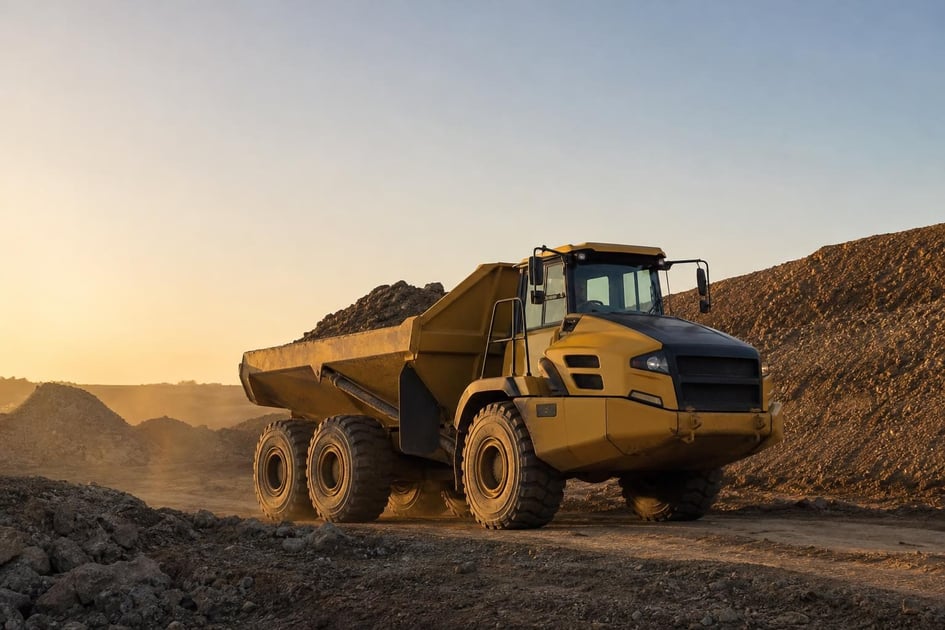
Most dump truck financing terms run from 24 to 72 months, with the equipment itself serving as collateral. Rates vary by credit profile, equipment age and term. Borrowers with strong credit and two or more years in business can often secure longer amortizations and lower monthly payments, while newer operators or those buying older trucks should expect shorter terms and a larger down payment.
If you are weighing a purchase, see what financing you qualify for on that dump truck before you negotiate with the seller. Knowing your approved term and down payment in advance turns you into a cash buyer.
How Dump Truck Financing Terms Are Structured
Equipment lenders treat dump trucks as hard collateral with established resale value. Because the truck secures the note, lenders can offer competitive terms without requiring real estate or additional assets. Loan amounts generally start around $5,000 and can reach up to $5 million for fleet purchases or heavy-spec articulated models.
Repayment schedules usually align with the truck’s useful life. A new Class 8 dump truck might amortize over 60 to 72 months. A used truck with 300,000 miles might be capped at 36 or 48 months. The logic is simple: the lender wants the balance paid down while the collateral still holds meaningful value.
Loan Terms vs Lease Terms
An equipment loan transfers title to you once the final payment clears. A lease, by contrast, leaves title with the lessor unless you exercise a purchase option at the end. Loans build equity; leases preserve working capital. For a dump truck that will log 50,000 miles a year in abrasive quarry conditions, ownership often makes more sense because the residual value at lease end is hard to predict.
What Drives Your Rate
Lenders price dump truck deals based on a handful of variables. Your personal and business credit scores carry the most weight. Time in business matters next: operations with three or more years of filed tax returns present lower risk than startups. The age and mileage of the truck also shift pricing. A 2026 Peterbilt 567 with under 50,000 miles qualifies for better terms than a 2018 model approaching 400,000 miles. Finally, the size of your down payment matters. Putting 10 to 20 percent down improves your rate and shows the lender you have skin in the game.
Forbes Finance Council guidance on equipment financing notes that spreading payments across several years lets businesses put revenue-producing assets to work while preserving operating cash, provided the repayment period matches the asset’s useful life.
By the Numbers: A $150,000 dump truck financed over 60 months with 10 percent down creates a loan balance of $135,000. On a standard equipment finance agreement, that monthly payment typically falls between $2,600 and $3,000 depending on credit tier and term. Stretch the same balance to 72 months and the payment drops roughly 15 percent, though total interest paid rises.
Already have a machine in mind?
Provide Capital finances new and used equipment from $5,000 to $5 million, with same-day decisions possible.
Apply NowNew vs. Used Dump Trucks: Financing Differences
The age of the truck changes every variable in your deal. New units command longer terms, lower rates, and smaller down payments. Used trucks offer lower acquisition costs but require larger equity contributions and faster amortization.
| Factor | New Dump Truck | Used Dump Truck (5–7 Years) |
|---|---|---|
| Typical term | 60–72 months | 36–48 months |
| Down payment | 0–10% | 10–20% |
| Rate range | Competitive; varies by credit | Slightly higher; varies by credit |
| Mileage limit | None | Often capped at 500,000 miles |
| Warranty coverage | Full factory | Limited or expired |
| Title transfer | Immediate | Immediate with loan |
One detail many buyers miss: lenders often impose a mileage ceiling on used trucks. Exceed that ceiling and the lender may shorten the term or increase the down payment requirement. Always verify the lender’s equipment age and mileage policy before you fall in love with a specific unit.
Qualifying for Dump Truck Financing
Qualification standards for Dump Trucks financing center on cash flow, credit, and collateral quality. Lenders want to see that your existing revenue can absorb the new payment without strain.
Credit and Time in Business
A personal credit score in the mid-600s or higher opens the door to most equipment finance programs. Scores above 700 unlock the best-available structures. If your business has operated for two or more years, lenders will lean on filed tax returns and bank statements to verify cash flow. Younger businesses can still qualify, but the underwriter will scrutinize personal credit more heavily and may require a larger down payment.
Down Payment Expectations
For established buyers with strong credit, zero-down programs exist on new equipment. More commonly, expect to put down 5 to 15 percent. Used trucks and borrowers with credit challenges should plan for 15 to 20 percent. The down payment is not just a risk mitigator; it also prevents you from going underwater on the loan if resale values soften.
The SBA 7(a) loan program can fund equipment purchases up to $5 million and offers longer repayment horizons, though the application process is generally more involved than direct equipment financing. Owner-operators who need faster turnaround often prefer equipment-specific lenders.
Get a decision on your equipment, possibly the same day, by submitting a recent bank statement and the equipment quote along with your application. Many lenders can render a soft-quote within hours.
Tax Treatment for Dump Trucks in 2026
For tax year 2026, the Internal Revenue Code allows businesses to deduct the cost of qualifying equipment under Section 179, subject to annual dollar limits and a phase-out threshold. Dump trucks generally qualify because they are used more than 50 percent for business and are not passenger vehicles. For tax year 2026, the maximum Section 179 expense deduction is $2,560,000, and the benefit begins to phase out once total equipment purchases exceed $4,090,000. These figures are indexed for inflation and apply to property placed in service during the 2026 tax year.
Bonus depreciation may also apply, though recent tax law changes have begun scaling it back. For 2026, bonus depreciation may be available at a reduced percentage depending on when the property was acquired and placed in service. Because depreciation rules interact with Section 179 in complex ways, you should consult a CPA before structuring your purchase.
Key Insight: If you buy a dump truck in December 2026 but do not put it into service until January 2027, the deduction shifts to the 2027 tax year. Lenders care about the funding date; the IRS cares about the in-service date. Align your purchase timeline with your tax strategy.
Leasing vs. Buying: Which Structure Fits Your Operation?
Dump truck operators face a real strategic choice. A loan makes sense when you plan to keep the truck for its full useful life—typically seven to ten years for a Class 8 chassis. A lease works better when you need predictable monthly costs and plan to upgrade every three to four years.
| Consideration | Equipment Loan | Operating Lease |
|---|---|---|
| Monthly payment | Higher; you own the asset | Lower; you return the asset |
| Tax deduction | Interest + depreciation | Lease payment (usually fully deductible) |
| Mileage restrictions | None | Often 25,000–30,000 per year |
| End-of-term obligation | None; title is yours | Return, renew, or buy at FMV |
| Best for | High-utilization, long-term hold | Seasonal or contract-specific work |
One caveat: operating leases on dump trucks often carry excessive wear-and-use clauses. Hauling demolition debris or aggregates beats up a body faster than highway freight. If you lease, read the return condition language carefully. A $10,000 paint-and-body bill at lease end can erase years of monthly savings.
See what you qualify for
The equipment itself secures the financing, which keeps rates competitive. Checking your options takes minutes.
Check Your OptionsIndustry-Specific Considerations
Dump trucks serve multiple sectors, and the financing structure should match the revenue cycle of the industry you serve.
Construction
In Construction equipment financing, dump trucks often work alongside excavators and loaders. Contractors who bid municipal infrastructure jobs may see 60- to 90-day payment cycles. If that describes your business, negotiate a 90-day deferred first payment or align your term with your average receivables aging. Lenders who understand construction cash flow can build seasonal skips into the note, letting you skip one or two payments during winter slowdowns.
The construction sector is sizable. According to U.S. Census Bureau construction spending data, total construction spending continues to measure in the trillions of dollars annually. Even a modest share of that activity requires thousands of dump trucks to move material.
Transportation and Hauling
For-hire trucking companies that haul aggregates, asphalt, or agricultural products operate on tighter margins but steadier volume. In Transportation equipment financing, lenders like to see freight contracts or proof of recurring revenue. If 60 percent of your annual miles come from one quarry contract, show the lender the renewal history. It acts as a proxy for future cash flow.
The transportation and warehousing sector generated significant revenue in the first quarter of 2026, with general freight trucking alone accounting for billions in quarterly activity. That volume supports a robust secondary market for dump trucks, which gives lenders confidence in resale values and makes them more willing to extend competitive terms.
Common Mistakes to Avoid
Even experienced buyers trip over the same obstacles. Avoiding them saves money and frustration.
- Buying too much truck. A heavy-spec tri-axle with a 20-foot body looks impressive, but if 80 percent of your jobs are local residential site work, you are paying for capacity you rarely use. Match the GVWR and body length to your actual loads.
- Ignoring the total cost of ownership. Fuel, DEF, tires, and dump-body maintenance often exceed the monthly finance payment. Budget $15,000 to $25,000 annually for maintenance on a used Class 8 dump truck in severe service.
- Skipping the prepurchase inspection. On used trucks, demand an oil analysis and frame inspection. A cracked rail or a failing aftertreatment system can cost more than the down payment to repair.
- Not comparing term options. A 48-month term with a lower rate is not always cheaper than a 60-month term with a slightly higher rate. Run the full amortization schedule.
Pro Tip: If you are buying a used dump truck from a private party, ask the seller to provide maintenance records for the last three years. Lenders view documented maintenance as a proxy for collateral quality, and it can improve your approval odds enough to shave a quarter-point off your rate.
Documentation You Will Need
Lenders move faster when you bring a complete package. Expect to provide:
- One to two years of business tax returns, if applicable
- Three to six months of business bank statements
- A current year-to-date profit and loss statement
- The equipment quote or purchase agreement, including VIN, year, make, model, and mileage
- Proof of insurance with the lender listed as loss payee
- A copy of your commercial driver’s license if you will operate the truck
If you are a newly formed entity without tax returns, the lender will rely on your personal credit, personal tax returns, and a strong written explanation of how the truck will generate revenue.
What Happens After You Apply
Most equipment finance applications follow a three-step timeline. First, the lender reviews your credit and financials and issues a conditional approval or counteroffer. This step can take anywhere from a few hours to two business days. Second, the lender verifies the collateral by reviewing the equipment specs and ordering a title check or inspection. Third, you sign the closing documents and the lender funds the deal, either by wiring the seller directly or sending a check.
Same-day approvals are possible when the loan amount is under $250,000, the borrower has strong credit, and the equipment is standard stock from a reputable dealer. Larger transactions or complex entity structures may require additional documentation, extending the timeline to three to five business days.
Once funded, your first payment is typically due 30 to 45 days later. Many lenders do not charge a prepayment penalty, but you should confirm that in writing before you sign. If you plan to pay the note off early—perhaps with a seasonal cash surplus—knowing the penalty structure matters.
Start an application in a few minutes and get a conditional answer before the truck you want leaves the lot.
Put the right equipment to work
From $5,000 to $5 million, new or used, Provide Capital helps businesses nationwide finance the equipment they need.
Apply TodayFrequently Asked Questions
Can I finance a dump truck with bad credit?
Yes, but expect a larger down payment—often 20 to 30 percent—and a shorter term. The lender mitigates risk by limiting exposure and ensuring the truck retains equity throughout the loan.
How long can I finance a dump truck?
New dump trucks can often be financed for 60 to 72 months. Used trucks generally top out at 48 months, and high-mileage units may be limited to 36 months.
Is a personal guarantee required?
Most equipment finance agreements under $1 million require a personal guarantee from the majority owner. The exception is larger corporations with extensive credit history and substantial balance-sheet assets.
Can I finance a private-party sale?
Yes. Lenders treat private-party sales differently from dealer transactions, often requiring a title search and an independent equipment inspection. The process adds a day or two to funding.
What is the minimum down payment for dump truck financing?
Well-qualified buyers can find zero-down programs on new equipment. Most borrowers should plan for 10 to 15 percent. Credit challenges or used equipment typically push the requirement to 15 to 20 percent.
Does the lender need to approve the specific truck?
Yes. The lender will verify the year, make, model, mileage, and condition. Some lenders maintain a restricted list of brands or require that the truck pass a third-party inspection before funding.
Can I finance multiple dump trucks at once?
Yes. Fleet deals are common, and lenders may offer better terms on bundled transactions. You will still need to qualify for the total exposure, but the administrative work is streamlined.
Are lease payments tax-deductible?
Operating lease payments are generally fully deductible as a business expense. Finance leases and loans are treated differently, with deductions coming from depreciation and interest. Ask your CPA which structure maximizes your 2026 tax benefit.
Next Steps
Dump truck financing is straightforward when you know the variables. Start by deciding whether you need a new or used truck, how many months you want to spread the cost, and what down payment you can deploy without starving your operating account. Gather your financials and the equipment quote, then submit an application to a lender who understands heavy equipment.
At Provide Capital, we finance new and used business equipment from $5,000 to $5 million, with the equipment itself serving as collateral. Whether you run a single truck or a growing fleet, we can structure terms that match your cash flow. See what financing you qualify for on that dump truck and get back to moving material.
Disclaimer: The information provided in this article is for general educational purposes only and is not financial, legal, or tax advice. Funding terms, qualifications, and product availability may vary and are subject to change without notice. Provide Capital does not guarantee approval, rates, or specific outcomes. For personalized information about your business funding options, contact our team directly.
