
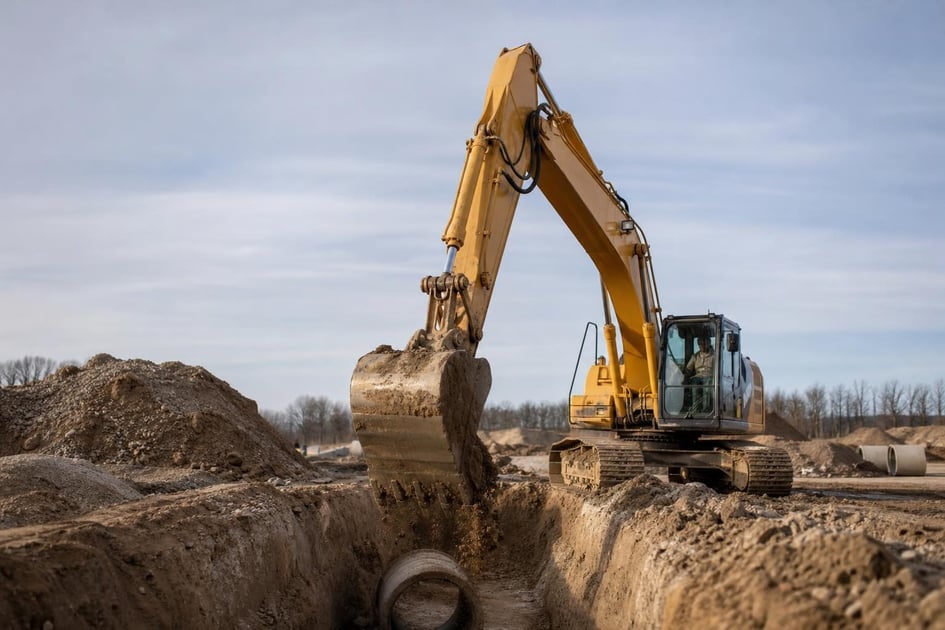
If you are staring at a job that requires moving earth and wondering whether you can get the excavator financed, the short answer is yes—provided your credit history, business revenue, and the machine itself check out. Equipment lenders do not treat excavator financing like a general business loan. The machine serves as collateral, which keeps rates competitive and approval times short. Provide Capital finances new and used business equipment from $5,000 to $5 million, so whether you need a compact mini-excavator for residential work or a 35-ton crawler for commercial grading, the financing structure works the same way. Same-day approvals are possible when your application and equipment details are complete. If you already have a quote from a dealer, see what financing you qualify for on that excavator before someone else buys it.
What Lenders Review When You Apply
Qualifying for Excavators financing comes down to three factors: your personal and business credit, the length of time you have been operating, and the details of the machine you want to buy. Lenders weight these differently depending on the transaction size, but none of them is a mystery. The U.S. Small Business Administration publishes general guidance on how lenders evaluate small-business equipment applications.
Credit History and Score
Your personal credit score matters even if the business is a separate legal entity. Most equipment lenders want to see a track record of on-time payments and a debt-to-income ratio that leaves room for a new payment. If your score is strong, you can expect better terms and a lower down payment. If it is bruised, you may still qualify, but the lender will likely ask for more money down or a shorter term. Rates vary by credit profile, equipment age and term, so there is no single cutoff that guarantees approval or denial.
Time in Business and Revenue
A business with two or more years of revenue history has an easier time qualifying because the lender can verify cash flow through bank statements or tax returns. That does not mean a newer company is automatically out. If the owner has strong personal credit and the equipment will generate revenue immediately—think a contractor with a signed job waiting on the machine—lenders can still make the deal work. The key is showing that the payment fits within your monthly cash flow. Some lenders also look at your industry experience. A contractor who has been operating excavators for a decade is viewed differently than a newcomer, even if both have similar credit scores. Experience reduces the lender’s risk that the machine will sit idle or be operated unsafely, which protects the collateral value.
Equipment Age, Hours, and Model
The excavator itself is the collateral. Lenders care about year, make, model, and operating hours because those details determine resale value. A late-model Caterpillar or Komatsu from a licensed dealer holds value better than an off-brand import with unclear maintenance records. If you buy from a private seller, expect the lender to require an independent appraisal or to limit the advance rate. The serial number, hour meter reading, and condition photos all factor into the final offer.
Key Insight: Lenders often advance a higher percentage of the purchase price on a used excavator from a major-brand dealer than on a comparable no-name machine, because the resale market for brands like Deere, Kubota, and Case is deeper and more predictable.
Already have a machine in mind?
Provide Capital finances new and used equipment from $5,000 to $5 million, with same-day decisions possible.
Apply NowNew vs. Used Excavators: How Condition Changes Qualification
New excavators are easier to finance on paper because the value is straightforward and the warranty protects the collateral. Used machines can be financed just as readily, but the lender will scrutinize the maintenance history and remaining useful life. The age of the equipment at the end of the term usually cannot exceed a lender’s internal limit—often ten to twelve years old—because the collateral must retain value if the loan goes south. A contractor running 2,000 hours a year on a single machine may prefer new for reliability. A company doing seasonal utility work might grab a low-hour used unit and pay it off in 36 months.
| Factor | New Excavator | Used Excavator |
|---|---|---|
| Down payment | Typically lower | May be higher depending on age |
| Interest structure | Rates vary by credit profile, equipment age and term | Rates vary by credit profile, equipment age and term |
| Collateral valuation | Invoice price from dealer | Appraisal, auction comps, or guide values |
| Term length | Up to 60 months or more | Often capped so equipment is not older than 10–12 years at maturity |
| Best for | Long-term ownership, high utilization | Short payback, lower total out-of-pocket cost |
Neither option is universally better. The right choice depends on your utilization rate, maintenance capabilities, and how long you plan to keep the machine in your fleet.
Equipment Loan or Lease: Which Fits Your Operation
An equipment loan means you own the excavator outright once the balance is paid, and the lender files a UCC lien until then. A lease—particularly a $1 buyout or fair-market-value lease—gives you lower monthly payments but changes who holds the title and how the tax treatment works. If you plan to run the machine into the ground over a decade, a loan usually makes more sense. If you upgrade every three years and want the flexibility to walk away, explore a lease. Business publications such as Forbes have noted that contractors who finance rather than pay cash often preserve liquidity for labor and material costs, which is especially important when input prices fluctuate.
Leases sometimes skip the large down payment requirement, which helps preserve cash flow. However, they may come with usage restrictions or return-condition clauses that do not fit a rough construction site. Read the residual and buyout language carefully before signing.
Pro Tip: If you are buying a used excavator from a private party, ask the seller for the original invoice and maintenance logs before you apply. Lenders fund faster when the collateral story is clean, and you avoid the two-week delay of an out-of-sequence appraisal.
2026 Tax Treatment for Financed Excavators
For the 2026 tax year, the Internal Revenue Code offers several ways to write off equipment. Section 179 allows businesses to deduct the full purchase price of qualifying equipment up to an annual limit that adjusts for inflation. The exact dollar cap for 2026 depends on your total equipment purchases for the year. If your investment crosses the phase-out threshold, the deduction shrinks. Because these limits change annually, check with your CPA for the precise 2026 ceiling and how it applies to your situation.
Bonus depreciation is also available for 2026, though the percentage has stepped down from prior years. You can combine Section 179 and bonus depreciation, but the order matters for your tax planning. The interest you pay on an equipment loan is generally deductible as a business expense. Lease payments are typically deductible in full as an operating expense, though the exact treatment depends on whether the lease is classified as an operating lease or a finance lease under current accounting rules. Again, a CPA who knows your books is the right source for the final word.
Find the right financing structure
Tell us about the equipment you need and we will show you the options that fit your business.
See Your OptionsIndustries That Rely on Excavator Financing
Excavators cross more industries than almost any other yellow iron machine. Understanding how your sector uses the equipment can help you choose the right model and financing structure.
Construction and Demolition
General contractors, site developers, and demolition crews use full-size excavators for foundation digs, trenching, and structural tear-downs. In Construction equipment financing, the machine often moves from job to job, so lenders may ask for proof of insurance that covers transit and multiple work sites. U.S. Census Bureau data shows that construction spending patterns directly affect equipment demand in regional markets. A financed excavator on a construction site can pay for itself in weeks if the contractor has backlog.
Landscaping and Utilities
Landscapers and utility contractors frequently choose a Mini Excavator financing package because tight residential lots and narrow utility easements require a smaller footprint. These machines cost less than full-size units, which opens the door to shorter terms and faster payoff.
Agriculture and Forestry
Farmers use excavators for pond digging, drainage tile installation, and clearing. Foresters need them for trail building and selective harvest support. In both cases, seasonal cash flow means lenders look for a payment schedule that skips the off-season or structures lower payments during winter months.
HVAC and Plumbing
Excavation for sewer lines, septic systems, and geothermal loops is increasingly handled in-house by HVAC and plumbing contractors. A compact excavator with a few attachments replaces hand digging and subcontracts. For these businesses, the equipment is a secondary revenue stream, so the lender may want to see that the excavation work is already built into the company’s pricing model.
By the Numbers: A contractor financing a $75,000 mini-excavator over 60 months might see a monthly payment that fits comfortably within one or two average job margins, while a $250,000 full-size unit financed over the same term requires a steady pipeline of larger earthwork contracts to keep cash flow positive.
The Documentation You Need
Having your paperwork ready before you apply speeds up approval and avoids the back-and-forth that kills same-day funding. Most lenders will ask for:
- Provide a signed equipment quote or purchase agreement showing the serial number, year, make, model, and price.
- Submit three to four months of recent business bank statements.
- Include the most recent business tax return, or personal returns if the business is new.
- Include a copy of your driver’s license or other government-issued ID.
- Secure proof of insurance that names the lender as loss payee.
If you are buying from a private party instead of a dealer, add a bill of sale and a title search to the list. The lender will not release funds until they are certain the seller has clear title and the machine is free of prior liens.
Mistakes That Delay or Kill an Approval
Some applicants sabotage themselves by cutting corners on the front end. Avoid these common errors:
- Shopping without pre-approval. You find the perfect machine, negotiate hard, and then learn the lender will not finance a private-sale unit that old. Get a decision on your equipment, possibly the same day, before you commit to the seller.
- Mixing personal and business names. The application, bank statements, and purchase agreement must all match the legal entity borrowing the money. A mismatch triggers compliance delays.
- Ignoring the UCC lien process. The lender files a lien on the equipment. If you have existing liens or a blanket filing from a prior lender, the new deal may need a subordination or payoff letter.
- Underestimating insurance costs. Heavy equipment insurance is not cheap, and the lender will require it. If your current policy does not cover the new acquisition, shop coverage before closing.
After Approval: How Funding Works
Once the lender issues approval, the closing process is usually fast. You sign the finance agreement and any UCC filings. The lender then pays the dealer or private seller directly. You do not take possession of a large check. If the seller owes money on the excavator, the lender may issue two checks: one to the lienholder to clear the title, and the remainder to the seller. You take delivery once the funds clear and the title is verified.
From application to funding, the timeline can be as short as 24 to 48 hours for clean deals. Complex transactions—those involving multiple liens, out-of-state sellers, or custom attachments—may stretch to a week. After you take delivery, your first payment is usually due 30 to 45 days later. Set up automatic payments from your business account to avoid missing a due date during busy season. Communicate openly with your lender and respond to document requests the same day they arrive.
Ready to move forward?
More than 10,000 businesses have financed equipment with Provide Capital. See what you qualify for today.
Get StartedFrequently Asked Questions
Can I finance an excavator with bad credit?
It depends on how the lender defines bad credit and what the rest of your file looks like. A low score paired with strong revenue and a solid down payment can still result in approval, though the rate and term will reflect the added risk. Rates vary by credit profile, equipment age and term.
How long can I finance an excavator?
Terms typically run from 24 to 60 months. The exact length depends on the equipment age, your credit, and how much you put down. Older machines may be limited to shorter terms so the collateral outlives the loan.
Do I need a down payment?
Most excavator financing deals require some money down, but the amount varies. Strong credit and newer equipment can push the advance rate higher, which means less out of pocket. Bruised credit or older machines usually trigger a larger down payment requirement.
Can I finance attachments?
Yes, buckets, thumbs, hydraulic hammers, and other attachments can be rolled into the same financing package if they are part of the initial purchase. Adding them later usually requires a separate transaction or a lease line of credit.
What tax benefits apply in 2026?
For the 2026 tax year, you may be able to deduct some or all of the equipment cost under Section 179 and bonus depreciation, depending on your total equipment spending and taxable income. The exact limits adjust annually, so confirm the 2026 figures with your CPA before you file.
Is a mini-excavator easier to finance than a full-size unit?
Not necessarily easier, but the lower dollar amount reduces the lender’s risk exposure, which can mean faster approval and less documentation. Mini Excavator financing follows the same underwriting logic as larger machines.
Can I buy from a private seller?
Yes, but expect extra steps. The lender will verify title, demand a bill of sale, and may require an independent appraisal. Funding takes longer than a dealer transaction because the lender must confirm no prior liens exist.
Does the lender file a lien on the excavator?
Yes. The lender takes a security interest in the machine through a UCC filing. You own the equipment, but the lender has the right to repossess if you default. Once you pay the loan in full, the lien is released.
Ready to Add an Excavator to Your Fleet?
Excavator financing is not about finding a miracle approval. It is about matching your credit profile, business history, and equipment choice to the right lender and structure. Know your numbers, gather your documents, and pick a machine that holds its value. If you have a quote in hand and want to move fast, start an application in a few minutes and get a decision that lets you bid the next job with confidence.
Disclaimer: The information provided in this article is for general educational purposes only and is not financial, legal, or tax advice. Funding terms, qualifications, and product availability may vary and are subject to change without notice. Provide Capital does not guarantee approval, rates, or specific outcomes. For personalized information about your business funding options, contact our team directly.
