
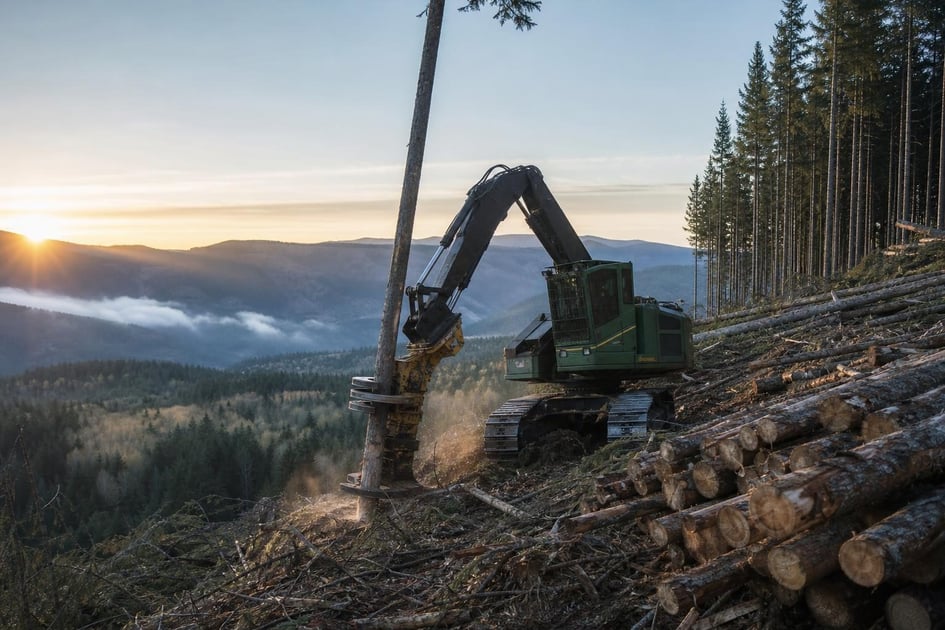
Forestry logging equipment financing terms typically range from two to seven years, with the equipment itself serving as collateral. Rates vary by credit profile, equipment age and term length, and same-day approvals are possible for qualified buyers. Whether you are buying a feller buncher, skidder, harvester, or loader, understanding how lenders structure these deals helps you borrow efficiently and keep your crew working through the season.
What Qualifies as Forestry Logging Equipment
Lenders in this space finance the full spectrum of machines used in timber harvesting, processing, and transport. Common collateral includes feller bunchers, harvesters, forwarders, skidders, delimbers, log loaders, knuckleboom loaders, chipper trucks, and whole-tree chippers. Most lenders also finance support equipment such as Skid Steers financing and Wheel Loaders financing when they are purchased for logging operations.
The key distinction is commercial use. The equipment must be used primarily for business purposes. A machine splitting time between personal land clearing and commercial logging may still qualify, but the financing terms will reflect the risk profile of the primary use. Lenders generally require a bill of sale or invoice showing the seller, buyer, and serial number.
Used equipment is financeable, often with the same structures as new. The age, hours, and condition of the machine affect the down payment requirement and term length. A five-year-old feller buncher with 8,000 hours will typically see a shorter term than a new machine fresh off the lot. Some lenders cap the age of used equipment at ten to fifteen years at the time of purchase, while others focus on the remaining useful life of the asset.
Key Insight: Many logging contractors finance support equipment on the same approval as their primary harvester. Bundling a skidder, loader, and chipper under one transaction reduces documentation overhead and can improve the overall rate by presenting a larger, more diversified collateral package to the underwriter.
Financing Terms and Structures
Most forestry equipment loans are structured as equipment finance agreements or capital leases. In both cases, the equipment is the collateral. The borrower makes fixed monthly payments over a set term, and at the end, owns the equipment outright. This structure keeps rates competitive because the lender has a tangible asset securing the deal.
Terms generally run from 24 to 84 months, depending on the cost of the machine and its expected useful life. A $400,000 harvester might qualify for a seven-year term, while a $45,000 used chipper truck may be capped at four or five years. Down payments typically range from zero to twenty percent, with stronger credit profiles and newer equipment trending toward the lower end.
Seasonal payment structures are available from some lenders and are worth asking about if your cash flow is concentrated in spring through fall. These arrangements may allow lower payments in winter months when operations slow, though the total interest cost over the life of the loan may be slightly higher. Not every lender offers this flexibility, so it should be discussed early in the application process.
New vs. Used Equipment Considerations
New forestry equipment carries the longest available terms and the lowest down payment requirements. It also comes with manufacturer warranties, predictable maintenance schedules, and the latest emissions and safety compliance. For a contractor looking to minimize downtime and maximize productivity, new equipment can justify the premium price even when financing costs are factored in.
Used equipment offers a lower entry point, which matters in an industry where margins fluctuate with timber prices and weather. A used skidder or feller buncher can be financed, but expect shorter terms and potentially larger down payments. Lenders will want to know the machine's maintenance history, hour count, and whether it has been rebuilt. A well-maintained machine with documented service records is far easier to finance than one with gaps in its history.
Depreciation plays a role in this decision as well. New equipment depreciates fastest in the first two years, which can affect your balance sheet and borrowing capacity for future purchases. Used equipment has already absorbed that initial depreciation, meaning your loan-to-value ratio may be more favorable from day one.
By the Numbers: A new wheeled feller buncher can exceed $600,000, while a five-year-old model with comparable specs often trades between $250,000 and $350,000. Financing the used machine at a four-year term with 15 percent down keeps the monthly obligation significantly lower, freeing cash for fuel, insurance, and crew wages during lean months.
Lease vs. Loan Trade-offs
Choosing between a lease and a loan depends on how long you plan to keep the equipment and how you want to handle maintenance, disposal, and taxes. A loan or finance agreement leads to ownership. A true lease, sometimes called an operating lease, gives you use of the equipment for a set term with a choice to purchase, return, or renew at the end.
Loans are the better fit for most established logging contractors who plan to run their equipment for six to ten years or more. Ownership means you can modify the machine, there are no hour-count restrictions, and you build equity in a hard asset. Leases can work for contractors who want to upgrade frequently to stay current with emissions standards or who need a machine for a specific contract with a defined endpoint.
The tax treatment differs between the two structures. With a loan, you generally depreciate the equipment and deduct the interest portion of your payments. With an operating lease, the entire lease payment may be deductible as a business expense. For tax year 2026, the specific deductions available depend on your entity structure, income, and other factors. Speak with a CPA before deciding based on tax implications alone.
| Factor | Equipment Loan / Finance Agreement | Operating Lease |
|---|---|---|
| Ownership | You own the equipment after final payment | Ownership transfers only if you exercise a purchase option |
| Term length | 2–7 years, matching equipment life | 2–5 years, often shorter |
| Down payment | 0–20%, depending on credit and collateral | Often minimal or first/last payments only |
| Hour restrictions | None | May include annual hour limits |
| Tax treatment | Depreciation and interest deduction | Lease payments may be deductible |
| Best for | Long-term ownership and heavy use | Short-term projects or frequent upgrades |
Qualification Criteria in Detail
Lenders evaluate forestry equipment applications on three axes: credit history, business revenue, and collateral quality. You do not need perfect credit, but a score in the mid-600s or higher generally unlocks the best terms. Lower scores are not disqualifying, though they may result in shorter terms, larger down payments, or a personal guarantee requirement.
Time in business matters. Most equipment lenders prefer two or more years of operating history, evidenced by tax returns or bank statements. If you have been in business for less than two years, you may still qualify with a larger down payment, strong personal credit, or prior industry experience. The SBA business guide emphasizes that detailed financial records improve your chances of approval for equipment financing.
Collateral quality is the third pillar. The lender will verify the equipment's wholesale value using industry guides or auction data. They also check whether the serial number matches the title and whether there are existing liens. For used equipment, an inspection may be required if the machine is older than a certain threshold or if the loan amount exceeds a set percentage of the stated value.
Personal guarantees are common for privately held logging contractors. This means the owner is personally liable if the business defaults. While this adds risk for the borrower, it also reduces the lender's exposure, which can translate into a lower rate or longer term. Some lenders will release the personal guarantee after a period of on-time payments, though this varies by program.
If you have a machine picked out and want to know how the numbers work, see what you qualify for and get a same-day decision on your equipment.
Tax Treatment for 2026
For tax year 2026, forestry logging equipment purchased with a loan or finance agreement is generally depreciable under the Modified Accelerated Cost Recovery System. Most logging equipment falls under the seven-year MACRS property class, though certain machines or attachments may qualify for different treatment depending on their primary use.
Section 179 allows businesses to deduct the full purchase price of qualifying equipment in the year it is placed in service, subject to annual limits and phase-out thresholds. For tax year 2026, the specific dollar limits and phase-out thresholds are set by the IRS. Because these figures are adjusted annually and may be affected by pending legislation, consult a CPA or tax advisor for the exact numbers before making a purchase decision based on tax strategy.
Bonus depreciation may also be available for tax year 2026, though the percentage and eligibility rules have been shifting in recent years. As with Section 179, the precise terms for 2026 should be confirmed with a qualified tax professional. The equipment must be used more than 50 percent for business to qualify for either provision.
Industry-Specific Use Cases and Seasonal Patterns
Logging is not a year-round business in every region, and financing terms should account for that reality. In the Pacific Northwest, the wet season limits ground access, meaning many contractors concentrate their harvest in late spring through early fall. In the Southeast, milder winters allow more continuous operation, though pulpwood prices and mill quotas still create seasonal cash flow swings.
A contractor in the Lake States running hardwood sawtimber operations may see strong revenue in winter when frozen ground supports heavy equipment movement. That same contractor may face mud-season shutdowns in March and April. Financing with seasonal payments or a longer term can smooth these gaps. The right structure depends on your specific region, product mix, and customer contracts.
Equipment needs also vary by operation type. A clearcut contractor with long-term timber supply agreements needs high-production feller bunchers and skidders. A selective-harvest operation in the Northeast may prioritize smaller, more maneuverable cut-to-length systems. A biomass or chip contractor needs reliable chippers and chip vans, while a logger supplying sawmills needs precision sorting and loading equipment. Forestry Logging equipment financing is structured to match these distinct operational profiles rather than forcing every borrower into the same template.
Data from the U.S. Census Bureau confirms that logging operations remain concentrated in rural timber-producing regions, where equipment-intensive businesses account for a significant share of local employment. This geographic concentration means lenders with national reach can still develop expertise in the sector by serving operators across multiple timber markets.
Pro Tip: Time your application for the off-season. Lenders see fewer forestry applications in December and January, which can mean faster turnaround. More importantly, having financing in place before the spring rush lets you bid on timber sales and mill contracts with confidence, knowing your equipment budget is secured.
What Documentation Is Needed
The application process requires standard business and financial documents. Expect to provide the prior two years of business tax returns, recent bank statements, a current profit and loss statement, and a copy of the equipment invoice or purchase agreement. If you are a sole proprietor or recently formed entity, personal tax returns and a personal financial statement may supplement or replace business records.
For the equipment itself, the lender needs the make, model, year, serial number, and seller information. Photos may be requested for used equipment, especially if the machine is located remotely or if the seller is a private party rather than a dealer. A title search or UCC lien search ensures the equipment is free of prior claims.
If you are buying from a private seller rather than a dealer, be prepared for additional scrutiny. Private-party sales carry more fraud risk, so lenders may require an independent appraisal or may cap the loan-to-value ratio more conservatively. Some lenders simply do not finance private-party forestry equipment, so confirm this policy before making an offer.
What Happens After Approval
Once approved, the lender issues a commitment letter or term sheet outlining the rate, term, payment amount, and any conditions. Review this carefully. The conditions may include proof of insurance naming the lender as loss payee, verification of the down payment funds, or a final equipment inspection. Do not assume the deal is done until these conditions are satisfied and funds are disbursed.
Funding typically occurs within one to three business days after all conditions are met. The lender usually pays the seller directly, though in some private-party transactions a check may be issued to you and the seller jointly. Once funded, you take possession and the payment schedule begins, usually 30 to 45 days from the funding date.
Insurance is non-negotiable. The lender will require comprehensive and collision coverage for the full replacement value of the equipment. If the machine is totaled, the insurance payout goes to the lender first, with any remainder to you. Maintaining this coverage for the life of the loan is a contractual obligation, and a lapse can trigger default.
Common Mistakes to Avoid
One of the most frequent errors is underestimating the total cost of ownership. The monthly payment is only part of the equation. Fuel, maintenance, insurance, tracks or tires, and unexpected repairs can equal or exceed the financing cost over the life of the machine. Build a realistic operating budget before deciding how much to borrow. Forbes analysis of equipment financing trends shows that contractors who match term length to equipment life outperform those who stretch payments beyond the asset's productive years.
Another mistake is financing equipment that is too old. A 15-year-old skidder at auction may look like a bargain, but if the lender caps financing at ten years of age, you are scrambling for cash or accepting punitive terms. Verify lender age restrictions before you bid.
Some borrowers also fail to account for the timing of their revenue cycle. Taking on a $4,000 monthly payment when your heaviest expenses hit in spring and your largest customer pays net-60 means you need a cash buffer. Match your payment structure to your actual cash flow, not your optimistic projection.
Finally, do not ignore the resale market. Logging equipment holds value differently depending on brand reputation, regional demand, and emissions compliance. A machine that is hard to resell in your area becomes a liability if you need to exit the loan early. Research resale trends before committing.
Ready to add a machine to your lineup? Talk to a specialist about your specific machine and learn what terms are available for your operation.
Frequently Asked Questions
What credit score is needed for forestry equipment financing?
Most lenders prefer a credit score in the mid-600s or higher for the best terms, though lower scores are not automatically disqualified. A strong business revenue history, larger down payment, or newer collateral can offset weaker credit.
Can I finance used logging equipment?
Yes. Used equipment is routinely financed, though terms are typically shorter and down payments may be higher than for new machines. Lenders focus on the equipment's remaining useful life, maintenance history, and current market value.
How long are financing terms for forestry equipment?
Terms generally range from 24 to 84 months, depending on the equipment cost, age, and the borrower's credit profile. Newer, more expensive machines usually qualify for longer terms.
Is a down payment always required?
Not always. Zero-down options exist for well-qualified buyers purchasing new equipment, but a down payment of 10 to 20 percent is common for used equipment or lower credit profiles.
Can I get same-day approval?
Same-day approvals are possible when the application is complete and the equipment and borrower profile are straightforward. Complex deals or private-party sales may take longer due to additional verification requirements.
What is the difference between a lease and a loan for logging equipment?
A loan leads to ownership and allows depreciation and interest deductions. An operating lease gives you use of the equipment with potentially deductible lease payments, but ownership only transfers if you exercise a purchase option at the end.
Are there tax benefits to financing forestry equipment in 2026?
For tax year 2026, you may be able to deduct equipment costs through Section 179, bonus depreciation, or regular MACRS depreciation. The exact benefits depend on your tax situation, so consult a CPA before making a purchase decision based on tax strategy.
What insurance is required?
Lenders require comprehensive and collision insurance naming them as loss payee. The coverage must equal the replacement value of the equipment and remain in force for the entire loan term.
Moving Forward With Your Equipment Purchase
Forestry logging equipment financing works best when the terms match your operational cycle, your cash flow, and the productive life of the machine. Whether you are upgrading a chipper, adding a second skidder, or moving from cable to mechanized harvesting, the right structure keeps your payments manageable and your equipment earning.
Start by gathering your financial documents and the equipment details. Compare new and used options. Consider whether a loan or lease fits your long-term plans. Then apply with a lender who understands the forestry industry and can move at the speed of your business. Get a same-day decision on your equipment and put your next machine to work.
Disclaimer: The information provided in this article is for general educational purposes only and is not financial, legal, or tax advice. Funding terms, qualifications, and product availability may vary and are subject to change without notice. Provide Capital does not guarantee approval, rates, or specific outcomes. For personalized information about your business funding options, contact our team directly.
