
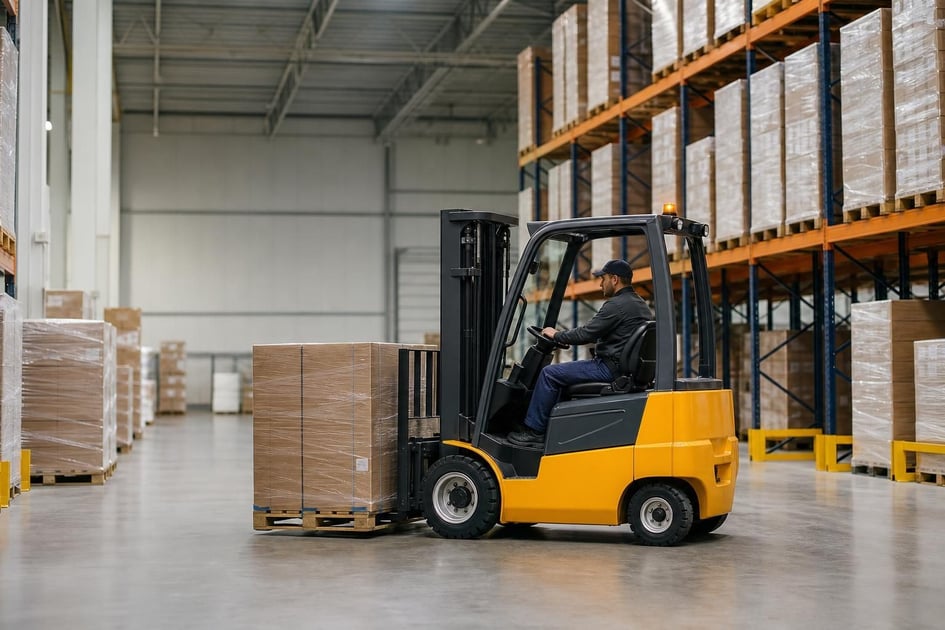
Forklift financing costs depend on four things: your credit profile, the age of the equipment, the term length, and whether you choose a loan or a lease. There is no single rate sheet that applies to every buyer. A well-qualified borrower financing a new electric warehouse forklift will see different numbers than a newer business buying a used diesel telehandler.
At Provide Capital, we finance new and used business equipment from $5,000 to $5 million, with the equipment itself serving as collateral. That collateral structure keeps rates competitive. Same-day approvals are possible. If you are weighing whether to add a lift truck now or wait, see what you qualify for on that forklift before you negotiate with the dealer.
Monthly payments vary widely. A $10,000 used sit-down forklift might carry a payment in the low $200s over a 60-month term, while a $75,000 new reach truck could run into the $1,300 to $1,600 range depending on the same variables. The total cost of ownership also includes maintenance, fuel or charging infrastructure, insurance, and any attachments. Financing spreads the purchase price over time, but the sticker price of the machine is still the largest component.
What Drives Your Forklift Financing Cost
Credit Profile and Time in Business
Lenders look at your personal and business credit, time in operation, and revenue stability. A business with two or more years under its belt, consistent deposits, and a credit profile showing clean payment history will generally access better terms. That does not mean newer businesses are shut out; it simply means the risk pricing shifts. The equipment itself is the collateral, which reduces the lender's exposure, but your financial track record still determines where you fall within the rate range.
Revenue consistency matters more than top-line size. A business doing $30,000 a month in steady deposits often presents less risk than one doing $100,000 in lumpy project payments. Lenders may average your deposits over three to six months to smooth out seasonality.
Equipment Age and Condition
New forklifts depreciate fastest in the first two years, but they also come with manufacturer warranties and lower expected maintenance. Used forklifts, especially those with higher operating hours, may command a slightly shorter maximum term or a larger down payment. A 2019 cushion-tire forklift with 4,000 hours will finance differently than a 2024 model with 200 hours. The lender's collateral value is tied to the equipment's expected remaining life, so age matters.
Term Length and Down Payment
Stretching a $35,000 forklift over 72 months lowers the monthly payment but raises the total interest paid. A 36-month term does the opposite. Some borrowers put 10% to 20% down to reduce the financed amount; others finance the full cost to preserve cash. There is no universal right answer, but the term and down payment interact directly with your rate to produce the final number.
Key Insight: Lenders often cap term length at the equipment's remaining useful life. A 10-year-old forklift with 8,000 hours may max out at 36 months, while a new unit can go to 60 or 72 months. That constraint can push your monthly payment higher on used equipment even if the purchase price is lower.
Get a fast decision on your equipment
Applying takes just a few minutes, and decisions can come as soon as the same day.
Start Your ApplicationNew vs. Used Forklift Financing
New forklifts offer predictable costs, full warranties, and the latest efficiency standards. Used forklifts offer lower acquisition costs and faster availability. From a financing perspective, the decision affects your rate, term, and down payment.
| Feature | New Forklift | Used Forklift |
|---|---|---|
| Typical purchase price | $25,000 – $75,000+ | $8,000 – $35,000 |
| Common finance term | 48 – 72 months | 36 – 60 months |
| Down payment expectation | 0% – 10% | 10% – 20% |
| Collateral confidence | Highest (full warranty, known history) | Varies (inspection dependent) |
| Best for | High-use operations, long-term holds | Short-term needs, budget constraints |
The table shows the trade-off. A used forklift saves money upfront but may require a larger down payment and a shorter term. A new forklift costs more to finance but often qualifies for longer amortization. If your operation runs multiple shifts, the uptime reliability of a new unit can offset the higher payment. If you need a backup lift for seasonal peaks, used may be the smarter spend.
Warranties also affect financing. A new forklift with a 24-month full warranty gives the lender confidence that major repair bills will not interrupt your cash flow. Some lenders will even require a service contract on used equipment as a condition of approval.
Small businesses exploring capital options can review SBA loan programs for additional context, though equipment financing through a direct lender often moves faster and uses the equipment itself as collateral.
Pro Tip: Always request the hour meter reading and maintenance log before applying to finance a used forklift. Lenders may ask for an independent appraisal on units older than seven years or with more than 6,000 hours. Having that documentation ready can cut days off your approval timeline.
Loan vs. Lease: How the Structure Changes Your Cost
Equipment Financing Agreement
An equipment loan, sometimes called an equipment financing agreement, lets you own the forklift outright once the final payment clears. You claim depreciation and any available Section 179 deduction. The equipment serves as collateral, so you do not typically need additional real estate or cash security. Monthly payments are fixed, and at the end of the term you own an unencumbered asset.
Fair Market Value Lease
A fair market value lease functions more like a rental with a purchase option. Monthly payments are usually lower than a loan because you are only paying for the equipment's use during the lease term. At the end, you can return the forklift, buy it at fair market value, or extend the lease. This works well if you expect technology to change or if you only need the equipment for a defined contract period.
$1 Buyout Lease
A $1 buyout lease is technically a lease but functions like a loan. You make higher monthly payments than an FMV lease, but at the end you own the equipment for one dollar. For accounting purposes, this is often treated as a capital lease. The total cost is usually comparable to a loan, but the structure may offer different tax treatment depending on your business's situation.
Which structure costs less overall depends on your tax bracket, how long you keep the forklift, and whether residual value matters to your balance sheet. A loan builds equity. An FMV lease preserves flexibility.
Tax Treatment for the 2026 Tax Year
For the 2026 tax year, businesses may be able to deduct the full or partial cost of qualifying equipment in the year it is placed in service. Section 179 allows an immediate deduction up to an inflation-adjusted annual limit, with a phase-out that begins once total equipment purchases exceed a separate threshold. The exact dollar figures for 2026 adjust yearly; consult your CPA for the current limits.
Bonus depreciation may also apply to forklifts placed in service during 2026, though the percentage has been scheduled to step down from prior years. Your accountant can confirm whether your purchase qualifies and at what rate.
If you finance the forklift, you still own it for tax purposes under a loan or $1 buyout lease, which means depreciation and Section 179 are generally available. Under a fair market value lease, the lessor typically claims depreciation, and you deduct the lease payments as an operating expense. The best structure depends on your taxable income, other capital expenditures, and AMT exposure. A CPA familiar with your books should review the decision.
Financing preserves liquidity. Instead of writing a $50,000 check, you might put zero down and spread the cost over five years. That leaves cash in the business for payroll, inventory, or unexpected repairs. The tax benefits of ownership or leasing are added advantages, but the cash flow preservation is often the primary reason owners choose to finance.
By the Numbers: A $40,000 forklift financed over 60 months might carry a monthly payment ranging from roughly $750 to $1,050 depending on credit and equipment age. Shortening the term to 36 months could push that range toward $1,150 to $1,500, while a 72-month term might drop it to $600 to $850. These are illustrative ranges; your actual payment depends on the rate you qualify for.
See what you qualify for
The equipment itself secures the financing, which keeps rates competitive. Checking your options takes minutes.
Check Your OptionsWhat Documentation You'll Need
Application Paperwork
You will need a completed application, proof of business ownership or authority to sign, and identification. If the business is incorporated, that includes articles of incorporation or an operating agreement. If you are a sole proprietor, a business license or fictitious name filing usually suffices.
Financials and Bank Statements
Most lenders want the last three to six months of business bank statements. Some will request two years of tax returns, especially for larger requests or longer terms. A vendor quote or invoice for the specific forklift helps the lender verify collateral value. If you are buying used, be prepared to provide photos, serial numbers, and any inspection report.
If you are buying from a private seller rather than a dealer, the lender may need additional verification. A bill of sale, proof of the seller's ownership, and a lien search may be required. Private-party transactions take longer, so build in extra time if you are not buying from a dealership.
Having these items ready before you apply can speed the process. Provide Capital can often review a package and return a decision the same day if the documentation is complete.
Common Mistakes That Raise Your Total Cost
Buying more capacity than you need is the easiest way to overpay. A 15,000-pound capacity diesel forklift costs substantially more to finance, fuel, and maintain than a 5,000-pound electric model. Match the machine to your loads, aisle width, and duty cycle.
Another mistake is ignoring the total cost of charging or fueling. Electric forklifts have lower energy costs but may require battery replacement around year five. Internal combustion units run on propane, diesel, or gasoline, and those fuel costs add up over a 60-month term.
Choosing the wrong term also hurts. A 36-month term on a $20,000 forklift keeps total interest low but can strain weekly cash flow. A 72-month term eases the monthly burden but may leave you owing money on a machine that needs major repairs. Aim for a term that matches the equipment's useful life in your operation.
Finally, failing to compare the out-the-door price before financing can hide markups. Negotiate the equipment price first, then structure the finance. Rolling soft costs into the deal without scrutiny inflates the financed amount and the total interest. Another costly error is financing through the dealer without shopping the terms. Dealer financing is convenient, but it is not always the best structure. An independent equipment lender may offer longer terms, lower payments, or more flexibility on used equipment.
Industry-Specific Forklift Use Cases
Warehousing and logistics operations typically run three-shift fleets and need reliable uptime. Financing a new electric pallet jack or order picker makes sense when downtime costs exceed the monthly payment. Forklifts financing through Provide Capital covers these units from $5,000 up.
Construction sites demand rough-terrain forklifts and telehandlers. These machines face harsher conditions and shorter replacement cycles. Cold weather, mud, and uneven ground wear out tires and hydraulics faster than smooth warehouse floors. That means a construction forklift may need replacement sooner, making the term length a critical decision. A used telehandler with a solid maintenance record can be a smart finance if the project duration is under 24 months. For longer-term fleet additions, new may be safer. Many of our construction clients also look at Construction equipment financing for excavators and loaders alongside their lifts.
Manufacturing facilities use forklifts to move raw materials and finished goods. A $1 buyout lease or loan works well here because the equipment stays in service for years. The tax deductions from ownership often align with manufacturers' capital expenditure strategies. Just-in-time delivery models mean a down forklift can stall an entire production line. Financing a reliable unit with a maintenance contract built into the payment is often cheaper than paying overtime to clear a backlog caused by a breakdown. Demand for material handling equipment has grown alongside the WSJ coverage of U.S. manufacturing expansion, which increases the need for reliable lifts.
Food service and restaurant distributors need compact electric forklifts that operate quietly and without emissions indoors. Used units are popular in this sector because the purchase price stays low and the operating environment is relatively clean. Just verify that the battery and charger are included in the finance, since a missing Forklift Battery Charger financing add-on can strand a new owner with an unexpected $2,000 to $4,000 outlay.
Transportation and trucking yards use heavy-duty lifts to load and unload freight. These units see high hours and benefit from robust service contracts. According to U.S. Census Bureau industry data, manufacturing and wholesale trade remain heavy users of forklifts. Financing the lift alongside a Dump Trucks financing package can sometimes streamline paperwork for fleets adding multiple asset types at once.
If you are ready to move forward, get a decision on your equipment, possibly the same day. Provide Capital serves businesses nationwide across construction, healthcare, dental, restaurant and food service, manufacturing, transportation, agriculture, HVAC, and forestry.
Ready to move forward?
More than 10,000 businesses have financed equipment with Provide Capital. See what you qualify for today.
Get StartedFrequently Asked Questions
What credit score do I need to finance a forklift?
There is no fixed minimum. Lenders look at the full picture: credit history, revenue, time in business, and the equipment's value. Stronger profiles receive better terms, but businesses across the credit spectrum can often qualify because the equipment serves as collateral.
Can I finance a used forklift?
Yes. Provide Capital finances both new and used equipment. Used forklifts are common in financing. The age, hours, and condition will influence the term and down payment.
How long can I finance a forklift?
Terms typically range from 24 to 72 months. New equipment usually qualifies for longer terms. Used equipment may be capped based on remaining useful life.
Is it better to lease or loan a forklift?
It depends on your holding period and tax strategy. A loan builds equity and may offer Section 179 benefits. A fair market value lease offers lower payments and flexibility at the end. A $1 buyout lease splits the difference.
What is the minimum amount I can finance?
Provide Capital finances equipment starting at $5,000. That covers smaller pallet jacks and used lifts. There is no maximum below $5 million.
Can I finance attachments and batteries with the forklift?
Yes. Many borrowers roll forks, side shifters, carton clamps, batteries, and chargers into the same finance agreement. Just make sure the vendor quote itemizes everything so the lender can verify collateral value.
Does the lender need to see the equipment before approval?
Not always. For new equipment ordered from a dealer, the invoice and spec sheet usually suffice. For used equipment, photos and an inspection report may be required, especially for private-party sales.
What happens after I am approved?
Once approved, you or the lender pays the vendor. You take delivery and begin making payments according to the schedule. If same-day approval was granted and documentation was complete, funding can sometimes follow within 24 to 48 hours.
Next Steps
Start by getting a firm quote on the forklift you want, including any attachments, delivery, and installation. Then gather your last three months of bank statements and a current vendor invoice. With those two items, you can start an application in a few minutes. Provide Capital serves businesses nationwide across construction, healthcare, dental, restaurant and food service, manufacturing, transportation, agriculture, HVAC, and forestry. Whether you need a single electric pallet jack or a fleet of telehandlers, we can review your deal and, in many cases, deliver an answer the same day.
Disclaimer: The information provided in this article is for general educational purposes only and is not financial, legal, or tax advice. Funding terms, qualifications, and product availability may vary and are subject to change without notice. Provide Capital does not guarantee approval, rates, or specific outcomes. For personalized information about your business funding options, contact our team directly.
