
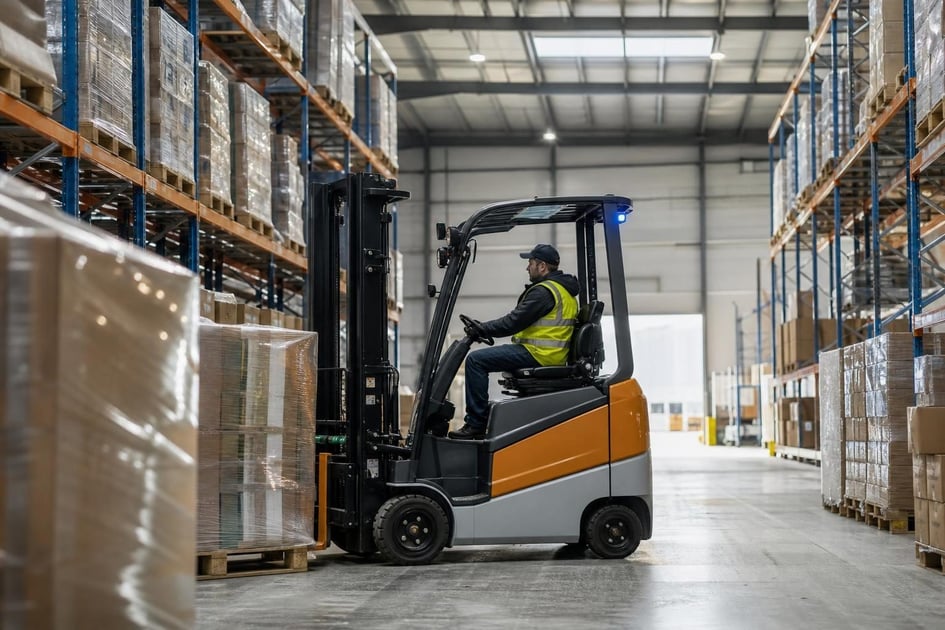
Forklift financing rates vary by credit profile, equipment age and term. For most owner-operators buying or leasing a forklift, monthly payments depend heavily on time in business, personal credit score, whether the machine is new or used, and the length of the repayment schedule. At Provide Capital, we finance new and used business equipment from $5,000 to $5 million, with the equipment itself serving as collateral to keep rates competitive.
If you are shopping for your first sit-down or standing forklift, or adding a telehandler to a growing fleet, understanding how lenders price these transactions helps you budget accurately and avoid surprises at closing. This guide breaks down the factors that shape your offer, compares leasing and loan structures, and walks through what documentation you will need to move from quote to approval.
What Drives Your Forklift Financing Rate
Lenders do not use a single sticker rate for every forklift. They build an offer from several risk and cost variables. Knowing them in advance lets you present your business in the best light and choose terms that match your cash flow.
Credit Profile and Time in Business
Your personal credit score and business credit history are the starting point. A longer track record with consistent revenue lowers the lender's risk. Startups face tighter underwriting, but established contractors, warehouses, and manufacturers with two or more years of operation and documented income generally see more competitive structures. If your credit has blemishes, expect a shorter term or a larger down payment rather than an automatic decline.
Equipment Age and Condition
New forklifts carry lower rates than used ones because the collateral holds value longer. A brand-new electric forklift with a full manufacturer warranty is easier to resell than a ten-year-old propane unit with 8,000 hours. That said, used equipment financing is common and practical, especially for operations that run machines hard and replace them on a shorter cycle. The key is matching the loan term to the remaining useful life of the asset.
Loan Term and Down Payment
Stretching a forklift loan over 60 months lowers the monthly payment but increases total interest paid. A 24- or 36-month term costs less overall and often carries a lower rate because the lender's exposure ends sooner. A down payment of 10% to 20% improves your loan-to-value ratio and can move you into a better pricing tier. Zero-down options exist for strong credits, but they compress the lender's margin and can raise the rate slightly.
Key Insight: Lenders often reserve their most aggressive pricing for transactions where the equipment is less than five years old and the financed amount is between $50,000 and $150,000. Smaller deals carry proportionally higher origination costs, while deals above $1 million trigger additional underwriting layers that can add basis points to the rate.
New vs. Used Forklift Financing
Deciding between a new forklift and a reliable used model affects both your monthly payment and your total cost of ownership. New units offer the latest safety features, longer warranties, and lower maintenance costs in the first few years. Used units free up cash flow and depreciate more slowly.
| Factor | New Forklift | Used Forklift (3–7 Years) |
|---|---|---|
| Typical financing term | 36–60 months | 24–48 months |
| Down payment expectation | 0–10% | 10–20% |
| Collateral value stability | High | Moderate |
| Maintenance reserve needed | Lower | Higher |
| Warranty coverage | Full manufacturer | Limited or expired |
When you finance a used forklift, the lender will likely require an inspection or appraisal. They want confirmation that the serial number matches the title, that there are no undisclosed liens, and that the hour meter reading is accurate. Providing a clean maintenance log from the prior owner speeds up this step.
Lease vs. Loan: Which Structure Fits Your Operation
Not every forklift acquisition should be a loan. Depending on your tax strategy, usage pattern, and balance sheet goals, a lease might leave you in a stronger position after 36 months.
Equipment Finance Agreement
An Equipment Finance Agreement (EFA) is essentially a loan structured for business equipment. You make fixed monthly payments, and when the final payment clears, you own the forklift outright. The equipment serves as collateral, which keeps the rate competitive. An EFA appears as debt on your balance sheet, but it also builds equity in the asset. For owner-operators who plan to run a forklift for seven to ten years, an EFA is usually the most straightforward choice.
Fair Market Value Lease
A Fair Market Value (FMV) lease functions like a rental with a purchase option. You pay lower monthly amounts than you would under an EFA, and at the end of the term you can buy the forklift for its then-current market value, return it, or extend the lease. This structure works well if you upgrade equipment frequently or if you are unsure whether electric or propane models fit your operation long term. The trade-off is that you do not build equity during the lease term.
$1 Buyout Lease
A $1 buyout lease splits the difference. Your monthly payments are higher than an FMV lease but lower than a standard loan, and at the end you purchase the forklift for one dollar. For tax purposes, the IRS often treats a $1 buyout lease as an installment sale, meaning you may be able to claim depreciation. Always confirm the structure with your CPA before signing.
Pro Tip: If you are adding a forklift to a fleet that already includes scissor lifts or telehandlers, ask your financing specialist about bundling the assets into a single master lease or loan agreement. Bundling reduces documentation and can improve pricing by raising the total financed amount into a more competitive tier.
What the Application and Approval Process Actually Looks Like
Same-day approvals are possible when the file is complete, but that speed depends on you having the right paperwork ready before you apply. According to SBA loan programs, equipment financing is one of the most common uses of small-business borrowing, and having clean documentation is the fastest path to a decision.
Documentation You Will Need
For a forklift financing request under $150,000, most lenders ask for a one-page application, your last three months of business bank statements, and an invoice or equipment quote from the seller. Requests above $250,000 usually trigger a deeper review: two years of business tax returns, a current year-to-date financial statement, and sometimes an equipment appraisal. If the forklift is private-party used, the lender will also want proof of a clear title.
Timeline from Quote to Funding
A clean file on a new forklift from a dealer can move from application to funding in 24 to 48 hours. Used equipment and private-party sales take longer, usually three to five business days, because of the extra title and inspection work. If your business is structured as a partnership or has multiple owners, add a day for signature collection.
If you have your equipment quote and bank statements in hand, see what you qualify for today. A specialist can review your file and tell you whether same-day approval is realistic for your specific transaction.
Tax Treatment and Section 179 for 2026
For the 2026 tax year, Section 179 of the Internal Revenue Code allows businesses to deduct the full purchase price of qualifying equipment, including forklifts, up to an annual limit that adjusts yearly. There is also a phase-out threshold that reduces the benefit once total equipment purchases for the year exceed a certain amount. Because these limits change annually, you should consult your CPA for the exact 2026 figures before making a purchase decision.
Bonus depreciation may also be available, but the percentage and rules have shifted in recent years. What matters for financing is whether you structure the deal as a loan or a true tax lease, because that determines who claims the depreciation. In most Equipment Finance Agreements, you as the borrower take the depreciation. In a Fair Market Value lease, the lessor typically claims it. Again, confirm the details with your tax advisor.
By the Numbers: A contractor in the 24% federal tax bracket who finances a $75,000 forklift and claims a Section 179 deduction for the 2026 tax year could reduce their tax liability by a meaningful four-figure amount in the first year. Spread across a 48-month term, that tax saving often offsets the first six to nine months of payments. Your CPA can model the exact impact for your bracket and state.
Industry-Specific Forklift Use Cases
Forklifts are not one-size-fits-all. The model you need, and therefore the amount you finance, depends heavily on your industry and application. Census Bureau business data consistently ranks construction, warehousing, and manufacturing among the top capital-investing sectors in the United States.
Construction and Contractors
Rough-terrain forklifts and telehandlers dominate job sites. These machines see dirt, weather, and heavy loads, so lenders pay close attention to hour meters and maintenance records. Contractors often finance used machines to match the length of a major project, then trade or sell when the work wraps. Construction equipment financing from Provide Capital covers these units nationwide, with terms structured around seasonal cash flow.
Warehousing and Logistics
Electric sit-down and stand-up forklifts are standard in warehousing. Because these facilities run multiple shifts, lenders view the equipment as revenue-generating collateral. If you are expanding a distribution footprint, bundling a forklift with pallet jacks and racking into one facility improvement loan can simplify your books.
Manufacturing
Manufacturers use forklifts to move raw materials to the line and finished goods to shipping. Lenders like manufacturing equipment deals because the collateral sits indoors on a predictable schedule. If your shop runs lean, a shorter-term lease on a late-model forklift preserves capital for raw material purchases.
Food Service and Agriculture
Restaurants with catering operations and food distributors need refrigerated or outdoor-rated forklifts. Agriculture buyers look at diesel or propane units for barn and field use. In both cases, the equipment is essential to daily revenue, which strengthens the financing application.
Pro Tip: If you are financing a forklift for a seasonal business such as agriculture or landscaping, ask about skip-payment structures. These allow you to miss one or two payments during your off-season, then resume on schedule. Not every lender offers them, but they can prevent cash-flow stress when revenue dips.
Common Mistakes When Financing Forklifts
Avoid these errors that delay approvals or inflate your total cost.
- Overextending the term. Financing a used forklift over 60 months often means making payments on a machine you have already retired. Match the term to the useful life.
- Ignoring total cost of ownership. A lower monthly payment on an older propane forklift can disappear into fuel and maintenance costs within the first year.
- Skipping the title search. On private-party used sales, an unreleased lien can block funding for days or kill the deal entirely.
- Mixing personal and business credit unnecessarily. If your business has its own credit profile, use it. Relying solely on a personal guarantee when you do not have to can crowd your personal debt-to-income ratio.
Worked Cost Examples
These examples illustrate how term, down payment, and equipment age interact. Rates vary by credit profile, equipment age and term, so treat these as directional only. Many business owners also track equipment price trends in AP News business coverage when planning their capital budgets.
Example 1: New Electric Warehouse Forklift
A distribution company finances a $45,000 new electric forklift with a 10% down payment. The lender structures a 48-month Equipment Finance Agreement. With strong credit, the monthly payment falls in a competitive range, and the company retains roughly $4,500 in cash for facility upgrades. Over the full term, total interest paid stays in the low four figures.
Example 2: Used Rough-Terrain Forklift
A landscaping contractor buys a $28,000 used rough-terrain forklift with 3,200 hours. Because the unit is six years old, the lender caps the term at 36 months and asks for 15% down. The shorter term keeps the total interest cost contained, and the contractor owns the machine free and clear before its anticipated replacement cycle.
Example 3: Telehandler for Construction Crew
A general contractor adds an $85,000 telehandler to a growing fleet. The deal is structured as a 60-month loan with zero down, thanks to two years of strong revenue and an existing equipment-financing relationship. The monthly payment is manageable against a six-figure monthly job volume, and the telehandler serves as collateral alongside other Dump Trucks financing already on the books.
Frequently Asked Questions
What credit score do I need to finance a forklift?
There is no hard cutoff. Applicants with scores in the mid-600s and above usually see the widest range of options, while those in the low-600s or below may need a larger down payment or a shorter term. Lenders also look at time in business, revenue consistency, and the quality of the collateral.
Can I finance a forklift from a private seller?
Yes, but the lender will require a clear title, a bill of sale, and usually an inspection. Private-party deals take slightly longer than dealer transactions because the lender must verify there are no undisclosed liens.
Is it better to lease or buy a forklift?
It depends on your tax strategy, usage pattern, and how long you plan to keep the machine. If you run high hours and replace equipment every three to four years, a Fair Market Value lease may cost less overall. If you intend to keep the forklift for seven to ten years, a loan or Equipment Finance Agreement builds equity and usually makes more sense.
How fast can I get approved?
Same-day approvals are possible for clean files with complete documentation. Most straightforward deals fund within 24 to 48 hours. Complex transactions or private-party sales can take three to five business days.
What industries do you serve?
Provide Capital finances forklifts and related equipment for construction, healthcare, dental, restaurant and food service, manufacturing, transportation, agriculture, HVAC, and forestry nationwide. We also handle related assets such as Forklift Battery Charger financing and Scissor Lifts financing.
Can I finance multiple forklifts at once?
Yes. Fleet deals often receive better pricing than single-unit transactions because the total financed amount moves into a more competitive tier. Bundling also reduces duplicate paperwork.
Does the equipment type affect my rate?
Yes. New electric forklifts from major brands generally qualify for the best terms. Older propane units, niche brands with limited resale markets, or highly specialized attachments can trigger more conservative structures.
Should I talk to my CPA before I sign?
Absolutely. For the 2026 tax year, the interaction between Section 179, bonus depreciation, and your chosen financing structure can significantly affect your first-year tax position. A CPA can tell you whether to optimize for a deduction now or spread it over the term.
Ready to Finance Your Next Forklift?
Forklift financing rates are not mysterious. They reflect your credit history, the age and quality of the machine, and the structure you choose. The best way to get an accurate picture of your monthly payment is to submit a complete file with your equipment quote and recent bank statements.
At Provide Capital, we specialize in Forklifts financing for owner-operators and growing businesses across every major industry. Whether you are buying a single electric pallet jack or financing a fleet of telehandlers, we can structure terms around your cash flow. Get a same-day decision on your equipment and move your operation forward without tying up the working capital you need for payroll and materials.
Disclaimer: The information provided in this article is for general educational purposes only and is not financial, legal, or tax advice. Funding terms, qualifications, and product availability may vary and are subject to change without notice. Provide Capital does not guarantee approval, rates, or specific outcomes. For personalized information about your business funding options, contact our team directly.
