Why Financing a Used Forklift Beats Paying Cash
Used forklift financing lets you put a reliable machine to work without draining the operating account you need for payroll and materials. Most owner-operators and fleet managers already know that a forklift loses value the moment it rolls off the dealer lot. Financing a used unit simply aligns your payment schedule with the productive life of the asset, keeping cash on hand for the expenses that keep your doors open.
The equipment itself serves as the collateral. That means the lender secures the loan against the forklift, not your home or a separate line of credit. Because the asset backs the deal, rates vary by credit profile, equipment age and term, and approval decisions can move quickly when the paperwork is clean. Same-day approvals are possible for well-qualified buyers with clear documentation.
Financing amounts for used forklifts typically start around $5,000 and can scale well into six figures for multiple units or fleet refreshes. We finance new and used business equipment from $5,000 to $5 million nationwide, so a single used forklift or a full fleet replacement both fit within the program.
Key Insight: Lenders care more about the hour meter than the model year. A 2019 forklift with 2,000 hours and documented maintenance often finances more easily than a 2022 unit with 8,000 hours and no service records. Keep your maintenance logs organized; they are worth more at underwriting than you might expect.
Get a fast decision on your equipment
Applying takes just a few minutes, and decisions can come as soon as the same day.
Start Your ApplicationWhat "Used" Actually Means in Forklift Financing
Not every used forklift is the same risk profile to a lender. The term covers a wide band of age, condition, and prior use. Understanding where your target machine sits in that band helps you set realistic expectations for down payment, term length, and monthly payment.
Age and Hour Thresholds
Lenders typically divide used forklifts into three categories. Units under three years old with fewer than 3,000 hours are often treated almost like new, with competitive terms and minimal down payment requirements. Machines between three and seven years old with 3,000 to 7,000 hours represent the sweet spot for most buyers; they have already taken the steepest depreciation hit but usually retain years of productive service. Forklifts older than seven years or with more than 7,000 hours can still qualify, though the term may shorten and the down payment requirement may rise to offset the lender's risk.
High-hour machines are not automatically disqualified. A 10,000-hour forklift with a recent dealer rebuild and new tires can be a better collateral risk than a 6,000-hour unit showing signs of neglected hydraulics. The inspection report matters as much as the odometer.
Where the Unit Comes From
Dealer certified pre-owned programs usually come with warranties and inspection checklists that make underwriting smoother. Fleet lease returns are another solid source; these units were maintained on strict schedules by large warehouses or distribution centers. Auction purchases can work, but most lenders want an independent appraisal or dealer inspection before funding. Private-party sales require extra diligence on title and lien status.
How Used Forklift Financing Works
The process is straightforward. You identify the forklift, submit an application with basic business and equipment details, and the lender evaluates both your creditworthiness and the asset value. Because the equipment is the collateral, the deal structure depends heavily on the machine's age, brand, condition, and resale market.
Approval Timelines
For deals under $150,000 on standard equipment, many applications receive a decision the same business day. Larger requests, older equipment, or applications requiring additional documentation may take 24 to 72 hours. Having your business bank statements, the equipment invoice or listing, and any maintenance records ready before you apply removes the usual bottlenecks.
By the Numbers: A typical used forklift financed through an equipment lender carries a term between 24 and 60 months. Shorter terms are common for high-hour or older units, while newer used machines often qualify for the longer end of that range. The monthly payment scales with the term, but stretching a high-hour unit across 60 months can leave you paying for a machine that is already out of service.
Rates and Down Payments
Rates vary by credit profile, equipment age and term. Well-qualified borrowers financing late-model used equipment can see minimal down payment requirements, sometimes as low as zero to ten percent. Borrowers with challenged credit or those seeking older machines should expect to put 15 to 20 percent down to align the loan balance with the realistic resale value. No lender can promise a specific rate before reviewing the full file.
Loan vs. Lease: Choosing the Right Structure
The decision between a loan and a lease comes down to how long you plan to keep the forklift and how you want to treat it on your books. Loans build equity. Leases preserve maximum monthly cash flow and simplify disposal at the end.
| Factor | Equipment Loan | Equipment Lease |
|---|---|---|
| Ownership | You own the forklift after the final payment. | You return it or purchase at fair market value at lease end. |
| Upfront Cost | Often 0% to 20% down, depending on credit and equipment age. | Usually first and last payment upfront. |
| Typical Term | 24 to 60 months. | 24 to 48 months. |
| Tax Treatment (2026) | Depreciation and potential Section 179 deduction; consult your CPA. | Payments may be fully deductible as an operating expense; consult your CPA. |
| Best Fit For | Core fleet equipment you expect to run for seven or more years. | Seasonal spikes, temporary warehouses, or testing a new workflow. |
If you plan to run the forklift until the wheels fall off, a loan usually wins. If you need three extra units for a 36-month distribution contract and want to hand them back when the contract ends, a lease is the cleaner fit.
Pro Tip: Match your financing term to the remaining useful life of the forklift, not just the monthly payment. Financing a 10,000-hour unit over 60 months means you could be making payments on a machine that is no longer productive in year four. A 36-month term on high-hour equipment often makes better operational sense.
Tax Treatment for the 2026 Tax Year
The tax code offers several incentives for businesses that acquire equipment, and used forklifts qualify for many of them. For the 2026 tax year, Section 179 allows businesses to deduct the cost of qualifying equipment purchased and placed in service during the year, subject to annual limits and phase-out thresholds. The exact dollar limits for 2026 change with inflation adjustments, so you should consult your CPA for the current-year ceiling and whether your taxable income supports the full deduction.
Bonus depreciation may also apply to used equipment in 2026, though the percentage has been stepping down from prior peaks. Again, the specific rate depends on legislative updates and IRS guidance for the 2026 tax year. Your accountant can model whether Section 179, bonus depreciation, or standard MACRS depreciation delivers the best outcome for your specific situation.
One constant remains: the interest portion of your equipment loan payments is generally deductible as a business expense. Lease payments are typically deductible in full as an operating expense. Never guess at a five-figure tax decision. Speak with a CPA who knows your books before you file.
Who Qualifies for Used Forklift Financing
We work with established businesses across construction, healthcare, dental, restaurant and food service, manufacturing, transportation, agriculture, HVAC and forestry. Startups and new businesses are outside our program scope. Most approvals require at least two years in operation, though exceptions exist for strong-credit borrowers with substantial industry experience.
Credit score matters, but it is not the only factor. Stable revenue, a clean business bank account without repeated overdrafts, and a reasonable debt-service coverage ratio all carry weight. The equipment value itself provides a backstop. Even borrowers with credit challenges can often secure approval on used equipment by increasing the down payment or selecting a newer unit with stronger resale value. According to the U.S. Small Business Administration guidance on equipment loans, equipment financing remains one of the most common funding tools for small businesses acquiring productive assets.
Documentation to Gather Before You Apply
Speed up your approval by assembling the following before you start the application:
- The equipment invoice, listing, or purchase agreement showing the serial number, year, make, model, and hour reading.
- Maintenance records or a dealer inspection report for units older than five years or with more than 5,000 hours.
- Three months of business bank statements.
- Your most recent business tax return.
- A brief description of how the forklift will be used and what revenue it supports.
For requests over $100,000 or for equipment older than ten years, a current appraisal from a qualified equipment dealer may be required. Having these materials ready is the difference between a same-day decision and a week of back-and-forth.
See what you qualify for
The equipment itself secures the financing, which keeps rates competitive. Checking your options takes minutes.
Check Your OptionsIndustries That Rely Heavily on Used Forklift Financing
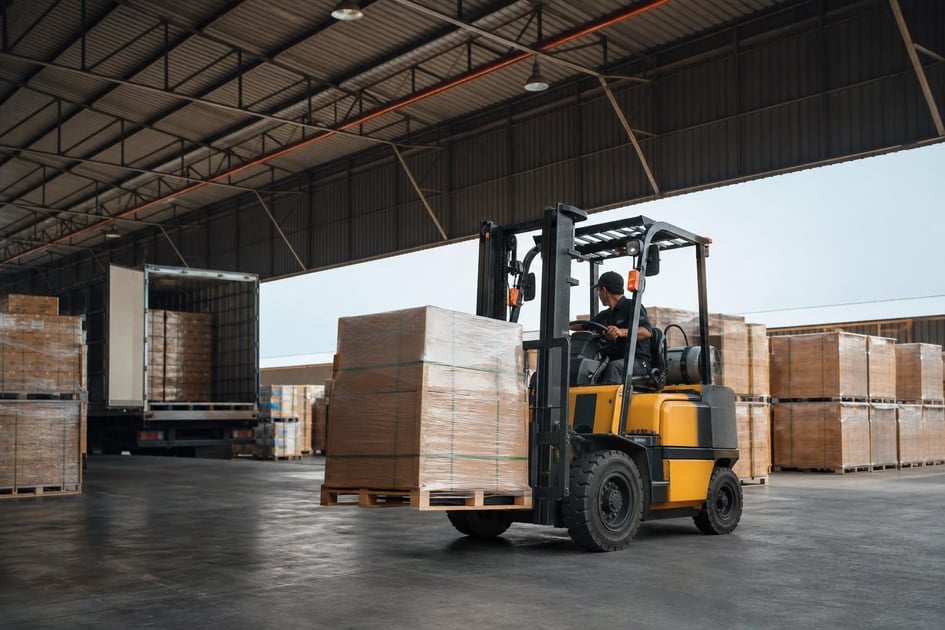
Construction firms use forklifts to move materials across uneven job sites, often preferring pneumatic-tire units that can handle dirt and gravel. Manufacturing plants run cushion-tire forklifts indoors around the clock, making used fleet purchases a constant need as they replace worn units. Food service distributors and cold-storage warehouses need reliable lift capacity but face tight margins that make used equipment attractive. U.S. Census Bureau data on business and economy consistently shows construction and manufacturing as two of the most equipment-intensive sectors in the country.
If you are looking at Construction equipment financing, a used rough-terrain forklift or telehandler often fits the budget better than a new unit that will take a beating on site. Forklifts financing covers both warehouse machines and outdoor units, so match the tire type and mast to your actual working conditions.
A Worked Example: Preserving Cash on a $30,000 Used Forklift
Imagine you are buying a four-year-old, 4,000-hour cushion-tire forklift for $30,000. You could write a check and own it outright. That leaves you with a depreciating asset and $30,000 less in working capital.
Instead, you finance the unit over 48 months. You keep roughly $25,000 to $30,000 in cash reserves. That capital covers operator wages, fuel or battery maintenance, insurance, and unexpected repairs during the first year. If the forklift generates $8,000 per month in measurable labor savings or revenue support, the cash flow advantage of financing pays for itself quickly. Rates vary by credit profile, equipment age and term, so the exact monthly outlay depends on your specific deal, but the structural benefit of preserving liquidity is constant.
This same logic scales. Financing three used forklifts at $25,000 each preserves $60,000 or more in operating cash versus buying outright. That is enough to cover payroll during a slow month or fund a materials order that lets you take on the next job. Many owners today are prioritizing capital efficiency, and Wall Street Journal coverage of business capital trends notes that used equipment acquisitions continue to rise as firms preserve liquidity for operations.
Ready to run the numbers on your next unit? Get a same-day decision on your equipment and keep your cash working where it matters most.
Common Mistakes Buyers Make
Buying on price alone is the most expensive error. A $12,000 forklift that needs $8,000 in immediate hydraulics, tires, and battery work is not a deal. Always budget 10 to 15 percent of the purchase price for immediate maintenance on any used unit over 5,000 hours.
Another mistake is mismatching the mast to the job. A standard two-stage mast works fine for loading docks, but if you need to stack to 20 feet in a warehouse, verify the lift height and free-lift specifications before you sign. Swapping a mast after purchase is costly.
Buyers also forget to account for attachments. If you need a carton clamp, sideshift, or multiple forks, confirm that the attachment mounting class matches the forklift carriage. Ordering the wrong class means downtime and additional adapter costs.
Finally, do not ignore the power source. Electric forklifts save on fuel but require battery chargers and adequate electrical infrastructure. If you are adding electric units for the first time, factor in the charger cost and installation. We also offer Forklift Battery Charger financing if you need to spread that expense across the same term as the lift itself.
Pro Tip: Always verify that the seller has clear title before you apply for financing. A private-party unit with an outstanding lien or a missing serial number plate can delay funding by weeks. Ask for the title or a dealer payoff letter upfront, and compare the serial number on the frame to the paperwork before the inspection.
What Happens After Approval
Once approved, you receive a term sheet outlining the monthly payment, term length, any down payment required, and the UCC filing details. Review it carefully. The lender places a UCC-1 filing against the equipment to perfect their security interest. This is standard and does not affect your ability to use the forklift.
After you sign and submit any required down payment, the lender pays the seller directly or funds your account if the machine is already paid for. Most fundings complete within 24 to 48 hours of signed documents. Your first payment is typically due 30 to 45 days after funding, giving you time to put the unit to work before the note begins.
Throughout the term, keep the forklift insured with the lender listed as loss payee. Maintain it according to the manufacturer schedule. If you sell or trade the unit before the loan matures, the balance must be paid in full to release the lien.
Put the right equipment to work
From $5,000 to $5 million, new or used, Provide Capital helps businesses nationwide finance the equipment they need.
Apply TodayFrequently Asked Questions
Can I finance a used forklift from a private seller?
Yes, though the process requires extra steps. The lender needs to verify clear title, confirm the serial number, and may require an independent inspection. The seller must cooperate with the UCC filing and payment process. Private-party deals often take a few days longer than dealer purchases.
Does the forklift have to be a specific brand to qualify?
No specific brand is required, but mainstream brands with strong dealer networks and parts availability finance more easily. Niche or discontinued brands may require a larger down payment or a shorter term because resale value is harder to predict.
Will I need a down payment?
Down payment requirements vary by credit profile, equipment age and term. Well-qualified buyers financing late-model used forklifts may qualify for little or no money down. Older machines, higher-risk credit profiles, or specialized attachments usually trigger a down payment in the 10 to 20 percent range.
Can I finance the attachment and the forklift on the same contract?
Often, yes. If the attachment is essential to the equipment's function and is purchased at the same time from the same seller, it can usually be rolled into the financing. Separate aftermarket purchases may need to stand alone or be added as a second schedule.
What credit score do I need?
There is no hard cutoff. We look at the full picture: time in business, revenue trends, bank account health, and the equipment value. Strong credit speeds approval and improves terms, but we regularly fund used equipment for borrowers across the credit spectrum by adjusting term and down payment to match risk.
Can I pay off the loan early?
Most equipment loans allow early payoff, though the specific prepayment terms depend on the contract structure. Some loans carry a fixed interest amount with no prepayment penalty. Others use a declining balance method. Review your term sheet for the exact language before you sign.
Is a used forklift still eligible for the Section 179 deduction in 2026?
Yes, used equipment qualifies for Section 179 if it is new to you and placed in service during the 2026 tax year. The exact deduction limits and phase-out thresholds for 2026 depend on inflation-adjusted IRS guidance. Consult your CPA to confirm how much you can deduct based on your taxable income and total equipment purchases for the year.
How do I know if a loan or lease is better for my situation?
If you plan to keep the forklift for its full useful life and want to build equity, choose a loan. If you need flexibility to return the equipment after a contract or season, choose a lease. Your CPA can also advise on which structure delivers the stronger tax outcome for the 2026 tax year.
Talk to a Specialist About Your Specific Machine
Used forklift financing is one of the fastest ways to add capacity without stripping your cash reserves. Whether you are replacing a worn unit or expanding the fleet, the process moves quickly when you have the right documentation and a clear understanding of what lenders look for.
See what you qualify for today. Our team reviews applications for used forklifts and other essential equipment daily, and same-day approvals are possible when the file is complete. If you are comparing multiple machines or need help structuring the deal, talk to a specialist about your specific machine before you buy.
Disclaimer: The information provided in this article is for general educational purposes only and is not financial, legal, or tax advice. Funding terms, qualifications, and product availability may vary and are subject to change without notice. Provide Capital does not guarantee approval, rates, or specific outcomes. For personalized information about your business funding options, contact our team directly.