
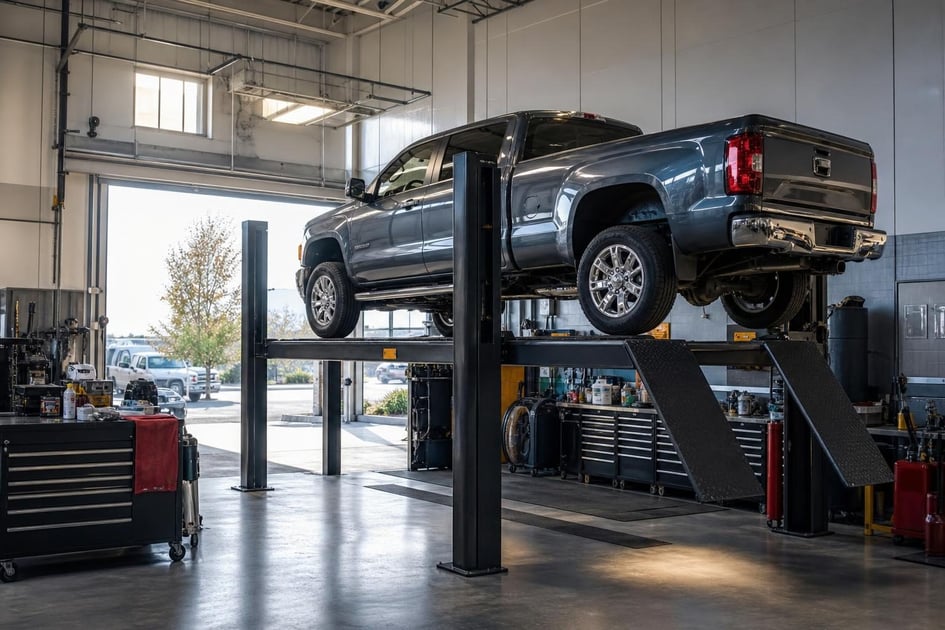
Four-Post Vehicle Lift Financing When Your Credit Is Bruised
Yes, you can finance a four-post vehicle lift with bad credit. The equipment itself serves as collateral, which means lenders weigh the lift's resale value and your business revenue more heavily than a perfect personal credit score. If your shop generates consistent cash flow and you have been operating for at least a year, financing options are available. See what financing you qualify for on that lift before you assume the answer is no.
A four-post lift typically runs between $3,000 and $15,000 for standard automotive models, with heavy-duty commercial versions reaching $30,000 or more. For shop owners who need the capacity to hoist trucks, fleet vehicles, or storage platforms, this is one of the larger equipment purchases outside of a diagnostics bay. Because the lift is a fixed asset with a long useful life—often 15 to 20 years—lenders treat it as stable collateral, which opens doors that unsecured working capital loans would close.
By the Numbers: A lender financing a $12,000 four-post lift at 48 months will usually cap the advance at 80% to 100% of the invoice for established shops, and 60% to 80% for newer businesses or lower credit profiles. The difference comes down to time in business, monthly revenue, and whether the lift is new or used.
Get a fast decision on your equipment
Applying takes just a few minutes, and decisions can come as soon as the same day.
Start Your ApplicationHow Bad Credit Changes the Financing Conversation
Bad credit in the equipment financing world generally means a FICO score below 620, recent bankruptcies, tax liens, or a history of judgments. Lenders do not treat every 580 the same way. A score dragged down by high utilization looks different from one damaged by a recent Chapter 11. The key is transparency: if you can explain the event and show that revenue has stabilized, many equipment lenders will listen.
Because the lift secures the financing, the lender's worst-case scenario is repossessing and reselling a standardized piece of equipment. That is fundamentally different from an unsecured line of credit, where the lender has nothing to recover. This is why Four Post Vehicle Lift financing remains accessible even when traditional bank doors are closed. According to Reuters reporting on 2026 bank loan demand, business lending standards remain tight for borrowers with lower credit scores, which makes collateral-backed equipment financing a more reliable path for shop owners. Rates vary by credit profile, equipment age and term, so expect to pay more than a prime borrower, but far less than merchant cash advance rates.
What Lenders Actually Review
Credit score is only one line on the application. Lenders also look at monthly bank deposits, existing debt service, the age of your business, and whether you own or lease your shop space. A construction fleet maintenance garage with $50,000 monthly revenue and a 600 FICO often gets a better offer than a one-bay shop with $8,000 monthly revenue and a 650 FICO. Volume and consistency matter.
Time in business is usually the second-most important factor after collateral. Most equipment lenders prefer two years in operation, though some will consider 12 months with strong deposits. If you are under a year old, expect a larger down payment or a shorter term, and possibly a personal guarantee even with the equipment securing the loan.
Qualifying for a Four-Post Lift With Challenged Credit
Qualification criteria shift based on whether you are buying new or used, and whether you want a $1 lease buyout, a 10% purchase option lease, or a traditional equipment term loan. With challenged credit, lenders tighten some requirements and relax others. They may demand a larger security deposit or add a nominal documentation fee at closing, but they rarely refuse outright if the deal makes financial sense.
Revenue Minimums and Bank Deposits
Most equipment finance companies want to see at least $10,000 in monthly business revenue, though some specialist lenders will go as low as $8,000 for lower-ticket items like lifts. They verify this through three to six months of business bank statements. Large, irregular spikes help less than steady weekly deposits. If your shop does seasonal fleet work, be ready to explain the cyclical pattern and show that you have managed it before.
Down Payment Expectations
For credit scores above 680 on an equipment loan, zero down is common. For scores between 600 and 679, expect 10% to 20% down. Below 600, 20% to 30% is standard, though it can sometimes be offset by strong revenue or a co-signer. On a $15,000 lift, that means bringing $3,000 to $4,500 to the table. The down payment protects the lender and lowers your monthly obligation, which improves your debt-service coverage ratio and makes approval more likely.
Key Insight: If you are buying a used four-post lift, lenders often discount the collateral value by 20% to 40% compared to new. That means a $10,000 used lift may only secure a $6,000 to $8,000 advance. You will need to cover the gap with a down payment or secondary collateral, which is why many shops with credit challenges choose new equipment despite the higher sticker price.
New vs. Used Four-Post Lifts: Financing Differences
The age and condition of the lift shape your financing terms more than most buyers expect. New lifts come with manufacturer warranties, clear installation support, and a known residual value. Used lifts can save 30% to 50% upfront, but financing them with bad credit is harder because the lender's collateral cushion is thinner.
| Factor | New Lift | Used Lift (5-10 Years) |
|---|---|---|
| Typical financing advance | 80% to 100% of invoice | 60% to 80% of purchase price |
| Down payment for sub-620 credit | 10% to 20% | 20% to 35% |
| Term length available | 36 to 60 months | 24 to 48 months |
| Warranty coverage | Standard 1 to 5 years | Limited or none |
| Residual value at month 48 | 40% to 60% of cost | 15% to 30% of cost |
If your credit is bruised and cash is tight, a new lift with a longer term often produces a lower monthly payment than a used lift with a shorter term, even though the total amount financed is higher. Run both scenarios with your account before deciding. Get a decision on your equipment, possibly the same day, and compare the monthly numbers side by side.
Lease vs. Loan: Which Structure Works for Bad Credit
Equipment leasing and equipment loans both let you put a lift in service without paying the full price upfront, but they treat ownership, tax deductions, and end-of-term obligations differently. For borrowers with challenged credit, the choice often comes down to which structure the lender is more comfortable offering.
A $1 buyout lease is essentially a loan in disguise: you make monthly payments and own the lift at the end for $1. A 10% purchase option lease (FMV lease) gives you lower monthly payments but requires you to buy the lift at fair market value or return it. True leases are harder to get with bad credit because the lender takes more residual risk.
| Feature | Equipment Term Loan | $1 Buyout Lease | FMV Lease |
|---|---|---|---|
| Ownership at end | Yes, immediately | Yes, for $1 | Must buy at FMV or return |
| Monthly payment | Moderate | Moderate | Lowest |
| Depreciation (2026) | Bonus + Section 179 eligible | May not claim depreciation | May not claim depreciation |
| Credit flexibility | High | High | Lower with bad credit |
| Early payoff | Usually allowed | Usually allowed | Often restricted |
Most shop owners with credit challenges end up in a term loan or $1 buyout lease because the collateral is straightforward and the lender's exposure is limited. According to equipment lease versus loan analysis, the decision should hinge on how long you plan to keep the lift and whether you want to claim depreciation on your 2026 return. Consult your CPA before choosing based on tax strategy alone.
Tax Treatment for the 2026 Tax Year
For the 2026 tax year, businesses that purchase and place a four-post lift into service may be eligible for Section 179 expensing and bonus depreciation, subject to the limits Congress sets for that year. As of the 2026 tax year, Section 179 allows qualifying businesses to deduct the full purchase price of qualifying equipment up to the annual limit, which is indexed for inflation. The exact 2026 dollar limit should be confirmed with your CPA, as legislative adjustments can occur late in the year.
Bonus depreciation for 2026 is scheduled to phase down from prior years, though the specific percentage depends on federal legislation in effect when you file. If you finance the lift through a loan, you generally still claim depreciation because you are the owner. If you finance through a true lease where the lender retains ownership, the lender claims the depreciation and your payments are typically deductible as a business expense. Do not assume; ask your accountant which structure gives you the better outcome for 2026.
Pro Tip: Place the lift in service before December 31, 2026, to claim the deduction on that year's return. A lift ordered in November but not installed until January 2027 lands on the 2027 tax year. If you are cutting it close, ask the dealer for a delivery and installation commitment in writing before you sign the financing documents.
See what you qualify for
The equipment itself secures the financing, which keeps rates competitive. Checking your options takes minutes.
Check Your OptionsReal Cost Scenarios by Credit Tier
Below are three realistic scenarios for a $14,000 four-post lift financed over 48 months. Rates vary by credit profile, equipment age and term, so these monthly ranges illustrate what shops typically see, not guaranteed offers.
- Strong credit (720+ FICO): $325 to $375 per month with $0 down on a new lift. Total cost of financing is modest because the rate lands in the lower range of the lender's spectrum.
- Mid-tier credit (620 to 719): $375 to $450 per month with 10% down ($1,400). The down payment keeps the advance in line with lender risk guidelines and keeps the monthly manageable.
- Challenged credit (below 620): $450 to $575 per month with 20% to 25% down ($2,800 to $3,500). The rate is higher, but the equipment collateral and documented revenue still make approval possible.
Extending the term to 60 months drops the monthly by roughly 15% to 20%, but increases total interest paid. Shortening to 36 months raises the monthly by 20% to 30% and lowers total cost. With bad credit, 48 months is the most common term because it balances affordability with the lender's desire to get paid back before the equipment ages significantly. A shop financing a $20,000 heavy-duty four-post lift on a 60-month term with a 25% down payment ($5,000) will finance $15,000. At the higher end of the rate range for challenged credit, the total repayment over five years can run $22,000 to $26,000. That is still far less than the revenue a busy bay can generate with lift access, which is why lenders make these deals.
Documentation You'll Need to Apply
Lenders ask for more paperwork when credit is thin or damaged, because they need alternative ways to verify stability. Have these items ready before you start:
- Three to six months of business bank statements showing consistent deposits
- Avoided-bounce record: most lenders want to see fewer than three NSF events in 90 days
- Invoice or quote for the specific lift, including model, capacity, and vendor
- Business tax returns for the most recent year, or two years if available
- Voided business check for ACH setup
- Driver's license and, for some lenders, a personal financial statement
If you are buying from a private seller rather than an equipment dealer, be prepared for extra scrutiny. Private-party sales carry more fraud risk, so lenders may require an independent inspection or a bill of sale notarized before funding. Dealer purchases are cleaner because the vendor has a track record and can provide a formal invoice.
Common Mistakes to Avoid
Shop owners with credit challenges sometimes sabotage their own approval by making easily avoidable errors. The most common is applying for an unsecured business loan first, getting declined, and then shopping for equipment financing with that decline already on their record. Start with collateral-backed financing for the specific lift; it is a different underwriting channel with different standards. The SBA loan program directory shows how government-backed options work, but for speed and credit flexibility on a single equipment purchase, direct equipment financing is often the better fit.
Another mistake is shopping for the lift without knowing what monthly payment the business can support. Lenders calculate debt-service coverage ratio by comparing your monthly debt payments to your monthly revenue. If you already carry a high equipment balance or a large vehicle loan, adding a $500 monthly lift payment may push your ratio below the lender's floor, usually around 1.15 to 1.25. Pay down smaller existing balances first if you can.
Key Insight: Some buyers try to inflate their revenue by including personal deposits in their business account. Lenders spot this quickly and it damages credibility. Keep business and personal accounts separate for at least three months before applying. If you must transfer funds, document the source in a cover letter so the underwriter does not assume the worst.
What Happens After You Apply
Most equipment finance companies can render a decision within a few hours to two business days. Same-day decisions are possible when the file is clean and the lift is from a known vendor. If your credit is challenged, expect 24 to 48 hours while the underwriter verifies bank statements and checks the equipment value.
Once approved, you receive a term sheet or finance agreement specifying the payment, term, down payment, and any fees. Review it carefully for prepayment penalties, late fees, and default provisions. If everything looks right, you sign and the lender pays the vendor directly. You take delivery, install the lift, and start making monthly payments. The entire process from application to installation can take as little as three to five business days.
For shops that also service Construction equipment financing customers, adding a four-post lift expands your capacity to handle heavy-duty trucks and utility vehicles. Similarly, if you are comparing lift types, Two Post Vehicle Lift financing has different space and access trade-offs worth reviewing before you commit to a four-post model.
Ready to move forward?
More than 10,000 businesses have financed equipment with Provide Capital. See what you qualify for today.
Get StartedFrequently Asked Questions
Can I finance a four-post lift with a credit score under 600?
Yes, though you should expect a larger down payment—often 20% to 30%—and a monthly payment at the higher end of the rate range. The lift's collateral value and your business revenue are the deciding factors, not the score alone.
Will the lender check my personal credit or just my business credit?
For most lifts under $50,000, lenders check personal credit, especially if the business has a limited credit history. The personal guarantee is standard for smaller shops and newer businesses.
How long does the approval process take?
Clean files can receive a same-day decision. Files with credit challenges typically take 24 to 48 hours while the underwriter verifies bank deposits and equipment specs.
Can I finance a used lift from a private seller?
Yes, but expect extra documentation. Lenders may require an independent inspection, a notarized bill of sale, and proof that the lift is not encumbered by a prior lien.
What happens if I miss a payment?
Most lenders offer a short grace period, typically 5 to 10 days. After that, late fees apply. Repeated missed payments can trigger default, which may lead to repossession of the lift. Call your lender before you miss a payment; many will work out a temporary modification.
Is a four-post lift better for bad credit financing than a two-post lift?
Not inherently, but four-post lifts often have higher resale value and broader buyer demand if repossessed, which lenders like. Vehicle Lift financing in general is accessible for both types if the collateral and cash flow are solid.
Can I deduct the payments on my 2026 taxes?
It depends on the structure. If you own the lift, you may be able to claim Section 179 and bonus depreciation for the 2026 tax year. If you lease and do not own it, your payments are typically deductible as operating expenses. Ask your CPA for advice specific to your return.
Do I need a commercial location to qualify?
A commercial shop space strengthens the application, but it is not always required. Some lenders will finance lifts for home-based mobile mechanics if revenue and credit minimums are met. Expect stricter terms if you do not have a dedicated commercial bay.
Moving Forward
A four-post lift is a revenue-producing asset, not an expense. It lets you stack jobs, attract fleet accounts, and justify higher labor rates because you can handle larger vehicles safely. Even with a bruised credit profile, the collateral-backed nature of equipment financing keeps this purchase within reach.
Gather your bank statements, pull the quote for the lift you want, and start an application in a few minutes. The sooner you know what terms are available, the sooner you can schedule installation and put the lift to work generating returns.
Disclaimer: The information provided in this article is for general educational purposes only and is not financial, legal, or tax advice. Funding terms, qualifications, and product availability may vary and are subject to change without notice. Provide Capital does not guarantee approval, rates, or specific outcomes. For personalized information about your business funding options, contact our team directly.
