
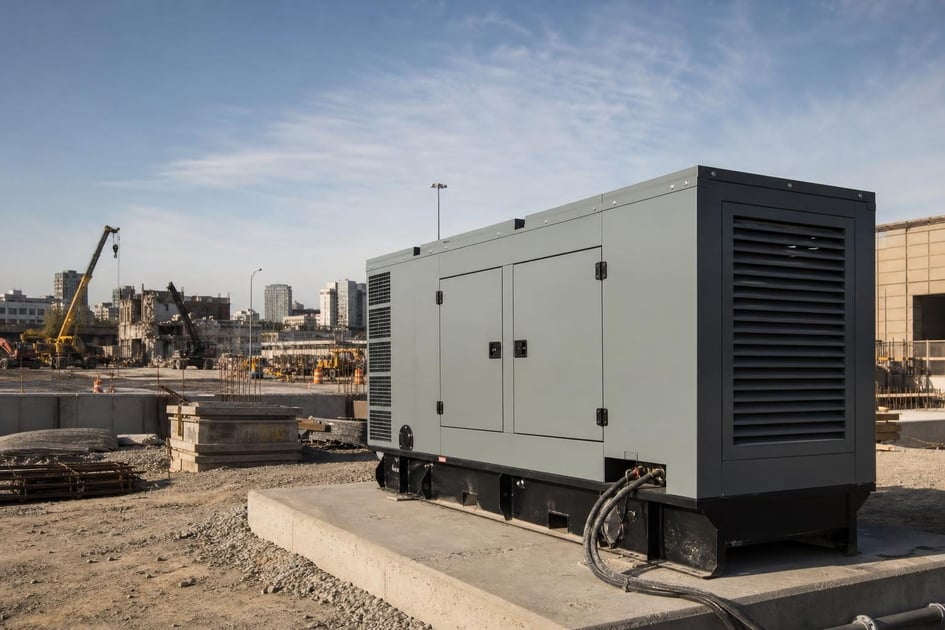
What Drives Generator Set Financing Cost
A generator set financing package typically breaks down into a monthly payment driven by four factors: the equipment's purchase price, its age and condition, your business credit profile, and the length of the term. At Provide Capital, we finance generator sets from $5,000 up to $5 million, with the equipment itself serving as collateral. That collateral requirement is what keeps rates competitive compared with unsecured borrowing. If you are shopping for a unit and want to know what the note will look like, see what financing you qualify for on that generator set before you negotiate the purchase price. You can learn more about our specific Generator Set financing programs on our equipment page.
The most important pricing input is the equipment cost. A 20-kW natural-gas standby unit for a small medical practice might run $8,000 to $15,000, while a 500-kW diesel generator for a data center or hospital can exceed $200,000. Industrial sets above 1,000 kW can climb well into six figures. Because the equipment backs the note, lenders price the deal partly on the resale market for that asset class. Diesel units with low hours and Tier 4 Final emissions compliance hold value better than older Tier 2 models, so the former often command slightly better terms.
Equipment Age and Condition
New generator sets carry the lowest risk for the lender because they come with manufacturer warranties and predictable maintenance schedules. Used sets can be financed just as readily, but expect the term to tighten if the unit is more than ten years old or has over 10,000 runtime hours. Lenders may also require a recent inspection report or oil-sample analysis on used industrial units before final approval. The older the asset, the larger the down payment that may be requested to keep the loan-to-value ratio in line.
Credit Profile and Time in Business
Your business credit score and length of operation influence the rate range you are offered. Established contractors or facilities with two or more years in business and clean credit histories generally see the most favorable structures. That does not mean newer businesses cannot qualify; it simply means the financing may be structured with a shorter term or a modest down payment to align risk. We look at the overall health of the operation, not just the score.
Term Length and Down Payment
Terms for generator set financing usually run 24 to 60 months, though some larger industrial deals stretch to 72 months. A longer term lowers the monthly payment but increases total interest paid over the life of the agreement. A shorter term saves on total cost but demands higher cash flow. Down payments typically range from zero to 20 percent depending on the applicant and the asset age. Zero-down options exist for well-qualified buyers on new equipment, while used units often call for 10 to 15 percent upfront.
By the Numbers: A $50,000 generator set on a 48-month term with competitive equipment financing rates typically produces a monthly payment in the low four figures, while the same unit on a 60-month term may drop that figure by 15 to 25 percent. Rates vary by credit profile, equipment age and term.
Get a fast decision on your equipment
Applying takes just a few minutes, and decisions can come as soon as the same day.
Start Your ApplicationNew vs. Used Generator Sets
Deciding between a new and used unit is usually the first fork in the road for a buyer, and it affects both your monthly cost and your total capital outlay. New sets offer the latest emissions compliance, full warranties, and longer useful life, but they depreciate sharply in the first two years. Used sets cost less upfront and shorten the financing term, yet they may carry higher maintenance reserves.
| Factor | New Generator Set | Used Generator Set |
|---|---|---|
| Purchase price | Higher; includes warranty and latest specs | Lower; depreciation absorbed by first owner |
| Financing term available | Up to 60–72 months | Typically 24–48 months |
| Down payment | Often 0–10% | Often 10–20% |
| Monthly payment | Higher absolute dollars, lower rate | Lower absolute dollars, shorter term |
| Maintenance risk | Covered by warranty initially | Buyer assumes; inspect before closing |
| Emissions compliance | Current Tier 4 Final or equivalent | May be Tier 2 or Tier 3; check local rules |
If your project requires Emergency Generator financing, a new unit is often the safer bet because reliability is paramount. For backup power at a remote job site, a well-maintained used diesel set may be the smarter financial move.
Lease vs. Loan: How the Structure Changes Your Cost
The next decision is whether to finance with an equipment loan or an equipment lease. Both are widely available for generator sets, but they treat ownership, tax deductions, and end-of-term options differently.
Equipment Loan
An equipment loan is a straightforward installment agreement. You make monthly payments, and at the end of the term you own the generator free and clear. Because you are the owner from day one, you claim depreciation and any available Section 179 deduction on your business tax return. The monthly payment is fixed, and there is no residual balloon at the end. Loans make sense when the generator set is a long-term core asset, such as a standby unit for a hospital or a primary power source for an off-grid operation.
Equipment Lease
A lease splits into two common types. A $1 buyout lease, or capital lease, functions almost identically to a loan for tax and accounting purposes. A fair-market-value lease, or operating lease, gives you lower monthly payments because you are only paying for the use of the equipment, not its full purchase price. At the end of an FMV lease, you can return the unit, renew the lease, or buy it at fair market value. Operating leases work well when you expect technology to improve or when the generator is only needed for a defined project duration.
Which Costs Less Per Month
Operating leases usually offer the lowest monthly payment because they do not amortize the full cost of the asset. However, they do not build equity. Loans and capital leases build equity but require a higher monthly outlay. If your goal is to minimize cash flow impact this year, an operating lease is worth exploring. If your goal is to own the asset and capture depreciation, a loan or capital lease is the better fit.
When you are ready to compare structures side by side, get a decision on your equipment, possibly the same day, and review both loan and lease options with your account manager.
2026 Tax Treatment for Generator Sets
For the 2026 tax year, the Internal Revenue Code allows businesses to deduct the cost of qualifying equipment through Section 179 expensing and bonus depreciation. Generator sets used more than 50 percent for business purposes generally qualify as eligible property. The exact dollar limits for 2026 depend on inflation adjustments published by the IRS. Rather than quote a specific ceiling that may change with final IRS guidance, speak with your CPA about how much you can expense under Section 179 for the 2026 tax year.
Bonus depreciation may also apply to generator sets placed in service during 2026, though the percentage has been phasing down from prior-year peaks. Your accountant can model whether Section 179, bonus depreciation, or regular MACRS depreciation delivers the best 2026 result for your tax bracket and liability. We do not provide tax advice; we provide the financing so you can place the equipment in service and let your CPA handle the deduction strategy.
See what you qualify for
The equipment itself secures the financing, which keeps rates competitive. Checking your options takes minutes.
Check Your OptionsWhat It Takes to Qualify
Provide Capital finances generator sets nationwide for businesses in construction, healthcare, dental, restaurant and food service, manufacturing, transportation, agriculture, HVAC, and forestry. Same-day approvals are possible when the application is complete and the equipment details are clear. Equipment financing remains a primary source of capital for small businesses acquiring productive assets. According to the Small Business Administration, term loans and equipment financing agreements are consistently among the most common credit products used by employer firms.
Documentation You'll Need
The basic file includes a completed application, the equipment quote or invoice, and your most recent two months of business bank statements. For requests above $150,000, we may also request two years of business tax returns and a year-to-date profit-and-loss statement. If the generator set is used, we need the serial number, hour meter reading, and the seller's information so we can verify title and condition. Having these items ready before you apply is the single biggest factor in how fast you receive a decision.
Common Application Stalls
Incomplete equipment quotes are the most frequent delay. A quote that lacks the serial number, model year, or seller contact forces us to pause for clarification. Another common stall is a mismatch between the requested loan amount and the documented equipment value. If you are negotiating a private-party sale, make sure the bill of sale is legible and includes both parties' business names and federal tax ID numbers. Finally, verify that your business bank statements show consistent deposits; lumpy or seasonal cash flow is fine, but unexplained gaps raise questions.
Pro Tip: If you are buying a used generator set from an auction or private seller, request a load-bank test report before you submit your application. Lenders view a recent load-bank test as the equivalent of a clean vehicle history report, and it can shave a day or two off the approval timeline.
If you are weighing a generator purchase against other equipment needs, remember that we also finance related assets. Many contractors bundle a Portable Generator financing package with their primary standby unit to cover remote job sites.
Real-World Cost Ranges
Because rates vary by credit profile, equipment age and term, the best way to understand your cost is to look at how term length affects monthly outlay at different equipment price points. The examples below assume competitive equipment financing rates for qualified borrowers and do not represent a guaranteed offer.
A $10,000 used portable generator on a 36-month term might carry a monthly payment in the mid-$300 range. A $75,000 new diesel standby unit on a 60-month term could run in the low-$1,500 range per month. A $250,000 industrial natural-gas set for a manufacturing facility, financed over 72 months, might land in the mid-$4,000 range monthly. These figures are illustrative only; your actual payment depends on underwriting.
Notice how the term length changes the monthly commitment. Stretching a $75,000 unit from 48 months to 60 months can reduce the monthly payment by roughly 15 to 20 percent, but it adds to the total interest cost. If your business has seasonal revenue, ask about skip-payment or seasonal structures that align your largest payments with your busiest quarters.
Who Buys Generator Sets and Why
Generator set demand cuts across nearly every industry we serve, but the buying patterns and size ranges differ significantly. Data from the U.S. Census Bureau shows that construction and manufacturing continue to account for a significant share of annual capital-equipment spending in the United States.
Construction firms typically buy portable diesel units between 20 kW and 100 kW for job-site power. These units travel from site to site and take abuse, so contractors often favor used units with steel enclosures and trailer packages. For heavy civil work, Construction equipment financing covers not just generators but the full power-distribution setup.
Healthcare and dental practices need standby natural-gas or diesel units that meet NFPA 110 standards. Reliability outweighs price; a new unit with an automatic transfer switch is the norm. Monthly payments are treated as an operating cost because the alternative—closing during an outage—is far more expensive.
Restaurants and food-service operations in storm-prone regions buy generators to protect refrigerated inventory. A 50-kW to 150-kW unit is typical for a mid-size restaurant. These buyers often need fast approval because a hurricane or ice storm is already on the radar when they call.
Manufacturing and transportation facilities buy large stationary sets, often 300 kW and above. These are long-term infrastructure investments, and the financing usually matches the useful life of the asset. Agriculture buyers need portable units for irrigation and remote barn power, while HVAC contractors increasingly bundle generator sales with installation contracts.
Mistakes That Raise Your Total Cost
Buying too small is the most expensive error. An undersized generator runs at full load constantly, burns more fuel, wears faster, and may need replacement years earlier than a properly sized unit. Right-sizing the load with a certified electrician before you apply for financing prevents this.
Another costly mistake is neglecting the installation and transfer-switch costs in your financing request. A $50,000 generator may need $15,000 in electrical work, concrete pads, and permitting. If you only finance the equipment, you pay those soft costs out of pocket. Ask your account manager about including installation in the total financed amount.
As Forbes has reported in coverage of capital allocation, failing to account for total cost of ownership is one of the most common and expensive errors owners make when acquiring heavy equipment. A used unit with a lower monthly payment but no warranty can cost more over three years than a new unit with a higher payment and full coverage. Add up expected maintenance, fuel consumption, and potential downtime before you decide on new versus used.
Key Insight: Lenders price generator set deals partly on the liquidity of the collateral. A Caterpillar, Cummins, or Kohler unit holds resale value better than a no-name import, which means the brand-name generator often qualifies for a lower rate or a longer term even when the purchase prices are identical. The secondary market for industrial generators is deep, but only for brands that service departments know how to support.
Ready to move forward?
More than 10,000 businesses have financed equipment with Provide Capital. See what you qualify for today.
Get StartedFAQ
Can I finance a used generator set?
Yes. Used generator sets are financed regularly. Expect the term to be slightly shorter than for new equipment, and be prepared to provide hour-meter readings, maintenance logs, and possibly a load-bank test report. Units under ten years old with fewer than 10,000 hours are the easiest to place.
What credit score do I need?
There is no single cutoff. We look at the overall business, including cash flow, time in operation, and credit history. Strong files see the best terms, but we work with a broad range of credit profiles. If your credit has recent blemishes, a larger down payment or shorter term may allow approval.
How fast can I get approved?
Same-day approvals are possible when the application and equipment documentation are complete. Deals requiring additional verification, such as used-equipment inspections or supplemental financials, may take 24 to 48 hours. The fastest path is to submit a complete file upfront.
Can I include installation and soft costs?
In many cases, yes. Electrical work, transfer switches, concrete pads, and freight can often be rolled into the financing amount as long as they are documented on the vendor invoice or a separate contractor quote. Ask your account manager about the specific structure for your deal.
Is a generator set a good candidate for a tax deduction?
For the 2026 tax year, generator sets used primarily for business may qualify for Section 179 expensing and bonus depreciation. The exact deduction depends on your taxable income, the cost of the equipment, and final IRS guidance for 2026. Consult your CPA before you count on a specific deduction amount.
Do you finance startup businesses?
We focus on established businesses with operating history. If your company is newer, approval may require additional collateral, a larger down payment, or a personal guarantee. We evaluate each file individually.
What happens after approval?
Once approved, you receive a term sheet outlining the monthly payment, term, and any down payment required. After you accept and sign, funds are typically sent directly to the equipment vendor or private seller. You take delivery, and payments begin according to the schedule.
Ready to Move Forward?
Generator set financing cost depends on the equipment you choose, your business profile, and how you structure the agreement. The best next step is to get a clear picture of what you qualify for before you commit to a purchase price. Start an application in a few minutes and review your options with a dedicated account manager who understands the generator market. Whether you need a portable unit for construction sites or a permanent standby system for a healthcare facility, we can structure financing from $5,000 to $5 million that keeps your cash flow intact and gets the equipment working for you.
Disclaimer: The information provided in this article is for general educational purposes only and is not financial, legal, or tax advice. Funding terms, qualifications, and product availability may vary and are subject to change without notice. Provide Capital does not guarantee approval, rates, or specific outcomes. For personalized information about your business funding options, contact our team directly.
