
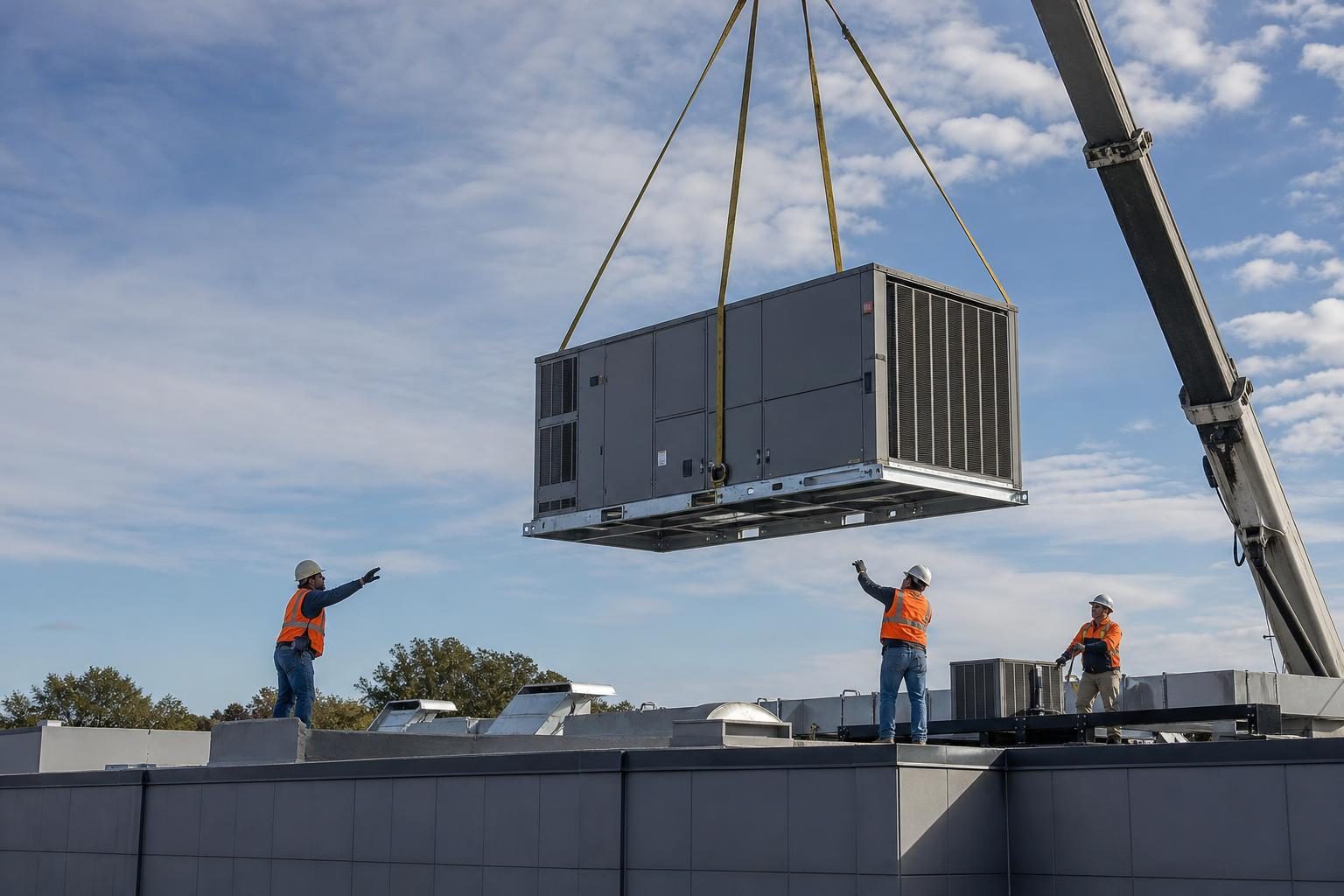
What HVAC Equipment Financing Terms Actually Look Like
Most HVAC equipment financing terms run from 24 to 84 months, with the equipment itself serving as collateral. Rates vary by credit profile, equipment age and term. Borrowers can finance new and used business equipment from $5,000 to $5 million, which covers everything from a single residential split system to a full commercial chiller plant. Same-day approvals are possible when the application is complete and the equipment is clearly identified.
Seasonal timing matters. Contractors who finance in January often beat the spring rush and lock in vendor pricing before peak demand drives costs up. Dealers are hungrier for orders in the off-season, which can translate into better quotes and faster delivery.
For an owner-operator replacing a failed rooftop unit before summer, the critical number is the monthly payment, not the rate itself. A 60-month term on a $35,000 package unit might keep the payment low enough to preserve cash flow for payroll and refrigerant inventory. If you want to see what financing you qualify for on that unit, start an application in a few minutes and review the term options side by side.
By the Numbers: A $125,000 commercial installation spread over 84 months can produce a monthly payment that is roughly 40 percent lower than the same amount financed over 36 months, though total interest paid rises accordingly. Always model the payment against your seasonal cash flow before choosing a term.
Already have a machine in mind?
Provide Capital finances new and used equipment from $5,000 to $5 million, with same-day decisions possible.
Apply NowHow Lenders Set Your Rate and Term
Credit Profile and Time in Business
Lenders typically reserve the longest terms for borrowers with two or more years in business and a personal credit score above 680. That does not mean a newer contractor cannot qualify; it simply means the term may land on the shorter end of the range, often 24 to 48 months, and the down payment requirement may edge higher. Provide Capital serves construction, healthcare, dental, restaurant and food service, manufacturing, transportation, agriculture, HVAC and forestry nationwide, so the underwriter will also weigh industry stability.
Equipment Age and Expected Life
The collateral is the equipment, which keeps rates competitive, but only if the collateral retains value. A brand-new 25-ton chiller with a 15-year expected life can support an 84-month term. A 10-year-old package unit with visible corrosion may cap out at 36 months. Lenders align the payoff date with the asset's remaining useful life so the loan does not outlive the collateral.
Loan Amount and Down Payment
Transactions from $5,000 to $5 million are available, but the structure changes by size. Deals under $50,000 often rely on an abbreviated application and may carry a slightly higher rate in exchange for speed. Deals above $250,000 usually require full financials and a larger down payment, sometimes 10 to 20 percent. The down payment protects the lender and lowers the monthly obligation.
Debt-service coverage ratio also plays a role. If your existing monthly debt payments consume more than 40 to 50 percent of your gross revenue, the lender may shorten the term to keep the new payment within guidelines. Conversely, a business with minimal debt and strong deposits may see terms stretch toward the 84-month maximum.
Key Insight: Lenders treat soft costs—installation, ductwork modifications, crane rental, and electrical permits—differently. Some will finance 100 percent of the equipment but only 80 percent of soft costs. Ask for a detailed breakdown before you sign so your out-of-pocket total does not surprise you.
New vs. Used HVAC Equipment Financing
New units come with manufacturer warranties, cleaner maintenance histories, and longer useful lives, which makes them easier to collateralize. Used equipment can save 30 to 50 percent on the purchase price, but lenders scrutinize the serial number, hour meter, and service records closely. If the compressor has 15,000 run hours, expect a shorter term and possibly a larger down payment.
| Factor | New HVAC Equipment | Used HVAC Equipment |
|---|---|---|
| Typical term range | 36 to 84 months | 24 to 60 months |
| Down payment | 0% to 10% | 10% to 20% |
| Rate outlook | More favorable | Rates vary by credit profile, equipment age and term |
| Collateral requirements | Standard | Additional inspection may be required |
| Warranty status | Full manufacturer coverage | Limited or expired; factor in repair reserves |
When you are deciding between new and used, match the term to how long you plan to keep the asset. If you intend to run the unit for 10 years, a 72-month note on new equipment keeps the payment manageable and aligns with the warranty. If you need a temporary unit for a 3-year project, a 36-month term on used equipment may be the smarter play. Hvac System financing covers both paths.
Lease vs. Loan: Which Structure Fits Your Business?
Equipment Finance Agreement
An equipment finance agreement, or EFA, is essentially a loan structured for equipment. You make monthly payments, and at the end you own the unit outright. This is the most common structure for HVAC contractors and facility owners because it builds equity and keeps the asset on your balance sheet.
Fair Market Value Lease
A fair market value lease works like a rental with a buyout option. Monthly payments are lower than an EFA, but you face a balloon decision at the end: return the equipment, renew the lease, or buy it at fair market value. This structure makes sense if you expect technology to change rapidly or if the unit serves a short-term contract.
$1 Buyout Lease
A $1 buyout lease looks like a lease for tax purposes but functions like a loan. You make fixed payments and own the equipment for one dollar at the end. The monthly payment is usually higher than a fair market value lease, but there is no ambiguity about ownership.
If you are ready to move forward, get a decision on your equipment, possibly the same day, and compare EFA and lease side by side.
Tax Treatment for HVAC Equipment in 2026
For tax year 2026, Section 179 allows businesses to deduct the cost of qualifying equipment in the year it is placed in service, subject to annual limits that adjust for inflation. The exact 2026 ceiling and phase-out threshold should be confirmed with your CPA before you file. HVAC systems generally qualify as long as they are purchased for business use and placed in service during the tax year.
Bonus depreciation has been stepping down in recent years, and for tax year 2026 the percentage may differ from prior years. Rather than cite a figure that could change with late legislation, speak with your accountant about how bonus depreciation interacts with Section 179 on your specific installation.
With a true lease, the lessor typically claims the depreciation while you deduct the monthly payment as a business expense. With an EFA or $1 buyout lease, you claim the depreciation and any applicable first-year deductions. The difference can shift your tax outcome by thousands of dollars, so model both scenarios.
Key Insight: If you finance a $75,000 replacement in November but delay startup until January, the deduction moves to tax year 2027. Coordinate your funding date with your install date and your CPA's calendar to avoid missing the current-year benefit.
See what you qualify for
The equipment itself secures the financing, which keeps rates competitive. Checking your options takes minutes.
Check Your OptionsQualifying for HVAC Equipment Financing
Minimum Requirements
Most equipment lenders look for a credit score in the mid-600s or higher, though exceptions exist for strong cash flow or large down payments. Two years in business is preferred, but startups are not the focus here; established trades with tax returns and bank statements move through faster. Provide Capital serves construction, healthcare, dental, restaurant and food service, manufacturing, transportation, agriculture, HVAC and forestry nationwide, so industry experience counts.
Documentation You Will Need
Be ready with a photo or invoice for the equipment, your last two years of business tax returns, three months of business bank statements, and a personal financial statement. For requests above $250,000, add interim financials and a brief description of how the equipment generates revenue. Having these files in a single folder can cut the approval time from days to hours.
For business owners exploring government-backed options, the SBA 504 loan program offers long-term, fixed-rate financing for major fixed assets, though the process is typically slower than direct equipment financing.
Industry-Specific HVAC Buying Patterns
HVAC demand is not uniform across the year. Construction crews often order rooftop units in late winter so they are ready for spring builds. Healthcare and dental practices time replacements around fiscal year-ends, often in summer or fall. Agriculture facilities rush to install climate-controlled storage before harvest season, which can strain local dealer inventory.
Transportation and logistics hubs need large-scale climate systems for warehouses, and those projects tend to cluster around facility expansions. Forestry and land-clearing contractors sometimes need mobile HVAC for job-site trailers, a niche where used equipment and shorter terms dominate. Understanding your industry's seasonal rhythm helps you negotiate better pricing from dealers and avoids the spring rush that backs up installers.
Restaurant and food service operators face a unique challenge: health department inspections and occupancy permits often dictate the exact timeline for an HVAC replacement. A failed inspection due to inadequate ventilation cannot wait for a month-long funding process. That urgency makes same-day approval valuable, but it also means the operator needs all documentation ready before the inspector returns.
Commercial HVAC demand remains robust in 2026. According to a Reuters report on commercial HVAC demand, major manufacturers have raised profit forecasts as data-center and industrial cooling needs grow. That strength means lead times can stretch during busy seasons, so financing pre-approval helps you reserve equipment before it leaves the factory floor.
Construction spending data from the U.S. Census Bureau economic indicators helps explain why HVAC demand clusters in certain months; when construction starts rise, mechanical subcontractor bookings follow within weeks.
For contractors focused on commercial installs, Commercial Hvac System financing addresses the larger tonnages and longer lead times common in these sectors. Industrial clients can explore Industrial Hvac System financing for chillers, boilers, and cleanroom systems.
Common Mistakes When Financing HVAC Equipment
Ignoring Soft Costs
The sticker price on the condenser is rarely the total project cost. Crane fees, refrigerant lines, controls, and commissioning can add 15 to 25 percent. If your financing only covers the equipment, you will pay those extras out of pocket. Ask for a single financing package that wraps equipment and installation into one note.
Overlooking Prepayment Penalties
Some finance agreements include a prepayment penalty or a structure that front-loads interest. If you plan to pay the note off early from a seasonal bonus or a large contract completion, read the fine print. A loan with no prepayment penalty gives you flexibility; one with a steep penalty can trap cash.
Mismatching Term to Equipment Life
Financing a rooftop unit over 84 months when its effective life is only 7 years leaves you paying for equipment you have already replaced. Match the term to the asset's realistic lifespan, and consider a balloon or shorter term if you plan to upgrade early.
Pro Tip: Always request the amortization schedule before funding. On a 60-month note, the principal paid in the first 12 months is often less than 20 percent of the original balance. Knowing that schedule helps you plan an early payoff or trade-in without guessing.
What Happens After You Apply
Once you submit an application, the underwriter verifies your identity, reviews the equipment details, and checks collateral value. For deals under $150,000, this can happen in hours. For larger requests, expect a 24- to 48-hour turnaround if documentation is complete. Same-day approvals are possible when the file is clean and the equipment is standard.
After approval, you receive a term sheet outlining the monthly payment, term, buyout structure, and any soft-cost limits. Review it with your accountant, sign electronically, and the lender pays the dealer or vendor directly. Funding usually occurs within 24 to 72 hours of signed documents.
Provide Capital finances new and used business equipment from $5,000 to $5 million, so a $20,000 ductless mini-split package might close in a single day, while a $1.2 million chiller replacement for a manufacturing plant may take 3 to 5 business days as appraisals and site inspections are completed.
Put the right equipment to work
From $5,000 to $5 million, new or used, Provide Capital helps businesses nationwide finance the equipment they need.
Apply TodayFrequently Asked Questions
Can I finance HVAC equipment with a 600 credit score?
Yes, though the term may be shorter and the down payment larger. Rates vary by credit profile, equipment age and term, so a 600 score does not automatically disqualify you. Strong cash flow and collateral value can offset a lower score.
How long can I finance a commercial HVAC system?
Terms typically range from 24 to 84 months. New, high-dollar equipment with a long expected life can qualify for the longest terms. Used equipment or smaller requests usually fall between 24 and 60 months.
Is installation included in the financing?
Often, yes, but the percentage of soft costs covered varies by lender and deal size. Some lenders finance 100 percent of the equipment and a portion of installation. Ask for a line-item breakdown before you commit.
What is the difference between an equipment loan and a $1 buyout lease?
Functionally, both end with you owning the equipment. An equipment finance agreement is a loan in legal structure, while a $1 buyout lease is a lease that transfers ownership at the end for a nominal amount. Your CPA can advise which structure delivers the better tax outcome for tax year 2026.
Can I get same-day approval on a $100,000 HVAC package?
Same-day approvals are possible for well-documented applications on standard equipment. Larger or custom packages may require additional review, but many deals under $150,000 clear the same day if bank statements and equipment quotes are ready.
Do I need a down payment?
Not always. New equipment deals sometimes require 0 to 10 percent down. Used equipment or lower credit profiles may require 10 to 20 percent. The down payment also lowers your monthly obligation and improves approval odds.
Can I finance used HVAC equipment?
Yes. Used equipment can reduce your purchase price by 30 to 50 percent, but expect a shorter term and possibly a larger down payment. The lender will want service records and may require an inspection. Hvac equipment financing includes both new and used options.
What documents do I need to apply?
Typically, a photo or invoice of the equipment, two years of business tax returns, three months of business bank statements, and a personal financial statement. Larger requests may require additional financials.
Next Steps
Review your equipment quote, gather your tax returns and bank statements, and decide whether a loan or lease fits your tax strategy for 2026. Then see what financing you qualify for on that unit and compare terms without obligation. Whether you are replacing a failed residential split system or bidding a multi-ton commercial install, the right financing structure keeps your cash flow intact and your project on schedule.
Disclaimer: The information provided in this article is for general educational purposes only and is not financial, legal, or tax advice. Funding terms, qualifications, and product availability may vary and are subject to change without notice. Provide Capital does not guarantee approval, rates, or specific outcomes. For personalized information about your business funding options, contact our team directly.
