
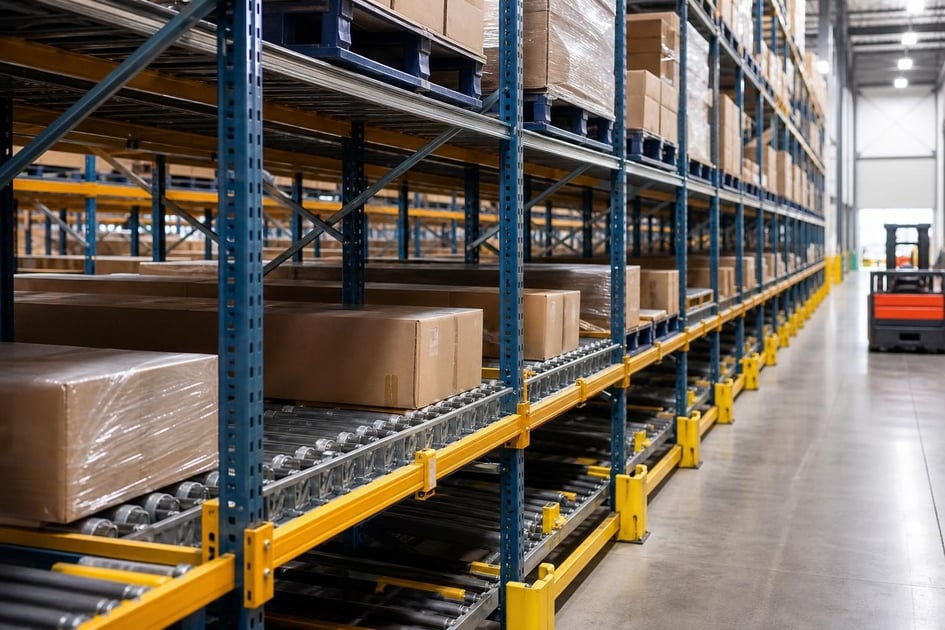
You Can Finance Pallet Flow Rack Without Draining Cash
You can finance a pallet flow rack system with no money down and start moving product through gravity-fed lanes while your cash stays in the business. At Provide Capital, the equipment itself serves as collateral, which means you do not have to pledge real estate or drain your operating account to add high-density storage. We finance new and used business equipment from $5,000 to $5 million nationwide, and same-day approvals are possible depending on the completeness of your application. If you are pricing a gravity-fed storage system for your facility, you can see what financing you qualify for in minutes and receive a decision, possibly the same day.
Get a fast decision on your equipment
Applying takes just a few minutes, and decisions can come as soon as the same day.
Start Your ApplicationWhat Pallet Flow Rack Is and Why Operations Finance It
Pallet flow rack is a first-in, first-out (FIFO) storage system that uses inclined lanes and gravity rollers to move pallets from the loading face to the picking face. Unlike static selective rack, where a forklift must drive into every bay, flow rack lets you load from one aisle and pick from another, cutting travel time and reducing aisle width requirements. Each lane is engineered for a specific pallet size and weight, with speed controllers and brakes that keep loads from slamming into one another.
Operations finance pallet flow rack because it is a capital-intensive infrastructure upgrade. A full system includes upright frames, beams, roller lanes, speed controllers, entry guides, and often pallet separators. The cost rises quickly when you add engineered columns, footplates for seismic zones, and professional installation. Financing spreads that cost across months or years while the equipment generates labor savings and denser cube utilization immediately.
Key Insight: A pallet flow lane is designed for a specific pallet width, depth, and weight. Mixing standard 48x40 GMA pallets with 48x45 or half-pallets in the same lane destroys flow and creates jams that require manual extraction. When you finance the system, include lane dividers, entry guides, and speed controllers in the same transaction to avoid retrofit costs later.
How No-Money-Down Equipment Financing Works
No-money-down equipment financing means the lender advances the full amount needed to acquire the rack, and your first outlay is the initial monthly payment rather than a deposit. Because the equipment itself is the collateral, the lender has a secured interest that reduces the need for a large upfront equity contribution. Rates vary by credit profile, equipment age and term, so the exact monthly payment depends on your business history and the structure you choose. The SBA loan programs page explains how secured equipment financing differs from unsecured lines of credit, which helps when you are comparing structures.
This structure is particularly useful for pallet flow rack because the project rarely ends at the rack itself. You may need concrete core drilling, anchor bolts, freight from a distant warehouse, and a rigging crew to stand the frames. Preserving cash for those peripheral costs—plus your normal inventory buys—keeps the warehouse running smoothly during the upgrade.
Pro Tip: No money down does not mean no cash required at all. Freight, installation, permits, and seismic engineering often sit outside the equipment invoice. Ask your vendor for a turn-key quote that includes dismantling, transport, and assembly so the lender can finance the full project rather than just the steel.
If your project is already quoted and you want to preserve liquidity for seasonal inventory, start an application in a few minutes to find out what structure fits your cash flow.
Who Qualifies and What Lenders Review
Credit History
Lenders look at your personal and business credit to gauge repayment probability. A score in the mid-600s or higher generally opens more competitive structures, but lower scores do not automatically disqualify you. What matters is the overall pattern: recent bankruptcies, unresolved tax liens, or habitual late payments raise more red flags than a single old collections account. If your credit has blemishes, be prepared to explain the circumstances and show how the new rack will improve revenue or reduce costs.
Time in Business
Most equipment-financing programs prefer two or more years in operation because that history demonstrates you can survive seasonal dips and vendor delays. Startups or new businesses face tighter scrutiny, and many lenders simply do not finance companies that have not filed at least one tax return. If you have been operating for less than two years, expect to provide a larger personal guarantee, more months of bank statements, or a co-signer.
Equipment Condition and Age
New pallet flow rack qualifies for longer terms—often up to 60 or 72 months—because the lender is comfortable with the remaining useful life. Used rack can still be financed, but the term may shrink to match the equipment’s age. A ten-year-old system might max out at 36 or 48 months. The lender may also require an inspection or photos to confirm the rollers, brakes, and uprights are free of damage.
Revenue and Bank Statements
Lenders typically request three to six months of business bank statements to verify that your revenue can support the new payment. They look for consistent deposits, reasonable average daily balances, and no recent overdrafts. If your business is highly seasonal—common in agriculture and food distribution—showing a full twelve-month cycle can help justify a monthly payment that looks aggressive against a slow quarter.
New vs. Used Pallet Flow Rack
New pallet flow rack comes with manufacturer warranties, engineered drawings, and the ability to customize lane depths and widths to your exact SKU mix. You also get longer financing terms because the lender is confident in the asset’s lifespan. The downside is cost: new systems run higher per bay, and lead times from domestic manufacturers can stretch several weeks.
Used pallet flow rack can cut the equipment cost by 40 to 60 percent, but you inherit the previous owner’s configuration. If their beam spacing was designed for 36-inch pallets and you run 48-inch loads, you will need new beams or crossbars. You also face unknown wear on the rollers and brakes. Always inspect used systems in person or demand detailed photos and video of a loaded lane test before you commit.
By the Numbers: A new pallet flow rack system for a mid-size distribution center typically falls between $35,000 and $120,000 installed. Used systems in good condition often trade at 40 to 60 percent of replacement cost, but freight and reconfiguration can add $8,000 to $15,000 to the total project. Rates vary by credit profile, equipment age and term, so the difference in monthly payment between new and used may be narrower than the sticker price suggests.
Lease vs. Loan: A Side-by-Side Look
Choosing between a lease and a loan comes down to ownership preference, tax strategy, and how long you plan to keep the rack. With an equipment loan, you own the rack from day one and build equity with every payment. At the end of the term, you hold title free and clear. With a fair-market-value lease, you make lower monthly payments but return the equipment at the end unless you exercise a purchase option. A $1 buyout lease behaves more like a loan for tax purposes, while a true lease keeps the debt off your balance sheet.
| Feature | Equipment Loan | Fair-Market-Value Lease | $1 Buyout Lease |
|---|---|---|---|
| Ownership | You own from day one | Lessor owns; you may purchase at end | You own after final payment |
| Down Payment | Often $0 with strong credit | Typically $0 | Typically $0 |
| Monthly Payment | Higher than FMV lease | Lower than loan | Similar to loan |
| Tax Treatment | Interest deductible; depreciate asset | Payments fully deductible | Depreciate asset; interest deductible |
| End of Term | No further obligation | Return, renew, or buy at FMV | $1 final payment for title |
| Best For | Long-term facilities, owned real estate | Rapidly changing SKU profiles | Businesses wanting ownership with lease structure |
Rates vary by credit profile, equipment age and term, so the cheapest structure on paper is not always the best fit for your tax situation. Discuss the trade-offs with your CPA before you sign.
2026 Tax Treatment and Deductions
For the 2026 tax year, Section 179 allows businesses to deduct the full purchase price of qualifying equipment, subject to annual limits that adjust for inflation. Bonus depreciation may also apply to pallet flow rack, though the exact percentage for 2026 depends on current IRS phase-down schedules. Because these figures change annually and interact with your overall taxable income, you should speak with a CPA before you decide whether to expense the full cost in year one or spread deductions across the asset’s useful life.
If you choose a true lease rather than a loan, your monthly lease payments are generally fully deductible as an operating expense. That can simplify bookkeeping for businesses that want a consistent line-item deduction without tracking depreciation schedules. Either way, do not rely on last year’s Section 179 limit as a guide for 2026; the thresholds and phase-outs update yearly.
Pro Tip: The IRS distinguishes between equipment that is "placed in service" and equipment that is merely purchased. If you finance pallet flow rack in December 2026 but the installer does not bolt it down until January 2027, the deduction likely shifts to the 2027 tax year. Coordinate your delivery and installation schedule with your CPA so the timing matches your tax strategy.
Find the right financing structure
Tell us about the equipment you need and we will show you the options that fit your business.
See Your OptionsReal-World Cost Examples
Consider a third-party logistics operator adding 40 lanes of pallet flow rack to a 20,000-square-foot facility. A new system with engineered drawings, seismic footplates, and professional installation might quote at $95,000. Financed over 60 months with no money down, the monthly payment could fall between $1,850 and $2,450 depending on credit and term. Over the life of the agreement, the business pays more than the cash price because of financing charges, but the rack is generating picking efficiency and denser storage from month one. Reuters Business coverage of warehouse capex trends shows that operators increasingly prioritize density investments over footprint expansion, which aligns with the economics of flow rack financing.
Now imagine a regional beverage distributor buying a used 30-lane system from a closing facility. The steel costs $28,000, but freight and reconfiguration add another $12,000, bringing the total project to $40,000. Financed over 48 months, the monthly payment might range from $950 to $1,300. Because the distributor preserved $40,000 in cash, they can still fund a seasonal SKU expansion without tapping a line of credit.
Industry Applications
Pallet flow rack appears across industries where FIFO inventory control and high-density storage matter. In food service and grocery distribution, gravity-fed lanes ensure that oldest product ships first, reducing spoilage and write-offs. In manufacturing, raw materials move from receiving to assembly in a predictable sequence that matches the bill of materials. Census Bureau data on manufacturing and warehousing construction highlights why operations continue reinvesting in denser storage configurations rather than expanding footprints. In agriculture, harvest-season surges require temporary density that static rack cannot provide.
Transportation and logistics hubs use flow rack to stage outbound freight, while healthcare distributors rely on it for temperature-controlled pharmaceuticals that cannot sit in deep reserve. Even Forestry Logging equipment financing customers sometimes add pallet flow rack to lumber yards for graded board storage, separating kiln-dried inventory from green stock.
If you already rely on Pallet Jacks financing to move loads, pairing them with a financed flow rack system creates a complete receiving-to-picking workflow without a large capital event.
Common Mistakes Buyers Make
The most expensive error is buying rack without verifying floor load capacity. Pallet flow rack concentrates enormous weight in a small footprint; a fully loaded bay can exceed 10,000 pounds. If your slab was poured for light selective rack, you may need core drilling and epoxy anchors or even a thickened slab, which adds thousands to the project.
Another mistake is ignoring forklift aisle width. Flow rack reduces the number of aisles, but the remaining ones must accommodate your mast height and turning radius. If you downsize aisles too aggressively, you will slow operations and increase rack impact damage.
Buyers also err by financing only the steel and forgetting installation. A turn-key quote protects you from budget overruns and gives the lender a complete picture of the project. Finally, do not assume that Pallet Flow Rack financing covers rack you buy at auction without inspection. Lenders may decline to finance used equipment that cannot be verified as structurally sound.
What Documentation You Need
A complete application speeds up approval. Gather a voided business check, a copy of your driver’s license, and the equipment quote or invoice. Most lenders also want three to six months of business bank statements and the most recent year of business tax returns. If your business is younger than two years, prepare to provide personal tax returns and a personal financial statement.
For larger requests—especially projects approaching the upper end of our $5,000 to $5 million range—lenders may ask for interim financials, a debt schedule, and a brief explanation of how the rack will improve revenue or cut costs. The more clearly you can show the return on the investment, the stronger your file looks.
What Happens After Approval
Once approved, you receive a term sheet or finance agreement spelling out the monthly payment, term, and any prepayment provisions. Review it carefully, noting whether the agreement has a prepayment penalty or a graduated payment structure. After you sign, the lender pays the vendor directly, and the equipment ships to your facility. You take possession and begin using the rack immediately; your first payment typically follows 30 to 45 days later.
The lender files a UCC-1 financing statement against the equipment to perfect their security interest. This is standard and does not affect your daily operations, but it means you cannot sell the rack without paying off the balance. When the final payment clears, the lender releases the UCC filing, and you hold clear title.
Once you have your vendor quote in hand, get a decision on your equipment, possibly the same day, so you can lock in delivery dates before your busy season hits.
Put the right equipment to work
From $5,000 to $5 million, new or used, Provide Capital helps businesses nationwide finance the equipment they need.
Apply TodayFrequently Asked Questions
Can I finance pallet flow rack with no money down if my credit is below 650?
Yes, though the structure may change. Lower credit scores often mean a shorter term, a higher monthly payment, or a requirement for additional guarantors. Rates vary by credit profile, equipment age and term, so the best way to know your options is to submit a complete application with your equipment quote.
How long does approval take?
Same-day approvals are possible when your file is complete and the request is straightforward. Larger transactions or situations requiring additional documentation may take 24 to 72 hours. Responding quickly to lender requests for bank statements or tax returns is the single biggest factor in speed.
Can I finance used pallet flow rack?
Yes. Used systems are common in equipment financing. The lender may cap the term to match the remaining useful life of the rack and may require photos or an inspection. Be prepared to show that the rollers, brakes, and uprights are in serviceable condition.
Is installation included in the financing?
It can be, if the vendor provides a single invoice that includes both equipment and installation. Some lenders will also finance freight and rigging if those costs are itemized on the same purchase order. Soft costs like seismic engineering or permitting may require separate negotiation.
What is the difference between pallet flow rack and push-back rack?
Pallet flow rack is FIFO: you load from one side and pick from the other. Push-back rack is LIFO: you load and pick from the same aisle, and pallets sit on nested carts that roll back when a pallet is removed. Choose flow rack when product rotation matters; choose push-back when you store bulk quantities of the same SKU and aisle space is tight.
Do I own the rack at the end of a finance agreement?
With an equipment loan or a $1 buyout lease, you own the rack free and clear once the final payment posts. With a fair-market-value lease, you return the equipment unless you exercise a purchase option. Read your agreement carefully so you know which structure you are signing.
Can I deduct the payments on my 2026 taxes?
For the 2026 tax year, loan interest and depreciation—or full Section 179 expensing, subject to annual limits—may be deductible. Lease payments are generally fully deductible as operating expenses. Because tax rules interact with your overall income and entity structure, consult a CPA before you file.
What happens if I need to move the rack to a new facility?
You can move financed equipment, but you must maintain insurance and notify the lender of the new address so their UCC filing remains accurate. Some agreements require written consent before the equipment crosses state lines. Dismantling and reassembling flow rack is labor-intensive, so factor that cost into your relocation budget.
Ready to Add Density Without Draining Cash?
Pallet flow rack turns warehouse space into productive inventory lanes, but the upfront cost can strain an otherwise healthy operation. Financing with no money down lets you preserve liquidity for payroll, inventory, and the unexpected while the equipment pays for itself through denser storage and faster picks. We serve construction, healthcare, dental, restaurant and food service, manufacturing, transportation, agriculture, HVAC and forestry nationwide, with financing from $5,000 to $5 million. Start your application now and find out what structure fits your warehouse and your budget.
Disclaimer: The information provided in this article is for general educational purposes only and is not financial, legal, or tax advice. Funding terms, qualifications, and product availability may vary and are subject to change without notice. Provide Capital does not guarantee approval, rates, or specific outcomes. For personalized information about your business funding options, contact our team directly.
