
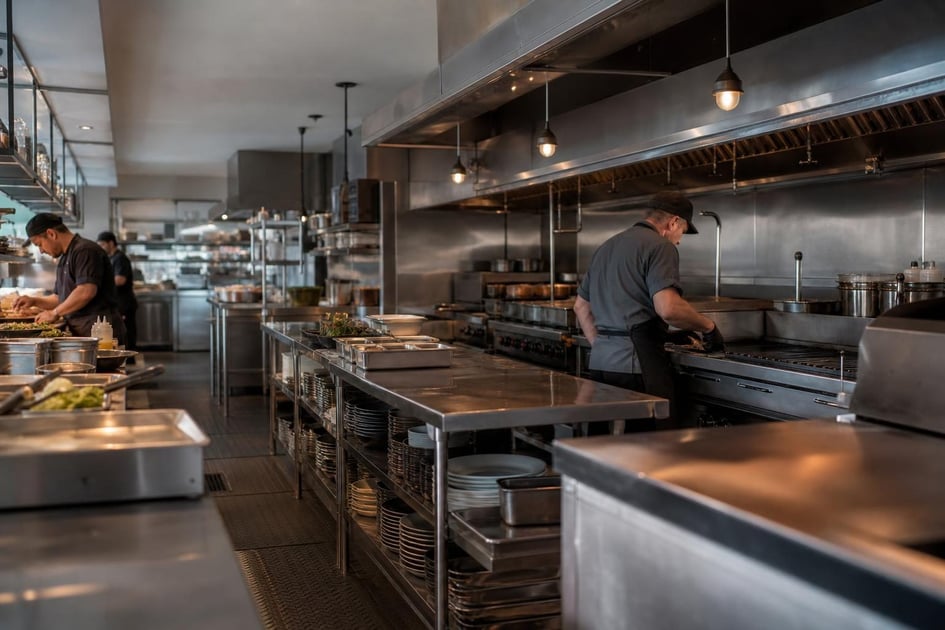
Restaurant food service equipment financing terms typically run from 24 to 84 months, with the equipment itself serving as collateral so you do not need to pledge real estate or drain operating cash. Rates vary by credit profile, equipment age and term, and amounts range from $5,000 up to $5 million. Whether you are replacing a failing fryer or opening a second location, understanding how lenders structure these agreements helps you compare offers and preserve liquidity for payroll and inventory. The U.S. Small Business Administration notes that equipment financing is one of the most common uses of small-business credit because the collateral is built into the deal.
What Restaurant Equipment Financing Actually Covers
This is not a general business loan. Financing is tied to the specific asset. Eligible items include commercial ranges, convection ovens, walk-in coolers and freezers, dishwashers, prep tables, exhaust hoods, point-of-sale systems, and furniture. We also finance mobile kitchen retrofits through our Food Truck financing program. Soft costs such as delivery, installation, and sales tax can often be rolled into the agreement, which keeps your out-of-pocket expense limited to a first and last payment or a small down payment depending on the program.
New vs. Used Equipment
New equipment usually carries longer useful lives, so lenders may extend terms toward the 72- or 84-month end of the range. Used equipment—especially late-model pieces—can also qualify, though terms may shorten to 36 or 48 months if the asset is older or has high hours. The key is the liquidation value. A 10-year-old steamer with no service history is harder to finance than a 3-year-old unit from a recognized brand. When you shop, gather the serial number, year, make, model, and photos.
Soft Costs and Bundling
Many owners do not realize that installation, freight, and initial training can be bundled into the financed amount. This matters because a $40,000 kitchen line can become $48,000 once rigging and ventilation hookups are included. Rolling those costs in prevents the situation where you buy the equipment but cannot afford to turn it on.
Key Insight: Lenders evaluate the equipment’s auction value, not its retail price. A $60,000 range from a national brand with a strong secondary market is easier to finance at a competitive rate than a $60,000 import with no service network, even if both are brand new.
How Financing Terms Are Structured
Most restaurant equipment is financed through a capital lease or an equipment loan. In a loan, you own the equipment outright and the lender files a UCC-1 lien against it. The lender files a UCC-1 notice in your state’s public records, which shows up on business credit reports until the obligation is satisfied. In a capital lease, the lessor owns the asset during the term and you typically purchase it for $1 or a small percentage at the end. Both structures use the equipment as collateral.
| Feature | Equipment Loan | Capital Lease |
|---|---|---|
| Ownership | You own from day one | Lessor owns during term |
| Collateral | The equipment itself | The equipment itself |
| End of term | No buyout needed | $1 or nominal buyout |
| Tax treatment (consult CPA) | Depreciation / Section 179 | May deduct full payments |
| Typical term | 36–84 months | 24–60 months |
| Best for | Long-life assets, ownership goals | Frequent upgrades, cash preservation |
Lease vs. Loan Trade-Offs
A loan builds equity. If you plan to run the same convection oven for 12 years, a loan or finance agreement makes sense. A lease keeps the obligation off your balance sheet in some cases and may let you deduct the full monthly payment as an operating expense, though you should verify 2026 deductibility with your CPA. If you expect to upgrade every 3 years, leasing limits obsolescence risk.
By the Numbers: A $75,000 kitchen package financed over 60 months typically breaks down to a monthly payment in the low four-figure range, though your exact cost depends on credit profile, equipment age, and term. Extending to 84 months lowers the payment but increases total interest cost.
What You Need to Qualify
Lenders look at four main factors: credit history, time in business, revenue, and the equipment itself.
Credit history. A 650+ personal credit score opens the most competitive programs, but we work with lower scores by adjusting term and structure. Recent bankruptcies, open tax liens, or judgments will slow approval and may require additional collateral or a larger down payment. If your score is below 600, expect to provide more documentation and possibly a 15% to 20% down payment.
Time in business. 2 years under the same ownership is the standard threshold. If you have been operating for less than 2 years, approval is still possible with stronger credit or a larger down payment, but expect shorter terms and more documentation. An experienced chef purchasing an existing location with proven cash flow will have an easier path than a first-time buyer, though both situations require more paperwork.
Revenue. Most programs want to see at least $100,000 in annual revenue. The lender calculates debt-service coverage to make sure the new payment does not absorb too much of your cash flow. A rough rule is that your total monthly debt payments should stay below a reasonable percentage of gross monthly revenue. For example, if you generate $25,000 per month in sales, a $500 equipment payment is comfortable, while a $2,500 payment needs stronger justification.
Equipment details. The lender needs an invoice or purchase agreement, the seller’s information, and equipment specifications. For private-party sales, a third-party inspection or appraisal may be required. The underwriter will check auction values for comparable models to confirm the loan amount matches the collateral value.
Pro Tip: Align your application timing with your slow season. A lender reviewing February books for a resort-town restaurant sees lower revenue and may flag cash-flow risk. Apply after a strong month, or include your year-end financials to show seasonality.
The Tax Impact in 2026
For the 2026 tax year, Section 179 allows businesses to deduct the full purchase price of qualifying equipment up to an inflation-adjusted annual limit. The exact 2026 limit is set by the IRS based on inflation adjustments; consult your CPA to confirm the current-year ceiling and whether your total equipment purchases trigger the phase-out threshold. Additionally, bonus depreciation continues to step down in 2026, offering an additional first-year deduction at a reduced percentage compared with prior years. Your CPA can tell you whether a loan or lease structure yields the larger 2026 benefit for your specific tax bracket.
Never take tax advice from a lender. The structure of your deal—loan versus lease—affects whether you claim depreciation or deduct payments, and that choice reverberates through your 2026 return. Forbes tax analysts regularly emphasize that the difference between a lease deduction and a depreciation schedule can shift tax liability by thousands of dollars for a mid-size restaurant.
Cost Examples for Common Kitchen Upgrades
Concrete numbers help you budget before you sign.
Example 1: Mid-size replacement. You need a new double-stack convection oven, a 40-quart mixer, and a 3-compartment sink. Equipment cost: $28,000. With soft costs, total financed: $31,500. Over 60 months, the monthly payment stays manageable, and the equipment is paid off before major maintenance hits.
Example 2: Full-line buildout. Opening a new casual-dining kitchen with a 10-foot hood, charbroiler, fryers, refrigeration, and stainless tables. Equipment cost: $115,000. Financed over 84 months, the monthly obligation spreads across the full useful life of the assets. You keep roughly 6 figures in working capital for opening inventory and payroll.
Example 3: Mobile expansion. Converting a step van into a coffee and pastry truck. Equipment and buildout: $55,000. Financed over 48 months, the truck is collateral alongside the espresso machine and generator. This is where Food Truck financing programs apply.
Industry-Specific Considerations
Restaurants are not like construction or manufacturing. Your equipment lives in a wet, hot, heavily regulated environment. U.S. Census Bureau data shows that food service and drinking places represent one of the largest small-business employer categories, which means lenders understand the segment but also know the risks.
Health code compliance. Lenders know that health departments can red-tag a kitchen. If you are financing a replacement for a failed unit, document the inspection report. It strengthens the story that the equipment is revenue-critical, not discretionary.
Seasonality. Many restaurants see revenue swings of 30% or more between peak and off-peak months. If your financials show seasonality, provide 3 years of tax returns or monthly bank statements so the underwriter can average your performance instead of relying on a single slow month.
Speed of failure. When a walk-in cooler dies on a Friday, you may need to order Monday and serve by Wednesday. Same-day approvals are possible with complete documentation. Having your equipment quote, business tax returns, and bank statements ready before the emergency hits turns a crisis into a 1-day inconvenience.
Installation requirements. Fire suppression systems and grease-trap interconnects often require certified installation, and those labor charges can be included in the financed amount if documented on the vendor invoice.
Common Mistakes When Financing Kitchen Equipment
Buying on payment alone. A lower monthly payment stretched over 84 months can cost significantly more in total outlay than a 60-month term. Run the full cost comparison.
Ignoring soft costs. If you finance only the invoice price, you may find yourself scrambling to cover $4,000 in delivery and rigging out of pocket.
Overlooking the end-of-term obligation. Some leases contain automatic renewals or large residual balloons. Read the final paragraph before you sign.
Financing personal taste instead of ROI. A $15,000 pizza oven makes sense if you sell 200 pies a day. It does not make sense if you sell 15.
Before you commit to any structure, see what you qualify for with a soft credit review that will not affect your score.
Documentation You'll Need
To move from quote to approval, gather the following:
- Business tax returns (last 2 years, if available)
- Personal tax return for the guarantor
- Last 3 months of business bank statements
- Current profit and loss statement
- Equipment quote or purchase agreement
- Business license and, for restaurants, health department permits
- Proof of insurance naming the lender as loss payee, with coverage at least equal to the financed amount
If you have been operating for less than 1 year, substitute personal bank statements and a detailed business plan. The more organized your file, the faster the decision. Most fundings require no formal appraisal on equipment under $100,000, which speeds the process.
What Happens After Approval
Once approved, the lender issues a funding letter or lease agreement. You review and sign. The lender then pays the vendor directly or, in a private-party transaction, sends funds via escrow. You take delivery, install, and start using the equipment. The first payment is typically due 30 to 45 days after funding, giving you time to train staff and debug the line before the obligation begins.
If the equipment is custom-built with a 12-week lead time, some lenders will lock terms for 30 to 90 days so you do not lose the rate while waiting for fabrication. Ask your representative whether a rate lock is available for your specific deal.
Key Insight: Some vendors offer “zero percent” in-house financing that simply marks up the equipment price by the interest cost. A transparent equipment finance agreement separates the asset price from the financing charge, which often results in a lower total outlay and cleaner tax records.
Frequently Asked Questions
What credit score do I need to finance restaurant equipment?
Most competitive programs look for a 650 or higher personal credit score. Lower scores are not automatic disqualifiers, but they may result in shorter terms or a larger down payment. Rates vary by credit profile, equipment age and term.
Can I finance used restaurant equipment?
Yes. Late-model, name-brand used equipment is regularly financed. Expect terms between 24 and 48 months depending on age and condition. You will need the serial number, photos, and service history if available.
Is a down payment required?
Not always. Many programs offer 100% financing for qualified buyers, especially on new equipment. If your credit or time in business is below program guidelines, a 10% to 20% down payment can strengthen the file.
How fast can I get funded?
Same-day approvals are possible when your documentation is complete. More complex files or large requests may take 24 to 48 hours. Funding occurs after you sign final documents and the vendor confirms delivery.
Can I include installation and delivery in the financing?
Yes. Soft costs such as freight, installation, and tax can often be rolled into the total financed amount. This is one of the main advantages over a general working-capital loan.
Will the lender put a lien on my house?
No. The equipment itself serves as collateral. The lender files a UCC lien against the asset, not your personal real estate, assuming the deal is structured as a standard equipment loan or lease.
What happens if I pay off the loan early?
It depends on the agreement. Some loans use a simple-interest structure with no prepayment penalty. Others may have a fixed fee or a minimum interest charge. Ask for the prepayment language before you sign.
Should I choose a loan or a lease for tax purposes?
For the 2026 tax year, both structures offer potential deductions, but the mechanics differ. A loan typically lets you claim Section 179 and depreciation, while a lease may allow you to deduct payments as an operating expense. Your CPA can model which approach saves more on your 2026 return.
Ready to Upgrade Your Kitchen?
Now that you know how Restaurant Food Service equipment financing works, the next step is to match your specific equipment list to a program that fits your cash flow. Whether you need a single reach-in freezer or a full Food Service Equipment financing package, terms are available from 24 to 84 months with the equipment acting as collateral.
If you are staring at a failing hood system or planning a Q1 opening, do not let cash flow stall the project. Get a same-day decision on your equipment by submitting your quote and financials today. A specialist will review your file, ask the right questions about your revenue and timeline, and structure terms that keep your kitchen running and your margins intact. Talk to a specialist about your specific machine and see what you qualify for before the next rush.
Disclaimer: The information provided in this article is for general educational purposes only and is not financial, legal, or tax advice. Funding terms, qualifications, and product availability may vary and are subject to change without notice. Provide Capital does not guarantee approval, rates, or specific outcomes. For personalized information about your business funding options, contact our team directly.
