
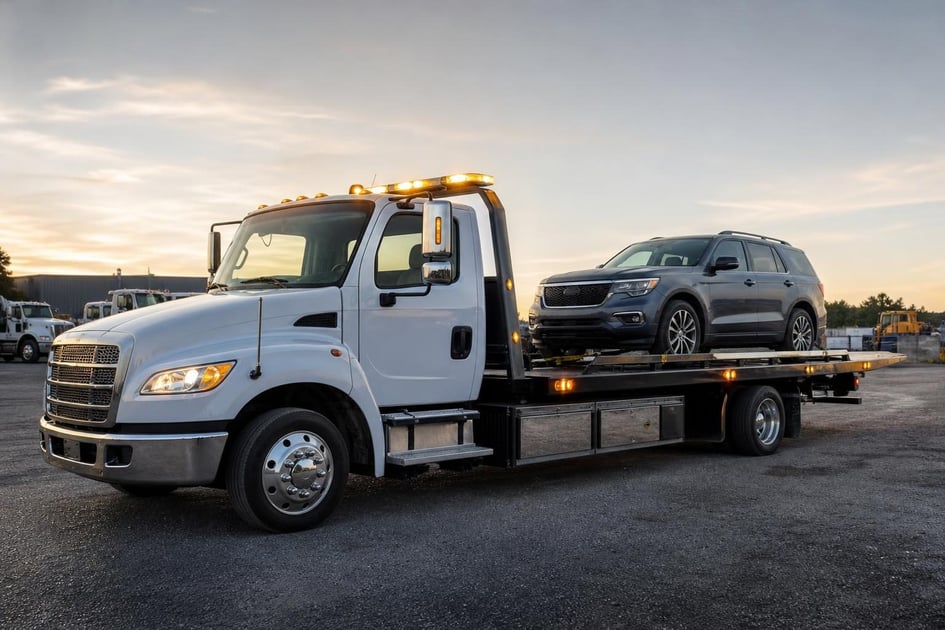
What "No Money Down" Actually Means for Rollback Tow Trucks
Rollback tow trucks typically range from $50,000 for a used light-duty model to over $250,000 for a new heavy-duty unit with a custom bed. When a lender advertises no-money-down financing, it means the loan or lease covers 100 percent of the equipment's cost, not that the transaction is free of fees or upfront costs. You will still need to cover insurance, registration, and any delivery charges before the truck hits the road. The equipment itself serves as collateral, which is why lenders can keep rates competitive without requiring a large upfront cash outlay.
Because the truck secures the financing, borrowers with established revenue and reasonable credit can often secure approval without depleting cash reserves. That matters in the towing business, where a single major repair or a slow winter month can strain working capital. A zero-down structure preserves liquidity for tires, fuel, payroll, and the occasional impound-lot expansion. It also means you start generating revenue from the truck immediately instead of waiting six months to rebuild the bank account after a large down payment.
If you are weighing a purchase right now, see what financing you qualify for on that rollback tow truck before you commit cash to a down payment.
Key Insight: Lenders typically cap 100% financing at the invoice or appraisal amount, which means any aftermarket toolboxes, LED light bars, or custom winches paid for outside the sale price may need to come from your operating funds. Roll those extras into the purchase order at the dealer if you want them included in the financed amount.
Get a fast decision on your equipment
Applying takes just a few minutes, and decisions can come as soon as the same day.
Start Your ApplicationWho Qualifies for Zero-Down Rollback Tow Truck Financing
Qualifying for 100 percent equipment financing depends on three factors: your personal credit history, time in business, and the age of the truck you want to buy. Most lenders prefer a personal credit score above 650 for zero-down transactions, though some programs accept scores in the low 600s if business revenues are strong and the equipment is newer. If your credit is below 600, expect a requirement of 10 to 15 percent down or a strong co-signer.
Time in business matters because towing is a cash-intensive industry with high insurance and fuel costs. Lenders generally like to see two years of operating history, but some programs accept one year or even less if the borrower has prior industry experience. Businesses with less than one year of revenue and no comparable prior operation rarely qualify for true zero-down equipment financing. If your business is younger than one year, you should prepare a significant down payment or explore alternative structures.
The equipment age also affects approval. New 2026 model year rollback tow trucks and those less than three model years old receive the strongest terms. Used trucks up to seven to ten years old can still qualify for no-money-down programs, but the lender may shorten the term to match the remaining useful life of the chassis and bed. Trucks older than ten years often require 20 percent or more down, regardless of credit. Debt-service coverage ratio also plays a role; many underwriters want to see business cash flow of at least 1.25 times the proposed equipment payment. The towing and recovery industry remains a significant employer in the U.S. transportation sector, according to U.S. Census Bureau business data.
Pro Tip: If you are buying a used rollback from a private seller, order an independent commercial truck inspection before applying. Lenders frequently require a third-party appraisal for private-party sales, and discovering frame corrosion or a rebuilt title after approval can delay funding by two weeks or more.
New vs. Used Rollback Tow Trucks
New rollback tow trucks offer the latest emissions standards, manufacturer warranties, and longer service life, but they also carry the steepest depreciation. A new Freightliner or International chassis with a Jerr-Dan or Century bed can cost between $160,000 and $240,000 depending on GVWR and accessories. Used units offer lower monthly payments and slower depreciation, with prices for five- to seven-year-old medium-duty rollbacks often landing between $55,000 and $95,000. The difference in acquisition cost directly affects your monthly outlay and the total interest paid over the term.
From a financing perspective, new equipment is easier to collateralize. The lender knows the exact market value, the warranty protects against early mechanical failure, and the asset will still hold value at the end of a five-year term. Used equipment requires more scrutiny. The lender will check auction values, verify mileage, and may require a larger equity cushion if the model year is older than 2018. That does not mean you cannot finance a used rollback with no money down; it simply means the underwriter will spend more time on the collateral review. In some cases, the lender will advance 100 percent of the auction value but not the full asking price if the seller is above market. Used commercial truck prices have stabilized after several volatile years, as Reuters autos and transportation coverage has reported.
| Factor | New Rollback | Used Rollback (5-7 Years) |
|---|---|---|
| Typical Price Range | $160,000 - $240,000 | $55,000 - $95,000 |
| Depreciation in First 3 Years | 30% - 40% | 10% - 15% |
| Term Available | Up to 84 months | Up to 60 months |
| Collateral Review | Invoice only | Appraisal + condition report |
| Best For | High-volume operators, long-term hold | First truck, tight monthly budget |
If you are unsure which route fits your fleet, our Rollback Tow Truck financing page breaks down how we structure deals for both new and used units.
Financing Structures: Lease vs. Loan
When you finance a rollback tow truck with no money down, you are usually choosing between an equipment finance agreement and a lease. An equipment finance agreement functions like a loan: you make monthly payments, and at the end of the term you own the truck outright. A $1 buyout lease works similarly for tax purposes but may have slightly different balance-sheet treatment. A fair market value lease, by contrast, treats the truck as a rental; you pay a lower monthly amount, but you must return the equipment or buy it at fair market value when the lease ends.
For a towing business that puts 80,000 to 100,000 miles on a chassis in four years, ownership usually makes more sense than returning the asset. Tow trucks are customized with specific bed lengths, winch configurations, and tool storage that do not transfer easily to a secondary market. A fair market value lease works better for fleets that plan to rotate equipment every three years and want the lowest possible monthly outlay. Keep in mind that leases often come with mileage or condition clauses; excessive bed rust or hydraulic leaks can trigger end-of-term penalties.
From a balance-sheet perspective, an equipment finance agreement and a $1 buyout lease usually appear as an asset and a liability, which can matter if you are seeking additional credit lines. A fair market value lease is generally off-balance-sheet, preserving your debt-to-equity ratios for other borrowing. If you are negotiating a real estate loan or a large line of credit in the next 18 months, ask your accountant how each structure affects your covenants. Small business owners across industries use equipment financing to preserve liquidity; the SBA business guide notes that asset-backed loans are a common growth tool.
| Feature | Equipment Finance Agreement | $1 Buyout Lease | Fair Market Value Lease |
|---|---|---|---|
| Ownership at End | Yes | Yes ($1 purchase) | No (return or buy) |
| Monthly Payment | Moderate | Moderate | Lowest |
| Tax Treatment (2026) | Section 179 / depreciation | Section 179 / depreciation | Deduct payments as expense |
| Balance Sheet Impact | Asset + liability | Asset + liability | Off-balance-sheet |
| Ideal Borrower | Long-term operators | Long-term operators | Fleet rotators |
Rates vary by credit profile, equipment age and term, so the exact monthly difference between these structures shifts with each application. Get a decision on your equipment, possibly the same day, to compare the numbers side by side.
By the Numbers: Provide Capital finances new and used business equipment from $5,000 to $5 million. A single rollback tow truck falls well inside that range, whether you are buying a $55,000 used light-duty wrecker or financing a $240,000 heavy-duty rotator package.
Tax Treatment for 2026
Tax year 2026 offers several incentives for business owners who purchase equipment, but the rules are shifting. Section 179 allows you to deduct the full purchase price of qualifying equipment in the year you place it in service, subject to an inflation-adjusted cap and a phase-out threshold. For 2026, consult your CPA for the exact limit, because the Internal Revenue Service adjusts these figures annually based on inflation indexing. If your total equipment purchases exceed the phase-out threshold, the deduction begins to reduce dollar for dollar.
Bonus depreciation continues to phase down in 2026. After peaking at 100 percent several years ago, the allowance drops each year under current law. For tax year 2026, the applicable percentage is lower than in prior years, which makes Section 179 even more relevant for buyers who want a large first-year write-off. Again, your CPA can confirm the exact percentage available for 2026 and model how it interacts with your other deductions.
Lease payments on a fair market value lease are generally fully deductible as a business expense, which simplifies bookkeeping but does not deliver the large upfront deduction of a purchase. If you choose an equipment finance agreement or a $1 buyout lease, you treat the truck as a purchased asset and recover the cost through Section 179, bonus depreciation, or MACRS depreciation over five to seven years. The MACRS schedule for heavy trucks uses a five-year recovery period, but the half-year or mid-quarter convention can alter the timing of those deductions. The right structure depends on your 2026 taxable income, your projected revenue growth, and whether you plan to hold the truck beyond the financing term.
Find the right financing structure
Tell us about the equipment you need and we will show you the options that fit your business.
See Your OptionsWorked Cost Examples
The best way to understand no-money-down rollback tow truck financing is to walk through two realistic scenarios. These examples are illustrative; actual monthly payments depend on rates that vary by credit profile, equipment age and term.
Scenario 1: Used Light-Duty Rollback
You find a 2019 Ford F-650 with a 21-foot Jerr-Dan steel bed and 110,000 miles. The seller asks $72,000. You apply for a 60-month equipment finance agreement with no money down. Assuming a strong credit profile and a mid-range rate environment, your monthly payment might land between $1,450 and $1,650. Over the full term, you would pay roughly $87,000 to $99,000 before the truck is yours. Because the equipment serves as collateral, you do not need to pledge real estate or another asset. If you keep the truck for two years beyond the loan term, the payment-free years effectively lower your average monthly cost of ownership.
Scenario 2: New Medium-Duty Rollback
You order a 2026 Freightliner M2 with a 22-foot aluminum bed and dual winches. The invoice is $185,000. You choose a 48-month term to pay the balance down faster and limit total interest. With excellent credit, the monthly payment might range from $4,200 to $4,800. Over 48 months, the total outlay is approximately $201,600 to $230,400. If your business generates enough taxable income, a Section 179 deduction for tax year 2026 could offset a meaningful portion of that cost in the first year. Keep in mind that the alternative minimum tax can limit the benefit for some taxpayers, so model the scenario with your accountant before you bank on a refund.
Key Insight: Rolling the soft costs-such as a $2,500 delivery fee or a $1,200 bed upfit-into the financing keeps your cash untouched, but it also means you pay interest on those add-ons. For upgrades exceeding $10,000, paying cash for the extras often lowers the total finance charge.
Documentation You Will Need
No-money-down equipment financing requires the same documentation as a conventional loan, and sometimes more, because the lender is absorbing 100 percent of the collateral risk. Gathering these items before you apply can cut the approval timeline from several days to a matter of hours.
Business Financials
Expect to provide the last three months of business bank statements, your most recent two years of tax returns if the business has been operating that long, and a current year-to-date profit and loss statement. If your business is younger than two years, the lender will weigh your personal tax returns more heavily. Some programs also request accounts receivable aging and a debt schedule. If you have outstanding equipment loans, disclose them upfront; hidden liens discovered during a UCC search will pause the file.
Equipment Details
The lender needs the year, make, model, VIN, mileage, and serial number of the rollback bed. For new trucks, a dealer invoice or purchase agreement is sufficient. For used trucks, you may need a third-party inspection and a bill of sale. If the truck has a rebuilt title or prior commercial use in a salvage yard, disclose it early; hidden history slows approval. Photographs of the bed, cab, and undercarriage can speed the collateral review, especially for private-party transactions.
Personal Guarantee and Insurance
Almost all no-money-down equipment finance agreements require a personal guarantee from the majority owner. You will also need a certificate of insurance naming the lender as loss payee, with coverage limits that meet the lender's minimum requirements. Physical damage and liability coverage are non-negotiable; the truck is the collateral, and the lender must protect its interest. Many tow truck operators carry $1 million in liability and full physical damage; your lender may require specific deductible limits.
Common Mistakes to Avoid
Even experienced operators stumble over the same pitfalls when financing rollback tow trucks. Avoiding these errors saves money and prevents delays.
Shopping Only by Monthly Payment
A low monthly payment stretched over 84 months looks attractive, but it can leave you underwater on a truck that is worth less than the remaining balance. If you plan to sell or trade the rollback at year five, a 60-month term leaves you with equity. Match the term to the truck's realistic service life. A rollback bed typically lasts 12 to 15 years with good maintenance, but the chassis engine and transmission may need major work after 300,000 miles. If you run high miles, a shorter term aligns the payoff with the mechanical life.
Ignoring Total Cost of Ownership
Fuel, DEF, tires, and hydraulics add up quickly. A used rollback with a $1,200 monthly payment but $800 per month in maintenance is more expensive than a new unit with a $1,600 payment and a warranty. Build a spreadsheet that includes estimated maintenance, insurance, and fuel before you decide which truck to finance. Diesel prices, tire costs for 22.5-inch rubber, and hydraulic cylinder rebuilds should all be line items.
Overlooking Prepayment Penalties
Some equipment finance agreements include prepayment penalties or minimum interest charges during the first 12 to 24 months. If you win a large municipal contract and want to pay the truck off early, those clauses can erase your expected savings. Ask your financing advisor to highlight any prepayment language before you sign. A deal with a slightly higher rate but no prepayment penalty often beats a low-rate deal that locks you in for two years.
Pro Tip: Buy your rollback in the fourth quarter if you want to maximize a 2026 Section 179 deduction. The IRS requires only that the equipment be placed in service by December 31, not that it be financed in January. Many operators negotiate aggressive year-end dealer discounts and still capture the full first-year write-off, but confirm the strategy with your CPA before you commit.
What Happens After Approval
Once approved, the timeline to funding depends on whether the truck is on a dealer lot or coming from a private seller. Dealer transactions can close in 24 to 48 hours because the title and lien paperwork are standardized. Private-party sales may take three to five business days while the lender verifies the title, orders an appraisal, and prepares the UCC-1 filing. If the seller has an existing lien, the lender may issue a payoff check directly to the lienholder and send the balance to the seller, which adds another day or two.
After the lender funds the deal, they file a UCC-1 financing statement against the truck, which perfects their lien in public records. You receive the title with the lender noted as lienholder, or in some states the lender holds the title until payoff. Your first payment is typically due 30 to 45 days after funding. If you set up automatic ACH payments from your business account, some lenders offer a small rate reduction. Late payments on equipment financing can trigger default rates and put the truck at risk of repossession, so treat the ACH authorization seriously.
Ready to move forward?
More than 10,000 businesses have financed equipment with Provide Capital. See what you qualify for today.
Get StartedFrequently Asked Questions
Can I finance a rollback tow truck with bad credit and no money down?
It is possible but difficult. Credit scores below 600 usually require 10 to 15 percent down or a co-signer with stronger credit. If your business cash flow is exceptional and the truck is newer, some programs will stretch to accommodate challenged credit. Expect a shorter term and a higher payment if you are in this tier.
Does no money down mean 100 percent of the truck is financed?
Yes, but soft costs like delivery, registration, and aftermarket accessories may fall outside the financed amount depending on the lender's policy. Ask whether the finance agreement covers only the invoice price or also includes ancillary costs. Some lenders cap the financed amount at 110 percent of the invoice to cover freight and upfits.
How long can I finance a used rollback tow truck?
Terms for used equipment typically range from 36 to 60 months. Lenders rarely extend beyond 60 months on a truck older than seven years because the collateral value must remain above the loan balance throughout the term. A 2018 model might qualify for 48 months, while a 2022 model could stretch to 60 or 72 months.
Is a personal guarantee required?
Almost always. Because the lender is advancing 100 percent of the equipment cost with no down payment, they look to the owner's personal credit and assets as a backstop. Only well-capitalized corporations with long operating history sometimes negotiate around this requirement.
Can I finance a rollback from a private seller?
Yes, but expect extra steps. The lender will verify title history, order an appraisal, and may require an escrow service to hold funds until the title transfers cleanly. Dealer purchases are faster and often come with warranties. If you do buy privately, choose a seller who can provide maintenance records and a clean title.
What insurance do I need?
You need commercial auto liability, physical damage coverage, and usually garagekeepers legal liability if you store customer vehicles. The lender must be named as loss payee on the physical damage policy, and deductibles typically cannot exceed $1,000. On-hook towing insurance is also essential for protecting customer vehicles while in transit.
Can I deduct the payments on my taxes?
With an equipment finance agreement or $1 buyout lease, you deduct depreciation and interest rather than the payment itself. With a fair market value lease, you deduct the lease payments as an operating expense. For tax year 2026, consult your CPA to see which structure delivers the larger benefit for your situation.
How fast can I get approved?
Many applications receive a decision within a few hours, and same-day approvals are possible when the file is complete and the collateral is straightforward. Dealer transactions fund faster than private-party sales. Submitting clean bank statements and a signed purchase agreement upfront is the single best way to speed the process.
Next Steps
Rollback tow truck financing with no money down is a practical way to add revenue-generating equipment without draining the cash reserves you need for fuel, payroll, and insurance deductibles. Whether you are buying your first wrecker or expanding a fleet of six, the structure of the deal matters as much as the truck itself. Compare new versus used, understand the lease-versus-loan trade-offs, and confirm your 2026 tax strategy with a CPA before you sign.
Provide Capital serves operators nationwide across Transportation equipment financing and related sectors. We also finance Tow Truck financing for wreckers, carriers, and roadside assistance fleets. If you are ready to move forward, apply now and review your options for no-money-down rollback tow truck financing.
Disclaimer: The information provided in this article is for general educational purposes only and is not financial, legal, or tax advice. Funding terms, qualifications, and product availability may vary and are subject to change without notice. Provide Capital does not guarantee approval, rates, or specific outcomes. For personalized information about your business funding options, contact our team directly.
