
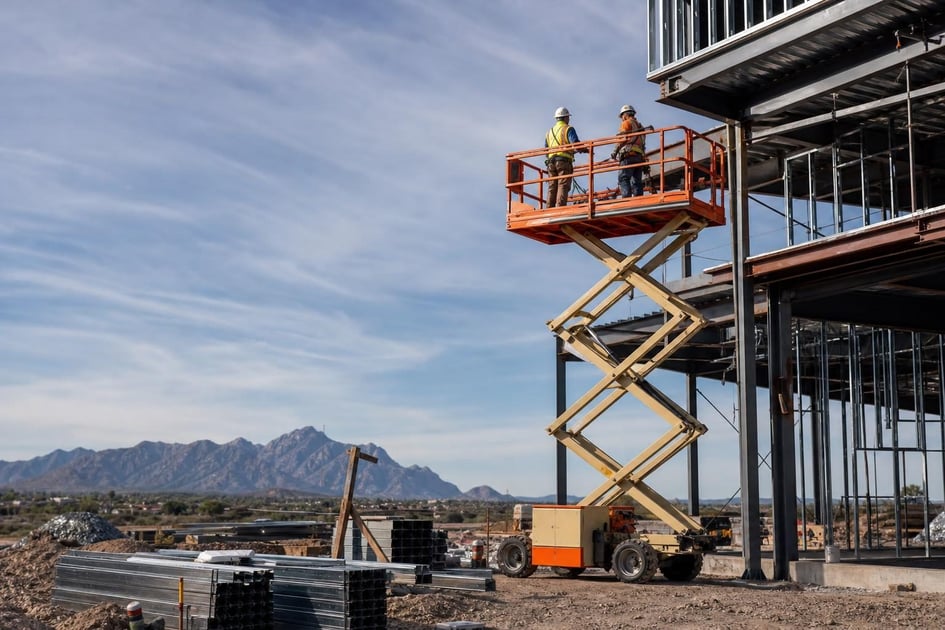
If you need a scissor lift for your Arizona jobsite, equipment financing lets you acquire the unit without draining your operating account. Rates vary by credit profile, equipment age and term, with financing available from $5,000 to $5 million and the lift itself serving as collateral. Same-day approvals are possible for qualified applicants. Whether you run a Phoenix-area construction crew, a Tucson mining services company, or a Mesa warehouse operation, you can spread the cost over months or years while putting the equipment to work immediately.
Arizona's particular mix of desert heat, monsoon weather, and rapid population growth shapes what kind of lift you need and when you need it. Understanding those variables before you finance will save you money and keep the unit working instead of sitting.
If you already have a quote from a dealer or private seller, see what financing terms you qualify for on that lift before another buyer commits.
Why Arizona Contractors Depend on Scissor Lifts
Arizona's economy runs on industries that require working at height. Construction dominates the Phoenix-Mesa-Scottsdale metropolitan area, where population growth and major semiconductor fabrication investments have kept cranes and lifts busy across residential, commercial, and infrastructure segments. Mining operations in Pima, Pinal, Mohave, and Greenlee counties require constant maintenance access to processing equipment, conveyors, and haul trucks. Warehouses and distribution centers along the I-10 corridor and Loop 303 industrial belt in the West Valley use scissor lifts daily for racking installation, lighting maintenance, and inventory management.
Even agriculture--one of Arizona's oldest industries--relies on lifts for packing house equipment maintenance, cold storage upkeep, and greenhouse operations in Yuma, Maricopa, and Pinal counties. Manufacturing facilities in Chandler, Gilbert, and Tucson need height access for assembly line maintenance and building repairs.
The state's extreme climate directly shapes equipment buying patterns. From June through September, daytime temperatures regularly exceed 105 degrees F, often pushing contractors toward early-morning shifts or indoor work. During these months, electric scissor lifts with non-marking tires become essential for warehouse interiors, retail fit-outs, and any finished-floor environment where emissions and tire marks are unacceptable. When fall arrives and temperatures drop into the 70s and 80s, outdoor construction surges. Rough-terrain diesel lifts see peak demand from October through May, when housing subdivisions, commercial tilt-up projects, and infrastructure work accelerate across Maricopa, Pinal, and Yavapai counties.
Arizona's monsoon season, typically July through mid-September, introduces another planning variable. Sudden dust storms and flash flooding can delay outdoor projects and damage unprotected equipment. Owning your lift rather than renting eliminates availability risk during the busy season, and financing makes ownership manageable without tying up the cash you need for labor and materials. Population and business growth data from the U.S. Census Bureau underscores why Arizona remains one of the busiest states for construction equipment demand.
Get a fast decision on your equipment
Applying takes just a few minutes, and decisions can come as soon as the same day.
Start Your ApplicationWhat Scissor Lift Financing Covers
Financing covers new and used scissor lifts across the full size and power spectrum. Eligible units include electric slab lifts designed for smooth indoor concrete surfaces, rough-terrain diesel and dual-fuel units with four-wheel drive for unpaved lots and undeveloped desert land, and narrow-width models that fit through standard 36-inch doorways. We also finance specialty configurations like extra deck extensions, rotating platforms, lifts rated for cold storage environments, and units equipped with onboard welders or pipe racks.
You can finance the lift alone or bundle in attachments, delivery charges, and initial maintenance contracts. Most equipment financing structures, including those at Provide Capital, use the lift itself as collateral. That means you do not need real estate or a separate asset to secure the deal, which keeps the approval process moving and preserves your bank line of credit for payroll, materials, and bonding.
Scissor Lifts financing is available for purchases from licensed dealers, private sellers, and auction houses. If you have not selected a specific unit yet, you can still get pre-qualified so you know your exact budget before walking onto a lot or bidding at auction.
Lease vs. Loan: Choosing the Right Structure
Equipment financing generally takes one of two forms: a loan that leads to ownership, or a lease that gives you use of the equipment for a fixed term. The right choice depends on your cash flow, tax strategy, and how long you plan to keep the unit.
| Feature | Equipment Loan | Equipment Lease |
|---|---|---|
| Ownership | You own the lift after the final payment | Return, renew, or purchase at lease-end |
| Monthly payment | Higher; paying off principal and interest | Lower; paying for use of the equipment |
| Tax treatment | Depreciation and Section 179 for 2026 | Deduct monthly payments as business expense |
| Typical term | 24-60 months | 24-48 months |
| Best for | Long-term use, high utilization | Preserving capital, frequent upgrades |
A loan makes sense if you want to own the asset, run it for seven to ten years, and capture the depreciation or Section 179 deduction. A lease works better if you prefer lower monthly payments, want to upgrade every three to four years as platform technology improves, or need to preserve capital for a specific expansion phase. Many Arizona contractors choose a $1 buyout lease, which functions almost identically to a loan for tax purposes while keeping the obligation off certain balance-sheet ratios.
Qualifying for Scissor Lift Financing in Arizona
Provide Capital evaluates your credit profile, time in business, and the equipment itself. You do not need perfect credit. A personal credit score in the mid-600s or higher typically opens the most competitive terms, but we regularly work with lower scores by adjusting the down payment, term length, or requiring additional documentation. Two or more years in business strengthens your application, though newer companies can qualify with stronger credit, a larger down payment, or a co-signer.
The equipment's age and condition carry significant weight. New lifts and late-model used units--generally those under five years with fewer than 2,500 hours--finance more easily and carry better rates than older machines with high hour meters. The lender will verify the serial number, hour meter reading, and overall physical condition before funding. Dealer purchases usually include recent service records, which smooths underwriting. For private-party sales, an independent inspection may be required, especially if the unit has been stored outdoors in Arizona's sun and dust.
Your debt-service coverage ratio also matters. Lenders want to see that your monthly revenue comfortably covers existing obligations plus the new equipment payment. Strong bank deposits during Arizona's busy season can offset thinner summer months if the overall annual cash flow is healthy.
Key Insight: Arizona contractors who submit applications during the November-through-January window often experience faster turnaround because underwriting volume dips after the fall construction rush. If your fiscal year ends December 31, purchasing and placing equipment in service during Q4 also positions you for a Section 179 deduction on your 2026 tax return, provided you meet the in-service deadline.
2026 Tax Treatment and Section 179
For the 2026 tax year, Section 179 allows qualifying businesses to deduct the full purchase price of eligible equipment in the year it is placed in service, subject to an annual limit that adjusts for inflation. The exact dollar ceiling and phase-out threshold change yearly, so consult your CPA for the 2026 specific numbers. If your total equipment purchases exceed the phase-out threshold, the deduction scales back dollar-for-dollar. Bonus depreciation may also apply to new and used qualifying equipment in 2026, though the percentage has continued stepping down from the elevated levels seen in prior years.
To claim either benefit for tax year 2026, you must place the scissor lift in service by December 31, 2026. That means delivery, inspection, and active use on an actual job--not merely a signed purchase agreement sitting on your desk. Keep your invoice, delivery receipt, and the hour meter reading at acquisition in your tax file. If you structure the deal as a lease rather than a purchase, you typically deduct the monthly lease payments as an ordinary business expense. This simplifies recordkeeping but changes the timing and magnitude of your tax benefit compared with a Section 179 purchase. Discuss the structure with a CPA before signing, particularly if you are near the threshold or have other major capital expenditures planned for 2026.
Arizona Industries That Rely on Scissor Lift Financing
Construction is the largest user by volume. Arizona has added tens of thousands of construction jobs over the past two years, driven by residential growth in Queen Creek, Buckeye, San Tan Valley, and Marana, plus commercial and infrastructure work in downtown Phoenix, Tempe, and Chandler. General contractors, drywall installers, HVAC technicians, electrical crews, and framing contractors all use scissor lifts daily for exterior facades, interior atriums, and ceiling work.
Mining and extraction operations across the state use lifts for conveyor maintenance, crusher access, screening equipment service, and facility repairs. Arizona produces more copper than any other state, and the associated processing plants, smelters, and solvent-extraction operations run continuously, requiring reliable height access for maintenance teams.
Warehousing and logistics have exploded along the I-10 corridor, near Phoenix-Mesa Gateway Airport, and throughout the West Valley along Loop 303. Companies operating distribution centers for e-commerce, grocery, and industrial suppliers need slab scissor lifts for racking installation, light maintenance, sprinkler work, and inventory management at height.
Manufacturing facilities in Chandler, Gilbert, and Tucson use lifts for assembly line maintenance, facility cleaning, and building upkeep. Agriculture--particularly the large-scale vegetable, citrus, and cotton operations in Yuma, Maricopa, and Pinal counties--needs lifts for packing house equipment maintenance, cold storage door repairs, and greenhouse shading system installation.
Construction equipment financing covers not just earthmovers and dump trucks but the aerial work platforms that let crews work safely and efficiently at height on every phase of a build. The U.S. Small Business Administration notes that equipment financing is one of the most common funding mechanisms for small contractors acquiring productive assets.
Find the right financing structure
Tell us about the equipment you need and we will show you the options that fit your business.
See Your OptionsNew vs. Used Scissor Lifts: Cost and Financing Differences
New scissor lifts typically run from roughly $12,000 for a compact 19-foot electric slab model to $70,000 or more for a 50-foot rough-terrain diesel unit with outriggers and deck extensions. Mid-size 26-foot to 32-foot electric models--the most common choice for commercial contractors--usually fall in the $25,000 to $40,000 range depending on brand, capacity, and feature set.
Used lifts offer significant upfront savings. A three- to five-year-old 26-foot electric model with under 1,500 hours often sells for 40 to 60 percent less than its new equivalent, depending on brand reputation and maintenance history. A ten-year-old unit might cost 70 percent less but will likely require more immediate maintenance and may not qualify for the most favorable financing terms.
Financing follows the depreciation curve. New equipment qualifies for the best terms because the collateral holds resale value. Used equipment under about five years still finances well on competitive terms, though you may need a slightly larger down payment--sometimes 10 to 20 percent instead of zero to 10 percent. Lifts older than ten years or with extremely high hours may require a larger equity stake, a shorter term, or a co-signer.
Warranty coverage differs materially. New lifts carry factory warranties, usually two to five years on major components and one year on batteries and wearable items. Used lifts may have remaining factory coverage if the original warranty is transferable, or you can purchase a third-party equipment service contract, which you can sometimes fold into the total financing amount.
By the Numbers: A 26-foot electric scissor lift with 500 hours might cost approximately $18,000 used versus $32,000 new. Financed over 60 months, that gap can mean the difference between a $375 monthly payment and a $665 payment, assuming comparable credit and a minimal down payment. Over the full financing term, the used route preserves roughly $17,000 in cash flow--money you can direct toward payroll during Arizona's slower summer months or toward bonding on the next municipal job.
Common Mistakes When Financing Lifts in Arizona
Buying insufficient platform height is the most frequent error. A 19-foot platform height sounds adequate on paper until you factor in worker reach, material stacking, and uneven terrain. For most commercial and residential construction in Arizona, 26-foot or 32-foot models offer far more versatility across job types.
Ignoring terrain and tire type is the second mistake. Slab lifts with solid non-marking tires work beautifully on warehouse floors and finished retail space but become dangerous and inefficient on undeveloped desert lots with caliche, gravel, or sand. If your jobsites include graded dirt, crushed stone, or slopes, a rough-terrain model with foam-filled or pneumatic tires and four-wheel drive is non-negotiable.
Some buyers overlook transport logistics. Scissor lifts weigh anywhere from 3,000 pounds for a compact 19-foot electric unit to 15,000 pounds or more for a large rough-terrain diesel. You need a trailer rated for the weight, plus a truck that can tow it safely across Arizona's mountain grades on I-17, I-40, or State Route 87. Factor trailer purchase or rental into your total acquisition cost if you do not already own suitable transport.
Failing to verify hour meter accuracy and maintenance history on used units is another pitfall. High-hour machines operated in Arizona's fine dust may have accelerated wear on joysticks, hydraulic seals, battery packs, and drive motors. Request a recent inspection report or service record, and inspect the underside for corrosion if the unit was stored near irrigation or in flood-prone areas. Industry analysts at Forbes have noted that contractor margins tighten when cash is tied up in equipment, making financing an operational necessity rather than a luxury.
Spider Lifts financing is worth exploring if you work in tight interior spaces, on finished flooring where weight distribution matters, or in atriums with delicate surfaces. These tracked units fit through standard doorways and distribute weight more evenly than traditional slab scissor lifts.
What Documentation You Need
The application requires your legal business name, EIN or SSN for sole proprietors, and ownership percentages. You will need two to three months of recent business bank statements to demonstrate operating cash flow, plus the equipment invoice or a detailed equipment description if you have not yet selected a unit. For financing requests above certain thresholds, we may request two years of business tax returns and a current year-to-date profit-and-loss statement.
If you are buying from a private party, we need the seller's contact information, the serial number, and confirmation of clear title with no outstanding liens. Dealer purchases streamline this because the dealer provides a standard invoice, handles sales tax collection, and manages title transfer.
Same-day approvals are possible when the application is complete, the equipment details are straightforward, and your credit profile matches our automated criteria. Delays usually stem from missing bank statements, unclear ownership structures, title issues, or discrepancies in the equipment description.
Once you have gathered your equipment details and bank statements, get a decision on your scissor lift, possibly the same day, so you can lock in the unit before another buyer does.
What Happens After Approval
After approval, Provide Capital issues a funding authorization, loan agreement, or lease document for electronic signature. For equipment loans, we either disburse funds directly to you or pay the vendor directly, depending on the structure and your preference. For leases, the lessor purchases the equipment from the seller and leases it to you under the agreed terms. Direct vendor payment is common and protects all parties--you do not take possession until the seller is paid in full.
Most scissor lift transactions fund within one to three business days after signed documents and any required down payment or documentation are received. If the seller needs to transport the lift from Prescott to Phoenix or from Tucson to Flagstaff, factor in that delivery timeline separately from the funding timeline.
Your first payment typically falls 30 to 45 days after funding, giving you time to put the lift to work on a paying job before the payment cycle begins. Automated ACH withdrawals from your business checking account are standard, though some borrowers prefer to schedule payments to align with their cash flow cycles.
Pro Tip: Contractors working on tribal land or federal installations--common in Arizona construction, mining, and utility work--should confirm that the financed lift meets any site-specific safety certifications or inspection requirements before funding closes. Retrofitting a lift with additional guardrails, fall-arrest anchor points, or spark-arresting exhaust packages after purchase is possible, but adding those costs into the original financing amount is far easier than paying out of pocket later. Mention the intended jobsite environment to your financing advisor during the application so the structure accounts for the full delivered cost.
Ready to move forward?
More than 10,000 businesses have financed equipment with Provide Capital. See what you qualify for today.
Get StartedFrequently Asked Questions
Can I finance a scissor lift as a new Arizona business?
Yes, though terms improve with established credit and operating history. Newer businesses may qualify with a stronger personal credit profile or a larger down payment.
Does the lift have to be new?
No. We finance new and used scissor lifts. Late-model used equipment usually qualifies for the best rates; older units may require a larger down payment or shorter term.
What credit score do I need?
There is no hard cutoff. Scores in the mid-600s and above generally access the most favorable terms, but we work across the credit spectrum by adjusting structure.
How fast can I get funded?
Same-day approvals are possible for complete applications. Funding usually occurs within one to three business days after you sign documents and provide any required down payment.
Can I deduct the payments on my 2026 taxes?
If you purchase and place the lift in service by December 31, 2026, you may qualify for Section 179 or bonus depreciation deductions for the 2026 tax year. If you lease, you typically deduct the monthly payments as a business expense. Consult a CPA for your specific situation.
Do you finance private-party sales?
Yes. We finance dealer purchases, private-party sales, and auction acquisitions. Private-party transactions require clear title verification and may need an equipment inspection.
What is the difference between a lease and a loan?
A loan puts you on the path to ownership, and you may claim depreciation or Section 179 deductions. A lease typically offers lower monthly payments and lets you deduct the lease expense, but ownership terms vary by lease structure.
Can I bundle attachments and delivery into the financing?
Yes. You can often include accessories, delivery, and even a service contract in the financed amount, provided the total stays within your approved limit.
Bottom Line
Arizona's ongoing construction boom, copper mining operations, and logistics growth create steady demand for scissor lifts across every size category. Financing lets you acquire the right unit--new or used, electric or diesel, slab or rough-terrain--without tying up the operating cash you need for payroll, materials, bonding, and insurance. Rates vary by credit profile, equipment age and term, and the equipment itself serves as collateral, which keeps the process efficient and avoids the appraisal delays common with real-estate-backed loans.
Whether you need a compact electric lift for warehouse racking in Tolleson, a narrow-width unit for hospital maintenance in Scottsdale, or a rough-terrain diesel model for subdivision framing in Gilbert, match the financing structure to your jobsite demands, tax strategy, and equipment lifecycle plans. Gather your documentation, know the equipment specifications and hour meter reading, and time the purchase to fit your workload calendar.
Start an application in a few minutes and find out what your monthly payment could look like on the scissor lift your Arizona operation needs.
Disclaimer: The information provided in this article is for general educational purposes only and is not financial, legal, or tax advice. Funding terms, qualifications, and product availability may vary and are subject to change without notice. Provide Capital does not guarantee approval, rates, or specific outcomes. For personalized information about your business funding options, contact our team directly.
